

Introduction
Think about the last time you logged into your email. You left behind a digital trace, even if you didn’t notice it. The same thing happens in healthcare systems, but the stakes are much higher. A single unauthorized login or data breach can cost thousands of dollars and risk patient trust. Every click, detail, update, and login containing patient information is recorded. These records are called audit trails. But audit trails are not limited to being a compliance under HIPAA. They are also about protecting sensitive information, holding staff accountable, and preventing misuse of data. Without them, it is almost impossible to trace who accessed patient information or spot any suspicious activity.
So, now you must be thinking, what exactly are audit trails for HIPAA compliance? How they word and why it is a very big deal under HIPAA compliance. Don’t worry, we’ve got you!! In this comprehensive guide, we will break it all down in simple terms and will cover everything you need to know about HIPAA compliance audit trails. So let’s get started.
Understanding Audit Trails
What Is an Audit Trail?
An audit trail is a record that records or documents every action that is taken within a system. It keeps track of who, when, and how a person is accessing the data and what changes are being made. In simple terms, it acts as a digital footprint that makes sure that every activity is monitored and traced back in case of any need.
What Is an Audit Trail in Healthcare?
In healthcare, an audit trail for HIPAA compliance refers to having a check and constant monitoring of activities related to electronic protected health information (ePHI). A HIPAA audit trail makes sure that every data access, modification, or transfer of patient data is logged. Establishing HIPAA compliance logging helps in early detection of any breach, along with ensuring adherence to necessary industry standards. Since healthcare practices deal with protected health information, maintaining healthcare audit logs is not only a best practice but also a legal requirement under HIPAA.
Why Audit Trails are Crucial in HIPAA Compliance
HIPAA-compliance audit trails are a critical component of HIPAA compliance as they document a clear record of how the patient data is being accessed and used. Here’s a deeper look at why HIPAA audit trails matter:
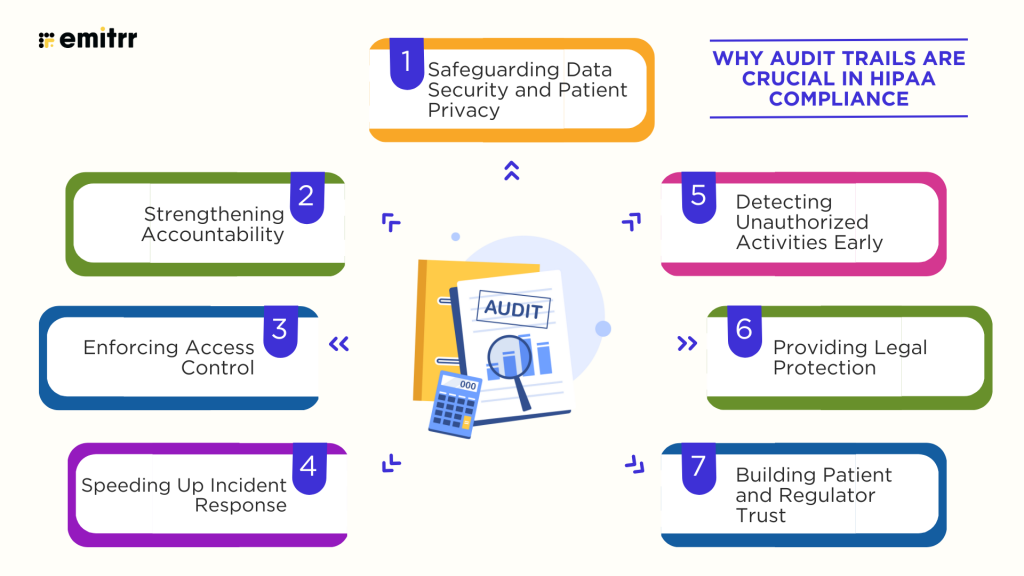
Safeguarding Data Security and Patient Privacy
Information related to the patient has sensitive health information that needs to be protected at all times. HIPAA audit trails log every detail about who accessed the patient data, what actions were taken, and what changes were made. By doing so, audit trails for HIPAA compliance act as an extra layer of protection to ensure that patient privacy is maintained and unauthorized actions can be protected.
Strengthening Accountability
With HIPAA audit trails, every action related to patient data can be linked back to an individual user. This means that the healthcare audit log holds healthcare practices or individuals accountable for how they are handling patient data. When healthcare practices know that their activities are being constantly monitored, it encourages them to adhere to security protocols and reduces any chances of misuse of data.
Enforcing Access Control
There are multiple roles involved in a healthcare practice, hence HIPAA audit trail requirements require different levels of access to patient data. Here is when HIPAA audit trails become important, as they make it possible to track and implement role-based permissions to make sure that only authorized members are able to view and modify the records.
Speeding Up Incident Response
In case of any breach or unauthorized access, response time becomes critical. Audit trail for HIPAA compliance here offers a clear path to trace the source, identify what data was affected, and take swift action to mitigate damage. With a healthcare audit log, in case of any suspicious activity, resolving or responding to such incidents would be significantly slower as well as less effective.
Detecting Unauthorized Activities Early
By now, it is clear that HIPAA audit trails can easily identify any unusual activity or login efforts. Apart from just identifying, these healthcare audit logs are also capable of sending alerts to respective teams to work on the issue before it escalates.
Providing Legal Protection
In cases of HIPAA investigation, compliance review, or a legal case, HIPAA audit trails act as evidence of how the data has been managed. An extensive medical record access log shows that the healthcare organization took proper measures to secure information.
Building Patient and Regulator Trust
Patients not only expect good treatment, but they also want assurance that their private health information is handled responsibly, and by managing a strong audit trail for HIPAA compliance, providers show their commitment to data security and transparency, which also helps in building trust with both patients and regulatory bodies.
Benefits of Implementing HIPAA-Compliant Audit Trails
Setting up a strong, HIPAA-compliant audit trail is not only limited to meeting regulatory requirements; the medical record access log also offers real, everyday value to healthcare organizations by making systems safer, more transparent, and easier to manage. Here’s how:
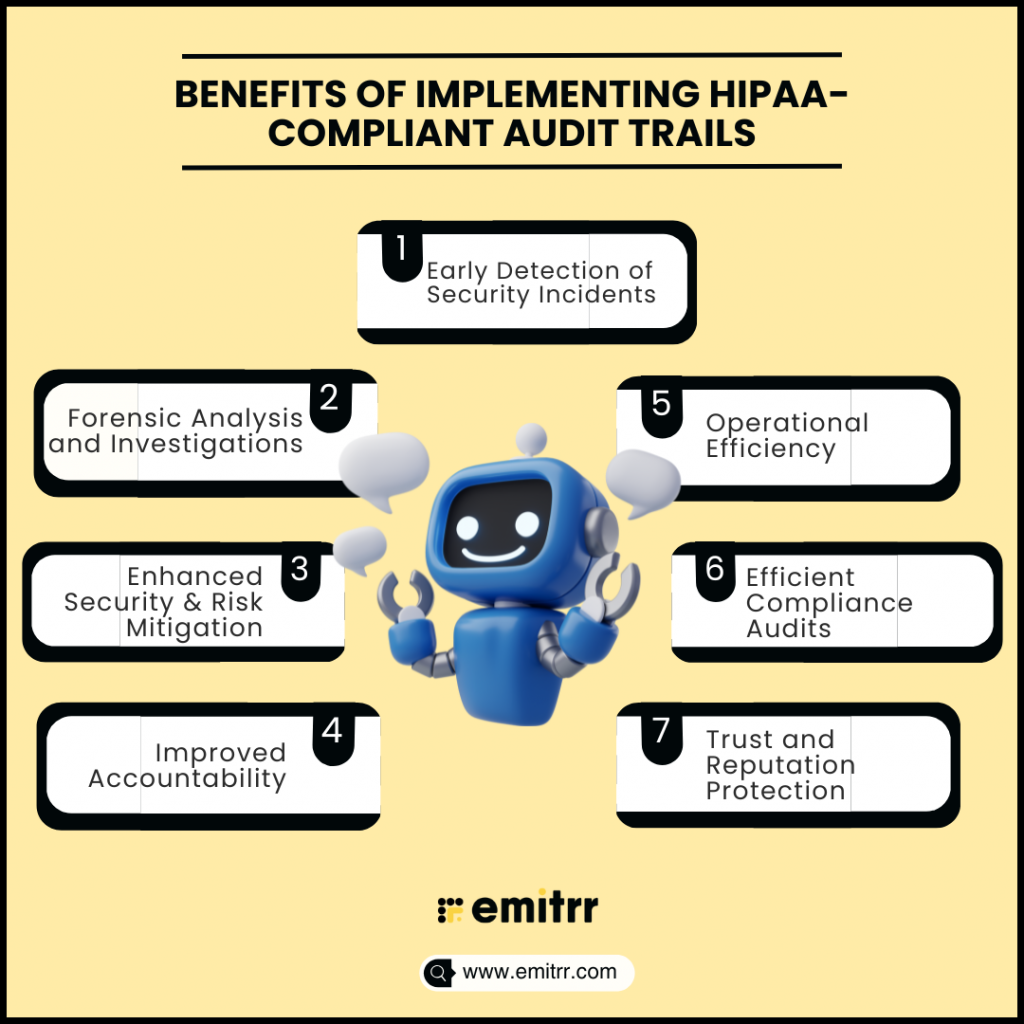
Early Detection of Security Incidents
HIPAA audit logs are very efficient when it comes to spotting any suspicious activity, including failed login attempts, access from odd locations, or unauthorized record views before they escalate. The early warning system gives the respective team a chance to respond quickly to the risk and prevent larger security issues.
Forensic Analysis and Investigations
In case of any security breach, audit trails for HIPAA compliance offer a complete history of what actually happened. These HIPAA audit logs help in investigating and reconstructing the event of a breach, identifying who was involved, and determining the scope of the issue. In the absence of a patient data audit, it is almost impossible to get a full picture of the incident.
Enhanced Security & Risk Mitigation
HIPAA audit logs are not just a record; they also act as a defense mechanism. By continuously monitoring system activity, they help organizations identify weak points, close security gaps, and reduce the risk of future threats.
Improved Accountability
Every activity in healthcare organizations is related to a specific individual. This level of visibility makes sure that staff members follow proper procedures because they know that their every action is being monitored.
Operational Efficiency
Manually monitoring the system and each activity is indeed time-consuming and also prone to human error. With proper HIPAA compliance logging in place, constantly monitoring and reporting becomes easy, automated, and streamlined, which not only saves staff time but also minimizes the chance of oversight.
Efficient Compliance Audits
When the Office for Civil Rights (OCR) or another regulatory body requests an audit, HIPAA audit trails make preparation much easier. If you have a well-organized medical record access log, it means healthcare organizations can quickly demonstrate compliance with HIPAA audit trail requirements and avoid any kind of penalties and delays.
Trust and Reputation Protection
In healthcare, even a single or small breach can damage your reputation for a long time. By maintaining strong healthcare audit logs, healthcare organizations show not only patients, regulators, but also partners that they take data and patient privacy seriously and handle the data responsibly, which also helps in building trust, along with protecting the organization’s credibility.
HIPAA Audit Trail Requirements: The Essentials
HIPAA audit trails are clearly not optional when it comes to healthcare; they are mandated under HIPAA compliance to protect patient health information. To understand HIPAA audit trail requirements, it is necessary to look at the rules that govern them and the different types of audit trails that healthcare organizations must maintain.
Overview of HIPAA Rules
HIPAA Security Audit Controls and Audit Logs
HIPAA audit trail requirements need healthcare organizations to implement systems that are capable of recording and examining activities in the system that contain electronic protected health information. HIPAA audit control helps in making sure to track user interactions, detect unauthorized access, and respond to potential breaches.
HIPAA Privacy Rule
This privacy rule emphasizes that only the minimum and necessary information should be accessed by staff. Audit trails for HIPAA compliance also support this by keeping a track of who, when, and why patient data is accessed to ensure compliance with “minimum necessary” standards.
HITECH Act – Strengthening Accountability
The HITECH Act expands HIPAA’s requirements by adding stricter enforcement, higher penalties, and greater emphasis on transparency. Not only this, but it also reinforced the need for an accurate healthcare audit log to hold organizations accountable for securely handling and protecting patient data.
Types of Audit Trail Requirements
- User Audit Trail Requirements: User audit trails focus on the activities of individuals within the system. They log events like logins, logouts, changes in access permissions, and the creation of new user accounts.
- System Audit Trail Requirements: System-level patient data audit monitors the IT infrastructure that supports healthcare applications, helping detect security issues and system errors.
- Application Audit Trail Requirements: Application audit trails focus on software handling ePHI; they track database changes, file access, and system-generated alerts or errors
- Manual Documentation Audit Trails: Not all audit trails are digital. Manual documentation involves recording paper-based activities or procedural logs, such as who accessed a physical file or signed off on patient records.
Which Information Should an Audit Trail in Healthcare Contain?
A comprehensive healthcare audit trail for HIPAA compliance should capture:
- User Logins (Successful and Failed): A HIPAA audit trail should include login, both successful as well as failed, as it helps in tracking who and when accessed the system. A failed login indicates an attempt at unauthorized access and allows teams to investigate any potential threat.
- Database Changes and Modifications: With respect to HIPAA audit logs, any additions, edits, or deletions in patient records should also be recorded. This ensures a clear record of who made changes and when, supporting data integrity and accountability.
- Details of Newly Added Users and Their Access Levels: Whenever a new user is added to the system, their account information and assigned permissions should also be logged.
- Files viewed, edited, or shared: HIPAA audit trails should also capture every instance of file access, including viewing, editing, or sharing.
- Operating system logs: Every event, such as system startups, shutdowns, or errors, also needs to be recorded.
- Firewall activity: Monitoring firewall activity allows organizations to track attempts to breach the system from outside sources.
- Anti-malware reports: HIPAA audit trails should include alerts or detections from anti-malware software.
List of HIPAA Audit Logs Requirements (Compliance Checklist)
To stay compliant with HIPAA, organizations must ensure that their audit logs meet the following standards:
- Automatic and Tamper-Proof Logs – HIPAA compliance logging needs to be generated automatically, which does not require any manual entry, and must be secured against alteration or deletion.
- Coverage Across All PHI-Handling Systems – Each system that stores or transfers protected health information should have a patient data audit enabled.
- Retention for At Least 6 Years – Under HIPAA, it is important for HIPAA audit logs to be stored in the system for at least six years; however, there are some states that mandate longer periods.
- Easy Retrieval and Reporting Capabilities – HIPAA compliance logging must be accessible in a structured format to quickly produce reports during audits or investigations.
- Regular Monitoring and Review Processes – It’s not enough to just store the medical record access log; they need to be actively reviewed for anomalies.
- Documentation for Internal and External Audits – Organizations should maintain clear documentation showing how HIPAA audit logs are captured, stored, and reviewed.
Practical Tips for Staying Compliant
Conduct Regular Risk Assessments
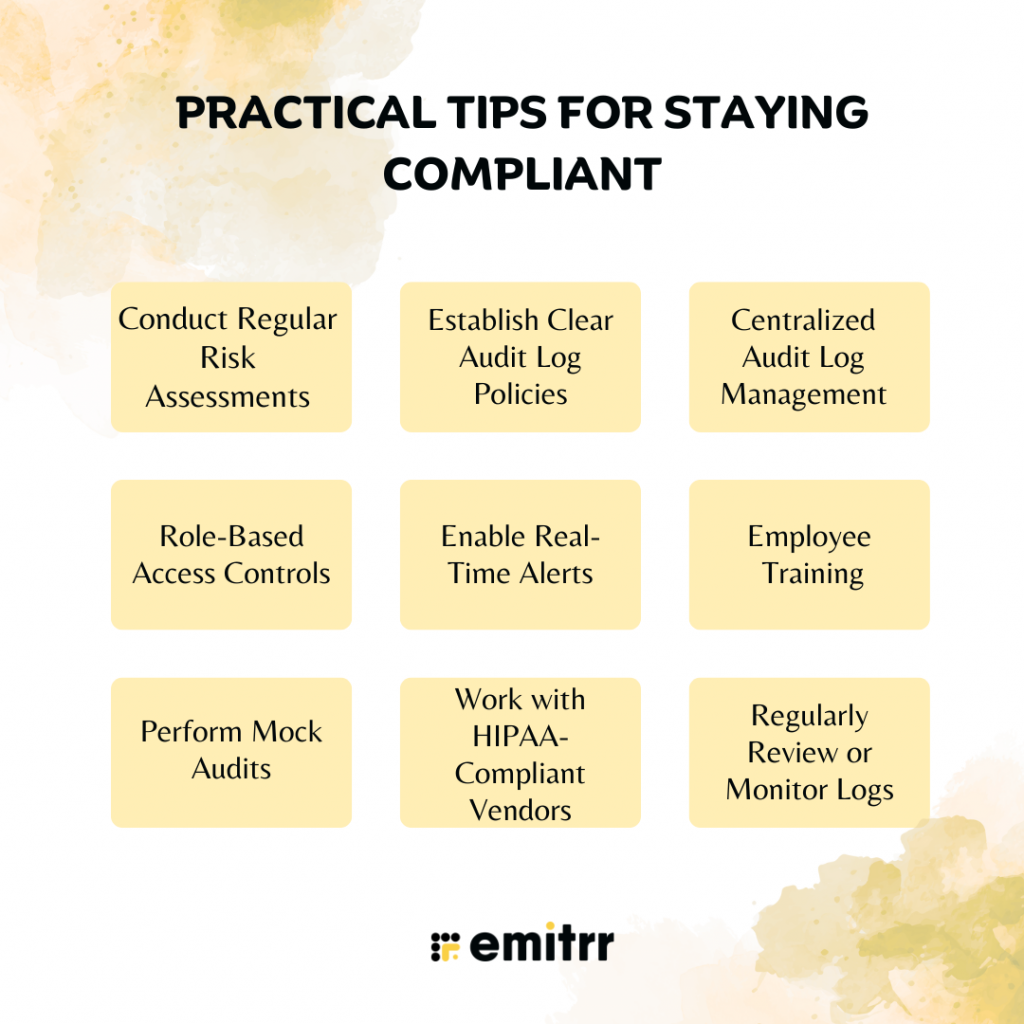
Healthcare systems are prone to risk, and they also face constant security risk; hence, it becomes important for them to regularly run risk assessments, as they help in identifying weaknesses in their IT infrastructure, workflows, or third-party tools that could expose Protected Health Information.
Establish Clear Audit Log Policies
Maintaining HIPAA audit logs is no doubt very critical, but they are only useful if managed properly. Hence, it is important to create well-structured policies that contain proper guidelines as to who is responsible for reviewing medical record access log, how frequently reviews should happen, and what steps to take when suspicious activity is discovered.
Centralized Audit Log Management
Healthcare organizations very often use multiple platforms such as EHRs, communication tools, billing systems, and cloud storage. A unified logging solution gathers all the records in one centralized place, which makes it easier to detect any unusual patterns, track user actions, and prepare for compliance audits without juggling multiple platforms.
Role-Based Access Controls
Not every employee requires full access to patient data, and this is where implementing role-based access control becomes important, as it ensures that staff can only have access to the information necessary for their responsibilities. This not only minimizes the risk of exposing the sensitive data but also minimizes the chance of accidental or intentional misuse.
Enable Real-Time Alerts
Patient data audit should not only be limited to storing information, but they should also actively warn healthcare practitioners of any potential risks. Real-time alerts like repeated failed login attempts, unauthorized access to PHI, or unusual system behavior allow IT and compliance teams to respond before a breach escalates.
Employee Training
Having a technology in place is not enough; hence, it is necessary for the staff also to understand HIPAA guidelines and how these logs protect patient privacy. Conducting regular training session help employees recognize any risk, follow best practices, and avoid careless mistakes that could put PHI at risk.
Perform Mock Audits
Waiting until an official audit to test your preparedness is risky. Conducting internal mock audits simulates real-world scenarios and helps uncover gaps in policies, documentation, or technical systems.
Work with HIPAA-Compliant Vendors
Many healthcare organizations depend on vendors for EHR systems, cloud storage, or communication tools. It is important to verify that the vendors you are opting for are HIPAA-compliant and are ready to sign a Business Associate Agreement(BAA), as it also ensures that they maintain proper HIPAA audit trails and safeguard PHI.
Regularly Review or Monitor Logs
Simply collecting medical record access logs is not enough. If they are not regularly reviewed, then unusual activity or security incidents may go unnoticed for weeks or months. Regular monitoring makes sure that any such issues are caught and addressed quickly.
HIPAA Audit Trail Tools & Solutions
Features to look for in a HIPAA audit trail solution:
Automated Log Generation
When it comes to manual logging, it poses the risk of manual error and inconsistency. Automated log generation makes sure every access, alteration, and system activity is captured accurately and in real time without depending on staff intervention.
Encryption and Tamper-Proof Storage
The HIPAA audit logs must remain secure and unedited. Here is when strong encryption plays a crucial role, as HIPAA compliance logging protects logs from any unauthorized access while tamper-proof storage ensures they cannot be edited or deleted, preserving their integrity for audits and investigations.
Easy Integration with EHR and Communication Platforms
By now, it is clear that PHI very often is spread across various systems such as EHRs, VoIP, fax, email, and messaging platforms. Hence, it is important for a good HIPAA audit trail solution to integrate seamlessly with all of the platforms.
Real-Time Monitoring and Alerts
Any delay in identifying any unusual activity can indeed lead to serious issues. Hence, real-time monitoring becomes important as it immediately alerts in case of any anomalies.
Simple Reporting for Audits
Preparing for HIPAA or OCR audits can be stressful if medical record access log are hard to retrieve or understand. An effective solution should generate easy-to-read reports that clearly demonstrate compliance, saving time and reducing the risk of missing information.
Consequences of Non-Compliance with Audit Trail Requirements
Failure to maintain proper HIPAA audit trails leads to fines and cases such as intentional misuse of patient data, as well as criminal charges. Such penalties can also extend to organizations as well as patients involved. Here’s what non-compliance can lead to:
- Financial Penalties – HIPAA violation comes with hefty fines that can range anywhere from $100 to $50,000 per violation, which completely depends on the severity as well as intent of the violation.
- Corrective Action Plans – The Office for Civil Rights (OCR) also requires organizations to implement corrective action plans, which very often involve costly system upgrades, additional monitoring tools, and external audits.
- Reputational Damage – Patients trust healthcare providers that they will safeguard their sensitive information, and when they get to know about the failure to comply, it not only damages the trust but also leads to a damaged reputation.
- Increased Regulatory Scrutiny – Non-compliant organizations often face comparatively more monitoring, mandatory audits, and stricter oversight from regulators, consuming time and resources.
- Legal Liability – Patients who are affected by data breaches may also go for legal remedies, which leaves providers open to significant legal costs and settlements.
- Exclusion from Federal Healthcare Programs – In severe cases, healthcare entities may be barred from participating in Medicare or Medicaid, which can be financially devastating.
Frequently Asked Questions (FAQs)
Under HIPAA Compliance, audit logs are required to be maintained for at least six years from the date of creation or the last time they were in effect.
No, HIPAA compliance requires audit logs to be automated, accurate, and tamper-proof, as manual logs are prone to error and manipulation.
The responsibility of reviewing audit trails typically falls on compliance officers, respective IT staff, or designated privacy officers.
HIPAA audit logs track access and activity related to patient data, while system logs capture general technical events like server errors or software updates.
Not necessary. While many cloud vendors offer logging features, they may not meet HIPAA’s full requirements.
Logs should be reviewed on a regular basis, with many organizations opting for daily or weekly reviews depending on the system’s sensitivity.
Yes, Audit train monitoring as well as management can be outsourced to vendors that are HIPAA-compliant and have a proper BAA in place.
Conclusion
By now, it is clear that audit trails are much more than a compliance under HIPAA. Audit trails are not just optional; it is required. By logging every access, alteration, and interaction, healthcare organizations can easily detect unauthorized activity and protect sensitive information from exposure. Prioritizing HIPAA audit trails not only reduces the risk of fines but also safeguards your practice’s reputation. In today’s online world, where regulatory demands are constantly growing, HIPAA audit trail management is no longer an optional choice; it’s essential.

 4.9 (400+
reviews)
4.9 (400+
reviews)