
Introduction
Text messaging has become a standard part of patient communication, but following HIPAA rules takes more than sending messages through a secure platform. From patient consent to protecting sensitive information, every step matters. This guide breaks down the HIPAA texting rules healthcare practices need to know, explains the most common compliance mistakes, and shares practical tips for texting patients safely and confidently.
AI Summary
- Most practices texting patients are breaking at least one HIPAA rule, not from carelessness, but because standard compliance training rarely covers SMS-specific requirements.
- Six enforceable rules are covered: written consent, minimum necessary content, Security Rule platform safeguards, opt-out management, TCPA interaction, and the fine structure per violation category.
- HIPAA and TCPA violations can stack, a non-consented text can trigger both simultaneously, with TCPA adding up to $1,500 per message on top of HIPAA penalties.
- Unknowing violations still carry fines of $100 to $50,000 per incident, intent affects the penalty amount, not whether the violation occurred.
- Emitrr manages consent collection, opt-out tracking, and PHI-safe message delivery automatically, so the rules are enforced at the platform level rather than relying on staff memory.
- You will leave with a reference specific enough for staff training, clear enough for platform evaluation, and detailed enough to identify the violations most likely happening right now.
Is Texting Patients a HIPAA Law Violation?
Many factors influence whether texting patients is in violation of HIPAA. This includes, context of the text, who the text is being sent to, information contained in the message, the platform used to send it, and what measures are in place to avoid unauthorized access to the message.
According to the HIPAA texting policy, if you have the patient’s written consent, use a HIPAA-compliant messaging platform, not mishandling ePHI, and follow the Health Insurance Portability and Accountability Act of 1996 (“HIPAA”) issued by the U.S. Department of Health and Human Services, then texting patients is not a violation of HIPAA.
Learn more about HIPAA Compliant Texting:
HIPAA Texting Rules You Must Follow
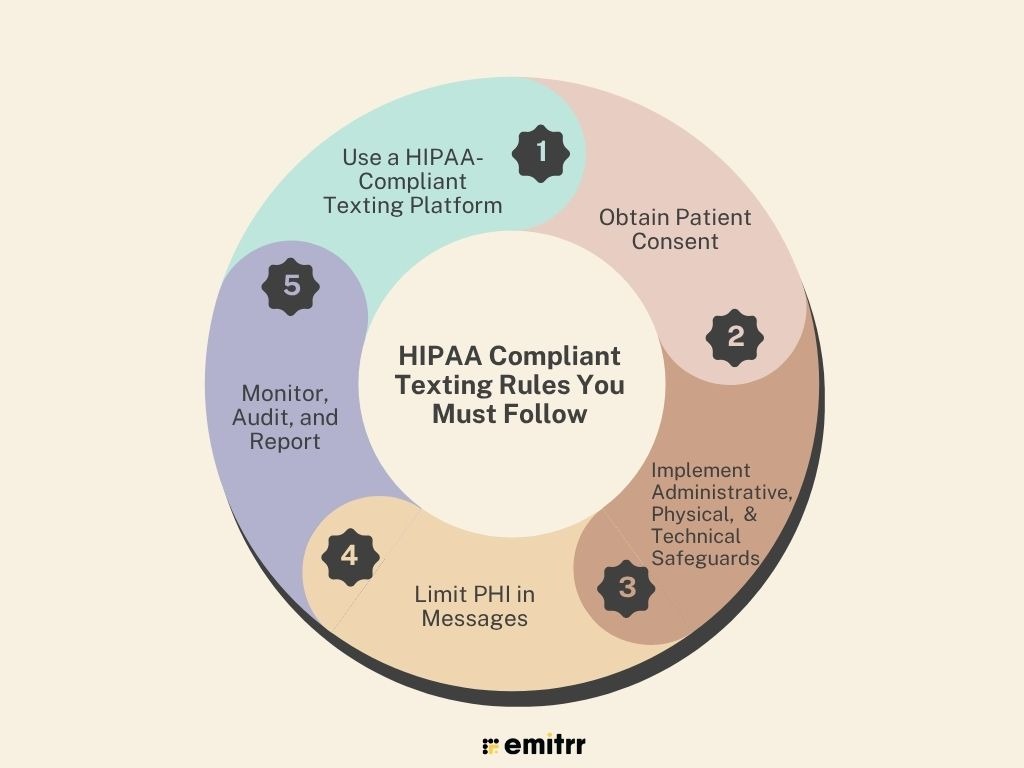
Texting is surely a convenient way for healthcare professionals to communicate with their patients, but you must follow rules for HIPAA compliant texting for doctors strictly to protect ePHI. HIPAA-compliant texting is only possible when providers follow specific HIPAA compliant texting checklist, obtain patient consent, and use secure platforms. Here’s what you need to know
1. Use a HIPAA-Compliant Texting Platform
Regular SMS or consumer apps (like WhatsApp or iMessage) do not meet HIPAA security standards. This is why HIPAA-compliant texting for physicians has become essential, allowing providers to communicate with patients securely while maintaining privacy, documentation, and regulatory compliance. To remain compliant, healthcare providers must use a HIPAA secure messaging app that offer robust security features like end-to-end encryption, user access control, audit trails, etc. These platforms also require a Business Associate Agreement (BAA) with any third-party vendors handling PHI.offers
2. Obtain Patient Consent
As per HIPAA texting rules, you can only text PHI if the patient requests it or explicitly consents in writing, acknowledging potential security risks. This is why documenting patient consent is extremely important; it helps in protecting your practice in case of HIPAA compliance audits.
3. Implement Administrative, Physical, and Technical Safeguards
The HIPAA texting rules require regulated entities to implement appropriate administrative, physical, and technical safeguards for protecting ePHI.
- Administrative safeguards: This includes establishing texting policies, training staff on HIPAA texting rules, and performing regular risk assessments.
- Physical safeguards: This includes using secure mobile devices, implementing remote wipe capabilities, and restricting access to authorized personnel only.
- Technical safeguards: This includes encrypting messages, enforcing secure logins, and maintaining audit logs of all patient communications.
4. Limit PHI in Messages
Only include the minimum necessary information in texts. Avoid sending full medical records, lab results, or detailed diagnoses unless using a HIPAA-compliant secure text messaging solution. Using message templates can help reduce risk while maintaining clarity.
Following HIPAA texting rules also means being careful about how patient messages are written. Using pre-approved, HIPAA-safe message formats helps reduce the risk of sharing unnecessary PHI while keeping communication clear.
Get free HIPAA-compliant text message templates.
5. Monitor, Audit, and Report
Regularly review your HIPAA secure messaging logs to detect unauthorized access. Additionally, you must report any breach that may have happened promptly following the HIPAA Breach Notification Rule to stay compliant.
6. Follow New HIPAA Rules for Text Messaging and Email
Don’t rely on an outdated HIPAA texting policy. Keep an eye on any new HIPAA rules for text messaging and email that may be updated to prevent accidental HIPAA violations. Under the HIPAA text messaging policy, healthcare providers must use systems that offer user authentication, encryption, audit logs, and a signed Business Associate Agreement (BAA). Regular SMS or unsecured email services violate these standards, while HIPAA-compliant messaging and email platforms ensure patient data remains private and protected.
To help your practice stay compliant with evolving HIPAA communication rules, here are essential free downloadable medical forms PDF you can use to properly document consent and protect patient information:
What is a HIPAA Violation?
A HIPAA violation occurs when the person or organization handling Protected Health Information (PHI) fails to comply with HIPAA Privacy, Security, or Breach Notification Rules. In simpler words, a HIPAA violation happens when PHI is disclosed without proper safeguards or authorization.
Here are a few HIPAA violation examples in healthcare:
- Sending texts or emails using unencrypted or non-secure channels
- Sharing private patient details with unauthorized individuals
- HIPAA violation examples include not obtaining the patient’s consent before texting them
- Not obtaining a Business Associate Agreement (BAA) with vendors who access PHI
- Losing devices that have unprotected patient data inside
- HIPAA violation examples in healthcare also include posting patient photos on social media without their consent
- Texting a patient’s name can be a HIPAA violation if the message contains or reveals Protected Health Information (PHI) and is sent through an unsecured or non-compliant messaging platform without the required safeguards or patient authorization.
- Disclosing PHI in marketing messages
These can be willful or unintentional hipaa violations; in either case, violations are taken seriously by the U.S. Department of Health and Human Services (HHS) Office for Civil Rights (OCR).
If you also call your patients then you may want to watch this:
What are the Penalties for a HIPAA Violation?
HIPAA violations can result in civil and criminal penalties, depending on the severity and intent. Penalties are assessed per violation and can accumulate quickly. Here’s a quick look at some common HIPAA violations and their penalty charges :
1. Civil Penalties for HIPAA Violations:
The U.S. Department of Health and Human Services (HHS) Office for Civil Rights (OCR) uses a tiered structure based on culpability and defines civil HIPAA violation penalties under three tiers:
- Tier 1: Unknowing violation – minimum $130 per violation, up to $53,000 annually
- Tier 2: Reasonable cause – minimum $1,000 per violation, up to $53,000 annually
- Tier 3: Willful neglect, corrected – minimum $10,000 per violation, up to $53,000 annually
- Tier 4: Willful neglect, not corrected – minimum $50,000 per violation, up to $1.5 million annually
2. HIPAA Criminal Penalties:
The Department of Justice can pursue criminal charges for intentional or malicious HIPAA violations:
- Up to $50,000 in HIPAA penalties and 1 year in prison for knowingly obtaining PHI
- Up to $100,000 in HIPAA penalties and 5 years in prison for violations committed under false pretenses
- Up to $250,000 in HIPAA violation fines and 10 years in prison for violations committed with intent to sell, transfer, or use PHI for personal gain or harm
There are many real life hipaa violation cases and their respective HIPAA violation fines that you can check to learn more.
How to Make Texting Safe & HIPAA Compliant?
For those looking for ways to stay HIPAA compliant to avoid HIPAA breach penalties, here are some HIPAA compliant messaging best practices to follow:
- Use a HIPAA-compliant texting software with robust security features like end-to-end encryption, user access control, remote wipe, auto log off, audit logs, etc., and have a signed BAA as well.
- Monitor/audit texting logs and report breaches per the Breach Notification Rule.
- Create HIPAA texting rules for nurses and staff, and train them on how to avoid HIPAA texting violations.
- Familiarize your staff with common HIPAA violation examples in healthcare
- Obtain documented patient consent
- Avoid sending full PHI unless necessary. Try to use HIPAA-compliant message templates to avoid ePHI risk exposure.
- Implement remote wipe and access controls for staff devices.
Use Emitrr to Avoid HIPAA Texting Fines
Emitrr software is a reliable & renowned HIPAA-compliant texting platform that offers the most intuitive features, a user-friendly layout, and top-notch customer support. Some of the popular software reviewing platforms (Capterra, G2, etc.), has rated Emitrr a five out of five stars for its ease of use and customer support.
Emitrr follows all the HIPAA texting guidelines and works on bringing the best features with more security adaptability. Let’s have a look at Emitrr’s benefits:
End-to-end encryption
End-to-end encryption safety measure that ensures that no third party can access any messages you share with your patients. At Emitrr, with HIPAA compliance being the pivotal point, data hosted on the servers is encrypted, and only the intended recipient can view those messages. No third party, or middle ground intercepters, including Google, can access your messages, ensuring you don’t end up doing accidental HIPAA violation.
Secure PHI sharing
Emitrr offers a special feature called “secure texting and secure PHI sharing”. With Emitrr, all the sensitive phi information of patients can be shared through HIPAA-compliant texting in a controlled environment. There is no data breach or loss of personal information, and therapists can easily discuss healthcare plans with their patients over text.
Here’s how this feature works:
Multi-tenant architecture
Emitrr’s multi-tenant architecture is another big win for any healthcare organization looking to avoid HIPAA texting fines. Emitrr supports multi-tenant architecture. It means that all the patient data is not hosted on one single architecture but on different servers. Since data is well distributed over different servers, decryption or data breach is nearly impossible. By following the HIPAA text messaging policy, Emitrr ensures that all communication complies with HIPAA rules and keeps patient information safe at all times.
SOC2 Compliance
SOC2 Compliance is a voluntary compliance standard developed by the American Institute of CPAs (AICPA) that has guidelines on how service organizations should manage all customer data. It is categorized into 4 Trust Services Criteria; namely, Security, Confidentiality, Availability, and Processing Integrity. Emitrr does an amazing job of offering HIPAA-compliant but also SOC2-compliant solutions. It’s essential to check whether a texting platform offers SOC2 Compliance while choosing a HIPAA-compliant platform and to avoid accidental HIPAA violation.
HIPAA compliance
Emitrr offers HIPAA-compliant texting for secure messaging. In line with the HIPAA texting policy, all texts sent to patients or vice versa are monitored, and no retention of PHI data on different servers is allowed, ensuring HIPAA texting guidelines are followed. The texts go through an audit and access controls and are encrypted to prevent any third-party interception. In fact, Emitrr offers not only texting, but also HIPAA-compliant VoIP and a virtual fax system to ensure communication with patients on any channel is always secure.

FAQs
To send a HIPAA-compliant message, you must use an app that follows HIPAA texting guidelines like Emitrr, get the patient’s consent, limit PHI in the message, and implement other security safeguards essential to keep the patient’s confidential information safe.
You can make HIPAA breach reporting by submitting a complaint to the U.S. Department of Health and Human Services (HHS) Office for Civil Rights (OCR). By submitting a HIPAA violation, you can protect the patient’s privacy and ensure that your healthcare organization follows HIPAA rules and regulations.
Data stripped of all identifiers (name, date of birth, address, Social Security number, medical record numbers, etc.) is not considered PHI and can be shared freely for research, training, or public health purposes. Additionally, sharing educational material, wellness tips, etc., can be shared without violating HIPAA.
Yes. Contacting patients via social media platforms is generally not HIPAA-compliant, this is because these platforms cannot guarantee secure transmission of PHI and privacy. So yes, any patient-specific information shared publicly or privately could be considered a violation.
Yes, if the patient’s picture contains identifiable patient information such as face, medical condition, or other PHI, and is shared anywhere without their written consent, then it can be a violation of HIPA
Generally, no, if the text message only includes the patient’s first name and no other identifying health information, then texting first name is okay. Using just a first name typically does not constitute PHI, but be cautious if combined with other health-related details.
Yes, texting can be a HIPAA violation if Protected Health Information (PHI) is shared through unsecured channels like iMessage or regular SMS. These platforms lack encryption and other safeguards required by HIPAA and may lead to accidental HIPAA violation. However, texting is not a HIPAA violation when done through a HIPAA-compliant texting platform that uses encryption, access controls, and a signed Business Associate Agreement (BAA).
Key Takeaways
- Written patient consent is required before any health-related text is sent: a verbal “sure, you can text me” is not sufficient under HIPAA’s authorization standards.
- The minimum necessary standard applies to every text: messages must contain only the information required for the specific purpose, not everything the practice knows about the patient.
- HIPAA and TCPA violations can stack: a non-consented patient text can trigger simultaneous fines under both regulations, with TCPA adding up to $1,500 per message per violation.
- Automated opt-in/opt-out management is a platform requirement, not an optional feature: practices that manually manage opt-outs are one oversight away from sending to a withdrawn-consent patient.
- Unknowing violations still carry fines of $100–$50,000 per incident: “we didn’t know” is a mitigating factor on penalty amount, not a defense against the violation itself.
- Why Emitrr: Emitrr helps healthcare organizations apply HIPAA texting rules automatically through built-in compliance workflows, reducing reliance on manual processes.
Conclusion
HIPAA violations can result in hefty HIPAA penalties; this is why it is important to have the right knowledge and train your staff when it comes to handling sensitive patient information.
While we understand so many nuances make texting patients a bit tricky, by using a HIPAA-compliant texting platform like Emitrr and training your staff to text the right way, you can avoid hipaa violation court cases and costly troubles.
Book a free demo with Emitrr and text your patients confidently.

 4.9 (400+
reviews)
4.9 (400+
reviews)