
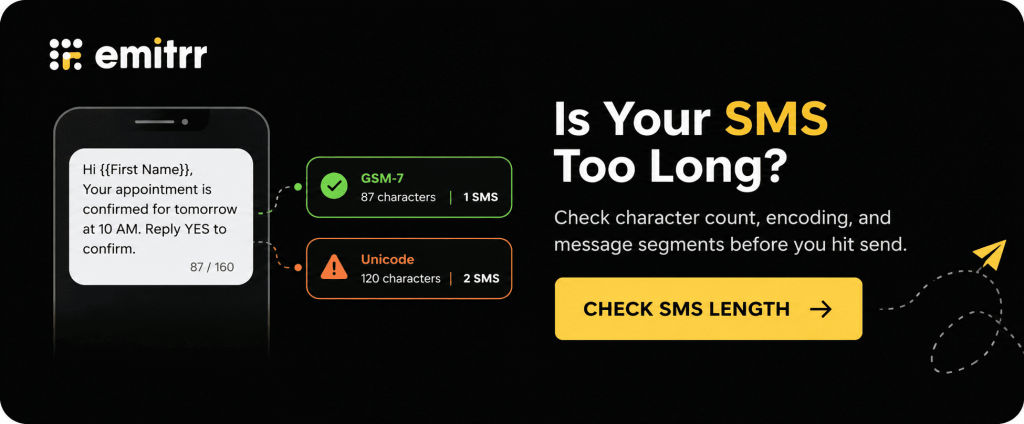
The standard number of characters available for an SMS is 160.
However, the use of special characters and emojis reduces this limit to 70.
What are Non-Special Characters?

What are Special Characters?
Any character not listed in the table above + emojis are special characters.
Note: Most non-special characters use 1 bit to be encoded and hence are counted as 1 character. Some non special characters such as the vertical bar ( | ) and the Tilde ( ~ ) use 2 bits to be encoded and hence are counted as 2 characters.
Special characters and Emojis use more than 2 bits to be encoded and hence are counted accordingly. The emoji “👩👧👦” uses 8 characters.×Dismiss alert
How are credits calculated for non-special characters?
Most non-special characters fall under the GSM-7 encoding mechanism which means each character takes up 1 bit to be encoded.
One message segment allows you 160 characters. An SMS containing the message “ Hi this is a simple text message.” has 33 characters and hence has used up 33 out of the available 160 characters for one message segment.
However, if I add a character like a “|” (vertical bar), it will take up an extra 2 characters as it takes 2 bits to be encoded. Hence, the modified message “ Hi this is a simple text message.| ” will use 35/160 characters.
As this message uses only 1 message segment, only 1 credit will be utilized.
What happens when I exceed the 160-character limit?
As soon as the characters go above 160 characters, the following characters will become part of the second message segment.
Since 2 message segments will be used to send the message, the number of credits used will be 2.
Note: The second message segment will only have 153 characters because 7 of the 160 characters will be used for a header in the backend. This header will help the carrier identify that the message segments need to be sent together.×Dismiss alert
How are credits calculated for Special characters?
Special characters fall under the UCS-2 encoding mechanism. In this mechanism the special characters take up 2 or more than 2 bits to be encoded.
With the UCS-2 encoding one message segment equals 70 characters. For example,
“ Hi this is a simple text message 🙂”
will use 35 out of the 70 characters available for one message segment. The presence of the emoji 🙂changed the available characters to 70.
As this statement only uses 1 message segment (under 70 characters), one credit will be used for this message.
What happens when I exceed the 70 character limit?
If the above message was modified to
“Hi this is a simple text message 🙂Please confirm if you have received this message.”
This statement now has 84 characters which has exceeded the 70-character limit. The characters following this limit will now be part of the second message segment. The message will now cost you 2 credits, for 2 message segments
Note: The second message segment will only have 67 characters because 3 of the 70 characters will be used for a header in the backend. This header will help the carrier identify that the message segments need to be sent together.×Dismiss alert
Any unicode character is considered special, even if it looks similar to a non-special character. Let’s use the example of double quotation marks.
- This is the non-special character: “
- These are special characters: «, “, ‟, ❝,〝, “
Summary
| Non-Special Character Length | Special Character Length | Segments(in numbers) | Charged as |
| 0 – 160 characters | 0 – 70 characters | 1 | Single credit |
| 161 – 306 characters | 71 – 137 characters | 2 | Two credits |
| 307 – 459 characters | 138 – 204 characters | 3 | Three credits |
| 460 – 612 characters | 205 – 271 characters | 4 | Four credits |
| 613 – 765 characters | 272 – 338 characters | 5 | Four credits |
| 766 – 918 characters | 339 – 405 characters | 6 | Four credits |
| 919 – 1,071 characters | 406 – 472 characters | 7 | Four credits |
| 1,072 – 1,224 characters | 473 – 539 characters | 8 | Four credits |
| 1,225 – 1,377 characters | 540 – 606 characters | 9 | Four credits |
| 1,378 – 1,530 characters | 607 – 673 characters | 10 | Four credits |

 4.9 (400+
reviews)
4.9 (400+
reviews)