
Introduction
Wondering why patients keep calling about prescription refills even after submitting a request? They aren’t calling because they love calling. They’re calling because something in the refill process is unclear, slow, or invisible, and when medication is involved, silence is not the best thing.
In this blog, we break down why refill calls keep happening even after patients submit a request, what pharmacies are actually hearing on real calls, and how teams are quietly fixing the problem without hiring more staff or answering more phones.
So if refill-related calls are eating up 10–30% of your day, this will show you exactly where they’re coming from, and how to stop them.
The Real Reasons Patients Keep Calling About Prescription Refills
One common pattern that we noticed among all healthcare providers is that for most, 10%-30% calls are related to prescription refills, which takes up a lot of unnecessary time. In a recent call with a multi-location clinic, staff shared very specific, repeat patterns behind why patients call in the first place.
“I’m completely out, I need this today”
Many refill calls happen under urgency. Staff described patients realizing they’re out of medication only when they open the bottle to their last dose. At that point, the refill feels like an emergency, leading to repeated high-volume calls. This urgency is especially common for daily or chronic medications.
“Why was my refill denied? I’ve been taking this for years”
Patients do not realize that refills can be subject to visit rules. In the call, the staff explained that refills are often denied because the patient hasn’t been seen recently enough
Or the medication requires periodic follow-ups. From the patient’s perspective, the refill feels routine, and when it’s delayed or denied, they keep calling to get answers.
“It was sent, but the pharmacy says they don’t have it”
Another frequent reason for refill calls is pharmacy changes. Patients switch pharmacies but don’t always notify their clinic. And when the prescription is sent to the old pharmacy, the patient assumes it wasn’t sent at all, and keeps calling you to find out where their medication is.
“This medication can’t wait”
Clinic staff noted that medications related to anxiety, ADHD, or controlled substances lead to much faster follow-ups. This is because the patients have less tolerance for delays and will call quickly if they don’t get updates.
“I left a voicemail, but I don’t know if anyone heard it”
Patients frequently say they already requested a refill by phone, but they’re calling again because they are not sure whether the voicemail was received or not. They wonder
If the message was picked up, if it went to the right queue, or if someone is working on it.
They call to make sure someone got their request.
“I submitted the request online… I’m just checking the status”
Patients often reference an online or portal-based refill request and then immediately follow up with a call. The thing missing here is not the submission but any signal of progress after submission.
“They told me it needs doctor approval, but I don’t know where it’s stuck”
Patients repeatedly call asking whether:
- The pharmacy has already contacted the provider
- The provider has responded
- The pharmacy is still waiting
They are calling because they don’t know the exact status of their prescription refill.
“I don’t know when it will be ready, so I thought I’d call”
Many refill-related calls also boil down to timing uncertainty. Patients ask:
- “Is it ready yet?”
- “Will it be ready today or tomorrow?”
- “Should I come in or wait?”
Again, the call happens because no clear pickup expectation was set earlier.
“I just want to make sure it didn’t get missed”
This line comes up more often than pharmacies realize. Patients explicitly say they’re calling because they’re worried their refill request might have been overlooked, especially if it’s been more than a day with no update. This is especially common for ADHD, anxiety and other chronic disease medications.
What all these scenarios have in common is that patients aren’t calling so much just to place refills, they’re calling because they lack confirmation, visibility, or clear next steps after a request is made. To reduce such frequent calls, pharmacies are using platforms like Emitrr.

Why Patients Keep Calling About Prescription Refills (Even After Submitting a Request)
Let us now look at common reasons why patients keep calling about prescription refills even after submitting a request:
Voicemail refills that don’t go through
Patients often leave a refill request on voicemail, but never receive confirmation. When hours (or a full day) pass without an update, they call to make sure the message was heard.
Unclear or incomplete refill requests
Prescription refill requests often miss key details like medication name, dosage, or preferred pharmacy, especially when patients leave voicemails. Because of incomplete information, staff have to pause the refill and patients call back to clarify, creating back-and-forth phone traffic.
Patients Don’t Know Refills Are Blocked by Visit Rules
Sometimes patient sumbit a refill request after 3-6 months from their last issued medicine, and they assume they can get their dosage whenever they want. When in reality, if they are reaching out after 3-6 months, they need to see their provider again.
Insurance or coverage changes
Even small changes in insurance plans can block refills. If there has been a change in insurance or coverage plan, then patients might not find out until the refill fails, which leads to urgent calls asking why a “routine” refill suddenly isn’t going through.
Confusion between refills vs. new prescriptions
Patients often request refills when a new prescription is required. When the refill is denied or delayed, they call to understand the difference, something that should have been explained upfront.
Why Phone-Based Refill Workflows Break at Scale
Most of the above-mentioned reasons as to why patients keep calling you for a refill are because of your current phone-based refill workflows. The key problem is:
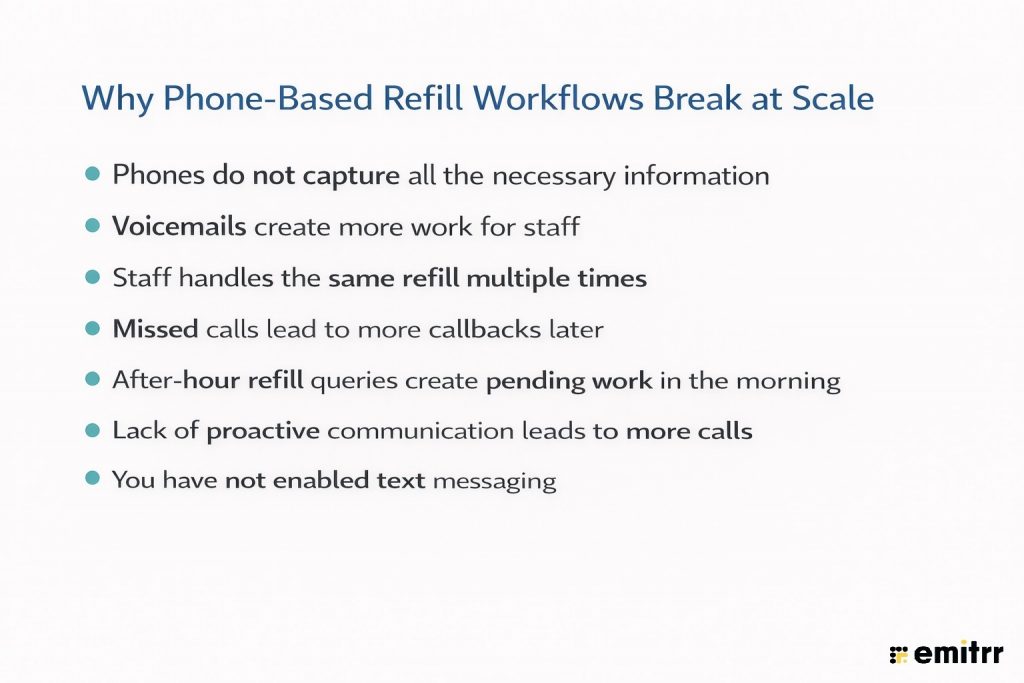
The day you fix all this, your call volume will be reduced by half. The good news is you can actually fix all this by automation; you absolutely do not need to add more staff.
How to Stop Repeat Refill Calls (Without Adding Staff)
Let us now look at how you can actually stop repeat refill calls without adding staff.
1. Confirm every refill request instantly
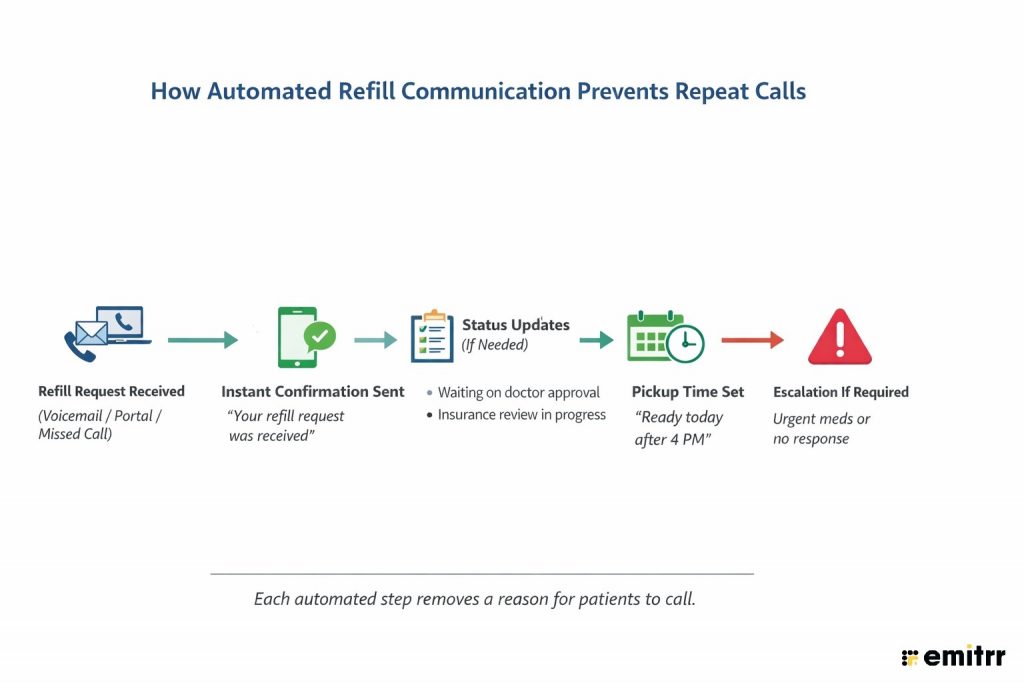
The moment a refill request is received, whether by voicemail, missed call, portal, or text, patients need immediate confirmation. Set up automated confirmation messages to reassure patients that:
- their request was received,
- it’s in the right queue,
- and someone is working on it.
When patients know their request didn’t disappear, the follow-up call never happens.
See- How SMS-based prescription refill requests reduce call volume.
2. Set clear expectations around timing
Most refill calls happen because patients don’t know when to expect their medication. Instead of leaving room for guesses:
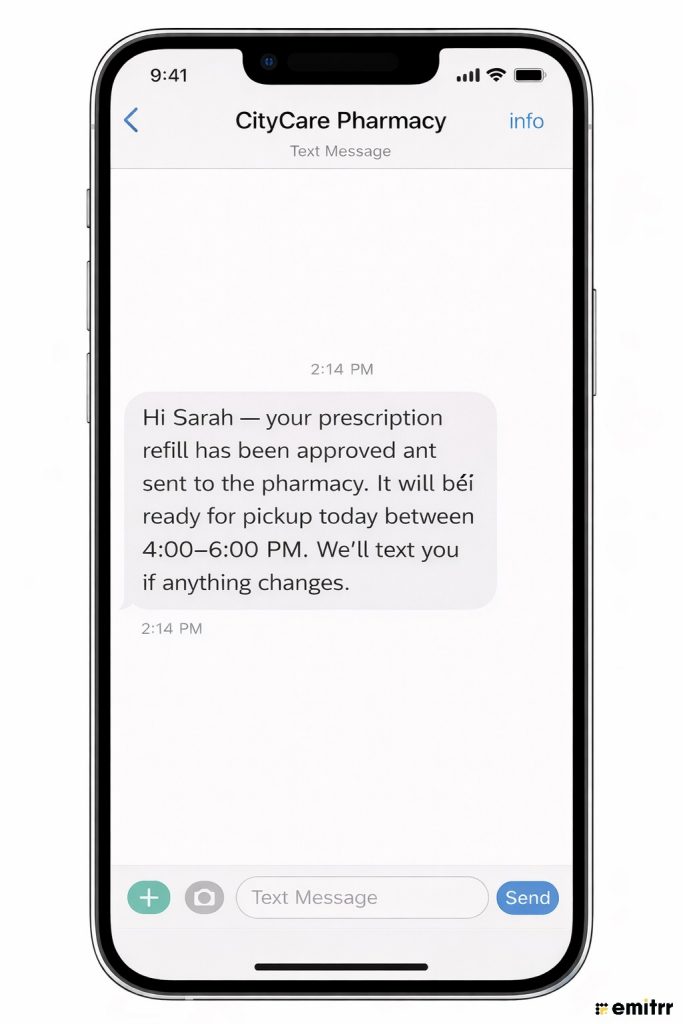
- send an estimated pickup window,
- clarify same-day vs next-day expectations,
- and update patients if timelines change.
Clear timelines can reduce “just checking calls”.
3. Automate status updates when refills get stuck
Provider approval, prior auth, and insurance issues are common reasons for delayed refills. To solve this, offer clear visibility by sending automated status texts like:
- “Waiting on provider approval”
- “Insurance review in progress”
- “We’ll notify you once approved”
4. Proactively flag visit rules and refill eligibility
When refills depend on visit history or medication rules, patients should know before they call. You can set up proactive automated messages to:
- explain why a refill can’t be processed yet,
- outline the next step (schedule a visit, contact the provider),
- and prevent repeated “why” calls to the pharmacy.
5. Catch wrong-pharmacy issues early
If a prescription is sent to the wrong pharmacy, patients usually find out before the staff do, and they call immediately. Simple confirmation messages that include the pharmacy name, location. or pickup instructions help patients catch errors early without calling to track things down.
6. Escalate high-anxiety medications automatically
For chronic medications where patients have low tolerance for delays, smart workflows are needed that automatically:
- send more frequent updates,
- escalate unanswered refills faster,
- or alert staff when a call-back is actually needed.
This keeps urgent cases moving without flooding the phones.
Refill Call Volume: Manual vs Automated Workflows
| Refill Scenario | Without Automation | With Automated Texting |
| Voicemail refill requests | Patients call back to confirm | Instant confirmation text sent |
| Online refill submissions | Follow-up calls for status | Automated progress updates |
| Provider approval delays | Repeated “is it approved?” calls | Status texts explain next step |
| Pickup timing | “Is it ready yet?” calls | Clear pickup ETA shared |
| Wrong pharmacy issues | Calls to track prescription | Pharmacy name confirmed upfront |
| Urgent medications | Multiple rapid calls | Faster escalation + proactive updates |
Learn more about how AI agents can reduce prescription refill calls in this interesting video:
How Emitrr Fixes the Refill Call Problem
Emitrr replaces manual back-and-forth with an AI-driven refill workflow. When a patient requests a refill, the HIPAA-compliant AI agent collects all required details in natural language, patient identity, medication, dosage, and pharmacy, and matches them against existing records and practice rules. If everything checks out, the request moves forward automatically. If not, a case is created in the EHR like Athena, and the patient is notified of the next step. Throughout the process, patients receive instant confirmations and updates, eliminating the uncertainty that leads to repeat refill calls.
Apart from this, here are the key features Emitrr offers that help in reducing prescription refill calls.
| Emitrr Feature | What It Does | Outcome for Pharmacies |
| Missed-Call-to-Text | Automatically texts patients when a refill call is missed, allowing them to submit the request by reply | Refill requests never disappear → fewer “Did you get my message?” calls |
| Instant Refill Confirmations | Sends an automatic confirmation as soon as a refill request is received | Patients don’t call back to verify their request went through |
| AI Refill Agent (Text + Call) | Collects structured refill details like medication name, dosage, urgency, and pharmacy preference | Fewer incomplete requests → fewer clarification calls |
| Automated Status Updates | Notifies patients when a refill is pending approval, in progress, or completed | Eliminates “Where is my refill stuck?” calls |
| Ready-for-Pickup Alerts | Sends clear pickup timing and next-step instructions | Reduces “Is it ready yet?” and “Should I come in?” calls |
| Automated Text Replies | Instantly answers common refill questions (eligibility rules, early refills, next steps) | Patients get answers without tying up staff |
| Voicemail Recording & Summaries | Records, transcribes, and summarizes refill voicemails | Faster processing and fewer follow-up calls due to missed details |
| EHR Write-Back | Syncs refill details and patient responses back into the EHR | Less manual entry → smoother refill workflows |
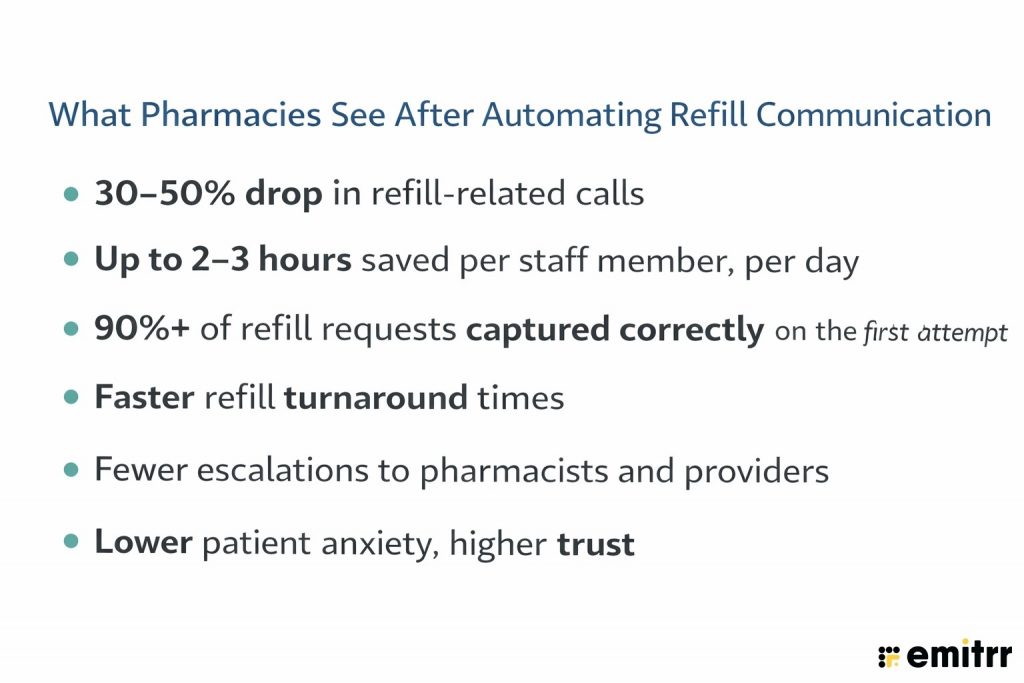
What Pharmacies See After Automating Refill Communication with Emitrr
FAQs
Pharmacies usually call when a refill request is incomplete, requires doctor approval, or hasn’t been confirmed. Many follow-up calls happen because patients haven’t received a clear update after submitting the request. Without confirmation or timing information, staff call to close the loop manually.
Pharmacies typically need the patient’s name, date of birth, medication name, dosage, and preferred pharmacy. If any of this information is missing or doesn’t match records, the refill may be delayed and require a follow-up call for clarification.
Prescriptions are commonly flagged when refill requests are too early, required follow-up visits are overdue, the medication is controlled, or patient details don’t match records. Flagged prescriptions are reviewed before they can be approved, which can delay refills
Doctors are notified only when a refill requires approval. This usually happens if the medication has no refills left, is a controlled substance, or falls outside visit or timing rules. Routine refills with valid authorization may not require provider review.
CVS calls are usually triggered by refill reminders, pickup notifications, or insurance issues. You can reduce calls by updating communication preferences, opting into text or app notifications, and responding promptly to refill messages so follow-ups aren’t triggered.
Prescription refill rules depend on the medication, how recently the patient was seen, and whether refills were previously authorized. Some medications allow automatic refills, while others require periodic provider review or have strict timing limits.
A doctor must approve a refill if there are no remaining refills, the medication is controlled, or required visits or labs are overdue. If these conditions aren’t met, the refill may be delayed or denied until reviewed.
Repeat prescriptions are often cancelled when follow-up visits are overdue, insurance coverage changes, refill limits are reached, or the medication needs reassessment. Without proactive communication, patients often only discover this by calling the pharmacy. Pharmacies that use automated refill communication platforms like Emitrr notify patients early when refills can’t proceed and explain next steps, reducing confusion and repeat calls.
Conclusion
Most refill-related calls don’t happen because patients are confused, but because they’re left waiting without confirmation, status, or clear next steps. Pharmacies that automate refill confirmations, status updates, and follow-ups reduce call volume and also free up staff time, helping move refills faster and reduce phone calls.
Emitrr helps pharmacies do exactly that by managing the entire refill conversation automatically, from first request to final confirmation.
See how Emitrr reduces refill calls and streamlines prescription workflows, book a demo!


 4.9 (400+
reviews)
4.9 (400+
reviews)