
Introduction
Missed calls are a major yet underestimated source of revenue loss, specifically for small and mid-sized businesses. Missed calls’ impact on business revenue is far more than most businesses realize. As per a few studies, approximately 60% of calls to small businesses go unanswered, and around 85% of those callers never try again. These missed calls very often happen during peak hours or after business hours, yet they still carry high intent, particularly when 78% of customers end up buying from the first business that responds.
As a result, various SMBs estimate losing around $500 or more every month due to missed calls, which quickly adds up to thousands in lost annual revenue. The missed calls’ impact on business growth is even more severe in call-heavy industries, with sectors like banking missing nearly 49% of calls and home services losing up to 62%. This guide clearly explains what missed calls exactly mean when it comes to businesses, what happens after a missed call, and how to reduce missed calls with features like call handling, business call automation, and call-to-text workflows. It also explains how platforms like Emitrr help businesses prevent missed calls without increasing staffing costs.
So let’s get started!!
What Is a Missed Call in a Business Context?
A missed call in a business context is not simply a phone that goes unanswered. It is also a failed communication at the exact moment a customer chose to reach out. Unlike emails or contact forms, phone calls usually signal urgency or strong intent. Customers most prefer calls when they want quick answers, immediate bookings, or confirmation before making a decision, and when the call goes unanswered, they rarely wait.
A missed call in a business setting is not simply a phone that rang unanswered. It is a failed interaction at the exact moment a customer chose to reach out. Unlike emails or contact forms, phone calls usually signal urgency or strong intent. Customers call when they want quick answers, immediate bookings, or confirmation before making a decision. From their point of view, the business appeared unavailable. This directly reflects missed calls customer behavior and missed calls customer expectations, making missed calls a revenue and growth issue, not just an operational one.
What Impact Does a Missed Call Have on Your Business?
Imagine that your customer has some personal requirements related to their health or any other service. What is the first thing that they will do? They’ll do a quick Google search and then pick the service provider that matches their expectations and has positive reviews.
Let’s say that they find your business to be aligned with their needs. They’ll fetch your contact details and call you up. What if their calls don’t get answered? What if their calls go to voicemail? What do they do then? It’s simple. They will direct their focus toward the ‘next best choice.’

Fun fact: With 32.5 million small businesses in the USA, they together receive a whopping 400 million calls daily. Nearly 62 percent of those phone calls made to small businesses are left unanswered.
Given the heavy service nature of most businesses, it is natural for them to miss calls. But what matters is what you do with those missed phone calls. Do you let go of those opportunities, or do you do something to convert the missed business calls?
Why Missed Calls Directly Impact Revenue
Every missed call costs businesses and has an estimated value attached to it. That value depends on the likelihood of conversion and the average value of a customer. When a call is missed, that value drops to zero.
Missed calls after business hours and high call volume missed calls quietly turn daily losses into major annual revenue gaps.

What Does a Missed Call Mean for Your Business?
A missed call not only means that you lost a potential customer, but you also lose a lot more every time you miss a call. Most small businesses spend a lot of dollars on building a website, advertising, SEO, and other forms of marketing. In addition, small businesses work very hard to channel these customers to a virtual door, and more than a quarter of these calls never get answered. So, how much damage does it cause your business?
A Missed Call Results In a Loss of Potential Revenue
Did you know that about 60 percent of consumers call a local business after discovering it on Google? If you have a healthy business, then it won’t be difficult for your potential customers to find you on Google search results. But when they call you and don’t receive a response, it is obvious that you have stumbled at the initial step of connecting with the consumer. So, as a business, a missed business call translates to a missed opportunity. One missed call costs businesses, which also means a missed prospect for a sale and, further, a loss of revenue.
A Missed Call Affects Your Online Reputation
It takes years’ worth of effort to build a strong online reputation for your business, and when you display ignorance concerning responding to calls, you are causing harm to your online reputation. You cannot expect new prospects to call you again and again. If there is no response from your end, they’ll dial the next best alternative.
On the other hand, repeated missed calls lead to frustration. Customers associate poor responsiveness with poor service, resulting in missed calls, negative reviews, and declining customer trust.
A Missed Call Restricts Further Growth
Suppose you make an average of $1000 from each customer. If you miss 50 calls a month, assuming all of those were business-related, you are losing out on $50,000 monthly! Such losses inevitably show up and affect your overall growth trajectory. This means that all your SEO and marketing efforts have been wasted on those missed business calls.

If you know your conversion ratio for inbound calls, then you can work out the cost of missed business calls purely in financial terms. Either way, with pay-per-click prices going through the roof and so much marketing noise out there, every call should be nurtured, cosseted, and treated as your number one priority, but it is not always possible, however much you may try. We are humans, and we can miss out on calls just like other finer details. It’s a given.
How do you protect your business from missed call revenue loss, then? How do you solve this good-to-have problem without actually involving another human being?
It’s not just the ROI of new sales. Although this in itself is reason enough to sit up and gawk at those stats. Nothing is more infuriating than calling a company with a question or issue and having the phone ring out or go to voicemail. It feels unprofessional, and your faith in that company rapidly declines. Your company is then on the back foot, and we all know what happens next. So, if you think that missing calls isn’t that big a deal, then it is time that you broaden your perspective and set measures to reduce the percentage of missed phone calls.
The Real Cost of “Missed Calls”
Before we talk about solutions, it’s important to understand the real cost of missed calls and what really happens when your business phone rings and no one answers.
- Missed call revenue loss: 27% of service business calls go unanswered, and restaurants miss up to 43% of calls during peak hours—costing mid-sized restaurants nearly $300,000 annually.
- Damaged customer experience: 70% of customers stop doing business after poor service, and missed business calls are seen as exactly that.
- Negative word-of-mouth: 95% of people share bad customer service experiences, with over half telling five or more people.
- Wasted marketing spend: Only 38% of business calls are answered, meaning most leads generated through ads, SEO, and social media never convert.
Why Do Businesses Miss So Many Calls?
Missed calls are rarely caused by carelessness. They usually happen because call handling systems are not designed for real-world demand. Here are a few quick reasons:
- High call volume during peak hours
- Missed calls after business hours
- No After-Hours answering service or 24/7 Solution
- Lack of Call Tracking and Reporting
- Lack of business call automation
- Ineffective Voicemail & Follow-Up
Do High Call Volumes Cause Missed Calls?
During high call volume, multiple calls arrive at once. Front desk teams juggle customers, systems, and in-person requests. Calls overlap, and some inevitably go unanswered.
How After-Hours Calls Lead to Lost Opportunities
Customers do not limit their needs to office hours. Many enquiries come in during evenings, weekends, or holidays. Without an after-hours response system, these calls are automatically missed—even though the intent is high.
How Manual Call Handling Creates Gaps
When calls depend entirely on human availability, gaps appear during breaks, meetings, or staff shortages. Without backup workflows or business call automation, missed calls become unavoidable.
Why “Just Hire Someone” Isn’t the Answer
Hiring more receptionists is an option. But here’s the catch:
- It adds up fast: $30K–$50K annually, plus benefits.
- They multitask, but not miracles: One call at a time — spikes still cause missed calls.
- Coverage gaps remain: Nights and weekends mean voicemail, and most callers won’t wait.
- People move on: Turnover means repeated training and added costs.
Tips to Reduce Missed Calls For Your Business
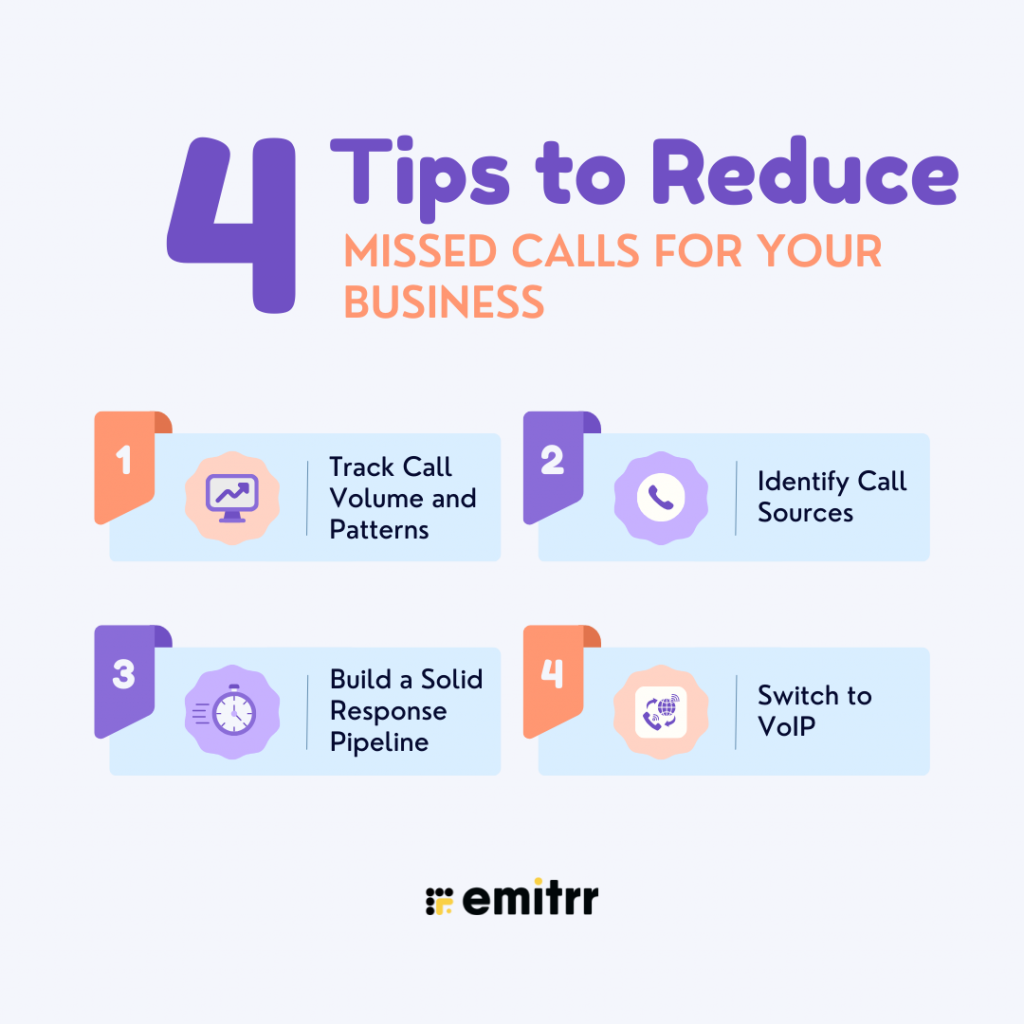
Analyze the volume and frequency of the calls received. Understand which number the customers are using the most and what the source of those calls is.
Track Call Volume and Patterns
Understanding how to handle missed calls starts with tracking peak times and identifying call trends. You can also start by analyzing the volume and timing of your incoming calls. Look into which numbers are receiving the most attention and identify peak call hours. This will help you prepare and plan resources accordingly.
Identify Call Sources
Understand where your calls are coming from—Google listings, ads, website buttons, or social media platforms. This helps in refining your marketing strategies and ensuring those channels are always monitored.
Build a Solid Response Pipeline
Every missed call should trigger a missed call follow-up strategy, such as callbacks or text responses. hence you need to create a system where every missed business call is followed up on within a specific timeframe. Whether through a call-back system, follow-up SMS, or an automated reminder, consistency is key.
Switch to VoIP for Smarter Call Management
Switch to VoIP (Voice over Internet Protocol) for better call management and gain flexibility in routing, tracking, and recording. VoIP can be accessed from anywhere and offers better reliability than traditional systems.
With AI VoIP solutions, businesses can automatically handle incoming and missed calls, route them smartly, respond with preset messages, and even gather useful insights without relying on traditional phone lines or manual effort.
Here are a few more Emitrr features that help you handle missed calls effortlessly:
- AI Voice Agent (24/7 Call Handling): Emitrr’s AI Voice Agent answers calls automatically, handles common questions, captures caller intent, books appointments, and routes complex requests to a human agent when needed. Conversations sound natural and context-aware, ensuring callers receive immediate assistance even after business hours. Watch this YouTube video to take a quick look:
- IVR / Call Tree with Keypress Routing: Create multi-level call flows and IVR that route callers based on their input, ensuring they reach the right department quickly.
- Smart Call Routing: Automatically direct calls to the most suitable team member, helping save time and reduce call handling delays.
- Call Queue Groups: Route incoming calls to predefined teams or extensions responsible for specific inquiries with the call queue feature.
- Individual Extensions: Provide each team member with a HIPAA-compliant direct extension and customizable call-forwarding rules based on availability.
- Ring-All Option: Ring all available team members at once so calls are answered by the first person available.
- Secondary Call Trees: Forward calls to another IVR or call flow for advanced routing or specialized support.
- Multi-User Call Groups: Set up call queues with multiple extensions or team members instead of routing to a single person.
- Call Recording Controls: With the call recording feature, automatically record incoming and outgoing calls for compliance, training, and quality monitoring.
- User-Specific Working Hours: Define individual availability schedules to ensure calls are routed only during working hours.
- AI-Powered Calling (Coming Soon): AI features designed to enhance call handling and customer communication while remaining HIPAA-compliant.
- Toll-Free Numbers: Enable customers to reach your business at no cost with toll-free numbers.
- Call Pop: Instantly view caller details and call history with the call pop feature during live conversations for faster resolution.
- Multi-Location Management: Monitor and manage calling activity across multiple business locations from one dashboard.
- Missed Call Texts: Automatically send SMS follow-ups when calls go unanswered.
- Quick Dialer: Place calls instantly using an in-app dialer without switching screens or manually entering numbers.
- Bulk & Mass Text Messaging: Send thousands of messages at once and achieve up to a 98% open rate.
Not sure how VoIP works?
Watch the video to get a clear idea before you get started:
Convert Calls to Text
Using missed call text response and automatic text for missed calls or missed call text-back software tools that convert phone calls into text messages. This allows you to respond immediately, even if you miss the call, keeping the communication loop active and improving customer satisfaction.
How To Reduce Missed Calls Without Hiring More Staff?
Solving missed calls does not require larger teams. It requires better systems.
How Call-to-Text Helps Recover Missed Calls?
When a call is missed, an automatic text response can acknowledge the caller instantly. This reassures the customer that their request was received and keeps the conversation alive. Many customers prefer replying by text instead of calling again.
Why Automation Is Essential for Missed Call Handling?
Business call automation ensures no call goes unnoticed. It fills gaps during busy periods and after hours, allowing teams to follow up later without pressure. Automation supports human teams instead of replacing them.
How Smart Call Routing Reduces Missed Calls?
Intelligent call routing ensures calls reach the right person or escalate automatically. Overflow calls are redirected instead of dropped, reducing caller frustration.
How Emitrr Helps You Never Miss a Call
Missing a call doesn’t have to mean losing a customer. Emitrr is built to help service-based businesses respond to every call, answered or not. With its missed call to text feature, Emitrr instantly sends a message to any customer you couldn’t pick up. Whether it’s a new inquiry, a follow-up, or an urgent concern, the platform keeps the conversation going through smart business call automation. This feature helps reduce missed opportunities and improves customer retention. Emitrr brings the power of AI to texting, helping businesses craft and send timely, relevant responses without lifting a finger.
Watch how effortless messaging can be on Emitrr with Al agent Sarah –
Beyond that, Emitrr offers a powerful VoIP phone system for business that allows teams to handle calls from anywhere, using any device. As an AI-powered call center software, Emitrr can route calls intelligently, send preset responses, integrate with calendars and CRMs, and even track call performance in real time. From SMS appointment reminders and follow-up texts to lead capture and feedback collection, Emitrr’s call and text capabilities keep operations smooth, organized, and responsive without extra manpower.
One of our customers, Dr. Mary Tilak and Associates, was having a hard time managing missed calls and was losing considerable potential revenue. Emitrr’s missed call to text capability helped them streamline communication and achieve 15x growth in revenue.
Emitrr is designed to make sure that missed business calls don’t quietly turn into lost revenue. It fills the response gaps that happen during busy hours, after-hours, or staff shortages—without adding pressure on your team.
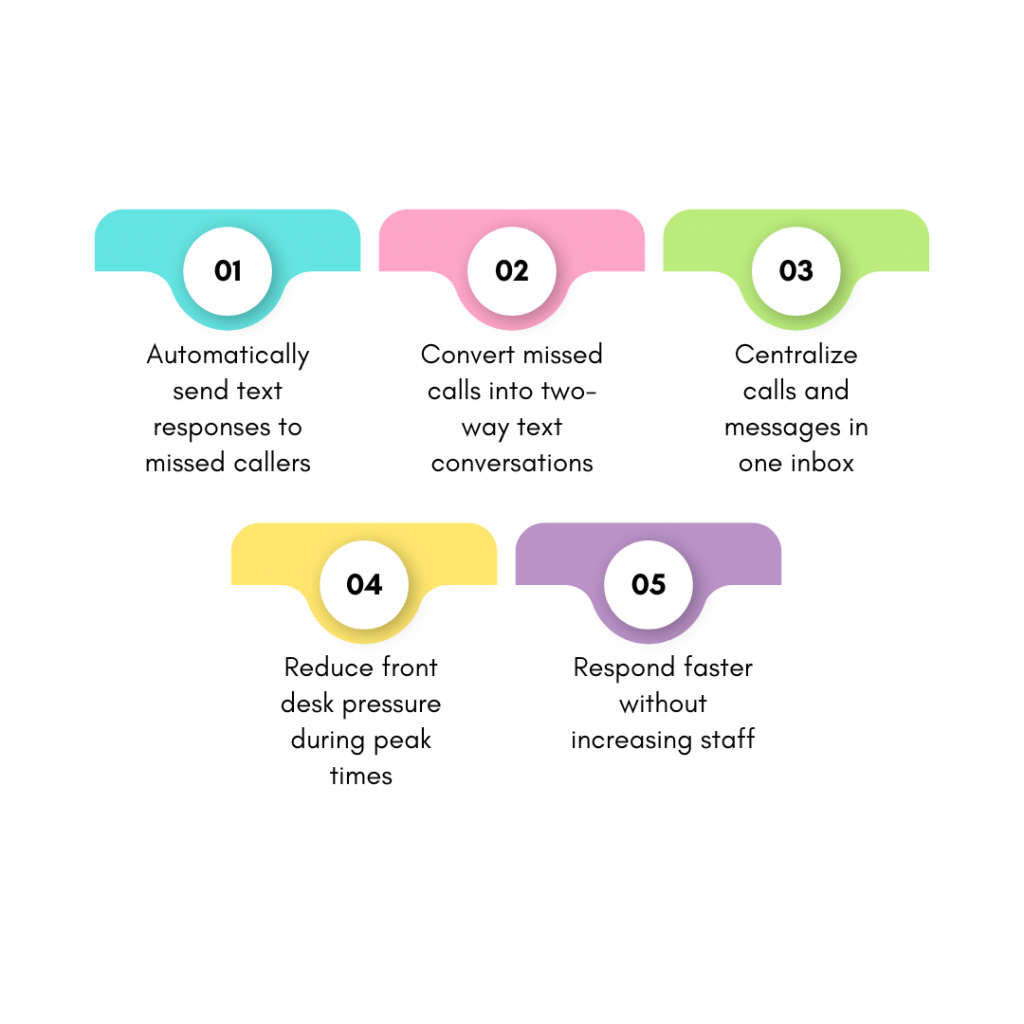
- Automatically send text responses to missed callers: When a call goes unanswered, Emitrr instantly sends a text acknowledging the call. This reassures the caller and keeps them engaged instead of moving on to a competitor.
- Convert missed calls into two-way text conversations: Instead of forcing customers to call again, Emitrr allows them to reply by text. This makes it easier to continue the conversation at their convenience and recover the opportunity.
Learn how to edit missed call-to-text through Emitrr:
- Centralize calls and messages in one inbox: All calls and text conversations are visible in a single shared SMS inbox. This helps teams follow up faster and ensures no customer inquiry slips through the cracks.
- Reduce front desk pressure during peak times: Emitrr acts as a safety net when call volumes spike. Even if staff can’t answer immediately, customers still receive timely responses.
- Respond faster without increasing staff: Automation handles the first response, giving teams time to reply thoughtfully. This improves response speed without hiring more people.
By capturing missed calls and continuing the conversation through text, businesses stay responsive—even when calls can’t be answered in real time.
FAQs
You can apologize for missing a customer call by apologizing, acknowledging the missed call with a brief explanation, and then assisting the caller with their queries.
You can implement VoIP software such as Emitrr in your organization. Emitrr comes with features like missed-call-to-text, automated messages, etc., that can help you in turning a missed call into a business opportunity.
It is considered courteous to pick up calls promptly and leave a good impression on the customer when you do not make them wait to pick up the call.
You can start by acknowledging a missed call politely by apologizing briefly and moving straight to helping the caller.
Example:
“Sorry I missed your call earlier. I’m available now—how can I help you?”
Businesses must follow Do Not Call (DNC) regulations when making outbound marketing calls. Key rules include:
– Do not call numbers listed on the National Do Not Call Registry
– Call only during permitted hours
– Clearly identify the business and purpose of the call
– Honor opt-out requests immediately
These rules apply mainly to marketing calls, not transactional or customer-initiated calls.
Not at all. Today’s AI voice technology sounds very natural. Most callers won’t realize they’re interacting with AI unless it’s explicitly mentioned.
The AI smoothly hands the conversation over to a team member. It passes along relevant details from the interaction, so the customer doesn’t have to repeat themselves.
Yes. You can customize greetings, responses, and workflows to match your brand’s tone and handle different situations exactly the way you want.
All conversations are securely recorded, transcribed, and logged in your CRM. Proper safeguards are in place to ensure compliance, visibility, and data protection.
Conclusion
All in all, no matter how much you believe in SEO or online advertising, the first thing that you need to do for customer acquisition is get your calls in order. Reduce the number of missed calls that you receive. Learn to convert missed calls into rewarding opportunities. Your business acumen, coupled with the assistance of customer communication and engagement software like Emitrr, will help you thrive in this cutting-edge, competitive business environment. So, book a free demo today and get ready to enhance your services.


 4.9 (400+
reviews)
4.9 (400+
reviews)