

Introduction
Traditional approaches can’t keep up with today’s fast-paced and complex business world. That’s where artificial intelligence in operations management is making a huge impact. AI tools are changing operations management by automating repetitive tasks, offering real-time insights, and completely transforming team communication. From sending reminders and updates automatically to predicting future trends and ensuring smooth information sharing, AI is filling communication gaps and helping businesses make better, faster choices.
This discussion dives into the common issues in operations management today and shows how AI-powered communication tools can provide the solutions businesses need. It explores how using AI in operations can simplify workflows, improve teamwork, reduce errors, and set companies up for lasting success in a competitive environment. So let’s begin!
What is AI in Operations Management?
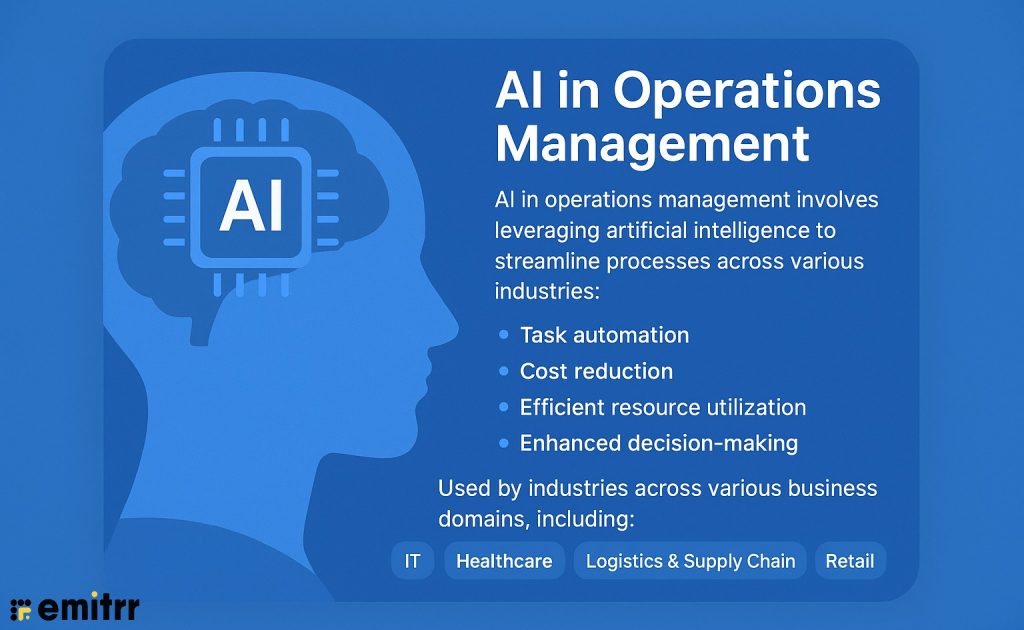
AI in operations management involves leveraging artificial intelligence to streamline processes across various industries. It serves multiple purposes, including task automation, cost reduction, efficient resource utilization, and enhanced decision-making. Because of so many advantages it is being used by industries across various business domains, including IT, healthcare, logistics and supply chain, retail, etc.
Operations management is what keeps a business running smoothly—it involves scheduling production, coordinating the supply chain, ensuring quality, and helping teams work together effectively. However, as businesses grow and markets get more complicated, certain challenges often pop up: manual tasks slow things down, miscommunications cause mistakes, and decision-making tends to be reactive instead of proactive. These problems can drive up costs and make it harder for companies to quickly adjust to customer needs and market demands.
Use Cases in Operations Management

Use Case 1: Process Optimization & Efficiency
Operations and maintenance teams often struggle with cascading delays caused by minor errors like data entry mistakes or missed deadlines.
To resolve, AI can:
- Send automated SMS/email alerts for bottlenecks (e.g., “Machine 3 overheating – act now”).
- Dynamically reallocate tasks using real-time data to reduce idle time.
- Predict maintenance needs to minimize downtime (Example: Manufacturers reduce downtime by 30% with predictive alerts).
Use Case 2: Cross-Team Communication Breakdowns
Fragmented systems across operations, sales, and customer service lead to wasted time clarifying tasks or tracking updates.
To resolve, AI can:
- Unify emails, texts, and calls into a single AI-powered platform.
- Deploy chatbots to handle routine queries (e.g., “When is the next shipment due?”).
- Auto-generate stakeholder progress reports (Example: Retailers cut supplier response times by 50%).
Use Case 3: Inventory & Supply Chain Disruptions
Manual tracking by supply chain and procurement teams often results in stockouts, overstocking, and customer dissatisfaction.
To resolve, AI can:
- Trigger predictive restocking alerts via SMS/email.
- Provide real-time shipment updates to internal teams and customers.
- Automate supplier coordination to prevent delays (Example: E-commerce firms reduce stockouts by 40%).
Use Case 4: Rising Customer Expectations
Customer service and logistics teams face pressure to deliver instant, personalized service without increasing costs.
To resolve, AI can:
- Use 24/7 chatbots to resolve common inquiries (e.g., “Where’s my order?”).
- Send proactive delay notifications with compensatory offers (e.g., discounts).
- Escalate complex cases to human agents using sentiment analysis (Example: Logistics firms reduce complaints by 60%).

Use Case 5: Regulatory Compliance & Sustainability
Compliance and procurement teams grapple with error-prone manual audits and sustainability reporting.
To resolve, AI can:
- Auto-generate compliance checklists and audit reports.
- Monitor supplier communications for safety/regulatory adherence.
- Highlight sustainability gaps in real-time (Example: Food manufacturers achieve 100% compliance).
Use Case 6: Sales Conversion & Lead Management
Sales and marketing teams miss opportunities due to delayed or generic follow-ups.
To resolve, AI can:
- Send personalized messages based on customer behavior (e.g., abandoned carts).
- Flag high-priority deals needing immediate attention.
- Auto-schedule follow-ups for leads nearing closure (Example: Sales teams boost conversions by 20–40%).
Use Case 7: Equipment Maintenance & Repair
Maintenance teams face costly downtime due to slow responses to equipment failures.
To resolve, AI can:
- Send predictive alerts for abnormal conditions (e.g., vibration spikes).
- Use voice-activated logs for hands-free issue reporting.
- Auto-dispatch technicians with repair checklists (Example: Repair times drop 50%).
Use Case 8: Recruitment & Employee Scheduling
HR teams waste time managing interview no-shows and scheduling errors.
To resolve, AI can:
- Send automated SMS reminders for interviews and document deadlines.
- Auto-schedule shifts based on employee availability.
- Provide real-time updates for schedule changes (Example: HR teams cut hiring cycles by 30%).
- A talent assessment platform like Marlee can assist hiring teams in understanding candidates’ strengths, motivations, and potential culture fit, helping streamline the hiring process.
How Does AI-Based Communication in Operations Management Differ from Traditional Communication?
Here’s how AI-based communication in operations management differs from traditional communication:
Proactive Problem-Solving in Operations Management
Traditional operational models often rely on reactive measures, addressing issues only after they disrupt workflows. In contrast, AI enables proactive problem-solving by predicting potential disruptions through real-time data analysis. For instance, sensors monitoring equipment performance can detect anomalies and trigger automated maintenance alerts, preventing unplanned downtime. This shift from reactive to predictive management minimizes operational disruptions, reduces costs, and ensures smoother workflows.
Enhanced Speed, Availability, and Scalability
Legacy systems typically limit communication to standard working hours, risking delays in critical decision-making. AI-driven solutions operate continuously, enabling instant responses to operational challenges. Automated chatbots, for example, can notify logistics teams of shipment delays in real time, allowing immediate rerouting. This 24/7 functionality accelerates response times, reduces downtime, and supports seamless scaling across global operations.
Advanced Data Handling and Insights
Manual data entry, prone to human error, often results in inventory discrepancies and forecasting inaccuracies. AI streamlines data aggregation from diverse sources—emails, IoT devices, and communication platforms—to generate actionable insights. Real-time dashboards provide visibility into stock levels, enabling predictive restocking and automated supply orders. This ensures accurate demand forecasting, optimized inventory management, and data-driven strategic decisions.
Personalized Communication for Operational Efficiency
Generic mass communications often obscure critical updates, leading to overlooked alerts. AI tailors communication by delivering role-specific notifications via preferred channels, such as SMS alerts for inventory teams and email confirmations for sales departments. This targeted approach ensures employees prioritize relevant information, reducing errors and enhancing productivity.
Automation of Routine Operational Tasks
Manual oversight of deadlines and workflows increases the risk of delays and compliance lapses. AI automates repetitive tasks such as payment reminders, meeting scheduling, and task prioritization. By reducing manual intervention, organizations can reallocate 20–30% of employee time to strategic initiatives, lowering operational costs and improving efficiency.
Integrated Collaboration Across Teams
Siloed communication tools often hinder cross-departmental alignment, causing delays in order fulfillment. AI bridges these gaps by integrating communication platforms and updating shared dashboards in real time. For example, customer complaints via email can automatically trigger production reviews, ensuring swift resolution and cohesive teamwork.
Multilingual Support for Global Operations
Language barriers in international communications can delay responses and introduce errors. AI-powered translation and transcription tools facilitate seamless multilingual interactions, enabling teams to collaborate effectively across borders. This capability accelerates global expansion and ensures error-free communication with suppliers and customers.
Continuous Operational Improvement
Annual feedback mechanisms provide outdated insights, slowing process optimization. AI analyzes real-time data from workflows and communication channels to identify bottlenecks, such as recurring customer complaints. This enables organizations to refine processes dynamically, enhancing efficiency and customer satisfaction.
And how does this affect businesses in operations management?
AI-based communication transforms operations by enabling faster problem-solving, reducing manual work, and fostering collaboration. Businesses gain real-time insights to make smarter decisions, break down silos, and adapt quickly to market changes. Operational costs decrease by 15–25% through reduced manual labor, while employee productivity rises as teams focus on high-value tasks. Personalized, automated communication enhances employee efficiency and customer satisfaction, while AI’s global accessibility supports scalable, error-free operations.
Global scalability becomes achievable through multilingual support and unified communication platforms, ensuring consistent operational standards across regions. By leveraging predictive analytics and continuous optimization, businesses gain a competitive edge, adapting swiftly to market shifts and future-proofing their operations.
Industry-Specific Applications of AI in Operations Management
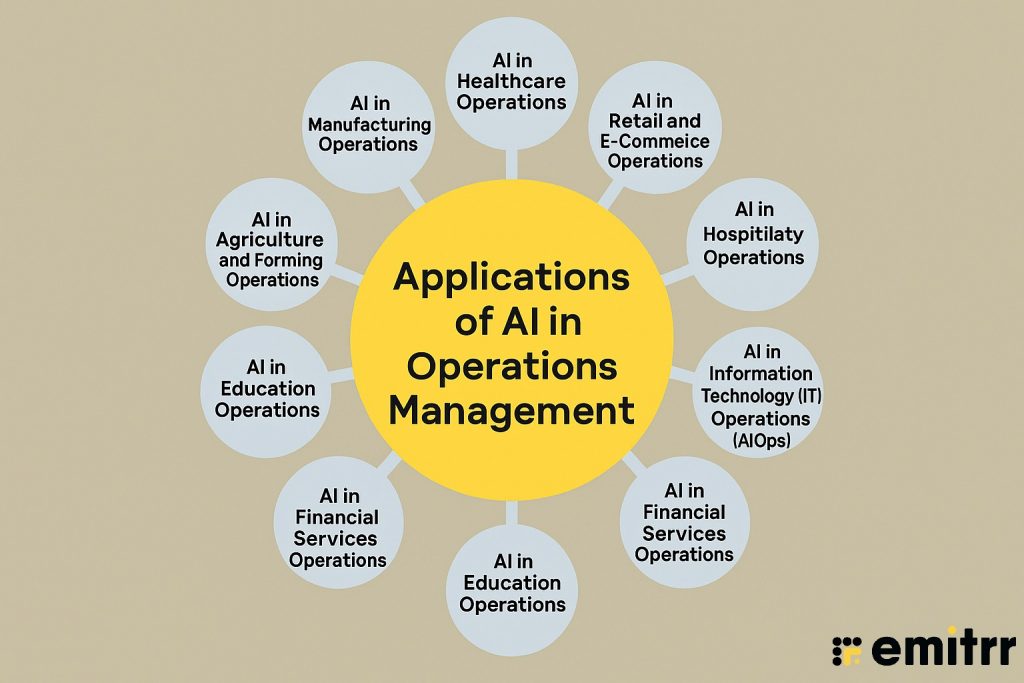
Let us have a look at operations across various industries where AI is bringing a big change:
AI in Manufacturing Operations
AI is enhancing manufacturing operations through predictive maintenance, real-time quality control using computer vision, and intelligent supply chain management. These applications are reducing downtime, ensuring consistent product quality, and optimizing production workflows.
AI in Healthcare Operations
In healthcare, AI is transforming operations by allowing smart staff scheduling, forecasting patient admission trends, and automating inventory and equipment management. AI is also helping reduce manual tasks, administrative workloads, and more. These improvements are leading to more efficient care and lower operational waste.
AI in Retail and E-Commerce Operations
AI is helping retail and e-commerce businesses to forecast demand more accurately, automate inventory allocation, personalize customer experiences, and streamline customer service through chatbots, leading to increased sales and reduced logistics overhead.
AI in Logistics and Supply Chain Operations
Artificial intelligence in supply chain management, is helping with route optimization, real-time shipment tracking, and in automating many warehouse operations. Use of AI here is reducing delivery times, cutting fuel costs, and improving end-to-end supply chain visibility.
AI in Hospitality Operations
AI is improving hospitality operations through demand-based staff scheduling, predictive maintenance of hotel facilities, and guest-facing virtual assistants. These tools are enhancing guest satisfaction while reducing operational inefficiencies and staffing costs.
AI in Information Technology (IT) Operations (AIOps)
AI in IT operations, often called AIOps, is helping in monitoring infrastructure, detecting anomalies, and predicting system failures before they occur. It is also automating incident management, improving cybersecurity, and system uptime.
AI in Human Resources Operations
AI is streamlining HR by automating hiring, improving workforce planning, and supporting talent development. These applications reduce bias, boost engagement, and strengthen organizational resilience.
AI in Financial Services Operations
Financial institutions are using AI for fraud detection, automated compliance checks, intelligent document processing, and in simplifying customer support. Overall, these tools are enhancing security, accuracy, and operational throughput.
AI in Education Operations
Educational institutions implement AI for student enrollment forecasting, administrative task automation, virtual teaching assistants, and to create learning paths.
AI in Energy and Utilities Operations
AI supports predictive grid maintenance, energy consumption forecasting, and fault detection in utilities. It helps with smarter load balancing and in reducing downtime in power distribution systems. Advances in energy software development make it possible to integrate these AI capabilities into scalable solutions for modern utilities.
AI in Agriculture and Farming Operations
In agriculture, AI is being used for crop health monitoring, autonomous farming equipment, yield prediction, and supply chain optimization, giving more productivity and resource conservation.
Challenges and Risks of AI in Operations Management
Here are some of the key challenges of using AI in operations management and tips to reduce its impact:
1. Data Quality and Availability
- Challenge: AI models need large, clean, and well-structured data sets, which many companies lack.
- Impact: Poor data can lead to inaccurate predictions and unreliable automation.
- Mitigation: Implement regular data audits and data cleaning processes.
2. Integration with Legacy Systems
- Challenge: Many businesses use outdated ERP, CRM, or supply chain software which are not built to integrate with AI tools.
- Impact: Increased cost and time for implementation of these AI operations management tools.
- Mitigation: Use APIs, or opt for modular AI tools that can be used on top of existing systems. In some cases, integrating AI on top of legacy infrastructure only addresses part of the problem, particularly when older applications cannot provide the scalability, data accessibility, or computing resources that AI workloads require. Organizations using Microsoft technologies can turn to azure migration services to move or modernize legacy applications, databases, and workloads in Azure, creating a cloud environment where operational data can be more readily integrated with AI, analytics, and automation tools. This can reduce the infrastructure limitations that otherwise make AI adoption more complex and costly.
3. High Implementation Costs
- Challenge: AI projects often require upfront investments in technology, infrastructure, and talent.
- Impact: Budget constraints, especially for small and medium sized companies.
- Mitigation: Start with low-hanging use cases (e.g., RPA, chatbots), and use cloud-based or no-code AI platforms.
4. Skill Shortage
- Challenge: There’s a gap in hiring professionals skilled in AI/ML, data science, and ops-tech integration.
- Impact: Delays in the execution of projects or reliance on external consultants.
- Mitigation: Upskill internal teams gradually.
5. Change Resistance and Workforce Concerns
- Challenge: Employees may fear job loss or resist AI-driven changes.
- Impact: Low adoption rates, culture clash.
- Mitigation: Involve teams early, focus on augmentation (not replacement), and run training programs.
6. Ethical and Compliance Issues
- Challenge: AI can unintentionally introduce bias or violate privacy laws (e.g., GDPR, HIPAA).
- Impact: Legal risks, reputation damage.
- Mitigation: Implement ethical AI tools, choose compliant vendors and do continuous monitoring.
7. Lack of Clear ROI
- Challenge: Without measurable KPIs, proving the value of AI can be tough.
- Impact: Projects may be paused or removed prematurely.
- Mitigation: Define ROI metrics before deployment (e.g., downtime reduction, cost savings), and track them regularly.
8. Cybersecurity Threats
- Challenge: AI systems are vulnerable to data breaches, model theft, and adversarial attacks.
- Impact: Operational disruption and data loss.
- Mitigation: Strengthen cybersecurity practices for use of AI tools and secure data environments.
Where Do AI Overtake Humans in Operations Management?
Operations management covers a wide range of activities in your organization—from planning and scheduling to inventory, supply chain, quality control, and customer service. While human expertise remains essential for strategic decisions and creative problem-solving, there are specific areas where AI now clearly outperforms human capabilities, delivering speed, accuracy, and efficiency that manual processes struggle to match.
1. Real-Time, 24/7 Responsiveness
AI-powered communication systems operate around the clock, instantly responding to issues like supply chain delays or equipment failures. Unlike humans, who need breaks or sleep, AI sends automated alerts via SMS or voice calls the moment a problem arises—whether it’s a warehouse stockout at midnight or a shipment delay during holidays. This eliminates downtime caused by human unavailability and ensures operations stay on track.
2. Processing and Analyzing Massive Data Volumes
Humans struggle to sift through thousands of daily emails, texts, and calls to identify critical updates. AI, however, analyzes communication patterns in real time, flagging urgent issues (e.g., a supplier’s delayed response) and summarizing key trends. For instance, it can detect recurring customer complaints about delivery times and automatically notify logistics teams to adjust routes, all without manual intervention.
3. Predictive and Proactive Communication
AI predicts operational risks before they occur. If sensors detect a machine overheating, AI doesn’t just log the data—it auto-calls maintenance teams and texts procurement to order spare parts. This proactive approach prevents costly breakdowns, unlike human teams, who might miss early warning signs buried in spreadsheets or emails.
4. Consistency and Accuracy
Manual communication often leads to errors: missed deadlines, typos in inventory updates, or conflicting instructions. AI ensures every message—whether a restock reminder or a production delay alert—is standardized and error-free. For example, automated texts to suppliers always include precise SKU numbers and deadlines, reducing miscommunication and rework.
5. Personalization at Scale
While humans can personalize a few emails, AI tailors thousands of messages daily. It sends role-specific alerts: low-stock warnings to inventory managers via SMS, shipment confirmations to customers via email, and maintenance reminders to technicians via voice calls. This precision ensures employees act faster and customers stay informed, boosting satisfaction and efficiency.
6. Seamless Multichannel and Multilingual Communication
Global teams face language barriers and channel fragmentation. AI bridges this gap by translating messages instantly and routing them through the right channel (e.g., SMS for urgent alerts, email for reports). A Japanese supplier’s email about a delay can auto-translate to English and notify the logistics team via a voice call, ensuring no time is lost.
7. Automation of Routine and Repetitive Tasks
Humans waste hours on repetitive tasks like scheduling meetings or sending payment reminders. AI in logistics and transportation automates these workflows: it texts clients overdue invoices, schedules shift changes via automated calls, and updates teams about schedule adjustments. This reduces administrative burdens and lets staff focus on strategy.
8. Intelligent Prioritization and Escalation
In a flood of emails and calls, critical issues like machine failures or compliance breaches can slip through. AI prioritizes alerts based on urgency, sending high-priority texts to managers and escalating unresolved issues to senior staff. This ensures urgent matters are addressed first, minimizing operational risks.
9. Continuous Learning and Improvement
AI learns from past interactions. If a specific supplier consistently delays responses, the system will auto-flag their emails for faster follow-ups. Over time, it refines communication workflows—like optimizing the timing of restock alerts—to match operational needs, driving continuous efficiency gains.
Where Do Humans Still Overtake AI in Operations Management?
While AI is transforming many aspects of operations management, your organization’s people remain the core drivers of success in several critical areas. Here’s where human strengths continue to outshine AI, and why these areas matter for your business.
Strategic Decision-Making and Complex Problem Solving
While AI excels at analyzing historical data, it struggles to navigate ambiguity or novel challenges that lack predefined frameworks. Human leaders, however, assess contextual nuances, prioritize competing demands, and adapt strategies dynamically. For instance, during an unexpected market shift like a competitor’s collapse, humans swiftly reallocate resources, forge new partnerships, and pivot operations, tasks requiring intuition and situational awareness beyond AI’s capabilities.
Creativity and Innovation
AI optimizes existing workflows but cannot generate transformative ideas. Humans drive innovation by conceptualizing entirely new solutions, such as designing circular supply chains that eliminate waste while aligning sustainability goals with operational efficiency. These breakthroughs stem from imaginative thinking that transcends AI’s data-driven parameters.
Emotional Intelligence and Relationship Building
AI lacks the empathy to foster trust or address interpersonal dynamics. Humans resolve conflicts, recognize burnout, and motivate teams through emotional attunement. For example, a manager adjusting workloads based on an employee’s well-being demonstrates nuanced judgment that automated systems cannot replicate.
Ethical Judgment and Values-Based Decisions
AI adheres to programmed rules but cannot navigate moral dilemmas. Humans balance profitability with fairness, such as absorbing costs to ensure equitable wages for workers, a decision rooted in ethical reasoning rather than algorithmic logic.
Change Management and Organizational Culture
AI cannot inspire teams or cultivate shared purpose. Humans lead cultural transformations by addressing fears, communicating vision, and reshaping norms. A leader transitioning a company to remote work, for instance, combines empathy and influence to align teams with new operational realities.
Talent Development and Coaching
AI tracks performance metrics but cannot offer holistic mentorship. Humans provide personalized guidance, identifying potential and tailoring growth plans. A supervisor crafting career-path training based on individual strengths exemplifies this deeply human approach to professional development.
Handling Exceptions and Anomalies
AI falters when confronted with unprecedented scenarios outside its training data. Humans improvise solutions during crises, such as rerouting shipments amid sudden port closures using real-time insights no algorithm could anticipate.
Building and Sustaining Company Reputation
AI cannot embody brand values or earn stakeholder trust. Humans craft authentic narratives and resolve PR crises through genuine engagement. A CEO’s heartfelt apology after a product recall, for example, rebuilds credibility more effectively than automated responses.
Contextual Communication and Negotiation
AI struggles with cultural nuances and unspoken cues in high-stakes discussions. Humans navigate sensitive negotiations by interpreting body language, tone, and subtext, fostering compromises that chatbots cannot achieve. A procurement head renegotiating contracts through mutual respect highlights this irreplaceable human skill.
While AI brings speed and efficiency to operations management, your organization’s human strengths—strategic vision, creativity, empathy, and ethical leadership—remain irreplaceable. By investing in people operations and empowering your teams, you ensure that technology enhances, rather than replaces, the human factor that drives sustainable growth and innovation.
Human vs AI Operational Output Comparison
| Feature/Task | Human-Driven Operations | AI-Driven Operations |
| Response Time | Minutes to hours | Instant (seconds) |
| Consistency | Variable | High |
| Scalability | Limited by staff | Virtually unlimited |
| Error Rate | Moderate to high | Low (with proper setup) |
| Data Sync with CRM | Manual, prone to delays | Automated, real-time |
| 24/7 Availability | No | Yes |
| Predictive Maintenance | Reactive | Proactive |
| Quality Control Accuracy | Moderate | High |
| Automated Routine Tasks | No | Yes (RPA) |
| Personalization | High (with effort) | High (data-driven) |
Overall Benefits of Communication AI in Operations Management

1. Enhanced Efficiency
- Automation of Routine Tasks: AI-driven tools handle scheduling, reminders, status updates, and routine inquiries, freeing staff for higher-value work.
- Streamlined Workflows: Automated communication ensures information moves quickly and accurately between departments, reducing manual workload and minimizing errors.
2. Smarter, Data-Driven Decision-Making
- Real-Time Insights: AI analyzes large volumes of operational data to identify patterns and provide actionable recommendations.
- Predictive Capabilities: Early warnings about supply chain disruptions or production bottlenecks allow proactive intervention and better resource allocation.
- Improved Forecasting: AI enhances demand forecasting and productivity by surfacing trends that traditional methods may miss.
3. Improved Collaboration and Coordination
- Unified Communication: AI-powered platforms centralize messages, updates, and documents, making it easier for teams to stay aligned.
- Language and Scheduling Support: Features like real-time translation and intelligent meeting scheduling break down barriers for global or remote teams.
4. Personalized Communication
- Targeted Alerts and Notifications: AI tailors messages to specific roles or individuals, ensuring relevance and reducing information overload.
- Faster Response to Critical Issues: Personalized updates help team members act quickly on urgent matters.
5. Cost Reduction
- Lower Manual Intervention: Automation reduces the need for repetitive manual tasks and minimizes costly errors.
- Operational Scalability: Organizations can grow and handle increased workloads without a proportional rise in overhead or staffing.
6. Continuous Improvement
- Ongoing Process Refinement: AI monitors interactions and feedback to highlight opportunities for workflow enhancements.
- Enhanced Customer Service: Insights from communication data help organizations adapt processes and improve service quality in response to changing demands.
Top AI Tools & Platforms for Operations Management
| Tool / Platform | Key Features | Ideal For | Notable Strength |
|---|---|---|---|
| Emitrr | AI-powered automation for customer ops & communication | Healthcare, Home Services, SMBs | Streamlined AI answering + ops tools |
| IBM Maximo | Predictive maintenance, asset lifecycle, IoT integration | Manufacturing, Utilities | Enterprise-grade asset management |
| SAP Business AI | Real-time analytics, intelligent supply chain, ERP AI | Enterprises with SAP ERP | Seamless integration with SAP systems |
| Oracle AI Cloud | Demand forecasting, digital twins, decision intelligence | Enterprise-scale retail & logistics | Advanced analytics with cloud scale |
| Microsoft Azure ML | Custom ML models, anomaly detection, forecasting | Tech-savvy teams, scalable needs | Integrates well with Microsoft stack |
| UiPath AI Center | Intelligent automation, document processing, RPA + AI | Process-heavy industries | Strong in AI+RPA workflows |
| Infor Coleman AI | Industry-specific AI, workforce optimization | Manufacturing, Healthcare, Distribution | Prebuilt AI for verticals |
How to Implement AI in Your Operations Management?
Step 1: Assess Operational Communication Bottlenecks and Needs
Conduct a comprehensive audit of existing communication workflows to identify inefficiencies, such as manual data entry delays, approval lags, or fragmented cross-departmental updates. Define measurable objectives for AI adoption, such as reducing response times or minimizing errors in critical operational alerts.
Step 2: Select an AI Communication Platform with Seamless Integration Capabilities
Evaluate AI solutions—like Emitrr—that offer robust integration with your organization’s current systems (e.g., ERP, CRM, or inventory software). Prioritize platforms with enterprise-grade security, scalability, and vendor support to ensure alignment with your operational infrastructure and long-term goals.
Step 3: Train Teams on AI-Driven Workflows and Collaborative Tools
Develop structured training programs to familiarize staff with AI-powered tools, emphasizing hands-on learning for tasks like automated reporting, real-time data analysis, and exception handling. Foster a culture of adaptability by addressing user concerns and demonstrating how AI enhances their roles through efficiency gains.
Step 4: Deploy AI-Driven Automation for Critical Communication Channels
Implement AI-powered texting, calling, and notification systems to automate high-impact processes such as supply chain alerts, maintenance reminders, or customer service updates. Begin with pilot programs in specific departments, refine workflows based on initial feedback, and scale enterprise-wide to maximize ROI.
Step 5: Monitor Performance Metrics and Optimize Configurations
Establish KPIs (e.g., resolution times, error rates, cost savings) to track AI effectiveness. Leverage analytics dashboards to identify gaps and iteratively refine AI models, rules, and integrations to ensure continuous alignment with evolving operational demands and business objectives.
Why is Emitrr the Ideal AI Communication Platform for Operations Management?
At Emitrr, we are transforming how teams communicate with patients and clients around the clock, across both voice and text channels. Our AI-powered agents do more than just respond to calls or messages. They act as intelligent front desk assistants, ensuring every inquiry is addressed, every appointment is confirmed, and every follow-up is handled on time.
By automating routine communication tasks, Emitrr helps teams reduce delays, improve billing accuracy, minimize missed appointments, and keep the revenue process running smoothly from start to finish.
Voice AI Agent – Your 24/7 Receptionist That Never Misses a Call
100% Call Capture, Zero Frustration
Our AI receptionist ensures every call is answered—even after hours. Whether it’s midnight or a busy weekday afternoon, your AI agent provides instant support, capturing every lead and inquiry with a 100% answer rate.
Smarter Scheduling, Less Admin Work
Customers can book, reschedule, or confirm appointments anytime. The AI auto-updates your CRM/EMR/PMS and sends reminders, saving 200+ hours annually and drastically reducing no-shows.
Instant Inquiry Resolution
From pricing to service-related FAQs, the AI Receptionist offers real-time, accurate answers, cutting response time by up to 75% and ensuring consistent customer satisfaction.
Proactive Engagement That Fills Your Calendar
Beyond answering calls, the AI Receptionist reaches out via voice or SMS to confirm bookings, follow up on missed calls, and remind customers about payments, reducing missed appointments by up to 90%.
Intelligent Call Routing
Based on the caller’s needs, the AI routes them to the right team or specialist, reducing wait times by 60% and ensuring faster resolution of urgent issues.
Text AI Agent – Intelligent Conversations at Scale
Automated SMS Conversations
Emitrr’s upcoming text AI agent will enable businesses to handle inbound and outbound text interactions intelligently. Whether it’s answering FAQs, scheduling appointments, sending follow-ups, or managing customer queries, the text AI ensures every message gets a timely, accurate response.
Frictionless Customer Experience
Many customers prefer texting over calling. Emitrr’s Text AI offers a conversational experience, mirroring human-like responses while maintaining context and personalization, making interactions feel natural and seamless.
Reduce Team Workload, Not Responsiveness
With the ability to manage multiple conversations simultaneously, the Text AI scales your support and outreach efforts without increasing headcount, freeing up your team to focus on high-value tasks.
Future Trends and Innovations in AI for Operations – change heading
The future of AI in operations management is rapidly unfolding, and it holds tremendous promise for businesses seeking to stay competitive and resilient. Here’s what your organization can expect as you look ahead:
AI in Eco-Efficient Logistics
AI will help in reducing environmental impact by optimizing delivery routes, minimizing fuel consumption, automating warehouse energy use, and recommending sustainable packaging. It is allowing logistics teams to balance efficiency by lowering carbon emissions and waste.
AI and Digital Twins in Operations
Digital twins are AI-powered virtual replicas of real-world systems, and these are going to emerge stronger in the near future. They will allow businesses to simulate, monitor, and optimize operations in real-time and help them in improving decision-making, predicting failures, and testing scenarios without real-world risk.
AI and Automation Will Drive Efficiency
AI will continue to automate routine tasks such as scheduling, inventory management, and quality control, minimizing manual intervention and human error. Predictive maintenance powered by AI will help detect equipment issues before they cause downtime, while machine learning will optimize workflows and resource allocation for maximum efficiency.
Data-Driven Decision Making Becomes Standard
With the integration of AI, IoT, and cloud computing, your business will have access to real-time operational data and advanced analytics. This will enable more informed, faster decision-making, reduce risks, and improve overall performance. AI will help identify patterns and provide actionable insights that were previously difficult to uncover.
Sustainability and Green Operations Take Center Stage
AI will play a key role in helping organizations meet sustainability goals by optimizing energy use, reducing waste, and supporting responsible sourcing. Businesses will increasingly use AI to monitor carbon footprints, implement circular economy practices, and invest in green technologies, aligning operations with environmental and regulatory expectations.
Remote and Hybrid Work Models Will Be Seamlessly Supported
AI-powered collaboration tools and virtual monitoring will make it easier to manage remote and hybrid teams. Real-time communication, flexible scheduling, and space optimization will become standard, helping your organization adapt to new workforce trends and maintain productivity regardless of location.
Advanced IT Operations with AI Ops
AI-driven IT operations (AIOps) will become more prevalent, allowing IT teams to proactively monitor, analyze, and resolve issues before they impact business functions. This will result in more secure, stable, and efficient IT environments, freeing your teams to focus on innovation and strategic projects.
Integration with Emerging Technologies
The future will see AI working alongside other technologies such as IoT, blockchain, and augmented reality. This integration will further enhance operational intelligence, enable predictive analytics, and open new possibilities for process optimization and business growth.
Human Expertise Remains Essential
While AI will handle more complex and repetitive tasks, human oversight, creativity, and ethical judgment will remain crucial. The most successful businesses will combine AI’s analytical power with human insight to drive innovation and maintain a strong organizational culture.
Preparing for the Future
To fully benefit from AI, your organization should invest in upskilling teams, modernizing data infrastructure, and fostering a culture of continuous improvement. Early adoption and proactive planning will position your business to leverage AI’s full potential as these technologies evolve.
FAQs
AI can automate repetitive tasks such as scheduling, inventory tracking, data analysis, customer communications, and real-time threat detection, significantly improving efficiency across operations.
AI-driven communication platforms use advanced encryption, real-time threat detection, and compliance measures to protect sensitive business information and ensure privacy.
AI is designed to augment human teams by automating routine work, allowing staff to focus on strategic and creative tasks rather than replacing them entirely.
AI solutions can often be deployed quickly, especially cloud-based tools, with initial benefits visible within weeks to a few months depending on integration needs.
Emitrr stands out by offering tailored, secure, and real-time AI-powered communication solutions that prioritize both efficiency and compliance for enterprise needs.
Conclusion
The challenges of operations management—inefficient workflows, communication silos, and manual errors—are no longer insurmountable. AI is reshaping the landscape by automating repetitive tasks, enabling real-time insights, and fostering seamless collaboration across teams. By integrating AI into your operations, you can reduce costs, boost productivity, and stay ahead in a competitive market.
That’s where Emitrr AI comes in. Emitrr AI is purpose-built to solve these exact operational pain points for businesses. It integrates seamlessly with your existing systems, automates reminders and follow-ups, flags errors before they escalate, and keeps your operations running smoothly.
Want to see how AI can transform your operations from a bottleneck into a growth engine? Book a demo with Emitrr AI today and take the first step toward smarter, more efficient operations management.

 4.9 (400+
reviews)
4.9 (400+
reviews)