
Introduction
If your nonprofit struggles to communicate effectively, it may not be fully living up to its mission.
Nonprofit communication has experienced a tidal change over the years, but the fundamentals—text messaging and voice calls—remain as effective as ever. Sure, everyone’s mobilizing emails and social media, but text messaging and voicemail systems have never lost their charm.
Unfortunately, too many nonprofits are either still sleeping on them or haven’t quite gotten the hang of them.
Luckily for you, we’ve created a guide that’s legit packed with real nonprofit SMS message templates you can actually use to spark interest and action. Plus, we’ve covered all the insider tips for setting up text messaging campaigns and voicemail systems.
With our insights, not only will you look trustworthy and reliable, but you’ll also be able to leave the intended impact—without breaking the bank.
So, let’s dive right in!
Why SMS is Essential for Nonprofit Communication
The real strength of SMS lies in their ability to connect with your donors and volunteers on a personal level.
Unlike emails that seem ruthlessly professional and social media posts that sink into the void of nothingness, texts hit the right chord and strike a one-on-one connection that actually binds and builds. From rallying supporters to thanking donors for generous contributions, texts and voicemail messages are the right mechanism, making people feel like an integral part of the whole system. After all, the whole point behind running a nonprofit is creating touchpoints that make people feel connected to your mission.
Besides, both tools are extremely budget-friendly. SMS campaigns cost way less per person than direct marketing. And, once you set up a good voicemail system, it runs on auto-pilot. Plus, integration is never a fuss. Both approaches play nice with your existing software estate, which means you get the complete visibility of each supporter and shape communications ever smarter.
Long story short: text messages pack a lot of punch. And, these areas are exactly the ones where most nonprofits falter. If you’re a nonprofit and your communication isn’t hitting the mark, fret not. With the right strategy and tools, you can turn every SMS into a powerful touchpoint. We’re here to help.
Getting Started: Setting Up SMS Systems for Your Nonprofit
This is your starting point for creating SMS messages that leave a mark on your target audience. Check out our templates—use them as-is or tailor them to suit your voice.
Top SMS Templates
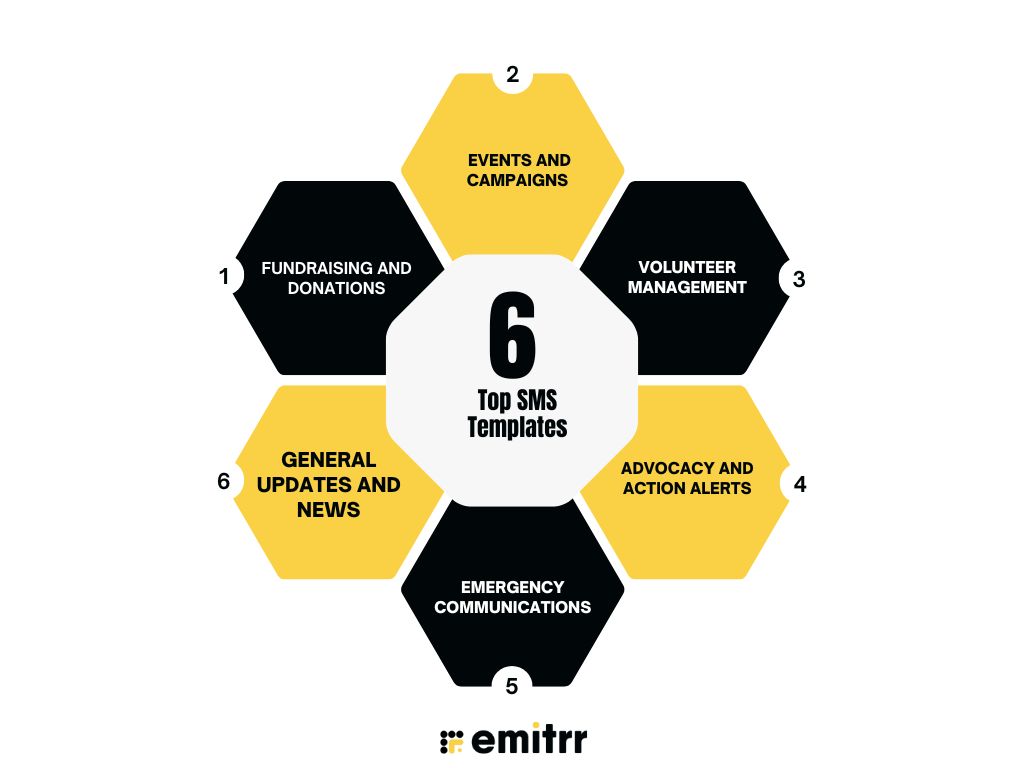
1. Fundraising and Donations
As far as fundraising and donation drives are considered, nonprofits must focus on creating direct, urgent text messages with specific impact statements and clear calls-to-action.
“URGENT: [Cause] needs help RIGHT NOW. Your $25 can [specific impact]. Donate in 30 seconds: [link]. Every minute counts. Text STOP to opt out.”
“Hey [Name]! Your monthly $[amount] gift is crushing it – this month you helped [specific achievement]. Thanks for being awesome! [link]”
“[Name], we’re not done with 2024 yet! Your tax-deductible gift before Dec 31st gets DOUBLED thanks to our matching challenge. Give now: [link] Questions? Just reply!”
“Welcome to the family, [Name]! Your first gift of $[amount] just [specific impact]. We’re pumped to show you how your generosity creates real change!”
“Wow, [Name]! You’ve now given $[total amount] to [cause] over [time period]. Your loyalty helped [specific cumulative impact]. You’re incredible!”
“[Name] is raising money for [cause] and they’re [percentage]% to their $[goal] goal! Help them out: [personalized link]. Every dollar counts!”
2. Events and Campaigns
The nonprofit imperative lies in crafting SMS and voicemail texts that build excitement and drive participation through timely reminders.
“You’re invited to [Event Name] on [Date] at [Time]! Join us for [brief description]. Spots are filling up fast – RSVP: [link] or text YES back!”
“One week until [Event Name]! Can’t wait to see you [Date] at [Location]. Questions? Just reply! Still have room for friends too.”
“HEADS UP: [Event Name] moved to [New Location] because of [reason]. Same time though: [Time] on [Date]. Sorry for the short notice! Questions? Call [number].”
“Thanks for coming to [Event Name]! You helped us [achievement/impact]. Want to see photos? Check them out: [link]. Can’t wait for the next one!”
“BIG NEWS: We’re launching [Campaign Name] today! Goal: [specific objective] by [date]. Join the movement: [action link]. Together we can [impact statement]!”
“AMAZING! We’re [percentage]% to our [Campaign Name] goal thanks to people like you! Help us hit [target] by [date]: [link]. So close to [specific impact]!”
3. Volunteer Management
Mobilizing volunteer support and action is indispensable for nonprofits. Organizations must craft Targeted messages to recruit, remind, and appreciate volunteers with specific opportunities and recognition.
“New volunteer gig: Need [Role] on [Date/Time] for [Activity]. Perfect if you’re into [skill/interest type]. Sign up: [link] or reply INTERESTED!”
“Reminder: You’re volunteering tomorrow [Date] from [Time] at [Location] for [Activity]. Contact: [Name] at [number]. Thanks for being awesome!”
“HELP! Need 3 more volunteers TODAY from [Time] for [Activity]. Can you help? Takes [duration]. Reply YES if you’re free!”
“[Name], you volunteered [X hours] this month! Your work helped [specific impact]. You’re making a real difference. We appreciate you so much!”
“Don’t forget: Volunteer training tomorrow [Date] at [Time], [Location]. We’ll cover [topics]. Can’t make it? Alt session [Date]. Questions? Reply!”
“Perfect match! We have a [skill-specific] opportunity that’s totally your thing. Project: [description]. Interested? Reply YES or learn more: [link].”
4. Advocacy and Action Alerts
To spark interest and response, nonprofits must blast out urgent calls-to-action for political engagement, policy changes, and community advocacy efforts.
“URGENT: [Bill/Issue] vote THIS WEEK! Your rep needs to hear from you NOW. Take 2 minutes: [action link]. Your voice matters!”
“BREAKING: [Policy change] could impact [affected group/cause]. Make your voice heard! Contact [Representative Name] before [deadline]: [contact info/link].”
“WE WON! Thanks to advocates like you, [Policy/Bill] passed! Your calls made the difference. This victory means [impact]. Celebrate: [link]!”
“Join us [Date] at [Time] for [Action/Rally Name] at [Location]! We’re advocating for [cause]. Bring signs, friends, and your voice! RSVP: [link].”
“Need your signature! Help us hit [number] signatures for [cause] by [deadline]. Sign and share: [link]. We’re at [current number] – almost there!”
“Update on [Issue]: [Current status]. Your advocacy is working! Next step: [specific action]. Keep the momentum going: [link]. Thanks for staying engaged!”
5. Emergency Communications
It’s almost routine how often nonprofits deal with emergencies. They must invest time to create Critical safety and operational updates during crises, disruptions, and emergency situations.
“NOTICE: [Service/Program] temporarily paused due to [reason]. Should resume [timeframe]. Emergencies? Call [number]. Updates: [website/link].”
“All [Organization] locations closed today [Date] due to severe weather. Everyone stay safe! Reopening [expected date]. Emergency help: [number].”
“SAFETY ALERT: [Specific situation] reported in [Location/Area]. If you’re nearby, please [safety instruction]. Call authorities if needed. Stay safe!”
“EMERGENCY: [Crisis situation] needs immediate response. We need $[amount] in [timeframe] to [specific need]. Every dollar helps: [emergency link]!”
“Help available for [crisis/disaster] victims: [Service details]. Location: [address]. Hours: [times]. Need help? Call [number]. We’re here for you.”
“ALL CLEAR: [Emergency situation] resolved. Back to normal operations [date/time]. Thanks for your patience during this situation. Stay safe!”
6. General Updates and News
This involves regular, everyday organizational communications about milestones, partnerships, and program announcements.
“This month’s wins: [Achievement 1], [Achievement 2], and [Achievement 3]! Read the full story: [link]. Thanks for making these victories possible, [Name]!”
“MILESTONE ALERT: We just helped our [number]th person! This wouldn’t happen without supporters like you. Celebrate with us: [link].”
“Exciting news! Meet [Name], our new [Position]. They’re bringing [brief background] to help us [mission connection]. Check out our team: [link].”
“NEW PROGRAM: Introducing [Program Name] for [target population] with [services]. First of its kind around here! Learn more: [link].”
“Big news! We’re teaming up with [Organization] to [collaborative goal]. Together we’ll [expand impact]. This means [benefit]. Details: [link].”
“Happy [Holiday/Season] from everyone at [Organization]! This [year/season] we’re grateful for supporters like you. Wishing you [appropriate sentiment]!”
Best Practices for Nonprofit SMS Communication
Having a few SMS templates on hand is a great way to jumpstart your nonprofit’s communication. But following best practices is what truly doubles the impact. After all, it’s not just about doing things the “right” way. It’s about doing them in a way that ensures results, compliance, and lasting value.
1. Segment Your Audience for Targeted Messaging
Don’t send the same message to everyone. Split your audience into smaller groups based on factors like where people live, how they prefer to support you, and what they care about. Messages for someone who donates should be different from those created for volunteers. When you tailor your messages to match what people actually like and care about, they’re much more likely to pay attention and respond.
2. Personalize Your Messages to Engage Supporters
Standard messages can seriously hurt a nonprofit’s reputation. Invest time in curating SMS systems that don’t alienate people—instead, they help supporters feel more connected. Think about things like what they’ve donated to or volunteered for, and include those details in your message. People notice when it feels like you’re speaking directly to them.
3. Ensure Compliance with SMS Regulations
To safely operate in today’s ever-evolving ecosystem, always get permission before texting people and make sure they know what to expect. Don’t pester and strive to build long-lasting relationships. Keep a record of when and how they opted in, and offer easy ways to unsubscribe. You should also check in on your process regularly to make sure everything’s still up to date and legal.
4. Time Your Communications Appropriately
When you send messages matters just as much as what you say. Most people are more likely to read texts between mid-morning and early afternoon on weekdays. Avoid texting too early, too late, or too often. If you’re promoting an event or campaign, spread out your messages so it doesn’t feel like a flood. Pay attention to seasons, holidays, or school breaks too.
5. Develop a Comprehensive Communication Strategy
All your communication should work together as part of one big strategy. Instead of repeating the same message everywhere or confusing supporters with mixed signals, build a plan that coordinates messaging across channels. Use each platform for what it does best and keep everything aligned around the same goals.
6. Maintain Consistent Branding and Tone Across Channels
Your tone, voice, and style should feel the same across the board irrespective of what you’re creating. That way, people immediately recognize it’s from you and know it’s legit. Stick to the same language, greeting style, and branding elements. Consistency builds trust and makes your nonprofit organization look polished and professional.
7. Provide Clear Instructions and Calls to Action
Don’t leave people guessing and ensure clear messaging. Make your asks simple, clear, and easy to follow. Tell your people exactly what to do, how to do it, and why it matters. Include working links, phone numbers, or keywords, and test everything before you hit send. The easier you make it for someone to act, the more likely they’ll follow through.
Measuring the Success of Your SMS Campaigns
Creating messages is great, but do you know which metrics to track to ensure they’re well received in the market? In the section below, we’ll tell you how you can measure the success of your nonprofit SMS communications.
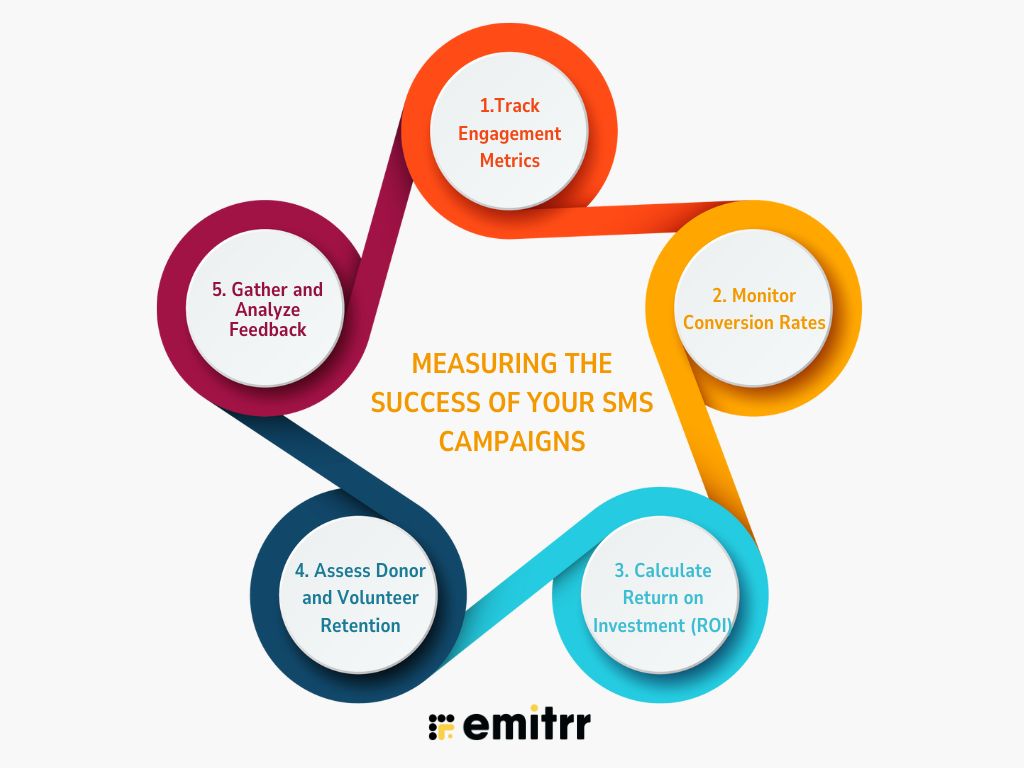
1. Track Engagement Metrics
Use engagement data from your nonprofit SMS marketing campaigns to understand message performance. Track metrics like opens and clicks to see which formats and timings resonate most.
2. Monitor Conversion Rates
To understand your messaging impact, keep tabs on how often communications lead to actions like event sign-ups or advocacy efforts. Break down these conversion rates by segment or message type, and experiment with different formats to continually boost effectiveness and amplify resonance.
3. Calculate Return on Investment (ROI)
ROI analysis is a crucial indicator of your nonprofit communication’s efficiency. It helps you determine whether your outreach efforts are worth the investment. Track both immediate outcomes and long-term value to see how SMS efforts contribute to your overall goals and supporter engagement.
4. Assess Donor and Volunteer Retention
A key success metric is donor and volunteer retention. Track patterns to see how communication efforts influence ongoing engagement. Evaluate which message types and frequencies stir the intended response and encourage participation. See the red flags and identify what increases unsubscribes or negative feedback. Redo and adjust accordingly.
5. Gather and Analyze Feedback
Understand your audience better by collecting and reviewing feedback. Patterns in survey responses can highlight what’s working and what’s not, guiding improvements in message design, timing, and delivery across different supporter groups.
How Can Emitrr Help Strengthen the Quality and Quantity of Nonprofit Texting?
Emitrr is the leading texting service for nonprofits, offering a comprehensive feature set, from personalized messaging to reputation management. By leveraging these features and tools, nonprofits can likely achieve higher engagement, stronger donor relationships, and increased fundraising success.
Here’s a closer look at what Emitrr is truly capable of.
1. Personalized Messaging: Emitrr enables nonprofits to tailor messages to individual supporters, fostering stronger connections. This personalization strengthens supporter bonds by making communications more relevant and impactful, potentially increasing donation rates and loyalty.
2. Two-Way Texting: The platform simplifies two-way texting, allowing direct engagement with donors and volunteers in real time. This feature facilitates quicker responses, builds trust, and enhances dialogue, crucial for maintaining active supporter relationships.
3. Advanced Analytics: Emitrr provides detailed texting analytics, enabling nonprofits to monitor campaign performance, measure engagement levels, and refine strategies. This data-driven approach helps organizations optimize their communication efforts for better outcomes, such as higher response rates and effective fundraising campaigns.
4. Mass Texting: Emitrr supports sending messages to thousands of contacts instantly, ideal for donation appeals, event promotions, and community outreach. This capability ensures broad reach with minimal effort, amplifying the nonprofit’s visibility and impact. It also includes text-enabling landlines for community outreach, expanding communication channels.
5. Automated Scheduling: Emitrr allows nonprofits to automate reminders for volunteer activities and schedule texts for donation drives or events. This feature, implied in scheduling texts for fundraisers and events, ensures timely communication without manual oversight, reducing no-shows and improving event attendance.
6. Seamless Integration: With integration capabilities for over 500 tools, Emitrr enables nonprofits to manage all communications from a single platform. This streamlined workflow enhances efficiency, allowing organizations to connect with existing systems like CRMs and reduce operational friction.
7. Reputation Management: Emitrr includes tools to boost trust and credibility, such as ensuring professional and consistent communication practices. This feature is vital for maintaining donor confidence, especially in an era where transparency and reputation are critical.
Think Emitrr can be your nonprofit’s BFF? Try our 20-min free demo today!

Frequently Asked Questions
Start with clear opt-in procedures that explain message frequency, content, and opt-out options before collecting numbers. Keep detailed consent records—date, time, method, and agreement terms. Make opt-outs simple with STOP keywords and process them immediately. Regularly review compliance: check consent logs, message content, and opt-out functions. Train staff and consult legal experts familiar with nonprofit communication laws to stay current.
Personalized texts drive higher open and response rates, boost retention, and deepen supporter connection. Tailoring messages based on donation history, interests, or past actions makes supporters feel valued and more likely to engage. Use supporter data to customize content, timing, and calls to action. This improves conversions and reduces unsubscribes by delivering relevant messages.
Track delivery, open, click-through, response, and conversion rates tied to specific goals like donations or sign-ups. Analyze by message type, timing, and audience to refine strategy. Monitor cost-per-acquisition, ROI, and supporter lifetime value to assess communication impact. Track retention, unsubscribes, and feedback to gauge long-term engagement.
Automation handles routine tasks like welcome messages, event reminders, and scheduled campaigns, reducing manual work. Advanced tools manage replies, route conversations, and integrate with CRM systems, taking efficiency, personalization, and cost-savings up a notch.
Conclusion
Remember, results-driven nonprofit communication rests on a strong foundation of technology. It’s about building genuine relationships with people who care about your cause and want to make a difference. Tools like Emitrr help facilitate community building by enabling nonprofits to create impactful SMS messages.
With AI-powered automation, intelligent response handling, and seamless integration, Emitrr empowers your nonprofit to streamline operations from the ground up, while enhancing communication. And you? You can stay focused on taking your mission to a global scale.


 4.9 (400+
reviews)
4.9 (400+
reviews)