
Introduction
There’s a growing tension in exam rooms today: providers want to focus on their patients, but endless documentation, billing codes, and compliance checks keep pulling their attention toward a screen.
AI is quietly changing this reality.
A recent survey by eClinicalWorks found that over 65% of providers see AI’s greatest value in documentation accuracy and speed, with many spending more than four hours per day on clinical notes alone. This is where AI medical scribe tools are stepping in.
They are more than just an upgrade to old dictation tools; they’re transforming how notes are created, coded, and submitted. In this blog, we’ll break down what is AI medical scribe, how it works in real-world settings, where it fits best, and how you can get started.
What is a Medical Scribe AI?
An AI medical scribe is a software tool that listens to the patient-provider conversation and automatically generates clinical notes. It utilizes a combination of speech recognition, natural language processing (NLP), ambient voice and medical context modeling to capture relevant details in real-time and format them directly into your EHR system.
But this isn’t just a better version of dictation.
Unlike traditional voice-to-text tools that require structured commands and manual editing, AI scribes for doctors are built to understand medical conversations the way a trained human would. They recognize when a provider is reviewing history, giving instructions, or discussing treatment plans. They tag those sections accordingly, summarize details in the correct clinical format, and often insert them into the right part of the chart automatically.
How the Process Works:
- Ambient listening or microphone capture during the clinical encounter
- Speech-to-text conversion using automatic speech recognition (ASR)
- NLP to interpret and organize the content (e.g., SOAP format)
- Seamless integration with your EHR system for finalized documentation
Virtual Medical Scribe vs Human Scribes vs Traditional Dictation
Here’s a table showing the difference between how virtual medical scribe or AI scribe works vs how human and traditional dictation works:
| Feature | Virtual Medical Scribe | Human Scribe | Traditional Dictation |
| Documentation Method | Automated, real-time transcription and structuring using AI and NLP | Manual, real-time, or delayed entry by a person | Audio recording for later transcription |
| Clinical Understanding | AI medical scribe learns context, recognizes medical terms, and organizes info logically | Relies on the scribe’s training and experience | No understanding, just records speech |
| Workflow Disruption | Minimal, ambient listening enables natural conversation | May require in-person or remote presence, can be intrusive | Requires the physician to dictate separately |
| Speed and Efficiency | Near-instant note generation reduces after-hours work | Slower, depends on scribe availability and speed | Delayed, requires manual transcription |
| Cost and Scalability | Virtual medical scribes are scalable, have lower long-term costs, with no staffing constraints | Requires hiring/training staff, limited scalability | No staff, but it is time-consuming for doctors |
| EHR integration | Direct integration or API-based syncing | Limited/manual | Typically, no direct integration |
| Error Potential | High accuracy (often >95%), but still needs physician review | Human errors possible (mishearing, typos, omissions) | Prone to transcription errors |

Why is it Important to have an AI Medical Scribe in Healthcare?
Understanding what an AI medical scribe does is only half the picture. To see why it matters, we need to look at what’s not working in the current system. Here’s a breakdown of the key problems:
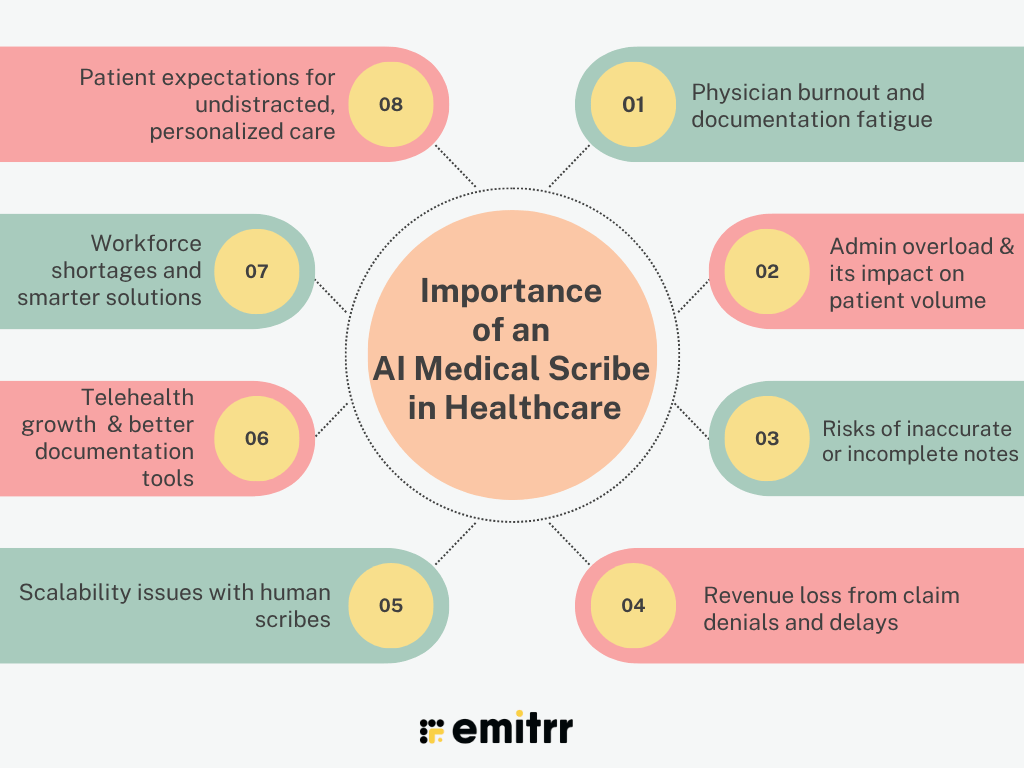
AI scribes reduce physician burnout & documentation fatigue
Many providers spend more time on charts than on patients. What starts as quick note-taking often stretches into after-hours work, leading to exhaustion and job dissatisfaction. With medical scribe notes taking up a significant portion of the day, clinical focus and personal time suffer.
AI scribe reduce administrative overload
The sheer volume of tasks tied to medical documentation, such as charting, compliance checks, and coding support, has forced many providers to cut down on the number of patients they see. This directly impacts access, revenue, and efficiency.
AI medical scribe reduce risks of inaccurate or incomplete notes
When documentation is delayed or rushed, key details might be missed. Errors in dosage, symptoms, or visit summaries are common. Incomplete medical scribe systems create risk for misdiagnosis and non-compliance.
AI medical scribe tools prevent revenue loss from claim denials
Claims often get rejected because of insufficient documentation or missing codes. Practices relying on inconsistent clinical documentation processes face delayed reimbursements and increased admin burden. Such practices can benefit greatly from ai for clinical notes.
AI medical scribes are scalable
While helpful, human scribes are expensive to hire, require training, and don’t scale easily, especially across large or multi-site practices. Practices looking for alternatives to scribes for doctors often hit roadblocks when trying to expand support.
AI medical scribe promotes telehealth growth
With the rise of virtual care, documentation has become even more complex. Poor audio, multitasking, and lack of in-person support all impact note quality. Current workflows aren’t built to handle this shift, especially for medical charting environments.
Medical scribe AI help with workforce shortages
Workforce gaps are making it harder to keep up with charting demands. Many organizations can’t afford additional headcount or time-intensive workflows. Without support, providers fall behind in medical scribe tasks that are critical to billing and compliance.
Medical scribe AI promotes personalized care
Staring at a screen, clicking through templates, this has become the new normal in many visits. Patients now notice when their doctor is distracted, and it’s affecting satisfaction scores. Practices using outdated medical scribe software models often see drops in engagement and trust.
Benefits of AI Medical Scribe
The problems are clear, now here’s what changes when you bring AI into the picture:
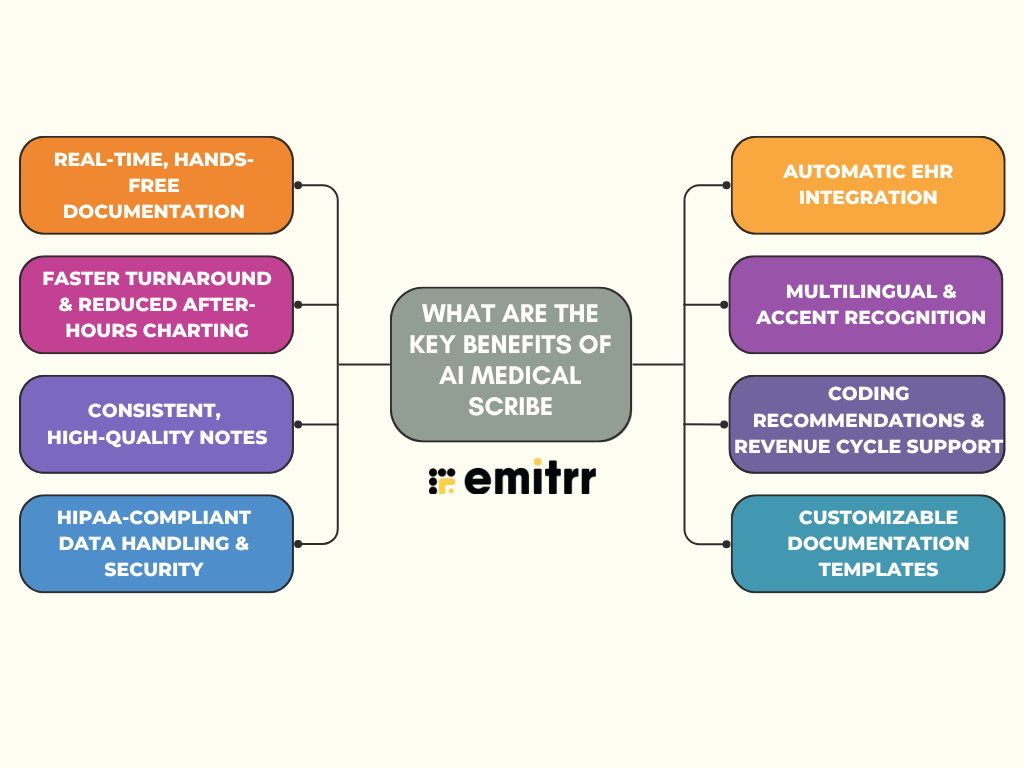
Real-time, hands-free documentation
AI scribe for doctors listens to the visit as it happens and documents in real time, no need to pause the conversation or dictate later. This means providers can stay focused on the patient while the AI medical transcription software captures everything in the background. This form of AI medical documentation eliminates backlogs and reduces reliance on memory after the visit ends.
Faster note turnaround and reduced after-hours charting
One of the biggest time sinks in healthcare is end-of-day charting. With AI, notes are generated instantly, so there’s no need to spend extra hours completing charts after clinic hours. Practices using AI for clinical notes documentation often report drastic reductions in late-evening documentation, improving work-life balance and reducing burnout.
Consistent, high-quality notes
Unlike manual entry, which varies between providers or scribes, AI scribe for doctors follow standardized formatting and language. That means fewer omissions, cleaner summaries, and stronger compliance. This consistency helps improve chart review, follow-up care, and downstream processes tied to medical scribe solutions.
HIPAA-compliant data handling and security
Modern AI scribes are designed with healthcare-grade security in mind. Many platforms are fully HIPAA-compliant, offer encryption at rest and in transit, and keep audit logs for accountability. That ensures sensitive patient data stays protected while still benefiting from automation.
Automatic EHR integration
The best AI scribes don’t stop at note generation; they push structured data directly into your EHR system. That means no copying, pasting, or toggling between systems. Whether it’s SOAP notes, vitals, or assessments, AI for medical charting tools ensures everything lands in the right place.
Multilingual and accent recognition
AI scribes for doctors are trained on diverse speech patterns, accents, and even multiple languages. That makes them more reliable in practices serving multicultural populations or providers with varied speech styles. Compared to traditional dictation, they deliver more accurate and inclusive note capture.
Coding recommendations and revenue cycle support
Many AI scribe tools offer built-in coding suggestions, flagging relevant CPT and ICD codes based on the clinical conversation. This supports more accurate billing and reduces the risk of undercoding or denials. This is where AI for medical documentation ties directly into revenue cycle improvement.
Customizable documentation templates
Every provider has a different documentation style. AI scribes can be configured to match that, such as SOAP, APSO, or custom templates designed for your specialty. This level of personalization ensures the technology fits seamlessly into your existing medical scribe software workflow.
Top Use Cases for AI Medical Scribes
The best AI medical scribes aren’t built for one environment; they’re being used across a wide range of care settings, each with its own documentation challenges. Here’s where they’re delivering the most impact:
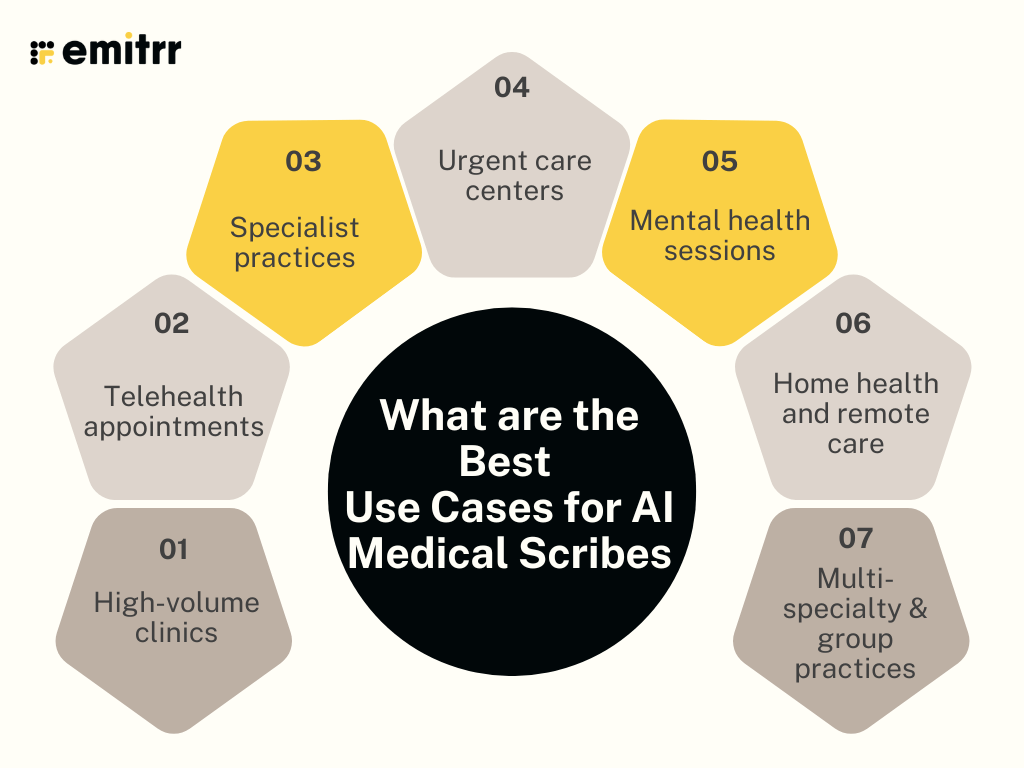
AI Medical Scribing for High-Volume Clinics
Fast-paced clinics often struggle to keep up with documentation during back-to-back appointments. Notes get rushed or delayed, affecting accuracy and billing. AI scribes support real-time, complete medical documentation without slowing providers down.
AI Medical Scribing for Telehealth Appointments
Virtual visits make documentation harder: no assistant in the room, variable audio quality, and frequent multitasking. AI scribes are built for these challenges, making them a go-to tool for companies supporting telemedicine workflows.
AI Medical Scribing for Specialist Practices
Specialists rely on precise terminology and detailed charting. AI scribes can be customized for specialty-specific language, helping maintain accuracy and consistency in medical scribe notes across cardiology, dermatology, and more.
AI Medical Scribing for Urgent Care Centers
Speed is everything in urgent care. Providers juggle high patient volumes and can’t afford to fall behind on documentation. AI scribes produce structured, fast notes that match the pace of care, making AI for medical notes an essential tool in these settings.
Mental health sessions
Therapists and psychiatrists need to document subtle, conversational details without disrupting rapport. AI scribes quietly generate structured summaries in the background, making them a natural fit for providers needing an AI medical note writer.
AI Medical Scribe for Home Health and Remote Care
In mobile settings, traditional documentation tools fall short. Medical scribe AI platforms offer hands-free, compliant note generation on the go, whether the visit happens in a home, facility, or through a remote consult.
AI Medical Scribe for Multi-Specialty and Group Practices
Large practices face workflow inconsistencies across departments. AI scribes support different provider needs through customizable templates and scalable deployment, making them an ideal fit for companies serving multi-provider environments.
Best Practices Using AI Medical Scribe Tool
AI scribes work best when they’re properly integrated into clinical workflows. These best practices can help your team get the most out of the technology while staying compliant, accurate, and efficient.
- Use high-quality microphones or VoIP integration: Audio clarity is everything. It matters both when you’re in-person or virtual. Poor sound quality leads to missed context and transcription errors. Invest in a good microphone or a VoIP platform that offers reliable, secure audio transmission.
- Early staff training and workflow integration: Introducing a new scribe tool works best when the entire team is aligned. Train providers and support staff early, and build the medical scribe into the natural flow of patient visits instead of treating it as a side process.
- Customize templates to fit practice style: Every provider documents differently. Use the medical scribe ai’s settings to customize note structure, i.e., SOAP, APSO, or specialty-specific formats, so it reflects how you already chart.
- Regular review and editing of initial AI-generated notes: AI can be accurate, but not perfect. Set up a routine for reviewing and finalizing notes to ensure clinical accuracy and alignment with each provider’s voice and intent.
- Pair with SMS-based or digital intake for automation: Combine your AI scribe with automated patient intake tools, like pre-visit forms or SMS-based forms, to collect symptoms, history, and preferences in advance. This reduces manual entry and speeds up visits.
- Use time-stamps for audit trails and compliance: Make sure the system captures when notes are generated, reviewed, and signed off. Timestamps support accountability and make compliance audits smoother.
- Maintain clear and updated patient consent processes: If you’re using ambient listening or recording in any form, make sure patients are informed. Add consent language to your intake forms and train your front desk to explain how the medical transcription software works.
Common Challenges Using AI Medical Scribe
AI medical scribes bring speed and efficiency to documentation, but like any technology, they come with challenges that need to be managed. Here are some of the most common ones practices encounter, along with ways to handle them effectively:
| Challenge | What Helps? |
| Learning curve for providers | Offer hands-on training and start with simple use cases. Most clinicians adapt quickly once they experience the time savings. |
| Accent and background noise issues | Use high-quality microphones and submit sample voice data during setup. AI medical transcription software models typically improve with exposure to specific speakers. |
| EHR compatibility gaps | Choose a scribe that supports direct EHR integration or API syncing. Ask vendors to show how notes flow into your system. |
| Privacy and data security concerns | Work only with HIPAA-compliant medical transcriptions vendors. Ensure encryption, audit logs, and proper patient consent are in place. |
| Customization limitations | Select platforms with customizable templates and provider-specific settings, especially for specialty care. |
| Potential for misinterpretation or errors | Treat AI notes as a first draft. Always review and sign off to catch and correct inaccuracies before finalizing. |
Is AI Medical Transcribing Software Right for Your Practice?
Still unsure if an AI medical scribe fits your workflow? This quick checklist can help you decide:
- Do you spend excessive time on documentation?
- Are you seeing high patient volumes or rapid turnover?
- Do you offer telehealth or mobile care?
- Is your team struggling with burnout or workforce shortages?
- Is note quality or billing accuracy a concern?
- Are you seeking scalable, cost-effective solutions?
If you answer yes to most of these, it’s probably time to explore medical transcribing software options.
One platform that’s built specifically to address these challenges is Emitrr. Unlike generic AI scribe tools, Emitrr is purpose-built for healthcare providers. It functions as a real-time AI medical scribe that listens to patient encounters, generates accurate, structured notes, and syncs them directly into your EHR.
Whether you’re running a fast-moving urgent care center, a remote care program, or a multi-specialty clinic, this AI medical transcribing software adapts to your setting. It supports multiple documentation styles, understands medical context, and is designed to reduce charting time without sacrificing compliance or accuracy.
Most importantly, it’s built with security, customization, and real clinical workflows in mind, not as a shiny add-on, but as a scribe tool that actually fits the way providers work. Thus, proving to be the best AI medical scribe solutions.
FAQs
Yes, when you choose the right platform. AI scribes designed for healthcare must meet HIPAA requirements, including secure data handling, encryption, and access controls. Emitrr is fully HIPAA-compliant and built specifically for clinical use, offering end-to-end data protection along with audit-ready documentation features.
For many practices, yes. AI scribes can significantly reduce documentation time, improve note accuracy, and help providers avoid after-hours charting, making them a valuable investment in both time and efficiency.
Yes, informed consent is important. Patients should be made aware if their visit is being documented using AI technology, especially when ambient listening or recording is involved.
Advanced AI scribe software is trained to recognize various accents and handle multiple speakers in a clinical setting. However, performance can vary; clear audio and quality microphones still make a big difference.
Conclusion
Thus, the growing complexity of healthcare documentation is no longer something practices can work around. It’s slowing teams down, affecting patient care, and putting added pressure on already stretched providers.
Best AI medical scribes offer a practical, scalable way forward. They simplify charting, improve documentation quality, and give clinicians the space to focus on what truly matters.
Emitrr is built with this purpose in mind: real-time note generation, seamless EHR integration, and HIPAA-compliant workflows that adapt to your practice.
Ready to see how it works? Schedule a free demo with Emitrr and take the first step toward faster, more efficient documentation.


 4.9 (400+
reviews)
4.9 (400+
reviews)