
Introduction: Beyond Image Analysis—The Unseen Impact of AI Agents
Radiology practices are quickly discovering that AI in Radiology is not only about improving the interpretation of images, but is quietly reshaping patient flow and communication, and improving efficiency in practice when using radiology AI assistants. The moment that a scan is uploaded, an AI-powered radiology system takes over the administrative one, can trigger post-imaging follow-ups, highlight patients missing their pre-scan calls, or pre-populate referral notes for the treating physician in a way that maintains HIPAA compliance in medical imaging AI systems.
Ultimately, the early adopters of AI-driven radiology solutions are reporting a transformation in care to patients as well. Patients feel supported from the initial scheduling of their imaging visit, all the way to post-scan results. Afterwards, the radiographers felt there was more “breathing room” to focus on radiographic imaging results or operations, rather than scheduling churn. Essentially, they have more “headspace” to be engaged with AI for diagnostic imaging that actually improves health outcomes for patients.
This blog assesses the full extent of how AI agents that assist radiology reporting and administration may be shaping a very different future, from smart scheduling to patient engagement, from staff productivity to secure communication. This blog will also address how platforms that incorporate Emitrr’s HIPAA-compliant AI agents for radiologists can continue to expand those capabilities.
Why AI Agents are Important to Radiology Practices
Radiology departments are operationally complex; AI in radiology practice management brings undeniable benefits, such as:
Patient Volumes & Bottlenecks
- Radiology centers are experiencing high no-show rates (20–30%) and complicated preparation rules (fasting, referrals, questionnaires). With an AI-enabled radiology workflow automation product, we can address these operational issues before they occur, not after.
- Data point: Research has shown that automated reminders can reduce no-shows by as much as 30%.
Interdepartmental Friction
- The use of multiple specialties that generate a referral most often leads to an unnecessary separation of data, time, and money. AI-enhanced medical imaging workflows can save time by correcting communication problems.
Interpreting Backlog & Burnout
- Radiologists are facing rising demand for imaging. An AI-enabled solution to assist in the element of radiologist burnout will reduce administrative overload. We can automate scheduling, reminders, and intake, allowing our nurse practitioners and radiologists to focus on interpreting images.
- Data point: Radiology practices that have adopted AI scheduling products reported a 35% reduction in the administrative workload.
Improved Patient Experience
- AI-enabled radiology decision support systems provide patients with timely reminders and pre-scan instructions and follow-ups. When patients receive an exam reminder from an AI-enabled product with a contact number, their level of satisfaction and anxiety for their imaging appointment improves significantly.
In summary, the value of using AI in radiology practices is clear: improved operational effectiveness, reduced stress and fatigue, and improved patient engagement.
Real-World Applications of AI Agents in Radiology Workflows
Artificial Intelligence is no longer an abstraction; it’s an essential part of the current AI-supported healthcare imaging process:
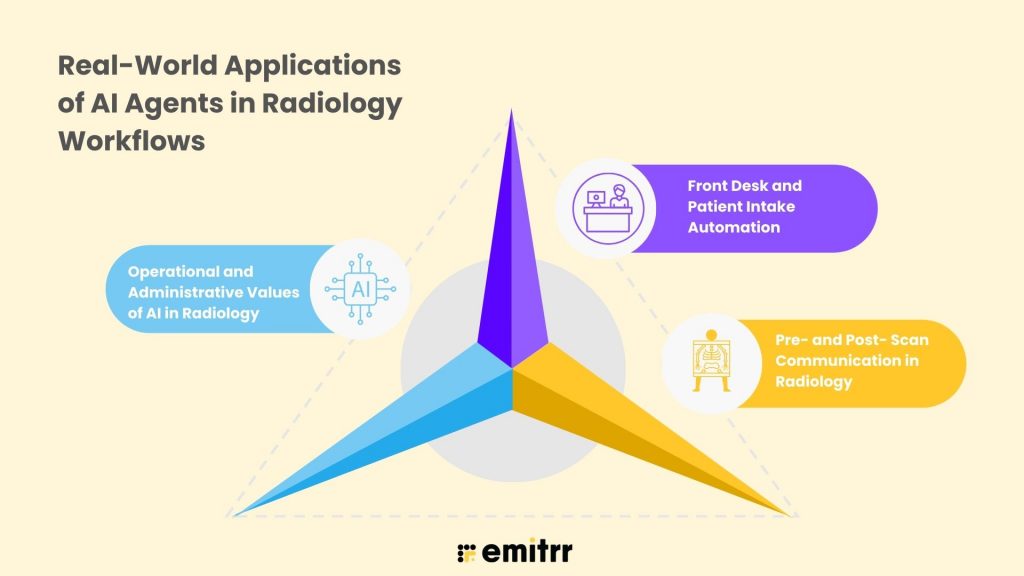
Front Desk and Patient Intake Automation
AI-Enabled Scheduling and Telephone Handling in Medical Imaging:
- Radiology AI assistants manage phone calls, answer general questions (hours, insurance), and book appointments for patients directly. This has cut telephone calls and wait times dramatically, up to 40%.
Automated Patient Engagement in Radiology
- From appointment confirmations through to collecting digital intake forms, AI-enabled HIPAA-compliant radiology solutions keep patients engaged and prepared, leading to better scan quality.
Pre- and Post- Scan Communication in Radiology
Pre-Appointment Instructions from AI
- AI sends automated messages for every scan (e.g., “Fast 8 hours for abdominal ultrasound”). This keeps patients from being rescheduled due to issues related to patient error.
Post-Scan Engagement for Patients
- AI will let the patient know when their report is available in their portal, minimizing anxiety and calls, and eliminating unnecessary concerns.
Operational and Administrative Values of AI in Radiology
Missed Call → SMS Automation
- AI sends an automatic text message to patients who have missed the call connecting with staff, with a link to self-book, and saves the practice a potential written-off appointment.
Analytics and Reporting for Medical Imaging
- AI technology in medical imaging can track no-shows, understand booking patterns, and peak scan times, and help plan resources accordingly.

How AI Agents Are Currently Being Utilized Within Radiology
The emergence of AI-assisted medical imaging workflows is no longer just a distant prediction; the results are measurable and observable.
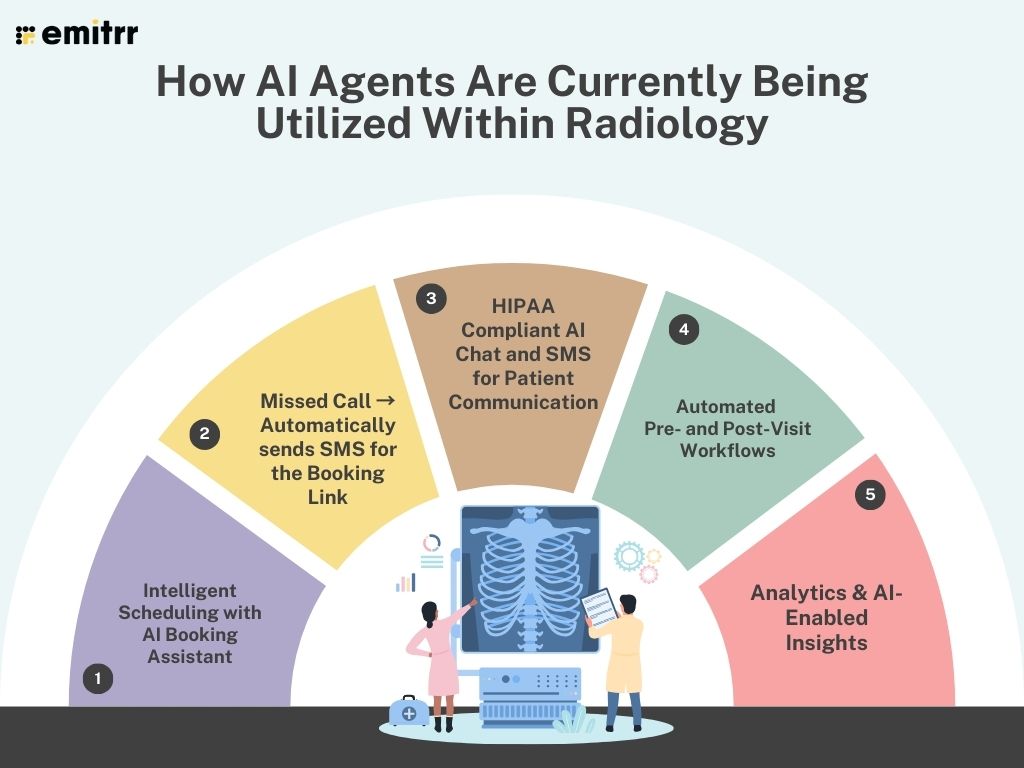
Intelligent Scheduling with AI Booking Assistant
- A Radiology AI assistant now acts as a 24/7 booking agent on the web, via SMS, or via Google Business Profile. Aiming to enhance the patient experience, it employs AI-enabled radiology solutions and applies smart filters – these filters are unique for each patient type, ensuring MRI patients are only given appropriate slots, while prep requirements remain a concern. If a referral is missed, the AI will intervene using SMS and re-book itself with the required forms in hand, meaning less rescheduling for the radiology clinic!
Missed Call → Automatically sends SMS for the Booking Link
- One of the most utilized AI-supported features in radiology practice management is automatically sending booking links to HR programs to patients after a missed call. This means less wasteful phone tag between patients and clinics while improving the workload of radiologists and clinics – and ultimately, a simple, powerful use of AI to mitigate early burnout.
HIPAA Compliant AI Chat and SMS for Patient Communication
- As someone who has built HIPAA-compliant AI for radiology, I know these types of impressions are important! If secure two-way messaging is possible for prep questions or post-visit follow-ups with an audit trail to prove it, then the large AI-enhanced medical imaging is safe and secure. The AI-powered HIPAA-compliant radiology solutions now being deployed will keep patient data safe while improving care.
Automated Pre- and Post-Visit Workflows
- AI drives the automation of intake forms, fasting reminders, post-scan surveys, and follow-up instructions. These personalized workflows are at the heart of what we can expect AI to do for radiology practices.
Analytics & AI-Enabled Insights
- In radiology reporting, AI agents keep track of no-shows, peak utilization, and patient engagement. Dashboards will empower managers with data-driven insights – and a transparent ROI from AI-based radiology solutions.
Challenges & Considerations for AI in Radiology
Although the future of medical imaging and AI is bright, adoption will still have some challenges.
- HIPAA and Data Privacy: AI platforms must use end-to-end encryption. Practices should be able to utilize HIPAA-compliant radiology AI assistants and only need a signed BAA.
- Clinical Accuracy vs. Administrative: IT should be clear on the distinction between AI for diagnostic imaging and AI for administrative workflows. Emitrr only focuses on patient communication for no-show and not clinical imaging interpretation.
- Patient Equity: Messaging should be multilingual, accessible, and inclusive.
- Change Management: Staff may feel threatened by AI. They should view the AI’s role in radiology practice management as an assistant and not a replacement.
- Technical Integration: Success will depend on seamless integrations with RIS, PACS, and EHR.
Best Practices for Radiology Practices when Implementing AI Agents
To transition as smoothly and painlessly as possible, consider the following best practices for implementing any AI-powered radiology-enabled tool.
- Pilot and Measure: Don’t attempt to moon-shot or change everything at once. Start by piloting, perhaps with a missed-call automation feature for X-rays. After you pilot, measure the results, and then use those data to justify scaling a rollout.
- Oversight: Have your staff manually follow up on patient interaction with AI until they establish sufficient trust in the system. It will provide them with trust and will be helpful for oversight if a change or redirection is required.
- Train on Edge Cases: Ensure the complexity of the AI agent is trained on a variety of scenarios, including common edge cases (e.g., late referrals, prep errors, emergency re-scheduling, etc. Training the agent on all types of scenarios, including edge cases, will provide patients and radiology ordering providers with confidence.
- Patient Feedback Loop: Use patient surveys to obtain patient feedback on their interaction with the AI-driven radiology enabled solution, including tone, timeliness, and clarity in messaging. This data is invaluable for tuning the AI.
- Data-Driven Tuning: Use the analytics dashboard to adjust booking windows, follow-up timing, and tone in messaging. By providing ongoing monitoring and data review as a continuous improvement feedback loop, this distinction separates a good AI for a diagnostic imaging platform from an exceptional AI.
Emitrr’s AI Offerings for Radiology
Emitrr is built for healthcare with real AI innovation in medical imaging – focused on patient experience and practice efficiency. Its AI agents for radiologists are HIPAA compliant and are addressing the biggest administrative needs, creating an environment for practices to flourish.
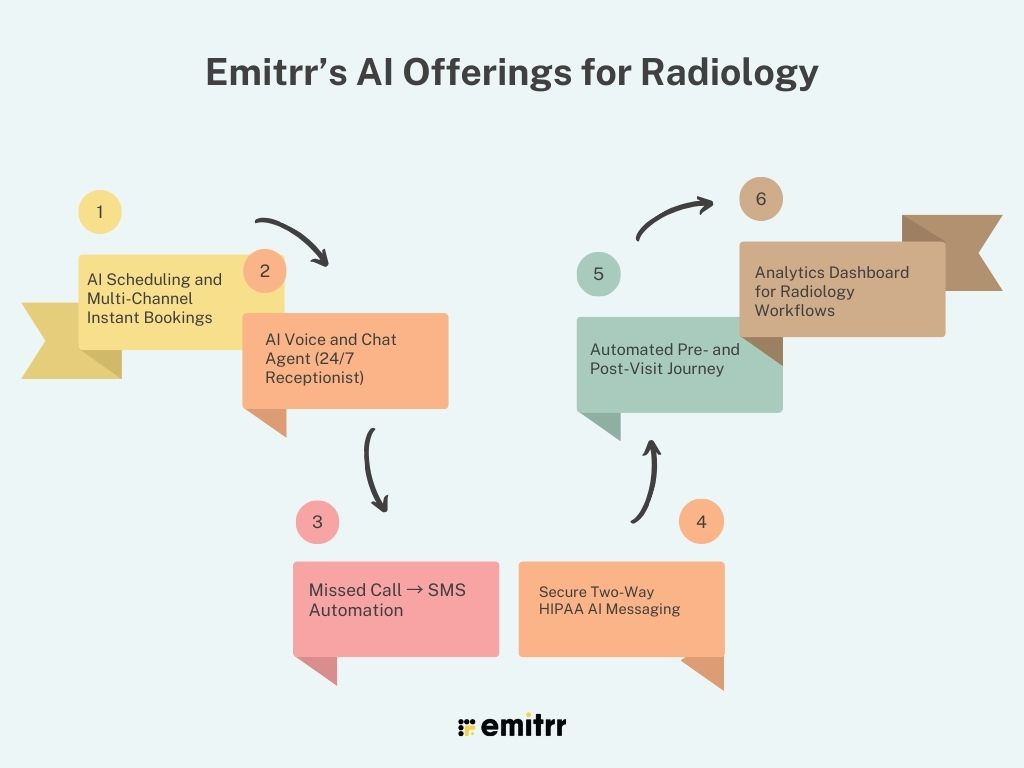
AI Scheduling and Multi-Channel Instant Bookings
- Patients can seamlessly schedule an MRI, CT, or X-ray scan immediately via the web, SMS, or Google. Emitrr’s AI-powered solution is HIPAA compliant, uses smart filters to only show the relevant modality and time slots, preventing booking mistakes and improving machine utilization.
AI Voice and Chat Agent (24/7 Receptionist)
- Emitrr’s next-gen AI radiology assistant can answer commonly asked scan-prep questions, accept bookings or cancellations, and, more importantly, can also triage urgent refills. This service is available to your patients after hours. This tool effectively offloads the radiology front desk and exhibits the power of AI for easing radiologist burnout.
Download free ready-to-use voicemail greeting script for radiology practices to elevate your patient communication instantly.
Missed Call → SMS Automation
- An automatic SMS link for rescheduling an appointment is instantly sent to the patient if someone has made a referral call to the radiology service but missed the call. This simple and effective tool drives down drop-offs, even when radio-oncologists get overloaded, and ensures there is nowhere for patients to fall through cracks. It is a demonstrable use of AI in radiology practices.
Secure Two-Way HIPAA AI Messaging
- With a HIPAA-compliant messaging tool built on AI for patient imaging data ownership, Emitrr is a two-way messaging tool for all patient messaging. Messaging includes anything. Prep directions (“You must fast 4 hours prior”), appointment reminders, follow-up messaging, and is fully auditable for HIPAA compliance in medical imaging AI.
Automated Pre- and Post-Visit Journey
- Emitrr automatically sends all prep checklists, intake forms, notifications to deliver results, and follow-up surveys as part of the patient’s journey. The entire journey is configured specifically for the patient’s modality, making it personalized to the patient’s experience.
Analytics Dashboard for Radiology Workflows
- Emitrr’s analytics dashboard allows radiology managers to track all relevant data, from ‘no show’ rates per modality to peak times for imaging and outreach response time for all types of patient outreach. These analytics help radiology managers optimize resource allocation and time shift planning, and to clearly see ROI in AI in radiology practice management.
FAQs
Ans: AI agents in radiology are automated programs that use AI to automate work, typically administrative, such as scheduling, patient engagement, and operational metrics. They are not diagnostic interpreters.
Ans: Yes, study after study has shown that by simply applying automated reminders and nudges for rescheduling, AI-powered radiology tools can reduce no-show rates by 20 – 30%.
Ans: Yes, but only on platforms designed with security and compliance in mind. Emitrr’s solution is designed using encryption and an audit trail to protect patient data; thus, it is a HIPAA-compliant AI for radiology solution.
Ans: No. While there are AI for diagnostic imaging tools that will assist with interpreting images, Emitrr is focused on automating patient communication workflows and administrative tasks, not the clinical assessment of a scan. The human radiologist will still be part of the diagnostic process.
Ans: Overall patient feedback is positive. Patients report happier experiences, less confusion, and improved follow-up compliance when having an interaction with an AI agent that has been well designed. This highlights the human-centered aspect of AI.
Ans: AI integration is a painless process for platforms with comprehensive API/EHR/RIS support, such as Emitrr. For platforms like Emitrr or others built to work seamlessly with existing software systems, transforming diagnostic healthcare with AI is a simple act of syncing.
Ans: The ROI of AI in radiology is substantial. Most practices can recoup their original investment within 3 – 6 months of roll-out. AI reduces no-shows, keeps the front-desk team member engaged, and increases patient turnover.
Conclusion
The future of radiology AI is not only image analysis; the future of AI in radiology includes workflow automation that enhances patient communication, scheduling, and operations. Clinical teams benefit from AI-assisted medical imaging workflows that relieve workers, reduce burnout, and enhance patient engagement.
Emitrr’s HIPAA-compliant AI agents for radiologists demonstrate how AI assists radiologists in diagnostics by eliminating administrative burdens; in doing so, enabling professionals to spend their time on the highest value diagnostic work.
The transformation of diagnostic healthcare using AI technology is unambiguous: Automation produces efficient, safe, and satisfying patient experiences without removing humanity.

 4.9 (400+
reviews)
4.9 (400+
reviews)