
Introduction to AI Agents in Pharmacy
The pharmaceutical landscape is experiencing a revolutionary transformation as artificial intelligence in pharmacy is reshaping how pharmacies operate, serve patients, and manage complex healthcare workflows via smart AI agents. These intelligent systems are no longer futuristic concepts but practical solutions addressing real-world challenges in modern pharmacy practice.
The future of AI in healthcare, particularly in pharmacy, will involve not just automation but adaptive learning systems that personalize treatment pathways at scale.
If you’re eager to know how AI agents are transforming pharmacies, we’ve curated just the 101 guide for you. In the next ten minutes, you’ll find out the answers for many questions, including:
What is the role of AI in pharmacy?
What are the benefits of Pharmacy AI chatbots?
And, how does the future of AI in pharmacy actually look?
Let’s dig right in.
Understanding AI Agents in Pharmaceutical Context
Definition and Core Characteristics
AI agents in pharmacy are intelligent software systems designed to handle specific tasks in pharmaceutical operations with autonomy and precision. In practice, these agents help pharmacists manage prescriptions, monitor drug interactions, optimize inventory, and improve patient safety, all while comprehending context and requiring minimum human intervention.
With advancements in technologies like machine learning, natural language processing, and computer vision — that help analyze data, predict needs, and support decision-making — the role of AI in pharmacy extends beyond automation into clinical decision support, medication adherence, and patient engagement.
Healthcare organizations worldwide are rapidly adopting AI technologies, with pharmacy operations emerging as a key beneficiary. Studies indicate that AI implementation in healthcare can reduce operational costs by up to 30% while significantly improving patient outcomes. Pharmacies, as critical healthcare touchpoints, are leveraging these technologies to enhance medication safety, streamline workflows, and deliver superior patient experiences.
Core Characteristics of Pharmacy AI Agents Include:
- Autonomy: Operating independently with minimal human intervention
- Learning Capability: Continuously improving performance through data analysis
- Adaptability: Adjusting to changing pharmacy environments and requirements
- Goal-Oriented Behavior: Working toward specific pharmaceutical outcomes
- Communication Skills: Interfacing effectively with pharmacy staff and systems
Types of AI Agents Used in Pharmacies
The pharmaceutical and healthcare sector leverages multiple categories of AI agents, each engineered to address specific operational challenges and clinical requirements. Understanding these distinct types helps pharmacy professionals select the most appropriate solutions for their unique needs.
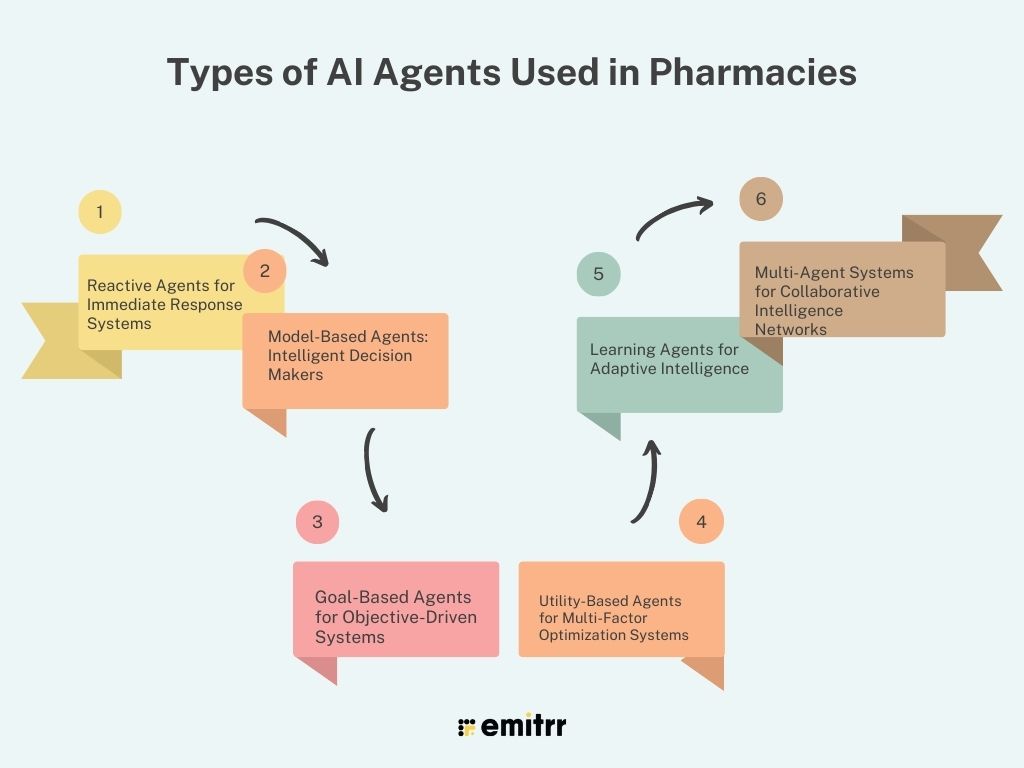
Reactive Agents for Immediate Response Systems
Reactive Agents function as first-line response systems, instantly reacting to immediate pharmacy conditions without maintaining historical context. These agents excel in time-sensitive scenarios where quick responses are critical for patient safety and operational continuity.
Model-Based Agents: Intelligent Decision Makers
Model-Based Agents represent a significant advancement in pharmaceutical AI, maintaining sophisticated internal representations of pharmacy operations, patient populations, and clinical protocols. These agents build comprehensive mental models of their environment, enabling complex reasoning and predictive capabilities.
Goal-Based Agents for Objective-Driven Systems
Goal-Based Agents operate with clearly defined objectives, systematically working toward specific pharmaceutical outcomes through strategic planning and coordinated actions. They analyze individual patient barriers to adherence, develop personalized intervention strategies, and coordinate multiple touchpoints, including automated reminders, educational content, and healthcare provider communications.
Utility-Based Agents for Multi-Factor Optimization Systems
Utility-Based Agents represent the most sophisticated category of pharmacy AI, simultaneously considering multiple competing factors while optimizing overall utility functions. Despite the progress, experts also warn about the disadvantages of AI in pharmacy, such as over-reliance on algorithms, data privacy concerns, and the risk of reduced human oversight.
Learning Agents for Adaptive Intelligence
Learning Agents continuously evolve their capabilities through experience and feedback, representing the cutting edge of pharmaceutical AI development. These agents improve their performance over time by analyzing outcomes, identifying patterns, and refining their decision-making processes.
Multi-Agent Systems for Collaborative Intelligence Networks
Multi-Agent Systems coordinate multiple specialized AI agents working together to address complex pharmaceutical challenges requiring diverse expertise and coordinated responses. These systems enable sophisticated workflows that leverage the strengths of different agent types.
You can take a look at this video to find out top AI tools that are changing the landscape of healthcare:
Technologies at the Core of AI Agents
AI agents draw strength from an amalgam of technologies, including:
Machine Learning (ML)
Machine learning powers pharmacy AI by analyzing large datasets like prescriptions, demographics, and clinical outcomes. It identifies unusual prescribing patterns that may signal fraud or medical errors while forecasting medication demand and inventory needs. By processing data at scale, ML delivers predictive insights that enhance safety, efficiency, and decision-making across pharmacy operations.
Automation
Pharmacy automation uses AI agents to streamline workflows, reduce human error, and boost efficiency. Robotic dispensing systems count, package, and label medications with audit trails, cutting errors by over 90%. Automated tools also manage stock rotation, track expiration dates, and guide purchasing. From robotics to predictive dashboards, pharmacy AI tools have proven to have an instrumental role in helping pharmacists make faster, safer, and data-driven decisions.
Natural Language Processing (NLP)
NLP enables pharmacy AI agents to interpret physician notes, patient messages, and regulatory documents for decision-making. It extracts medication orders and patient histories to support care accuracy. NLP also enhances patient communication by generating personalized counseling content and reminders. Pharmacy AI chatbots simplify prescription refills, answer FAQs, and guide patients on dosage with clear, accessible language.
Computer Vision
Computer vision equips pharmacy AI agents with visual recognition to verify prescriptions and medications. These systems scan documents for authenticity and identify drugs by shape, color, or imprint codes. They also detect packaging defects and ensure quality control. By exceeding human accuracy in inspection, computer vision enhances safety, efficiency, and trust across dispensing and verification processes in pharmacies.
Image Recognition
Image recognition enables precise medication and packaging identification in pharmacies. AI agents analyze pill shapes, colors, and imprints to ensure correct dispensing while spotting subtle differences in generics. They also authenticate packaging, detect counterfeit drugs, and monitor expiration dates.
Current AI Agent Use Cases in Pharmacy Operations
AI agents aren’t a born-yesterday technology. They’ve been around for a few years and are now starting to make headway with contextual learning. Below, we’ve outlined the key use cases of AI agents in healthcare, with a focus on pharmacies.
Medication-Related Patient Counseling
AI agents decode patient history and prescriptions to deliver tailored counseling, clear dosage guidance, and safety alerts. This isn’t just about compliance—it’s about building patient trust and loyalty at scale. While GPT-based systems shine at conversational depth, pharmacy-tuned models like DrugGPT set the bar for accuracy and prescribing support. Future edge? Multimodal AI that blends text, voice, and image for truly interactive counseling.
Intelligent Symptom Triage
Symptom-triage agents suggest OTC relief or escalate to professional care, keeping pharmacies both useful and responsible. HERMES kiosks show how multilingual AI can serve patients in public settings, a glimpse of care beyond the counter. The differentiator lies in context awareness: advanced agents combine local epidemiology, patient history, and wearable data for sharper triage than generic chatbots.
Medication Therapy Management Agent
Therapy management agents watch over medication regimens, flag interactions, and nudge providers toward optimization. Navina already empowers clinics to spot issues proactively, a competitive edge in care coordination. Pharmacies using such agents move from reactive refills to proactive therapy partners. Generative AI promises the next leap: automatically drafting collaborative care plans for providers.
Adherence & Refill Optimization
Smart adherence tools predict who might fall off track and intervene with reminders, refill syncs, or pillbox tech. Unlike basic SMS alerts, ingestible sensors and RFID trackers give real-time accuracy. Pharmacies using predictive AI here don’t just cut missed doses. They build measurable outcomes for payers and health systems, which fuels stronger reimbursement models.
Smart Inventory & Demand Forecasting
AI looks at prescription flows, seasonality, and community health to balance stock. Walgreens’ AI-driven fulfillment centers prove the scalability. What sets best-in-class apart is predictive layering: factoring in local outbreaks, insurance claims, and even social trends. Pharmacies that treat inventory as a dynamic data stream, not a shelf problem, edge ahead in cost and service.
Automated Prescription Processing
Prescription agents clear insurance checks, screen for interactions, and flag safety risks faster than manual reviews. The win isn’t just speed—it’s fewer errors and more pharmacist time for patient care. Where competitors rely on LLMs alone, pharmacies that integrate AI and EHRs and claims data create an end-to-end safety net.
Seamless Prescription Transfers
Transfer agents streamline cross-pharmacy continuity with automated insurance and data verification. The difference shows in patient loyalty: those who switch pharmacies seamlessly tend to stick. Market leaders are already piloting blockchain-backed transfers for tamper-proof records—an innovation likely to reset expectations in the next few years.
Lab Report Interpretation Agent
AI interprets labs in light of medication regimens, catching issues early. General models struggle with nuance, but pharmacy-tuned AI excels by layering in guidelines and patient context. The emerging frontier? Multimodal systems that merge labs, imaging, and medication history into a single interpretive flow for pharmacists. That’s where early adopters gain advantage.
Pharmacy Virtual Assistant
Virtual assistants handle calls, bookings, FAQs, and escalate complex queries. The real value is freeing pharmacists for higher-order care while giving patients 24/7 support. Cedars-Sinai shows how AI assistants can deepen satisfaction. Tomorrow’s edge is integration. Virtual assistants that tie directly into inventory, lab data, and insurance, making them more than chat windows.
Quality & Compliance Auditor
Compliance agents run real-time checks against FDA, DEA, and state rules, logging every action for audits. Unlike static compliance tools, AI spots risks before violations happen. Competitors still rely on after-the-fact fixes. Pharmacies that implement predictive compliance stay ahead of regulators, not just aligned with them.
Financial & Workflow Optimizer
Optimization agents track costs, refine pricing, and smooth workflows. The sharp edge comes when financial AI links with clinical data—showing not just profitability but how operational efficiency translates to better health outcomes. Competitors stick to accounting dashboards; forward-thinking pharmacies are building AI that connects dollars with outcomes, shaping payer negotiations.
Seven Key Benefits of AI Agents for Pharmacies
AI agents for pharmacies have been nothing short of some holy grail, streamlining the bottomline operations like never. Let’s decode the primary benefits of Pharmacy AI chatbots in the section below.
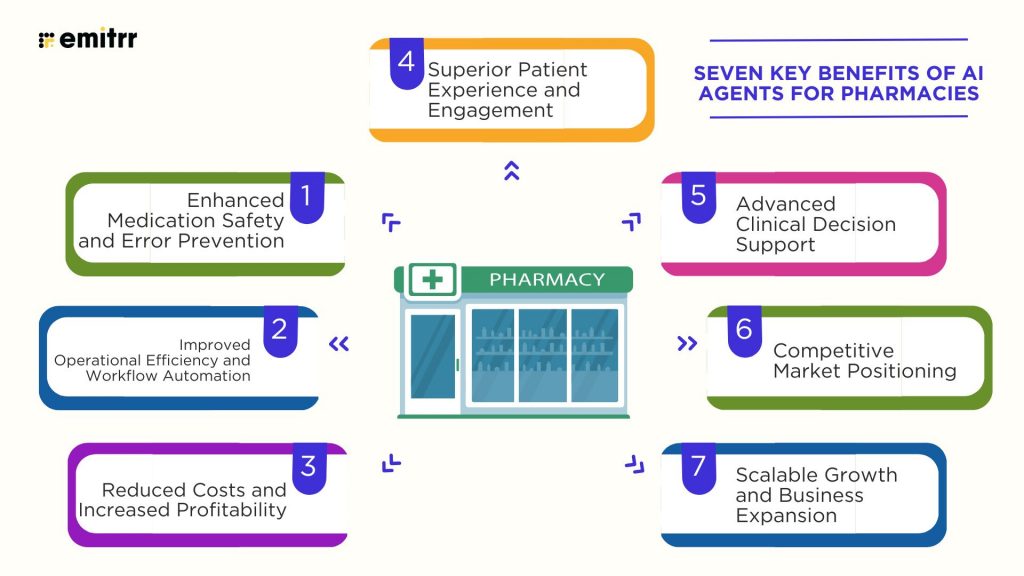
Enhanced Medication Safety and Error Prevention
AI agents reduce medication errors through multiple verification layers, drug interaction checks, and dosage validation. They analyze vast pharmaceutical databases in real time, catching potential issues often missed in manual processes. Key safety features include automated allergy checks, contraindication identification, and duplicate therapy detection.
Improved Operational Efficiency and Workflow Automation
AI-powered workflow automation eliminates manual bottlenecks and streamlines pharmacy operations. These systems coordinate tasks simultaneously—from prescription processing to inventory management—creating smoother workflows.
Efficiency gains include faster prescription processing, shorter patient wait times, and better staff allocation.
Reduced Costs and Increased Profitability
Cost savings arise through reduced labor for routine work, minimized inventory waste, and fewer error-related expenses. AI agents also optimize purchasing decisions, leverage data insights to negotiate with suppliers, and suggest cost-effective therapeutic alternatives.
Superior Patient Experience and Engagement
AI agents improve patient engagement with personalized interactions, shorter wait times, and proactive health support. Available 24/7, they handle inquiries consistently, regardless of staffing levels. Patient engagement increases through tailored communication, educational content delivery, and timely health reminders.
Advanced Clinical Decision Support
AI-powered clinical decision support gives pharmacists evidence-based recommendations for optimizing therapies. These systems analyze patient data, clinical guidelines, and pharmaceutical research to suggest the best treatment options. Support includes drug interaction checks, substitution recommendations, and dose optimization.
Competitive Market Positioning
Pharmacies adopting AI agents gain a competitive edge by enhancing services and operational excellence. Smaller pharmacies can now rival large chains by offering advanced capabilities previously limited to major players.
Scalable Growth and Business Expansion
AI agents enable growth without proportional increases in staff. They manage higher prescription volumes, support multiple locations, and maintain service quality during expansion. Scalability features include cloud-based deployment, modular functionality, and seamless integration with new sites.

What Regulatory Compliance Requirements Must AI-Powered Pharmacies Follow?
The role of AI in pharmacy is breakthrough, but only when it functions within clearly defined guardrails. AI agents work within a perimeter, which is important to make sure they work towards safety, security, and people’s best interests in mind.
Automated FDA and DEA Compliance Monitoring and Reporting
AI agents continuously monitor pharmacy operations against FDA and DEA requirements, automatically generating compliance reports and flagging potential violations. Automated monitoring includes real-time validation of prescriber DEA numbers, patient identification verification, and prescription authenticity checks. These developments highlight the future of AI in pharmacy, where compliance becomes proactive rather than reactive.
Real-Time State Board Regulation Adherence and License Verification
State pharmacy board regulations vary significantly across jurisdictions, and AI agents help ensure compliance with local requirements. These systems automatically verify pharmacist licensing status, monitor continuing education requirements, and track pharmacy permit renewals. Real-time compliance monitoring includes prescription transfer protocols, patient counseling documentation, and pharmacy technician supervision requirements.
Comprehensive HIPAA Data Privacy Protection and Security Controls
HIPAA compliance is critical for AI-powered pharmacies, requiring robust data protection measures and patient privacy safeguards. AI agents implement encryption protocols, access controls, and audit logging to ensure protected health information security. Privacy protection includes patient consent management, data minimization principles, and secure data transmission protocols.
Intelligent Risk Assessment and Management Systems
Risk management AI agents continuously assess pharmacy operations for potential compliance risks, patient safety concerns, and operational vulnerabilities. These systems implement predictive analytics to identify emerging risks before they become critical issues. Modern pharmacy AI tools offer integrated dashboards that simplify compliance oversight and risk tracking.
Streamlined Compliance Audit Preparation and Documentation
Audit preparation agents maintain comprehensive documentation systems and generate compliance reports for regulatory inspections. AI agents ensure audit readiness through continuous compliance monitoring and documentation maintenance.
In addition to these functions, AI agents support patient communication and prescription verification, showing how AI agents are transforming pharmacies into safer, smarter, and more efficient healthcare hubs.
Major Challenges When Implementing AI Agents in Pharmacies
AI agents promise a 360-degree shift for pharmacies in terms of efficiency and cost savings. But implementing them isn’t a straight path to walk on. Pharmacies face a volley of challenges, from integrating data pipelines to ensuring a balanced human intervention. We’ve covered the top seven below.
Data Integration Issues
Data integration represents one of the most significant challenges in AI agent implementation. Pharmacies often operate legacy systems with incompatible data formats, making seamless integration difficult. AI agents require access to comprehensive, standardized data to function effectively. Common integration challenges include disparate database structures, inconsistent data quality, and limited API availability from existing pharmacy systems.
Staff Resistance Problems
Pharmacy staff may resist AI agent implementation due to concerns about job displacement, increased complexity, or skepticism regarding technology benefits. Successful implementation requires comprehensive change management strategies and ongoing staff support. Resistance often stems from fear of technology, concerns about workflow disruption, or prior negative experiences with pharmacy technology.
High Implementation Costs
Initial AI agent implementation costs can be substantial, including software licensing, system integration, staff training, and ongoing maintenance expenses. Cost considerations include hardware requirements, cloud service fees, and potential system downtime during implementation. Pharmacies must carefully evaluate long-term benefits against upfront investment demands.
System Interoperability Failures
Interoperability challenges arise when AI agents cannot effectively communicate with existing pharmacy systems, healthcare networks, or insurance providers. These failures can disrupt established workflows and create operational inefficiencies, robbing pharmacies off their peace at night. Interoperability issues often involve incompatible communication protocols, differing data standards, and vendor-specific system
AI Algorithm Bias
AI algorithm bias can lead to unfair treatment of certain patient populations or inappropriate clinical recommendations. Pharmacy AI agents must be carefully designed and continuously monitored to ensure equitable treatment for all patients.
Bias concerns include discriminatory treatment recommendations, unequal service quality, and flawed risk assessments based on demographic factors.
Regulatory Uncertainty
Regulatory frameworks for AI in healthcare continue to evolve, creating uncertainty about compliance requirements and acceptable use cases. Pharmacies implementing AI agents must navigate unclear regulatory landscapes while maintaining compliance and procedural discipline. Areas of uncertainty include liability for AI-generated recommendations, required documentation standards, and approval processes for new AI applications.
Professional Liability Concerns
Professional liability questions arise regarding pharmacist responsibility for AI agent recommendations and actions. Clear policies must define when pharmacists should override AI recommendations and how to document decision-making processes. Liability concerns include malpractice coverage for AI-assisted decisions, professional accountability for system failures, and patient safety responsibilities.
How to Implement AI Agents in Your Pharmacy
To reap the benefits of artificial intelligence in pharmacy, it’s important to implement it the right way. We’ve outlined the steps below to show you where to start with AI in pharmacy.
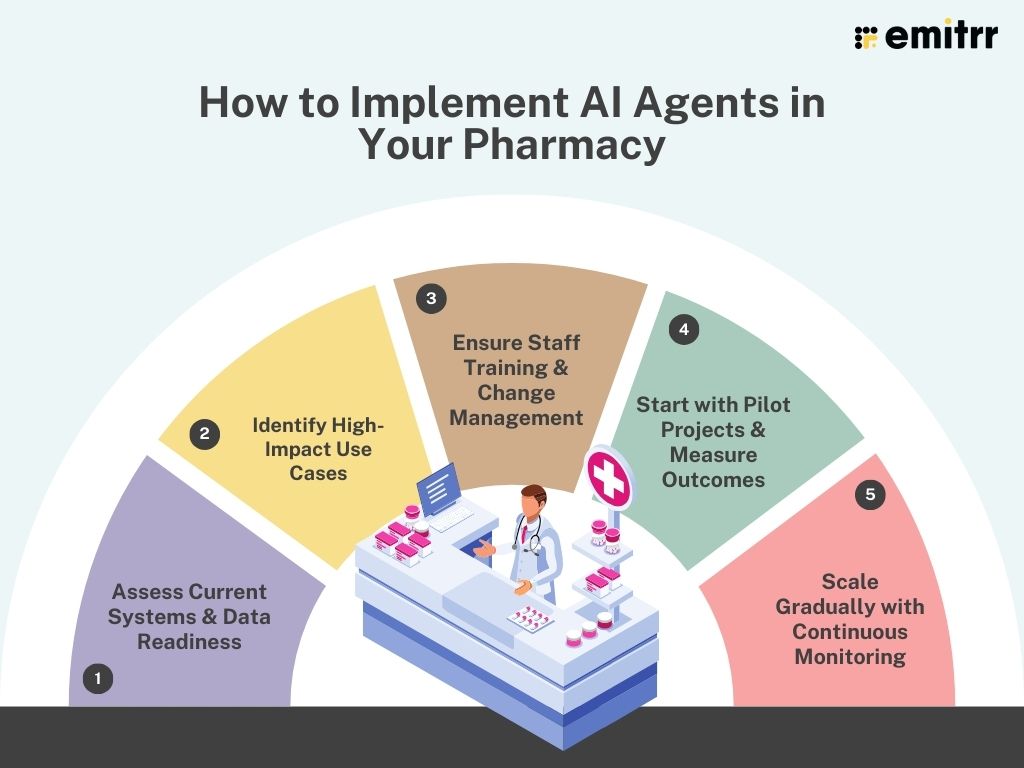
Assess Current Systems & Data Readiness
Begin implementation by thoroughly evaluating existing pharmacy systems, data quality, and technical infrastructure. This assessment identifies integration requirements, data cleansing needs, and necessary system upgrades. Assessment components include database analysis, system compatibility evaluation, and a review of staff technical capabilities.
Identify High-Impact Use Cases
Focus initial AI agent implementation on use cases that provide maximum benefit with minimal disruption. Prioritize applications that address significant operational pain points or offer clear financial returns on investment. High-impact areas typically include prescription processing automation, inventory management optimization, and patient communication enhancement.
Ensure Staff Training & Change Management
Implement comprehensive training programs covering AI agent functionality, workflow changes, and troubleshooting procedures. Change management strategies should address staff concerns and demonstrate technology benefits. Training components include hands-on system practice, scenario-based exercises, and ongoing support resources.
Start with Pilot Projects & Measure Outcomes
Launch AI agent implementation through controlled pilot projects that allow careful monitoring and adjustment. Measure key performance indicators to validate benefits and identify areas for improvement. Pilot project metrics include processing time reductions, error rate changes, patient satisfaction scores, and staff productivity improvements.
Scale Gradually with Continuous Monitoring
Expand AI agent implementation gradually, incorporating lessons learned from pilot projects. Maintain continuous monitoring systems to ensure optimal performance and to identify emerging issues. Scaling strategies include phased deployment across pharmacy departments, gradual feature activation, and performance benchmark tracking..
The Future of AI in Pharmacy
Wondering what the future looks like for pharmacies with AI in the picture? Keep the guesswork out and explore some top-of-the-cream trends below.
GenAI and LLMs Powering Next-Gen Pharmacy Intelligence
GenAI and LLMs are taking pharmacy ops to the next level. They help AI agents reason better, talk more naturally, and deliver personalized care. From auto-writing clinical notes to creating patient-friendly medication guides, they cut friction in daily workflows. By making conversations smoother and insights sharper, these tools push pharmacies toward smarter, more human-centered care.
IoT-Enabled Smart Systems for Real-Time Care and Monitoring
IoT is turning pharmacies into connected hubs. Smart pill bottles, wearables, and sensors track everything: medication storage, patient habits, even pharmacy environments. This real-time data gives AI agents context to act fast, catch risks, and support patients proactively. Instead of reacting after issues surface, pharmacies can monitor continuously, deliver smarter care, and keep both patients and inventory in top shape.
Blockchain and Distributed Ledger Securing Pharmacy Operations
Blockchain builds trust in pharmacy operations. Distributed ledgers lock in tamper-proof records for prescriptions, supply chains, and patient data. Pharmacies can verify authenticity, trace drugs instantly, and share information securely. Combined with AI agents, it fights fraud, keeps compliance tight, and protects patients. The result: safer, more transparent operations that boost confidence across healthcare at scale.
Getting Started: Choose Emitrr as Your Pharmacy AI Agent
If you’re fixated on implementing an AI agent for your pharmacy and looking for the right platform to start, give Emitrr a try.
Emitrr is an AI-powered agent built for healthcare. And yes, it works great for pharmacies. It offers a HIPAA-compliant virtual receptionist available 24/7 to handle patient messages, appointment reminders, VoIP calls, and text support across channels. It streamlines communication, reduces no-shows, and secures sensitive patient interactions.
Let’s walk you through the key features of Emitrr below.
All-in-One, HIPAA-Compliant Communication Platform
Emitrr works like an AI-powered agent built specifically for pharmacies. It combines calls, texts, emails, reminders, and notifications into one simple platform, while keeping everything HIPAA-compliant with secure storage and end-to-end encryption.
From prescription updates to patient queries, Emitrr makes it easier to connect, stay compliant, and deliver consistent care. With its pharmacy-first design, the platform blends automation with industry standards to improve both workflows and patient experience.
24/7 AI Reception and Smart Call Management
Patients hate unanswered calls, and staff can’t always keep up—Emitrr fixes that with an AI receptionist that runs 24/7. It picks up every call, manages routine questions, books appointments, and routes urgent issues to the right person.
The system even prioritizes calls by urgency, so critical cases never get buried under small inquiries. Pharmacies save time, reduce interruptions, and patients get quick responses around the clock.
Automated Reminders, Missed-Call Recovery & Prescription Refill Alerts
Emitrr makes sure patients don’t forget what matters most—their medications and appointments. Automated reminders and proactive refill alerts keep adherence on track without extra staff effort. If someone misses a call, the system automatically follows up, ensuring no patient feels ignored.
This small detail goes a long way in building loyalty and trust. By keeping communication consistent, pharmacies cut down on missed doses, boost outcomes, and reduce admin headaches.
Reputation & Review Management Built for Pharmacies
Online reviews can make or break a pharmacy, and Emitrr helps manage them without the extra hassle. The AI encourages happy patients to leave reviews while monitoring for negative feedback.
If something less-than-glowing comes through, it crafts thoughtful, professional responses to address concerns before they spiral. This proactive approach protects your reputation, shows patients you care, and keeps your brand looking strong. With Emitrr, pharmacies can build trust online just as effectively as they do at the counter.
Deep Integration with Pharmacy Systems & EHRs
Emitrr fits right into the systems you already use. It connects seamlessly with pharmacy management software and electronic health records (EHRs), so staff don’t waste time double-entering data or switching screens.
Prescription updates, patient records, and scheduling sync automatically, making workflows smoother and less error-prone. By reducing manual tasks, it frees up your team to focus on patient care instead of paperwork.
Actionable Analytics, Dashboards & Reporting
With Emitrr, you don’t just communicate better—you also get insights into how your pharmacy runs. The platform’s dashboards track call volumes, patient engagement, appointment adherence, and overall performance of your AI agent.
Real-time analytics show where workflows slow down, what patients need most, and how your team is performing. These insights help pharmacies fine-tune operations, improve service quality, and make data-driven decisions.
Affordable, Scalable, and Pharmacy-Friendly Support
Emitrr is designed to grow with your pharmacy. Its pricing works for independents as well as large chains, offering flexible plans that scale with your needs. Start small, expand as you grow, and never lose access to core AI-driven features.
Beyond affordability, Emitrr comes with hands-on support for setup, training, and optimization. Regular updates keep the platform ahead of changing patient expectations and industry demands.
Ready to Transform Your Pharmacy? Schedule your Emitrr demo today.
FAQs
AI agents complement rather than replace pharmacists by automating routine tasks and providing decision support tools. This technology enables pharmacists to focus on high-value clinical activities, patient counseling, and complex problem-solving, care and clinical interventions.
AI agents integrate with EHR/EMR systems through standardized APIs and data exchange protocols. These integrations enable seamless access to patient medical histories, medication records, and clinical documentation.
AI implementation costs vary significantly based on pharmacy size, system complexity, and feature requirements. Initial investments typically range from $10,000 to $100,000 for comprehensive AI agent systems, with ongoing subscription fees between $500 to $5,000 monthly.
AI agents improve patient care through personalized medication management, proactive health monitoring, and enhanced communication capabilities. These systems provide 24/7 availability for patient inquiries, automated adherence monitoring, and customized educational content delivery.
AI decision-making in healthcare maintains high safety standards through multiple validation layers, human oversight requirements, and continuous monitoring systems. Pharmacy AI agents operate within defined parameters and escalate complex situations to human pharmacists.
Conclusion
AI agents are fundamentally transforming pharmacy operations, offering unprecedented opportunities for enhanced patient care, operational efficiency, and business growth. Successful AI agent implementation requires careful planning, staff engagement, and gradual scaling approaches. The future of pharmacy lies in intelligent automation and AI-powered decision support systems.

 4.9 (400+
reviews)
4.9 (400+
reviews)