
Introduction
Does your practice still use fax to send patient information? If so, you’re not alone. Healthcare, dental, insurance, and even legal offices continue to rely on faxing because it’s familiar, fast, and accepted across industries.
But here’s the risk: if your cover sheet isn’t HIPAA-compliant, a single fax could expose sensitive health records. That kind of mistake doesn’t just frustrate patients, it can lead to penalties, lost trust, and serious liability.
That’s why understanding the HIPAA compliant fax cover sheet is so important. In this guide, we’ll break down what makes it different from a regular cover sheet, the rules you must follow, and the key elements that make your faxes both secure and professional.
By the end, you’ll have a straightforward roadmap to safer faxing that protects your patients, your staff, and your business.
What is a HIPAA Compliant Fax Cover Sheet
A HIPAA fax cover sheet is the page placed in front of any fax that contains protected health information (PHI). Its purpose is simple: to notify the recipient that the fax includes confidential medical details and must be handled according to HIPAA rules.
Unlike a standard cover page, a HIPAA-compliant fax cover includes a confidentiality disclaimer and other required information to reduce the risk of unauthorized access. It does not contain any patient data itself, but it signals that the pages following it are sensitive and legally protected.
Who Commonly Uses a HIPAA Fax Cover Sheet?
Now that we’ve defined what a HIPAA fax cover sheet is, let’s look at the types of organizations that rely on it every day. Any business that deals with protected health information (PHI) should use a HIPAA-compliant fax cover whenever faxing documents. Some of the most frequent users include:
- Hospitals and clinics – sharing patient charts, referrals, or lab results.
- Dental offices – exchanging treatment records and insurance claims.
- Pharmacies – handling prescriptions and refill requests.
- Insurance companies – processing claims that include medical details.
- Law firms – working with cases involving medical records or health-related disputes.
For these businesses, a medical fax cover sheet isn’t optional; it’s a critical safeguard to ensure patient privacy and demonstrate compliance.
To support these industries in maintaining strict privacy standards, here are free fax cover sheet templates designed specifically for HIPAA-regulated workflows:
Why is a HIPAA Compliant Fax Cover Sheet Important
Using a HIPAA-compliant fax cover is more than a formality, it plays a key role in protecting your practice and your patients. Here’s why it matters:
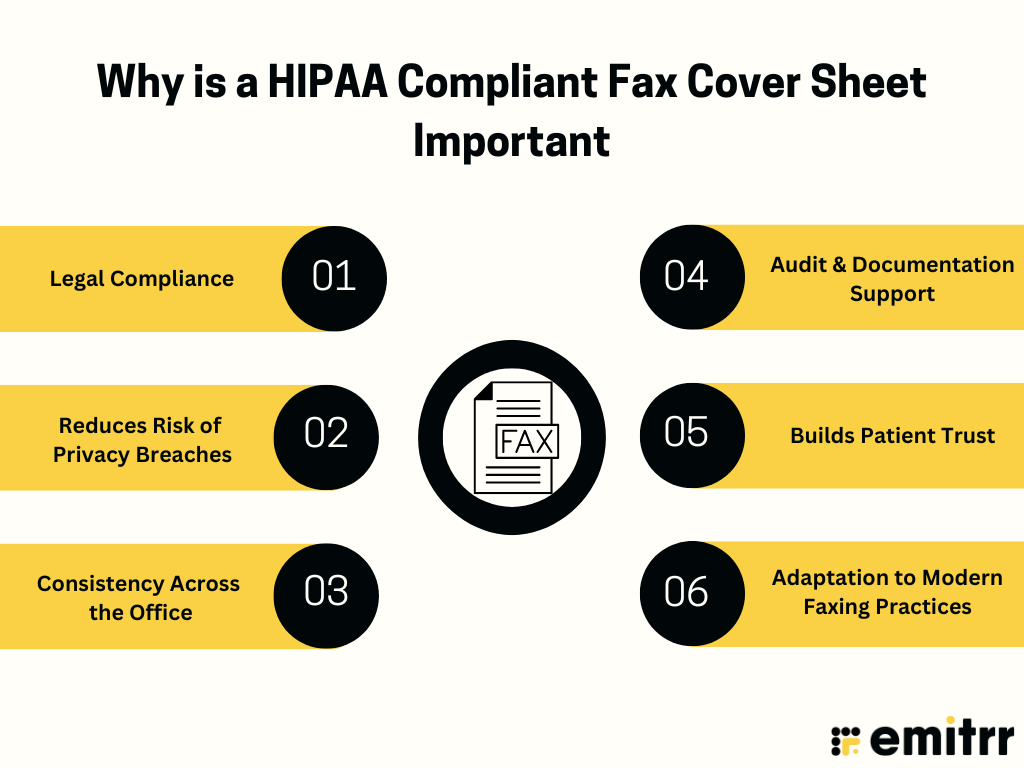
Legal Compliance
HIPAA requires health information to be shared securely. While the law doesn’t say you must use a fax cover sheet, it does require “reasonable safeguards.” A cover sheet with a clear HIPAA disclaimer for fax cover sheet shows auditors and regulators that your practice is following the rules.
Reduces Risk of Privacy Breaches
Faxing the wrong number happens more often than most offices admit. A confidential fax cover sheet won’t stop that mistake, but it reduces the fallout. The disclaimer warns unintended recipients that the information is private and must not be shared, copied, or used.
Consistency Across the Office
When every staff member uses the same HIPAA fax cover sheet template, it keeps communication professional and consistent. Pairing standardized cover sheets with other secure documentation, such as digital patient paperwork and online medical forms, helps reduce errors and creates a smoother, more reliable workflow.
Audit & Documentation Support
During an audit, showing that you always include a HIPAA fax cover sheet disclaimer helps prove your office has a compliance process in place. It’s a small step that adds credibility and reduces liability.
Builds Patient Trust
Patients trust you with their most sensitive details. Using a medical fax cover sheet sends a strong signal that your office values their privacy and takes extra steps to protect it.
Adaptation to Modern Faxing Practices
Even with e-fax and digital fax services, the same HIPAA fax cover sheet rules apply. Whether you’re faxing on paper or through a cloud service, the cover sheet remains a simple, practical safeguard.

HIPAA Fax Cover Sheet Requirements & Rules (Checklist)
Before designing a cover sheet, it’s important to understand the compliance rules that HIPAA expects you to follow. Here’s what you need to know:
Mandatory Info
Include basic details such as:
- Sender’s name and contact information
- Recipient’s name and fax number
- Date and time of transmission
- Total number of pages (including the cover sheet)
These details make the fax traceable and reduce confusion if pages are missing or misdirected.
Confidentiality Disclaimer
The most critical requirement is a HIPAA fax cover sheet disclaimer. This short statement warns that the fax may contain protected health information (PHI) and gives instructions if the fax reaches the wrong person. Without it, your cover sheet is not considered HIPAA-compliant.
Prohibited Details
HIPAA is very clear about what not to include. The cover sheet should never include sensitive patient data such as diagnoses, Social Security numbers, or billing information. Its role is to protect PHI, not display it.
Consistency Rules
Use one fax cover sheet template HIPAA compliant across your entire organization. Consistency avoids mistakes, ensures staff know what to use, and creates a standard that stands up during audits. Download ready-to-use HIPAA-compliant fax cover sheet templates and implement them organization-wide to streamline workflows and reduce compliance risk.
Retention & Recordkeeping
Always keep a copy of sent faxes, including the cover sheet. This creates a documentation trail that shows your office consistently follows HIPAA fax cover sheet rules, which is valuable during audits or investigations.
Technical Safeguards in Transmission
If you use cloud or digital faxing, apply security measures such as encryption and secure logins. A printable HIPAA compliant fax cover sheet works together with these technical safeguards to protect information in both paper and electronic formats.
Key Elements of a HIPAA Fax Cover Sheet
Once you know the compliance rules, the next step is designing the actual fax cover sheet. In HIPAA-compliant faxing, the cover isn’t just a formality; it provides clarity, builds trust, and creates a record that supports your compliance process. Below are the key elements every cover sheet should include:
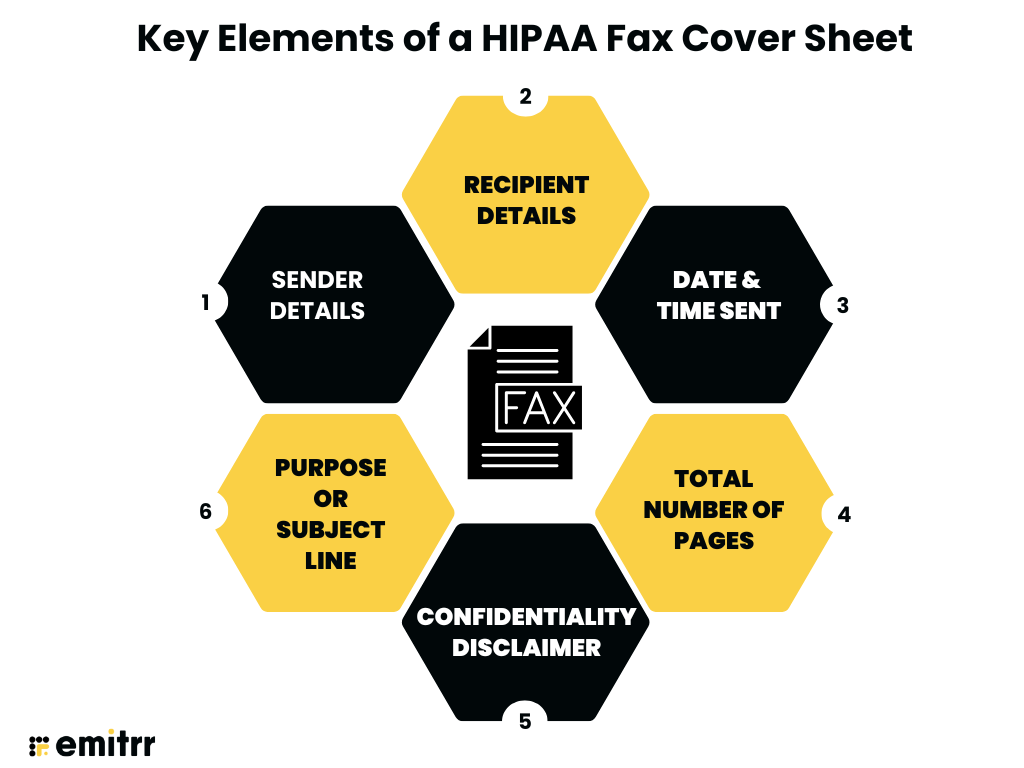
Sender Details
Every fax must make it clear where it came from. The cover sheet should include:
- Name of the sender
- Organization or department name
- Direct phone number or email for follow-up
This makes it easy for the recipient to confirm the fax’s legitimacy or reach out with questions. Without accurate sender details, misdirected faxes become harder to trace, which increases compliance risk.
Recipient Details
Clearly stating who the fax is for helps prevent it from ending up in the wrong hands. Include:
- Recipient’s full name
- Department or unit (if applicable)
- Fax number of the recipient
By narrowing the intended destination, you reduce the chance of a fax being read by someone who shouldn’t see it.
Date & Time Sent
Every fax should be timestamped. Recording the date and time creates an audit trail, which is valuable if your office is ever questioned about when patient information was shared. This also helps staff verify if the fax was delivered on schedule.
Total Number of Pages
List the total number of pages being sent, including the cover sheet itself. This simple step prevents miscommunication: if the recipient receives fewer pages than listed, they’ll know something is missing and can follow up immediately.
Confidentiality Disclaimer
This is the core of a HIPAA-compliant fax cover. The disclaimer should:
- State that the fax contains confidential health information
- Remind the reader that the information is protected by law
- Give instructions for what to do if the fax is received in error (e.g., destroy the fax and notify the sender)
The disclaimer doesn’t stop mistakes from happening, but it proves your office took reasonable steps to protect PHI, which matters for both compliance and liability.
Purpose or Subject Line
Provide a general description of what’s inside, without exposing any PHI. Examples:
- Insurance Claim Documentation
- Referral Request
- Authorization Form
This helps the recipient prioritize the fax without revealing sensitive details. Never include a patient’s name, diagnosis, or account number in this field.
Urgency or Priority Indicators (Optional)
If the fax requires immediate attention, a simple label like “Urgent” or “For Review Today” helps the recipient act quickly. While not required by HIPAA, priority markers improve efficiency, especially in busy medical or legal offices.
Return/Contact Instructions (Optional)
In case of a misdirected fax, add clear instructions on what the unintended recipient should do. This may include destroying the fax and calling a secure phone number, or emailing a compliance officer.
Footer or Additional Security Notice (Optional)
Many organizations add an extra line at the bottom of the cover sheet to reinforce their privacy policy. This may include:
- A reminder about HIPAA compliance
- Contact details for the organization’s privacy officer
- A short security notice (e.g., “Unauthorized use is strictly prohibited”)
While not mandatory, these extras strengthen your office’s compliance posture and show patients and partners that privacy is taken seriously.
Access & download free HIPAA-Compliant fax cover sheet templates
Benefits of Using a HIPAA-Compliant Fax Cover Sheet
Adding a HIPAA-compliant fax cover may seem like a small step, but it creates a big impact on both compliance and day-to-day operations. Here’s how it benefits your practice:
Keeps Patient Information Private
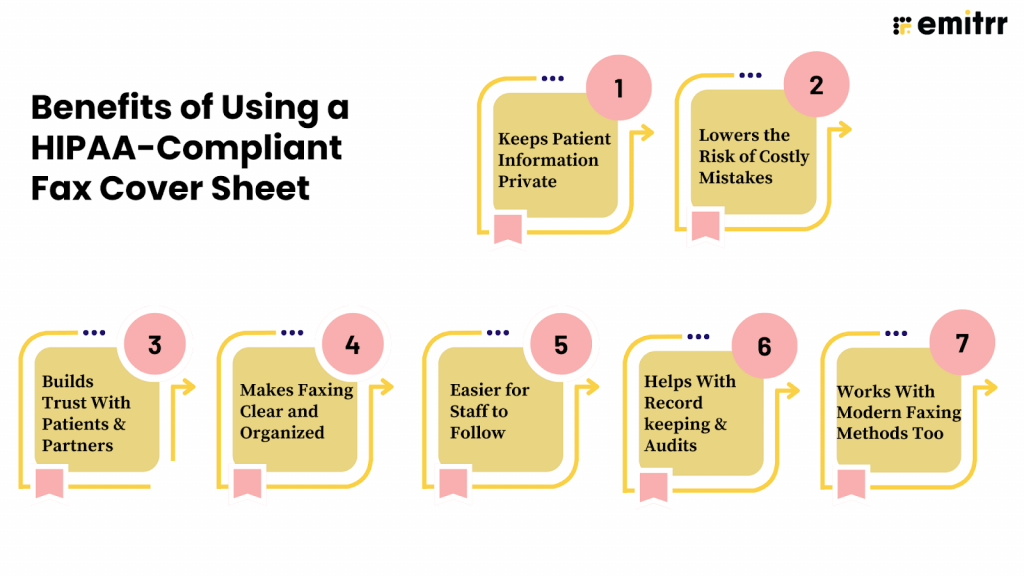
Privacy is the core of HIPAA. A confidential fax cover sheet signals that the pages contain sensitive medical details and should only be accessed by the intended recipient. This extra layer of notice prevents casual exposure, for example, if a fax machine is in a shared office area, and shows you’re taking patient confidentiality seriously.
Lowers the Risk of Costly Mistakes
Faxing to the wrong number or person is a common mistake. A HIPAA fax cover sheet disclaimer won’t stop that from happening, but it reduces the fallout. The disclaimer instructs unintended recipients not to read, copy, or share the content. Without it, a misdirected fax could trigger a compliance violation. HIPAA fines can be steep, anywhere from $100 to $50,000 per violation, depending on the severity. That’s an expensive consequence for something as simple as leaving out a disclaimer.
Builds Trust With Patients and Partners
Patients and business partners expect their information to be handled with care. A HIPAA fax cover sheet shows that your office values privacy and is following compliance practices. This builds trust not only with patients, but also with insurers, pharmacies, and referral partners who see your cover sheets regularly. Trust translates into stronger professional relationships and fewer disputes.
Makes Faxing Clear and Organized
A health information fax cover sheet helps keep communication neat and professional. Listing details like sender, recipient, and page count, it avoids confusion when multiple faxes are being handled at once. This is especially important in healthcare offices, where missing or incomplete transmissions can delay care or claim approvals. Organized faxing saves staff time and prevents errors that could otherwise affect patients.
Easier for Staff to Follow
Standardizing one fax cover sheet template which is HIPAA compliant makes staff training easier and reduces mistakes. Instead of improvising or using outdated forms, employees know exactly which template to pull. This consistency cuts down on errors and ensures compliance isn’t left to chance. For new staff, having a simple, standardized template reduces the learning curve.
Helps With Recordkeeping and Audits
Audits can be stressful, but cover sheets help ease the burden. Keeping copies of your HIPAA fax cover sheet creates a record that proves your practice took reasonable steps to safeguard PHI. If an investigation ever occurs, being able to show consistent use of compliant cover sheets can protect your office from larger penalties and demonstrate good-faith compliance.
Works With Modern Faxing Methods Too
Even with cloud and digital faxing, the same HIPAA fax cover sheet rules apply. Electronic transmissions can still be misrouted or intercepted, which means the disclaimer and required elements remain just as important. Whether you’re using a traditional machine or a cloud-based service, a HIPAA-compliant fax cover helps address both old and new risks, keeping your practice aligned with modern compliance needs.
Do’s and Don’ts for HIPAA Fax Cover Sheets
Even the best HIPAA-compliant fax cover won’t protect your practice if it’s used incorrectly. Here are the key do’s and don’ts every practice should follow:
Do’s
- Always include a clear confidentiality disclaimer: This is the foundation of a HIPAA fax cover sheet and alerts anyone handling the fax that the contents are protected.
- List sender and recipient details accurately: Full names, departments, and fax numbers reduce the chance of misdirected transmissions.
- Add the date, time, and total number of pages: These small details help confirm delivery and create a traceable audit trail.
- Use a simple, professional format: A consistent HIPAA fax cover sheet template across your organization prevents confusion.
- Train staff regularly: Make sure everyone knows how and when to use cover sheets, and update training as HIPAA rules evolve.
- Keep records of sent faxes: Retaining cover sheets helps with compliance checks and audits.
Don’ts
- Never include PHI on the cover sheet: Patient names, diagnoses, account numbers, or billing details belong in the attached documents, not on the cover page.
- Don’t skip the disclaimer: A vague or missing disclaimer leaves your fax non-compliant.
- Don’t fax without double-checking the number: One misdial could expose sensitive records to the wrong recipient.
- Avoid multiple versions of cover sheets across departments: Inconsistency leads to mistakes and weakens your compliance process.
- Don’t assume the cover sheet alone makes you HIPAA compliant: It’s only one part of a larger privacy strategy.
- Never circulate outdated templates: Old versions may miss updated HIPAA requirements, putting your office at risk.
Following these do’s and don’ts ensures your team avoids common mistakes, but it’s only half the picture. Knowing what not to do is important, actually building a proper cover sheet is the next step.
How to Create a HIPAA-Compliant Fax Cover Sheet
Here’s a simple step-by-step process you can follow to design a cover sheet that meets HIPAA requirements:
Step 1: Choose Your Format
Decide whether to create your cover sheet in Word, Google Docs, or a PDF editor. If your office uses digital or cloud faxing, check if your fax service already provides a HIPAA-compliant fax cover sheet template. Platforms like Emitrr offer HIPAA-secure faxing tools that come with built-in templates, which can save time and reduce formatting errors.
Step 2: Set Up a Clean Layout
Keep the design simple and professional. Leave enough space for sender/recipient details and the disclaimer. Avoid clutter that could make the important information hard to find.
Step 3: Add the Required Sections
Set up dedicated spaces for the essentials: sender, recipient, date/time, and total page count. Don’t just type them out, format them as clearly labeled fields or lines to be filled in each time. This keeps the template reusable and easy for staff to complete quickly.
Step 4: Write or Insert the HIPAA Disclaimer
Instead of copying vague text, draft a disclaimer that’s short, clear, and firm. It should warn that the fax may contain PHI and give simple instructions for misdirected faxes (e.g., “destroy and notify sender”). If you prefer not to write your own, adapt wording from a free fax cover sheet with HIPAA disclaimer, making sure it reflects your organization’s policies.
Step 5: Include Optional Enhancements
Like mentioned earlier, if useful for your workflow, add:
- Urgency or priority markers (Urgent, Time-Sensitive, etc.)
- Return instructions in case of a misdirected fax
- A footer note reinforcing HIPAA compliance or listing your privacy officer’s contact details
Step 6: Test the Cover Sheet Internally
Before using it with patients or partners, send a trial fax to confirm the formatting is clear and no PHI shows up on the cover sheet.
Step 7: Approve and Standardize
Once finalized, save the master template and share it with your team. HIPAA faxing tools like Emitrr can help here by keeping a single approved template accessible to all staff, ensuring consistency across your organization.
Frequently Asked Questions
HIPAA does not explicitly require fax cover sheets. However, it requires “reasonable safeguards” for protecting patient data. A HIPAA fax cover sheet with a confidentiality disclaimer is one of the easiest ways to show compliance and reduce risk when faxing protected health information (PHI).
No. A standard cover sheet lacks the disclaimer and safeguards needed for compliance. To meet requirements, you must use a fax cover sheet template HIPAA compliant, which includes sender/recipient details, page count, and a HIPAA-compliant disclaimer.
Without a HIPAA-compliant fax cover sheet, PHI may be exposed if a fax is misdirected. This can result in privacy breaches and HIPAA fines ranging from $100 to $50,000 per violation, depending on the severity and whether it was due to negligence.
Yes. Many e-fax platforms provide pre-formatted templates. Solutions like Emitrr include HIPAA-secure faxing with built-in cover sheets, making it easier for practices to stay consistent and compliant without manual setup.
A HIPAA fax cover sheet should never list patient names, diagnoses, Social Security numbers, or billing information. It should only include sender and recipient details, page count, and the confidentiality disclaimer, never any PHI.
No. A cover sheet alone does not make a fax HIPAA compliant. It must be used alongside secure transmission methods, staff training, and proper recordkeeping to fully meet HIPAA fax cover sheet rules.
Conclusion
Faxing isn’t going away anytime soon, and neither is the responsibility to protect patient data. A HIPAA fax cover sheet may be simple, but it carries real weight in reducing risk, supporting audits, and showing patients their information is handled with care.
Instead of juggling multiple versions, commit to one standardized, compliant template for your office. If you’re using digital faxing tools, choose platforms that make this easier and keep everything consistent, solutions like Emitrr can help.
Book a quick demo with Emitrr to streamline HIPAA-secure faxing and patient communication.


 4.9 (400+
reviews)
4.9 (400+
reviews)