
Introduction
Business texting has changed. What started as a simple SMS strategy has turned into a regulated ecosystem of short code texting, 10DLC texting, and toll-free texting. SMS continues to be the most direct communication channel for businesses, with mobile open rates consistently above 95%. Which is great, but using short code vs 10DLC vs toll-free texting can have significant implications for message deliverability, compliance, and customer engagement.
For most brands, the fundamental issue isn’t whether to text, but rather how short code vs 10DLC vs toll-free texting compares, and how it all works when it comes to understanding cost, compliance, and throughput. This guide will explain what each of these three number types entails, how it all works depending on your business goals, and how Emitrr’s AI-driven communication suite makes it easy to use each one.
What Is Short Code Texting?
Overview
Short code texting refers to a 5–6-digit number that businesses lease to send high-volume application-to-person (A2P) messages such as marketing blasts, OTPs, and alerts. Short codes can either be dedicated for a single business entity or shared with multiple organizations. In addition, short codes are pre-approved by carriers for very specific use cases.
This medium is suitable for companies with big campaigns, from retail promotions to public service announcements. It’s part of the business SMS comparison: short code vs 10DLC.
How it Works
Businesses obtain a short code from a vendor approved to supply it. Carriers vet the messaging content first to officially approve it for traffic. Once approved, you can send thousands of text messages per minute through a short code texting gateway while achieving high delivery rates and operator compliance.
Short Code Pros
- High throughput: The gold standard, allowing you hundreds of text messages per second.
- Highest deliverability: Carrier approved and whitelisted, the filtering is minimized and more reliable.
- Brand credibility: Authentic short codes (like 12345) will reinforce trust and recall in your campaigns and establish trust, preferred by major brands.
- Opt-in automation: Managing “Text JOIN to 12345” campaigns is simple, especially if you are building a large list quickly.
Short Code Cons
- Costly: It’s expensive to lease a short code at $500-$1,000, which is part of the substantial cost difference between 10DLC vs short code.
- Longer approval time: The carrier vetting process is a long approval process, lasting on average 6-8 weeks.
- Limited personalization: Not suitable for conversational or one-to-one messages that are better suited to a 10DLC texting number.
- Difficult to port: Porting moves from one vendor to another may require re-approval from carriers, which could lead to vendor lock-in.

What Is 10DLC Texting?
Overview
10DLC texting (10-Digit Long Code) is your normal long code local 10-digit number used for A2P business messaging. Brought to carriers in the United States to help regulate business texting, it mixes local flavour with legal eagle. This is the platform that combines marketing automation and personalization.
How It Works
Brands and campaigns are registered by businesses for recording completion against the Campaign Registry (TCR). Once authorized, messages are sent across trusted A2P routes with carriers and enhanced delivery, a significant differentiator in an A2P messaging comparison.
10DLC Texting Pros
- Local trust factor: Utilizes a real, ten-digit, recognizable local number to help ensure engagement.
- Affordable: Lower rates than short code texting.
- Fast approval: Typically approved in days to a week at most, compared to the above short code vs 10dlc registration and setup time.
- Supports 2-way messaging: Great for customer service and personal, conversational engagements.
- Compliance ready: Conforms to the latest A2P guidelines, with proper registration and assignment, this all but guarantees an even better 10dlc vs toll-free delivery rate of generic non-verified long codes.
10DLC Texting Cons
- Message caps: The throughput is average and will vary according to the type of campaign and the brand’s vetting/trust score. It is slower than a short code.
- Registration required: It requires registration; unregistered traffic will be very heavily filtered or blocked altogether.
- Not ideal for the highest volume: Not cut out for huge, immediate SMS blasts, political or national flash sales.
- Continued carrier charges: There are no fees required to register and continued carrier rates per message segment.
What Is Toll-Free Texting?
Overview
Toll-free texting is based on 10-digit 1-800, 888, and 877 numbers that can be used as the from / to address for nationwide SMS/MMS messages. It’s popular with service providers like customer support centres, SaaS companies, and healthcare organizations. You’ll see why it’s a top choice for toll-free texting vs 10DLC for customer support.
How It Works
Companies take existing toll-free numbers and turn them into textable ones through carriers. Once numbers are confirmed, they can sustain both inbound and outbound A2P, which is frequently used between helpdesks or for appointment reminders.
Toll-Free Texting Pros
- One size fits all: Supports all carriers and geographies, perfect for national service providers.
- Two-way conversations: Two way-texting is a perfect match for high-volume support and customer communication, exemplifying a toll-free texting vs 10dlc text customer service case in point.
- More throughput than 10DLC: Many times, it comes with faster speeds than the minimum 10DLC levels, making the short code vs 10dlc vs toll-free throughput battle a question of cost versus speed.
- Economical: Significantly reduced setup and rental fees vs short code texting.
- Brand appearance: Make the voice and text number consistent for customers to get in touch.
Toll-Free Texting Cons
- Verification laggard: Unverified numbers may, however, be heavily filtered and blacklisted. Your verification may take a few days.
- No local touch: It’s missing the personal, local area code touch of 10DLC text messaging.
- Average speed: Slower than dedicated short codes for very high volume, instant campaigns.
Short Code versus 10DLC versus Toll-Free Texting — Main Areas of Distinction
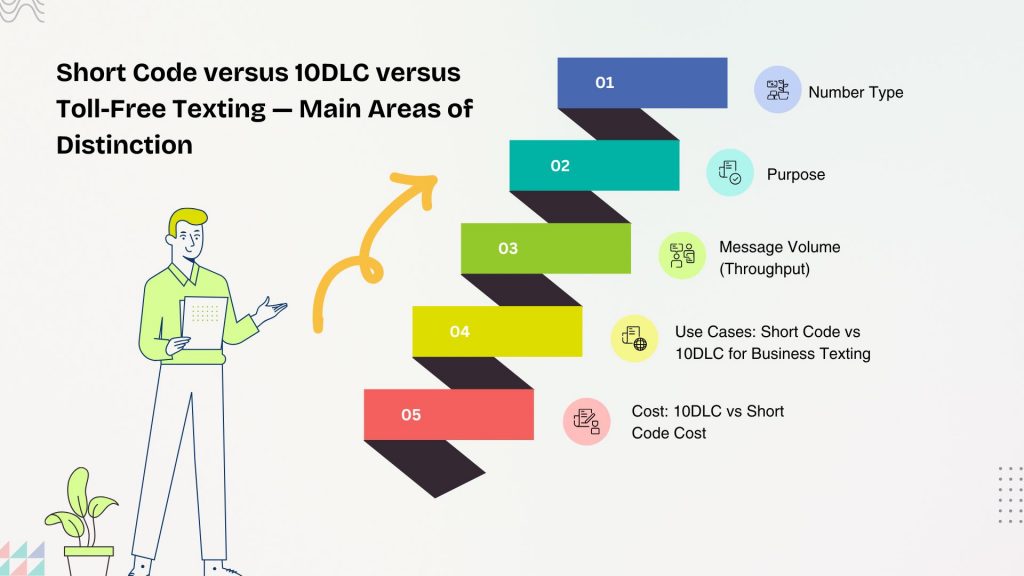
The distinction between a short code, 10dlc vs toll-free number comes down to volume, immediacy, and required customer experience.
Number Type
- Short code texting: 5–6-digit code.
- 10DLC texting: 10-digit local (e.g., (555) 123-4567).
- Toll-Free texting: 10-digit 1-800 or similar number (e.g. 1-800-555-1234).
Purpose
- Short code texting: High-volume marketing, flash sales, immediate alerts, and verification (OTP) codes.
- 10DLC texting: Local engagement, appointment reminders, localized promotions, and service notifications one-to-one.
- Toll-free texting: Nationwide support, helpdesk interaction, and service updates.
Message Volume (Throughput)
This is a very important area to understand in the A2P messaging comparison.
- Short code texting: Very high (up to 500+ messages/sec) with unrivalled throughput.
- 10DLC texting: Moderate (very different depending on vetting tier/trust score).
- Toll-free texting: Mid-high (provides a good cost-to-throughput balance for most business needs).
Use Cases: Short Code vs 10DLC for Business Texting
- Short code: Retail marketing for flash sales, political campaigns, contests nationwide, and major event alerts.
- 10DLC: Healthcare (reminders, rescheduling), education (communication with parents), local service businesses (confirmations), and localized marketing.
- Toll-free: National call centers, SaaS customer support, logistics companies, and any other business that requires one nationwide phone number for calls and text.
Cost: 10DLC vs Short Code Cost
- Short code texting: $$$ (High leasing costs, high carrier fees)
- 10DLC texting: $ (Low registration fees, small per-message carrier fees)
- Toll-free texting: $$ (Reasonably priced monthly plan, verification fee, competitive per-message fees).
Comparison Table: Short Code vs 10DLC vs Toll-Free Comparison Chart
| Factor | Short Code Texting | 10DLC Texting | Toll-Free Texting |
| Number Length | 5–6 digits | 10 digits (local area code) | 10 digits (1-800 type) |
| Speed/Throughput | Highest (Enterprise-level) | Medium (Varies by Trust Score) | High (Excellent for volume) |
| Setup Time | 6–8 weeks | 3–5 days | 5–7 days (for verification) |
| Regulatory Requirement | Carrier pre-approval/Leasing | The Campaign Registry (TCR) Registration | Toll-free verification |
| Cost (Monthly/Setup) | $$$ ($500–$1,000+) | $ ($10–$50) | $$ ($5–$25 + verification) |
| Two-Way Messaging | Limited (Primarily broadcast) | Supported (Excellent for conversations) | Supported (Ideal for support) |
| Ideal For | High-volume, time-sensitive marketing | Local engagement, reminders, and SMBs | National support, helpdesks, and customer care |
| Compliance (Opt-in) | Required | Required | Required |
| Scalability | Enterprise | SMB–Enterprise | SMB–Enterprise |
| Example Use Case | “Text WIN to 56789” | “Your 2 PM appointment is confirmed.” | “Text SUPPORT to 1-800-555-HELP” |
Short Code vs. 10DLC vs. Toll-Free – Which Channel Should You Choose?
When deciding on the best texting option for marketing—short code vs. 10-digit long code vs. toll-free—it requires thoughtful consideration of your business size, budget, and primary communication goals.
When to Choose Short Code Texting
- You regularly send millions of marketing texts each month or need to guarantee instantaneous delivery for alerts of time-sensitive information (e.g., major weather alerts, last-minute flight changes).
- You need guaranteed instant delivery speed, the highest deliverability, and premium brand awareness.
- Good examples of businesses include large national retailers, political campaigns, large non-profits, and media companies.
When to Choose 10DLC Texting
- Your business is a local business, a healthcare provider, or a regional service company sending reminders, localized promotions, or needing two-way conversations.
- Your priorities are regulatory SMS compliance, affordability, and the personal, familiar touch of a local area code.
- Best for: Small and mid-sized businesses (SMBs), healthcare and dental offices, real estate agents, and local services.
When To Choose Toll-Free Texting
- Knowing that you manage customer conversations nationally (or across multiple states), you need a single recognized number for calls and texts.
- You need higher message throughput than 10DLC texting, but you cannot justify the costs associated with short code texting.
- Best for: Call centres, national SaaS companies, logistics and transportation, and basically any business where toll-free texting vs 10dlc national accessibility is more important.
Expert Perspective
For most SMBs, 10DLC texting vs Toll-Free texting provides the best balance of personalization, cost, and compliance. Enterprises that need to use the maximum throughput and need carrier pre-approval for sending SMS at scale should continue using short code texting.
In the end, the simplest way to manage short code vs 10DLC vs Toll-Free compliance obligations under a single umbrella is leveraging Emitrr’s AI-powered platform that will intelligently automate the setup, registration, and routing.
Leverage the Power of Texting with Emitrr AI
The best option is not just one type of number; it is the platform that enables you to use all three intelligently and in compliance. Emitrr’s AI communication suite removes the confusion of short code vs 10DLC vs toll-free texting, while assuring you will always take the best route for the highest deliverability and ROI.
How Emitrr Benefits Subscribers
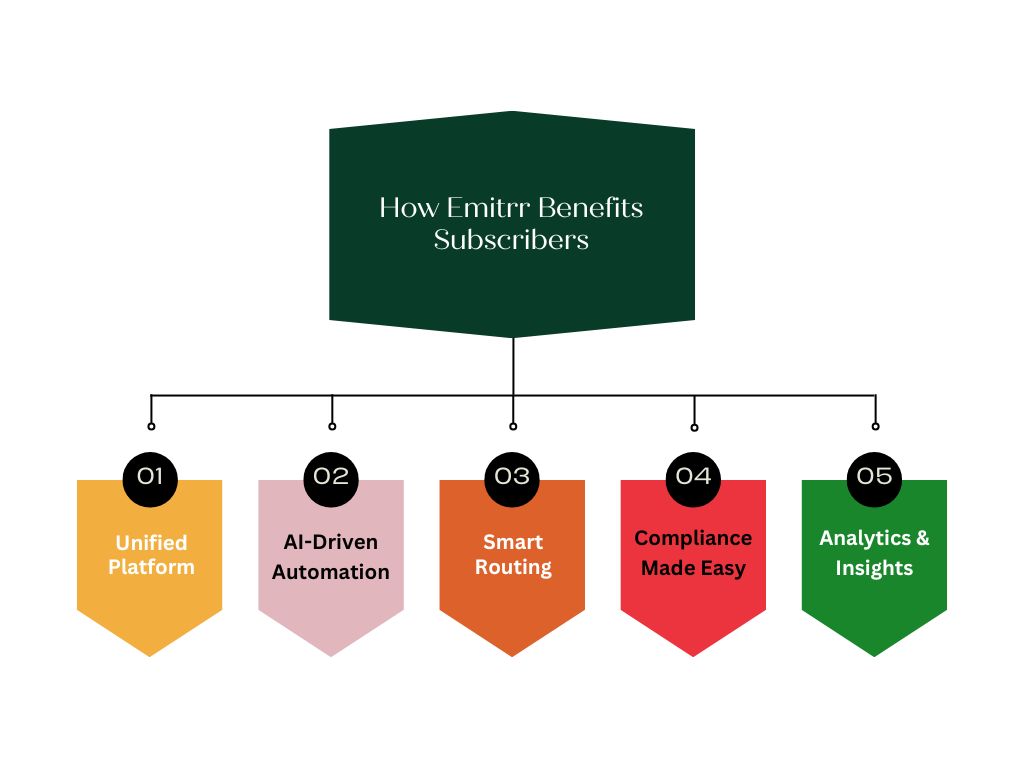
- Unified Platform: Manage your short code, 10DLC texting number, and toll-free texting number, all in one central dashboard.
- AI-Driven Automation: Automate inquiries, responses, follow-ups, and FAQs using conversational AI, greatly minimizing the workload on your staff.
- Smart Routing: The AI will determine if a message should be sent from a local (for example, 10DLC) or national (Toll-Free) texting. The AI makes that decision based on the customer’s area code or context to provide the best user experience.
- Compliance Made Easy: Emitrr handles all brand and campaign registrations required for 10DLC texting and/ or confirmations to meet compliance, while making short code vs 10DLC compliance easy.
- Analytics & Insights: View real-time key performance indicators across all number types, including delivery rates and campaign ROI.
Key Benefits of Emitrr
- HIPAA-compliant AI agent (important in healthcare).
- AI-powered auto responds, handling 80% of standardized inquiries!
- Integrates with leading CRMs (Salesforce, HubSpot, Denticon) for a single view of all readers and social activity.
- Support for bulk campaigns as well as 1-to-1 personal responses.
- Create personalized SMS templates for marketing, appointment reminders, and feedback campaigns across all three number types.
Frequently Asked Questions
Ans: Short codes are primarily for mass marketing, 10DLC is more localized for engagement, and toll-free texting is designated for customer support across the country.
Ans: 10DLC is better for localized businesses, as it will feel more familiar and be less expensive. If you are delivering service across multiple states or in a nationwide service, toll-free texting allows for consistency across multiple locations and a greater engagement for your audience.
Ans: Short codes are significantly more expensive than 10DLC from a cost standpoint. Short codes are approved first, then leased month to month. The cost and complexity of the short code approval process is greater than 10DLC, which can be approved and activated for texting much more quickly and cheaply.
Ans: Yes, there is a difference. 10DLC routes localized paths and can have compliance checks when sending. Toll-free is for larger-scale campaigns and sends all A2P messaging flagged as 100% opt-in and approved.
Ans: It depends on your objectives. Short code is great for marketing and mass messaging, 10DLC is best for engagement, and toll-free is best for customer support. Many businesses use a combination of all 3 with Emitrr.
Ans: It is, but regulated businesses are going to 10DLC texting or toll-free texting for enhanced encryption, compliance automation, and secure data management through platforms like Emitrr.
Ans: Unverified 10DLC or toll-free numbers set you up for blocking, carrier fines, and account suspensions. It’s imperative to stay compliant across all A2P channels with these numbers.
Conclusion
Determining whether to go short code vs 10DLC vs toll-free texting will depend on your purpose for your business texting strategy and your message volume:
- Short code texting = uncompromised throughput for large volume campaigns.
- 10DLC texting = trust in local and affordable compliance.
- Toll-free texting = reach across the US and brand consistency.
When it comes to the best texting option for marketing in short code vs 10DLC vs toll-free texting, it’s not about choosing your favourite or your number type; it’s about optimizing your configuration between all three on one platform for a cohesive texting strategy.
This is where Emitrr excels. Emitrr can automate your registration, manage compliance in delivery, and use Artificial Intelligence to route your messages to optimize deliverability and engagement.
Book a demonstration with Emitrr today to see how you can manage and scale your texting needs through all three number types, from short code to toll-free, and continue to store your data securely and late efficiently as well. Schedule A Demo Today.

 4.9 (400+
reviews)
4.9 (400+
reviews)