
Introduction
“When your calendar becomes a liability, not just a tool, it’s time for HIPAA-safe scheduling.”
Scheduling an appointment in healthcare and other regulated industries is not just a logistical exercise; you are also taking care of some sensitive patient data. Each time a client books, reschedules, or cancels an appointment, you are moving Protected Health Information (PHI) within a system. This is where HIPAA-compliant online scheduling systems become essential. The best online scheduling systems do not just keep your calendar in order but also provide privacy as a part of security, compliance, and usability.
In recent years, patients expect to directly book their own appointments, reschedule from their mobile device, and receive a reminder via SMS. The challenge here is doing these things while protecting the PHI. In this article, we are going to discuss what HIPAA-compliant online scheduling means, why it matters, and how exactly to build or choose online scheduling software that may help your practice scale with safety.
What Is HIPAA Compliant Online Scheduling?
HIPAA-compliant online appointment scheduling allows for the digital management of patient scheduling, with the promise that all communications containing patient information comply with the HIPAA privacy and security provisions.
In other words, when a patient books, cancels, or reschedules an appointment online, their protected health information (PHI), including a patient’s name, contact information, medical reason, or insurance, is handled in a secure way. This means that the scheduling process, from the time a patient enters the information until it is stored, retrieved, and accessed by staff, must be encrypted and subject to access controls and auditable.
To be more precise, HIPAA-compliant online scheduling means that all sensitive health data being exchanged when the appointment is scheduled is:
- Encrypted in transit and at rest.
- Only viewable by authorized users, and
- Tracked and logged to assure an auditable trail.
In the end, it’s not only about convenience, it’s about preserving patient trust and safeguarding your practice legally while providing patients with the modern digital experience they expect.

Main Components of a HIPAA Scheduling System
- Encryption while in transit and at rest: There should be secure encryption of patient data transfers while in suspended motion (i.e., booking forms, appointment reminders, etc.) and on the server for data at rest (stored on the server). This prevents unauthorized access while in transit and in storage.
- Access control and role-based access: The system should restrict access to only those authorized by front-desk staff, clinicians, or admins, and as appropriate, minimize exposure to PHI, etc., etc.
- Audit logs of scheduling activity: The system automatically logs every scheduled action. It tracks who viewed the schedule, booked, edited, canceled, etc., in ways that can be prompted.
- Secure messaging and reminder channels: Utilizes encrypted and HIPAA-compliant SMS or email systems to send appointment reminders or updates so that no sensitive PHI is shared in insecure formats.
- Business Associate Agreements (BAA) with providers: A legally binding contract between your organization and the scheduling vendor, where both parties are responsible for maintaining and protecting patient information as per HIPAA regulations.
In other words, a HIPAA-compliant scheduling solution turns what often is a weakness in your operation into a secure, compliant experience.
Why HIPAA Compliance Matters for Online Appointment Scheduling
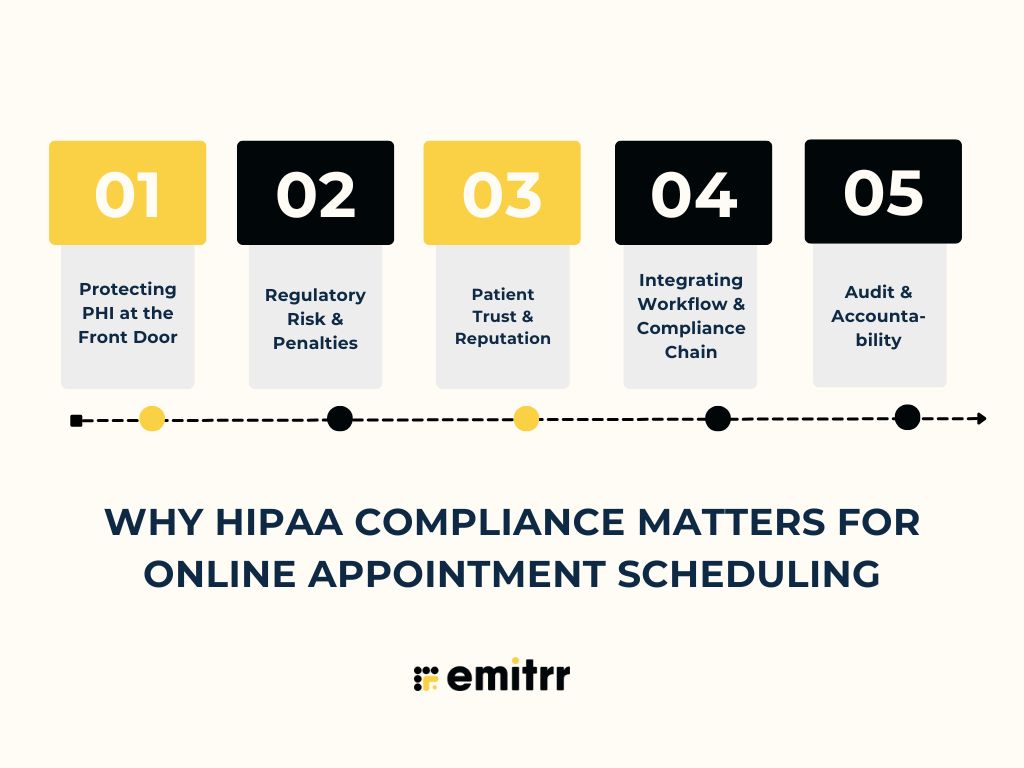
Protecting PHI at the Front Door
Appointment systems capture PHI at the earliest point: name, contact, reason for visit, etc. If booking is insecure, that data can be exposed before the patient information ever makes it to your internal systems.
Regulatory Risk & Penalties
Involvement with PHI and the HIPAA standard can lead to fines (from thousands to millions of dollars), required breach notifications, and lawsuits. A lot of these violations can come from simple tools that do not appear to be harmful, such as scheduling forms/booking reminders.
Patient Trust & Reputation
Patients expect their medical information to be kept safe. If a patient believes their information is not secure with your scheduling system, their trust in you and your team will be diminished before care starts.
Integrating Workflow & Compliance Chain
Your scheduling system typically pushes information into your EHR, CRM, and billing system. If the scheduling process itself is non-compliant, you sever the trust chain across your tech stack.
Audit & Accountability
HIPAA mandates you document who accessed, modified, or viewed PHI. A compliant scheduler provides audit logs, version control, and traceability for regulatory inspection.
HIPAA Regulations for Online Scheduling
The following are the most important HIPAA regulations:
- Access Controls and Authentication: Have a strong authentication process for users, role-based access, and implement user access policies.
- Encryption: Have your data encrypted while in transit and at rest using something like TLS for transmission and AES-256 for storage.
- Audit Logs and Monitoring: Have a log documenting who accessed, updated, or deleted appointment information or patient information.
- Data Minimization and Least Privilege: Only collect PHI that is necessary for the scheduling task, and if information is displayed, only information necessary to the task must be displayed.
- Business Associate Agreement (BAA): Any vendor accessing PHI (including scheduling software) must sign a BAA.
- Data Backup and Recovery: Follow HIPAA’s data retention, backup, and integrity provisions.
- Secure Reminder and Messaging: Any communications (i.e., reminders, SMS, email) made should not disclose sensitive health information unless encrypted and, in an ideal situation, de-identified.
- Breach Notification: In the case PHI is compromised, your scheduling should allow for a processing timeline for a breach notification process.
How to Schedule Appointments in Compliance with HIPAA
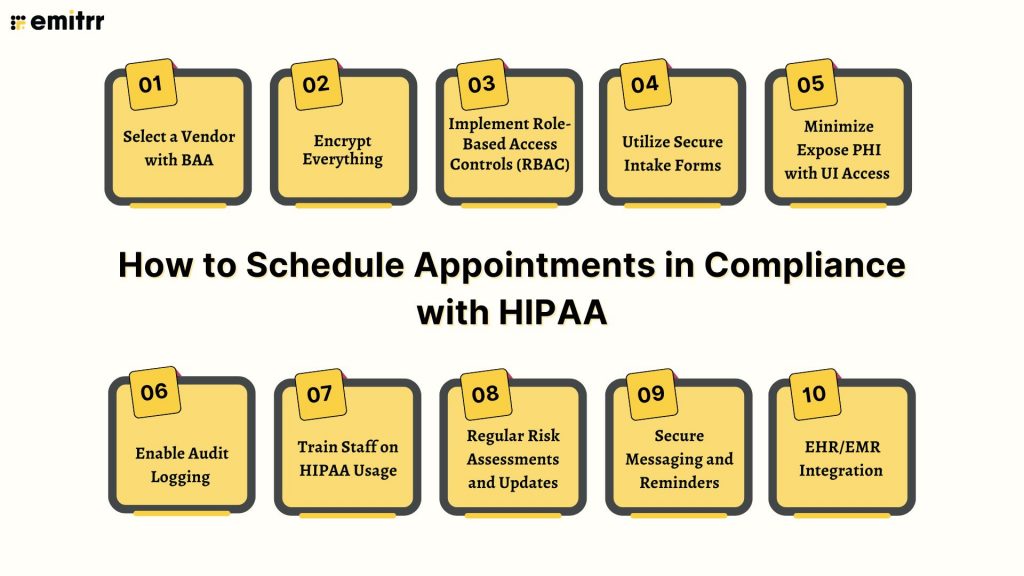
To utilize a HIPAA-compliant method of scheduling appointments, consider this list of action items:
Select a Vendor with BAA
Never utilize a platform for scheduling services until the vendor executes a Business Associate Agreement (BAA) for scheduling services.
Encrypt Everything
All data in transit should be encrypted using TLS 1.2 (or better), and all data at rest should be encrypted using AES-256 (or better). Additionally, PHI should not be in plain text for any communications or reminders.
Implement Role-Based Access Controls (RBAC)
Staff should have access to calendars or patient information based on their role, with no access to other sensitive information.
Utilize Secure Intake Forms
Home session or pre-appointment questionnaires must be securely stored and transferred.
To help you securely collect and store patient details, here are free downloadable medical form templates that support compliant digital intake and authorization workflows:
Minimize Expose PHI with UI Access (user interface)
Minimize identifiable information in regular reminders or booking confirmations (or use, rather than in emails)—e.g., “Appointment with Dr. Smith” vs “Appointment for evaluation of left knee pain.”
Enable Audit Logging
Track any changes to scheduling, cancellations, and other forms of who did what.
Train Staff on HIPAA Usage
A compliant scheduling system is meaningless if staff misuse it. Train staff on handling data, how to appropriately protect passwords, and incident reporting.
Regular Risk Assessments and Updates
Audits, software updates, vulnerability scans, and reviews are helpful to maintain the integrity of your scheduling system.
Secure Messaging and Reminders
For appointment reminders, use secure messages or secure communication. Avoid or limit using SMS in favor of secure options when possible. To support secure communication, practices can also download HIPAA-compliant SMS templates for scheduling and reminders. These ready-to-use templates help ensure messages are standardized, consent-based, and compliant with HIPAA guidelines, while keeping patients informed without manual follow-ups.
EHR/EMR Integration
Utilize secure, encrypted APIs and make sure the downstream systems understand HIPAA regulations.
Ensure Compliance with Emitrr
Here’s everything Emitrr accomplishes with its HIPAA-compliant scheduling platform to have secure, scalable appointment scheduling and list some advanced features:
- Online Appointment Scheduling (Self-Service Booking): Patients can effortlessly book through a branded portal at their convenience and with security.
- Group Appointments / Class Scheduling: This will allow multiple participants to join one or more sessions, without exposing PHI.
- Multi-Location Scheduling: Manage bookings for multiple branches or clinics, all with one user interface.
- Slot Management: Set availability, buffers, block times and manage the staff’s schedules.
- Appointment Reminders: Automated HIPAA-compliant appointment reminders sent via text messaging and secure means of communication to lessen no-shows.
- Autoresponders: Instantly confirm a booking and/or respond to requests for rescheduling.
- Automated Recall: Prompt previously treated patients to get re-care.
- Follow-up Surveys / Feedback: Gather limited health history or feedback after the appointment without figuring out who came to the appointment.
- CRM / EMR / EHR Integration: Sync bookings with the patient’s records, always safely, responsibly, and in a BAA-covered enclave.
- Custom Booking Pages / Branded Links: Maintain brand consistency without a traditional trade-off of exposing internal workflows.
- Client Portal: Patients can view secure upcoming and past appointments.
- Digital Intake Forms / Pre-Appointment Questionnaires: A secure and HIPAA-compliant way to collect health history or forms before a visit, with scheduling as a key feature.
- Metrics & Reporting: Monitor no-shows, utilization, and cancellations—without PHI exposure.
- HIPAA-Compliant Scheduling & Intake: The platform is constructed from the ground up with HIPAA requirements.
- AI-Powered Scheduling: Emitrr’s AI assistant supports booking and rescheduling as well as listing, so that the system intelligently minimizes your manual workflow.
With Emitrr, you don’t just have a HIPAA-compliant scheduling application; you have an entire ecosystem that incorporates automation, compliance, and patient engagement.
Frequently Asked Questions
Ans: Yes, if you are scheduling with PHI or patient identifiers, you have to use a HIPAA-compliant patient appointment scheduling solution.
Ans: Generally, no, especially if they don’t sign BAAs, or do not have the required encryption, or audit logging settings for HIPAA-compliant scheduling software.
Ans: Through the use of practice de-identified messaging or routing through secure channels, or requiring patients to view reminders, under a secure portal.
Ans: Yes, if using a patient self-scheduling platform that has encryption, authentication, and data minimization.
Ans: It means having a role-based access system with end-to-end encryption, audit logs, and a BAA with the vendor.
Ans: Yes, as long as the system aggregates the participants and does not share full PHI with all people (Emitrr will do this).
Ans: Regularly, at least once a year or with every feature change. HIPAA requires an ongoing risk assessment.
Conclusion
HIPAA compliance is more than a checklist; it is a way to build trust, protect patients, and overall safeguard your practice. When every booking, cancellation, and reminder carries the threat of exposure, your scheduling system is mission-critical.
By utilizing a HIPAA-compliant scheduling software and adhering to certain design principles, encryption, role-based access, secure reminders, and audits- you can make your calendar a secure, intelligent workflow for your practice. You also get reinforcement of that process when you use Emitrr as your online scheduling platform. Emitrr is HIPAA compliant and fully automated scheduling, reminders, and integrations for your practice.
Are you ready for secure scheduling that grows with your practice?
If you would like to schedule a free demo with Emitrr and see how we will turn being HIPAA compliant from a burden to an advantage, schedule today!


 4.9 (400+
reviews)
4.9 (400+
reviews)