
Introduction
Selecting an EHR is never simple, particularly when you have to choose between two major providers like Athenahealth and Epic. Both platforms are strong, popular, and offer the potential to improve patient care, expedite processes, and make billing easier.
However, the reality is that they are designed for quite different kinds of healthcare institutions.
Using data from YouTube reviews, user comments, product demos, and frequent conversations from administrators and clinicians who use these systems on a daily basis, this guide explains the differences. You don’t need to be a technical expert to follow along because everything is written in simple terms.
Athenahealth vs Epic: Why This Comparison Matters
The foundation of contemporary healthcare is Electronic Health Records (EHRs). Patient check-ins, physician workflows, billing, scheduling, communication, and even patient satisfaction are all impacted. Clinics and hospitals want to make this decision correctly the first time because switching systems is costly and disruptive.
- Both Athenahealth and Epic provide all-in-one platforms, they are frequently compared.
- Both support U.S. medical practices.
- EHR, practice management, billing, and patient communication are all integrated.
However, their ideal user base, complexity, pricing, and philosophy differ significantly. This blog will give you a thorough understanding of each platform so you can determine which one is best for your company.
At a Glance: Who Each System Is Best For
It’s helpful to know who these platforms are intended for before delving into features.
Athenahealth is ideal for:
- Small to medium-sized healthcare facilities.
- Expanding clinics with several providers
- Methods requiring cloud-based convenience
- Teams seeking quick and easy onboarding
- Businesses that favor revenue sharing over significant upfront expenses
To put it briefly, Athenahealth was designed with efficiency and usability in mind.
Epic is ideal for:
- Large hospitals.
- Health systems with multiple specialties
- Businesses that require intricate customizations
- Organizations requiring sophisticated reporting and analytics
- Organizations with IT departments and large implementation budgets
To put it briefly, Epic is designed for enterprise-level care, depth, and scale.
Platform Overview: How Each System Works
What is Athenahealth?
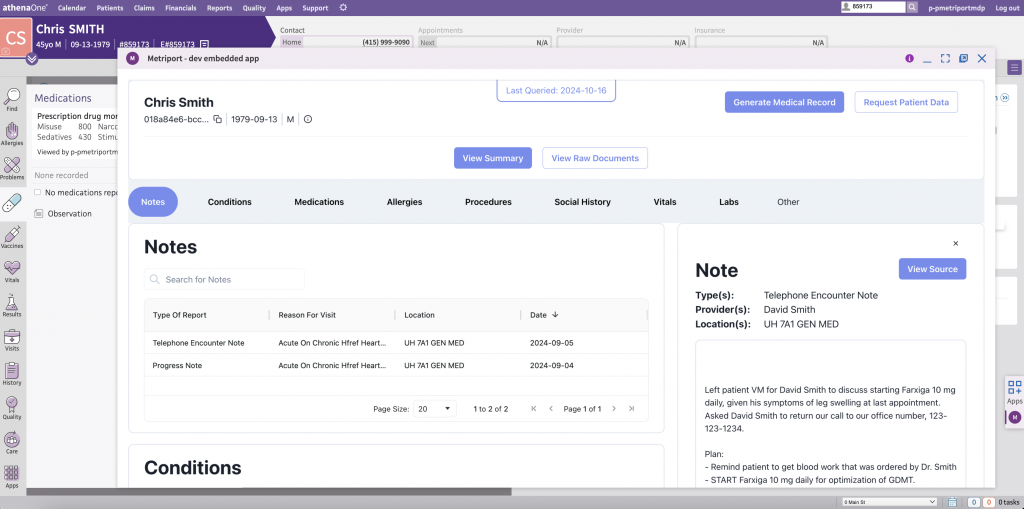
Athenahealth is an EHR and medical practice management system that runs on the cloud. Practices don’t require servers, complicated installations, or a sizable IT staff because it’s web-based. Updates are released automatically, and everything is done online.
All sizes of practices use it, but ambulatory practices, outpatient settings, and clinics that wish to remain flexible are where it excels.
What makes Athenahealth different?
- Fully cloud-based (nothing to install)
- Easy, intuitive interface for clinicians
- Revenue-sharing pricing: they only earn when you earn
- Strong patient engagement features
- Built-in support with a dedicated advisor
- athenaOne mobile app for iPhones and tablets
This is a platform designed for speed, simplicity, and practice growth.
What is Epic?
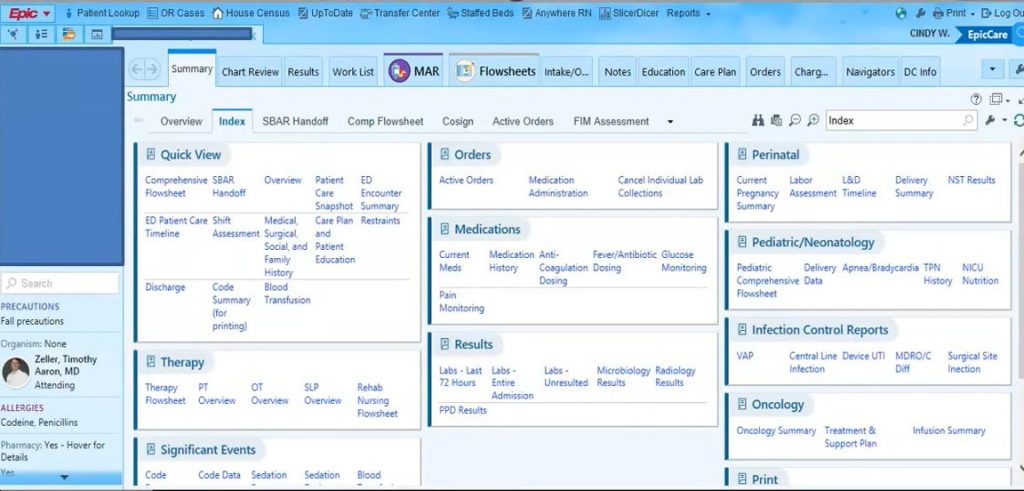
Since 1979, large hospitals and health systems have been dominated by Epic, an enterprise-grade EHR system. It is renowned for its breadth, adaptability, and capacity to handle enormous amounts of patient data from various facilities.
Because of its enormous scale and strong functionality, Epic is used by many of the best health systems in the United States, including Kaiser Permanente, Mayo Clinic, Cleveland Clinic, and others.
What makes Epic different?
- All modules run on a unified database
- Highly customizable for complex workflows
- Industry-leading interoperability
- Advanced scheduling and inpatient management tools
- Strong analytics and reporting
- MyChart — one of the best patient portals in the industry
This system is built for healthcare giants — but that also means a steep learning curve and high cost.

Feature Comparison: Athenahealth vs Epic
Below is a breakdown of the major feature categories and how each platform performs.
1. EHR & Clinical Workflows
Athenahealth
Athenahealth is commended for its clinical workflows that are simple to understand. Doctors don’t have to click through endless screens to navigate the patient encounter. Documentation is easily integrated into billing and follow-up tasks, and templates are easily customizable.
Clinicians especially like:
- Well-organized patient charts
- Simple note-taking
- Easy workflows for prescriptions. You can even add AI for automating prescription refill in Athena
- Access to medical records through CommonWell and Carequality
- Quick navigation with fewer pointless steps
It doesn’t have an excessive number of features, which is advantageous.
Epic
The clinical tools offered by Epic are very powerful. The platform supports:
- Inpatient care
- Workflows for outpatients
- Documentation specific to a particular specialty
- Integrations in the lab
- Imaging
- Coordination of care in hospitals
But there is complexity associated with this depth. Many medical professionals claim that Epic necessitates:
- Comprehensive training
- Customization of workflow
- It’s time to comprehend its reasoning
However, once mastered, Epic is incredibly powerful, particularly for cross-departmental or cross-specialty teams.
2. Practice Management & Scheduling
Athenahealth
Athenahealth’s scheduling system is easy to use and straightforward. This helps front-desk teams handle daily patient flow effectively. Appointments can be created or changed quickly, and the layout is simple enough for new staff to learn in a short time. Automated reminders and real-time insurance eligibility checks are part of the scheduling workflow. These features help lower no-shows and lessen last-minute disruptions. Patients can also schedule their appointments through the portal. This cuts down on phone calls and helps fill open slots more quickly.
What’s best is by adding a tool like Emitrr to Athenahealth, you can even:
- Automatically fill empty slots in your schedule by identifying patients in AthenaHealth with similar visit type and fill empty slots for last minute cancellations with our fast fill lists
- Send last-minute notifications to fill empty slots
- Setting up appointment reminders & recalls based on events
See this feature in action:
Epic
Epic’s scheduling module, Cadence, is much more customizable and was designed to help hospitals and large health systems with complex scheduling needs. It enables organizations to establish specific rules for appointment types, provider availability, linked resources such as rooms or equipment, and workflows across multiple locations. This flexibility is a big benefit for large organizations, but it also means the system takes longer to learn and needs more training. However, once set up correctly, Cadence provides a well-coordinated scheduling environment that handles large volumes and multi-department care.
3. Revenue Cycle Management (Billing)
Athenahealth
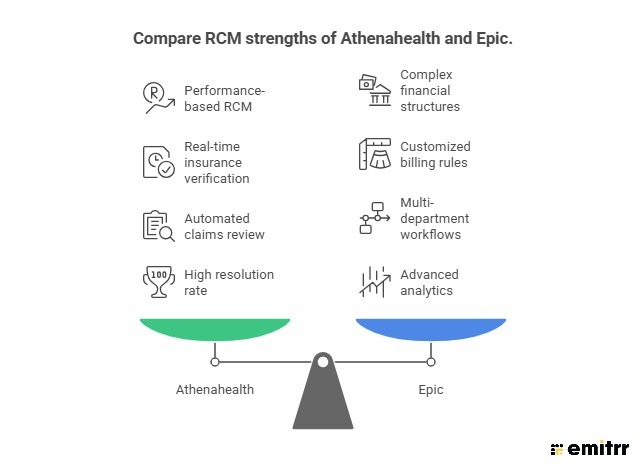
Athena is very strong in RCM, which is a major selling point for the platform. Its performance-based model connects Athena to a practice’s financial success. They only succeed when the practice collects revenue.
Key advantages:
- Real-time insurance eligibility verification
- Claims automatically reviewed for errors
- 93% first-pass resolution rate (as claimed)
- Automated tracking of denied claims
- Revenue dashboards with real-time updates
Epic
Epic’s RCM tools are designed for large systems with complex financial structures. This setup works well for hospitals but is often too much for small or medium-sized practices.
Key advantages:
- Customized billing rules
- Automated charge capture
- Multi-department billing workflows
- Advanced financial analytics
4. Patient Engagement
Athenahealth
Athena focuses heavily on digital patient experience. Patients can:
- Self-schedule appointments
- Access records digitally
- Receive automated reminders
- Make payments online
- Join telehealth sessions
- View test results easily
It’s built with modern patient expectations in mind. But many practices report that the communication tools feel restrictive. Mass outreach is difficult. Two-way texting is not always reliable. Staff often juggle multiple external tools to manage confirmations, rescheduling, or patient questions.
Solution within Athenahealth: Platforms like Emitrr fill these gaps by adding fully HIPAA-compliant two-way texting, automated reminders, and conversational workflows directly on top of Athenahealth. Practices can handle confirmations, updates, and follow-ups in real time without switching systems. This gives patients a smoother and faster communication experience.
See how you can engage with patients directly within Athenahealth via Emitrr:
Epic
Epic’s MyChart is one of the most recognized patient portals available. Millions of patients use it across major health systems.
MyChart enables:
- Appointment scheduling
- Messaging doctors
- Viewing prescriptions
- Paying bills
- Requesting refills
- Checking lab results
- Managing care for family members
Epic is very detailed, but it is designed for large health systems. Epic emphasizes MyChart for patient engagement. This works well for bigger systems, but it can be too much or confusing for patients who just want quick communication. Providers often say that patients overlook MyChart notifications, have trouble with login requirements, or fail to check messages promptly. Smaller departments also find it hard to carry out quick outreach campaigns or bulk communication without assistance from IT, which slows down their engagement efforts.
5. Interoperability
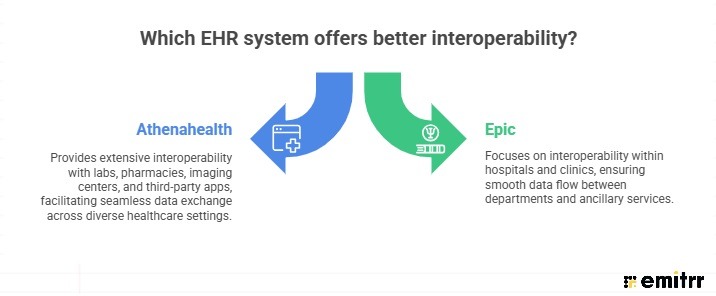
Athenahealth
Athena integrates smoothly with:
- Labs
- Pharmacies
- Imaging centers
- Third-party apps
- National networks (Carequality, CommonWell)
Because it’s web-based, integrations tend to be faster.
Epic
Epic is the gold standard in interoperability. Its unified database allows seamless, real-time data exchange across:
- Hospitals
- Clinics
- Departments
- Labs
- Ancillary services
For large organizations running multiple facilities, this capability is unmatched.
Recommended for reading: Practice Fusion Vs AthenaHealth
6. Athenahealth Pricing Vs Epic Pricing
Athenahealth Pricing
Athena pricing is based on a performance-based model, which means:
- No large upfront licensing fees.
- They take a percentage of your revenue only when you get paid.
- No hidden fees for maintenance or updates.
This approach attracts small and medium-sized practices looking for predictable, shared-risk pricing.
Epic Pricing
Epic pricing relies a lot on the size of the organization and usually includes:
- Large upfront licensing fees
- Implementation costs
- Customization fees
- Ongoing maintenance
- IT infrastructure or cloud hosting
For smaller clinics, Epic can be too expensive. For hospitals, it is seen as a long-term investment.
7. Epic vs Athenahealth Pros and Cons
Athenahealth Pros
- Easy to use, even for staff who are not tech-savvy.
- It is cloud-based, so there is no IT burden.
- It has strong billing and revenue management.
- The patient engagement tools are great.
- It is scalable for clinics with multiple physicians.
- The mobile app (athenaOne) is very convenient.
- You get a dedicated support advisor.
Athenahealth Cons
- Customer service feedback is inconsistent.
- The pricing can feel high for small clinics.
- There are occasional system delays or interface glitches.
Epic Pros
- Extremely powerful and customizable.
- Best interoperability in the industry.
- Perfect for hospitals and health systems.
- Strong analytics and reporting capabilities.
- MyChart is a highly trusted patient portal.
- Can handle complex inpatient and outpatient workflows.
Epic Cons
- Expensive upfront and long implementation timelines.
- Steep learning curve.
- Requires training and often an in-house IT team.
- Can feel overwhelming for smaller practices.
8. Which One Should You Choose? (Use-Case Scenarios)
Below are simple, real-world examples to help guide your decision.
Choose Athenahealth if…
- You run a small to mid-sized practice.
- You operate in ambulatory or outpatient care.
- You want something cloud-based and simple.
- You don’t want to hire a large IT team.
- You want built-in revenue cycle support.
- You prefer performance-based pricing.
- You want a system that can grow with you without becoming too complex.
Athena is a better fit for clinics that want an easy-to-use system without high overhead.
Choose Epic if…
- You are a large hospital or multi-specialty health system.
- You need extensive customization.
- You rely on detailed analytics for financial and clinical decisions.
- You want interoperability across multiple facilities.
- You can invest in training, IT, and implementation.
- You need inpatient and outpatient coverage in one system.
Epic is ideal for organizations that want a powerful, enterprise-grade EHR with features that extend across departments and facilities.
Athenahealth vs Epic: Comparison Summary
| Feature | Athenahealth | Epic |
|---|---|---|
| Best For | Small to mid-sized practices | Large hospitals & health systems |
| Deployment | Cloud-based | Primarily on-premise (with cloud options) |
| Ease of Use | Easy to learn and use | Complex, requires training |
| Implementation | Faster setup | Long, resource-intensive implementation |
| Customization | Limited flexibility | Highly customizable |
| Clinical Capabilities | Strong but standard | Advanced, enterprise-grade |
| Revenue Cycle Management | Built-in and strong | Available but more complex |
| Patient Engagement | Basic tools | Advanced (e.g., MyChart) |
| Integrations | Requires add-ons for advanced needs | Extensive built-in ecosystem |
| Pricing Model | % of collections (variable) | High upfront + ongoing costs |
| Support Needs | Lower IT dependency | Requires dedicated IT team |
| Scalability | Good for growing practices | Built for large-scale operations |
How Athenahealth Users Can Close Workflow Gaps with Emitrr
Athenahealth is powerful for EHR, billing, and clinical workflows, but falls short when it comes to high-volume patient communication and automation. Practices that rely heavily on reminders, follow-ups, and real-time texting often feel these limitations quickly. Combining Athenahealth with Emitrr helps users bridge these gaps without disrupting their existing setup.
What Emitrr Adds on Top of Athenahealth
- Enable high-volume 2-way texting in Athena that scales with patient load
- Automated reminders and follow-ups proven to reduce no-shows
- HIPAA-compliant SMS and email communication
- Centralized patient conversations across channels
- Improved response rates and faster task completion
- Bi-directional data sync
- Precision-based appointment notifications
- Bulk or segmented SMS/email campaign
- Communication & call analytics
- Text directly from Athenahealth
Take a look at Emitrr AI paired with Athena in action:
This pairing gives Athenahealth users the best of both worlds: rock-solid clinical workflows + modern patient engagement.
How Emitrr Improves Core Athenahealth Limitations
Feature Availability Overview
- Contact sync — ✔️
- Reviews — ✔️
- Reminders — ✔️
- Confirmations — ✔️
- No-show follow-ups — ✔️
- Review by patient type — WIP
- AI text generation — ✔️
- AI SMS agent — ✔️
- AI appointment scheduler — ✔️
- AI voicemail transcription — ✔️
- AI calling agent — WIP
Key Takeaways: Athenahealth vs Epic
What is athenahealth vs Epic comes down to practice size, Athenahealth fits small–mid clinics, while Epic is built for large hospitals and health systems
- In an athenahealth vs epic comparison, Athenahealth is cloud-based, simple, and faster to implement, whereas Epic is complex, highly customizable, and requires heavy training and IT support.
- Epic offers deeper clinical capabilities, analytics, and interoperability, making it ideal for multi-specialty care- one of the key epic vs athena ehr features differences.
- Athenahealth stands out for ease of use, faster onboarding, and strong revenue cycle management.
- Pricing differs significantly; Athena uses percentage-based (collections) pricing, while Epic involves high upfront + implementation + maintenance costs.
- Patient engagement differs; Athena is simpler but limited, while Epic’s MyChart is powerful but can feel complex for users.
- Athenahealth may need add-ons for advanced communication, whereas Epic has built-in enterprise-grade features but at the cost of complexity.
- Final choice depends on needs; athena emr vs epic ehr system differences show Athena is best for simplicity and growth, while Epic is built for scale and deep customization.
FAQs
Athenahealth is a cloud-based, SaaS EHR built for easier onboarding and faster updates, while Epic is a more complex enterprise EHR designed for large health systems. Epic offers deeper clinical functionality, but Athenahealth is generally more flexible, user-friendly, and cost-effective for small to mid-sized practices.
Yes, both are full-suite EHRs offering scheduling, charting, billing, and patient portals. However, Epic is enterprise-focused with more advanced clinical modules, while Athenahealth prioritizes usability, cloud efficiency, and faster deployment.
Typically, yes. Athenahealth uses a subscription-based pricing model that’s more affordable for small and mid-sized practices. Epic’s implementation and maintenance costs are significantly higher because it is built for large hospital networks with extensive customization.
Yes. Athenahealth and Epic can exchange patient data through interoperability frameworks like Carequality, CommonWell, and FHIR APIs. This allows providers on both systems to access shared clinical information such as records, labs, and referrals.
Epic’s major competitors include Cerner (Oracle Health), MEDITECH, Athenahealth, and NextGen, with Cerner being the closest large-scale competitor in hospital and health system deployments.
Athenahealth’s biggest limitations include less robust enterprise-level customization, lighter clinical modules compared to Epic, and limited built-in patient engagement tools. However, many practices pair Athenahealth with platforms like Emitrr to overcome communication gaps through automated reminders, 2-way texting, and scalable patient outreach
Epic is costly because it’s designed for large, complex health systems that require deep customization, extensive integration, and multi-year implementations. The system also demands higher IT infrastructure investment and ongoing support resources.
It depends on organization size and needs. Epic is better for large hospital systems needing advanced clinical depth and customization. Athenahealth is better for practices that want a cloud-based EHR that’s easier to manage, quicker to deploy, and more cost-efficient.
Yes. Athenahealth is considered a strong EHR for ambulatory practices thanks to its cloud architecture, user-friendly workflows, and revenue cycle features. Practices that need stronger patient engagement often extend its capabilities with tools like Emitrr, which adds automation, no-show reduction, and HIPAA-compliant 2-way communication.
What is athenahealth software used for becomes clear in its popularity, it offers cloud-based EHR, built-in billing, and easy implementation, making it ideal for small to mid-sized practices. Its revenue cycle management and usability are key drivers.
In an epic vs athenahealth comparison, Epic is often seen as expensive, complex to implement, and heavily dependent on IT support. It also has a steep learning curve, making it less ideal for smaller practices.
When exploring what is athenahealth, one concern has been past leadership controversies and business model criticism, particularly around its revenue-based pricing structure. However, the platform itself remains widely used.
Athenahealth is best known for its cloud-based EHR, integrated billing system, and quick deployment, making it a strong choice for growing practices.
Final Verdict: Athenahealth vs. Epic: Which One Is Right for Your Practice?
So, which is better Epic or Athenahealth? Both EHRs offer strong EHR capabilities, but they serve very different needs. Epic is a better choice for large hospitals and health systems that require deep customization, detailed analytics, and well-connected workflows across departments. It’s powerful but costly, complex, and better suited for organizations with robust IT support.
Athenahealth works best for small to mid-sized practices that want a modern, cloud-based system that is easier to adopt and manage. Its main weakness lies in patient communication. Clinics still struggle with no-shows, limited texting options, and manual follow-ups.
When paired with Emitrr, Athenahealth becomes much more effective. Automated reminders, AI-driven messaging, fast-fill scheduling, and real-time syncing help address many communication issues practices face. This combination helps reduce no-shows, improve patient response rates, and save staff time. Book a free demo now and get more out of your Athena EHR.

 4.9 (400+
reviews)
4.9 (400+
reviews)