
Introduction
It can be hard to choose the right EHR between Practice Fusion Vs AthenaHealth because it can feel like you’re choosing between two very different ways of doing things. When it comes to small to mid-sized outpatient practices, primary care clinics, and specialty groups looking for a cloud-based, compliant, and easy-to-use solution, these two EHRs are two of the most commonly compared systems.
But which one will really help you run your practice more smoothly? Which one reduces admin work? And which one gives you predictable costs?
This in-depth comparison of Practice Fusion vs AthenaHealth breaks down features, pricing, medical billing tools, patient engagement workflows, integrations, onboarding experience, and real-world pain points practitioners face daily.
Let’s dig in.
Quick Summary: Practice Fusion vs AthenaHealth
If you want the short answer:
- Practice Fusion is better for small practices needing affordable EHR pricing, simplicity, and quick setup.
- AthenaHealth is better if you want a robust Athena EHR, integrated Athena medical billing, population health tools, stronger analytics, and enterprise-grade workflows.
But the nuance is deeper, and price is a big deal for many clinics, so let’s break it down thoroughly.
2. Who Each EHR Is Best For
Practice Fusion is best for:
- Clinics with 1–10 providers
- Practices just moving off paper charts
- Solo practitioners seeking inexpensive access to EHRs
- Clinics that prioritize predictable Practice Fusion EHR costs
- Practices that aim for minimal disruption and quick onboarding
AthenaHealth is best for:
- Growing medical groups or multi-location practices
- Practices needing strong Athena medical billing tools
- Clinics with a large patient volume or complicated scheduling
- Businesses seeking high-quality dashboards and comprehensive reporting
- Healthcare organizations that require compatibility with NextGen, Cerner, eCW, Epic, etc.

Practice Fusion vs AthenaHealth: Feature Breakdown
1. EHR Usability & Interface
Practice Fusion
Practice Fusion was built with a simple mantra: “Make charting fast.” Providers often praise it for:
- Clean, predictable UI
- Quick chart creation
- Templates that don’t feel overly rigid
- Fast visit note workflows
- Minimal clicks
It doesn’t overwhelm you with 100 dashboards. Instead, it focuses on what smaller practices use most. Clinics moving from paper charts often choose Practice Fusion because the learning curve is minimal.
AthenaHealth
AthenaHealth’s interface is more detailed. Some providers love the depth; others find it overwhelming initially. Its Athena EHR includes:
- Task management workflows
- Centralized clinical inbox
- Population health insights
- Quality measure tracking
- Built-in care coordination tools
Athena gives you more power, but you have to climb the learning curve to leverage it. Busy clinics with part-time staff often struggle to get everyone up to speed quickly.
2. Charting & Clinical Workflows
Practice Fusion
Practice Fusion offers:
- Specialty templates
- Shortcut macros
- Lab integrations
- Medication management
- Voice dictation support
- Easy pasting of SOAP notes
Its templates feel straightforward, and even small teams appreciate that it doesn’t try too hard to be everything at once.
AthenaHealth
Athena’s charting system is richer:
- Automated quality prompts
- Order sets
- Clinical decision support
- Extensive specialty templates
- Integrated care coordination
- Clinical summaries tied to billing rules
Athena tries to optimize not just charting, but entire patient care cycles. If you’re in primary care, orthopedics, cardiology, behavioral health, or OBGYN, Athena’s specialty workflows can significantly reduce charting fatigue.
3. Practice Management & Scheduling
Practice Fusion
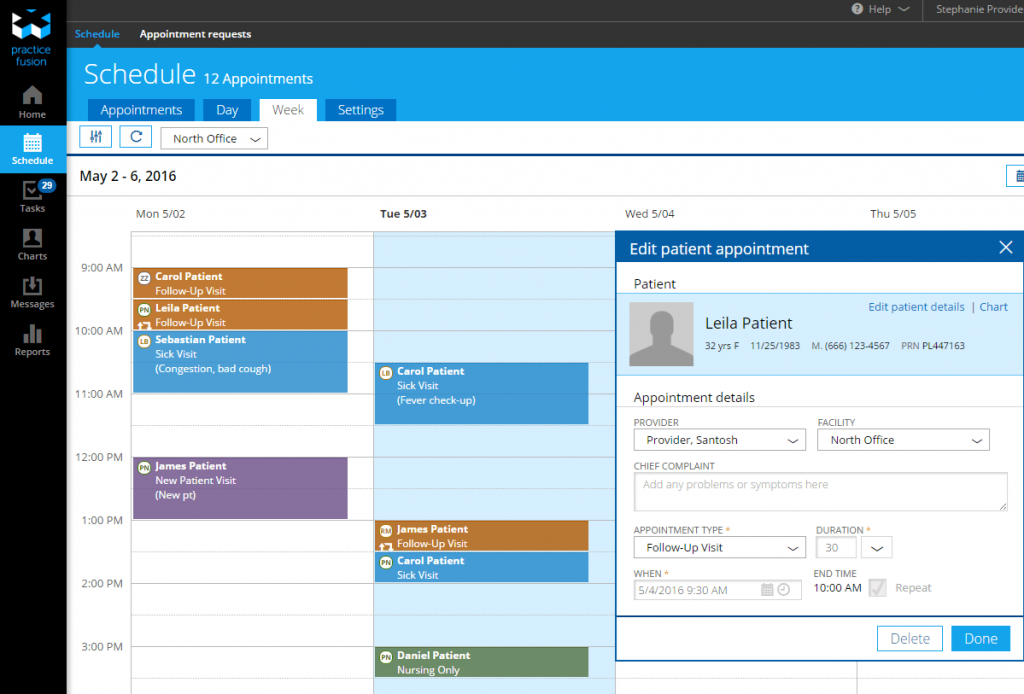
With its simple calendars, fast edits, and uncomplicated appointment workflows, Practice Fusion makes scheduling easy. Small practices looking for a simple layout without complicated operations will find it ideal. However, the platform does not provide advanced workflows, multi-location rules, or deeper automation beyond basic scheduling. Practices with high volume could soon reach their limit.
AthenaHealth

AthenaHealth’s scheduling is built for busier, multi-provider setups. It supports provider-specific rules, room/resource scheduling, automated eligibility checks, and analytics to reduce bottlenecks. It’s a step up in structure and efficiency for practices that need tighter control over volume.
Even with strong scheduling, Athena doesn’t cover high-volume patient coordination gaps like instant rescheduling, mass texting during gaps/cancellations, or automated follow-ups.
This is where Emitrr complements Athena by adding:
- Auto-texting for last-minute openings
- Instant rebooking links sent through SMS
- Workflow automation to reduce call volume
- 2-way texting to manage scheduling changes faster
Together, AthenaHealth + Emitrr make scheduling smoother, reduce no-shows, and keep calendars full in ways Practice Fusion simply can’t match.
4. Patient Portal & Engagement
Practice Fusion
Essentials like viewing results, secure messaging, refill requests, simple online scheduling, and basic reminders are all covered by Practice Fusion’s portal. However, it’s not designed for automated outreach or high-volume texting, but it works well for regular communication.
AthenaHealth
AthenaHealth offers a comprehensive platform that includes real-time messaging, bill payment, mobile access, and self-scheduling. Although engagement tools are more powerful, they are still not designed for extensive no-show reduction, campaigns, or two-way texting.
Here, a lot of Athena practices add Emitrr, which connects directly to AthenaHealth, to their engagement stack. Athena’s communication layer is improved by Emitrr by providing:
- Two-way HIPAA-compliant texting inside Athena
- Automated SMS + email reminders
- No-show recovery workflows
- Patient surveys
- Broadcast and campaign messaging
- Digital forms synced back to Athena
For clinics dealing with high patient volume, or those wanting to reduce call load, manage multiple locations, or modernize engagement, AthenaHealth + Emitrr becomes a much stronger, more scalable solution than Athena alone.
See how you can engage with patients directly within Athenahealth via Emitrr:
5. ePrescribing & Labs
Practice Fusion
Practice Fusion offers simple ePrescribing with quick refill approvals and easy access to patient medication history. Labs integrate smoothly for small practices, with simple ordering and results review. It’s fast, efficient, and easy for teams transitioning from paper.
AthenaHealth
AthenaHealth delivers more robust ePrescribing with automated safety checks, formulary compliance, and tighter medication management workflows. Lab ordering connects to a wider network, and results flow back in structured formats, making it stronger for busy, multi-provider environments.
6. Interoperability
Practice Fusion
Practice Fusion supports basic interoperability like file sharing, referrals, and lab connections, but it’s still largely made for small clinics that don’t need heavy data exchange. It works, but it’s not built for enterprise-level data movement.
AthenaHealth
AthenaHealth excels in interoperability with seamless connections to other EHRs, hospitals, HIEs, and imaging centers. It provides the capability of exchanging data in real time which reduces the number of manual processes and enhances patient care by making real-time updates. Also, AthenaHealth provides much better solutions for practices that want to scale or collaborate with other organizations through interoperability than Practice Fusion does.
- Athena <> Epic
- Athena <> eCW
- Athena <> Cerner
- Athena <> NextGen
- Direct secure messaging
- HIE connections
- Carequality & CommonWell access
7. Medical Billing: Practice Fusion vs AthenaHealth
Practice Fusion Medical Billing
Practice Fusion does not offer native billing, but it integrates with third-party billing partners.
Pros:
- You can choose your own RCM vendor
- Costs may be lower depending on partner
- Clean, simple superbill workflows
Cons:
- No single unified billing + EHR dashboard
- You depend heavily on the billing partner’s quality
- Reports may be limited
If you already have a trusted billing company, this is perfectly fine, but if you want an all-in-one “EHR + billing” system, Practice Fusion falls short.
AthenaHealth Medical Billing
Athena has one of the most powerful RCM systems in the cloud EHR market. It includes:
- Claims scrubbing
- Denial management
- Real-time billing rules
- Coding recommendations
- Performance dashboards
- Revenue forecasting
- Built-in clearinghouse
- Automated patient bill pay
- Eligibility verification
Many clinics choose Athena specifically for billing, not EHR.
If your front desk struggles with things like eligibility errors, coding mistakes, claims resubmission, follow-up delays, and missed revenue, then AthenaHealth’s RCM automation will feel like a major upgrade.
8. Pricing: Practice Fusion vs AthenaHealth
Practice Fusion EHR Pricing
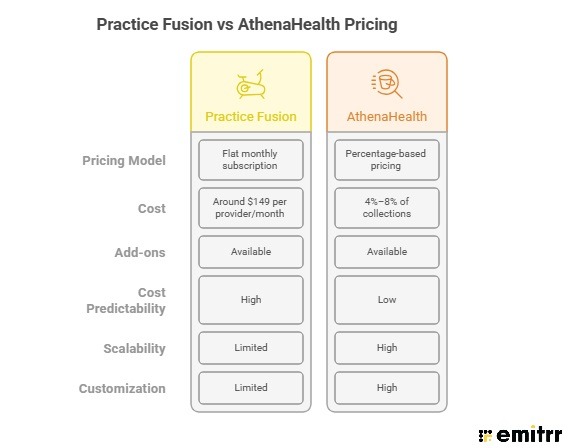
- Flat monthly subscription
- Historically around $149 per provider/month
- Add-ons available
The flat monthly subscription model keeps Practice Fusion EHR cost predictable and manageable. Small practices prefer it because it doesn’t scale costs based on volume.
AthenaHealth EHR Cost
AthenaHealth uses percentage-based pricing:
- Typically 4%–8% of collections
- Additional fees for add-ons or higher-tier features
- Custom quotes vary by specialty & size
Predicting Athena costs can be tricky unless you know your average monthly collections. For high-revenue practices percentage-based billing can lead to higher monthly spend. And for smaller clinics, it may be equal to or even cheaper than a flat subscription.
See how Athenahealth compares with eClinicalWorks
6. Onboarding & Customer Support
Practice Fusion
- Fast onboarding
- Training videos & resource center
- Support via ticketing
- Easy for staff to adopt
AthenaHealth
- Longer setup because workflows are deeper
- 1:1 support during implementation
- Ongoing training
- Support teams vary by practice size
AthenaHealth requires more time upfront, but the payoff is higher long-term efficiency.
7. Security, Compliance & Certifications
Both systems are:
- HIPAA-compliant
- Cloud-hosted
- ONC-certified
- Offer multi-factor authentication
AthenaHealth offers additional enterprise-level compliance features, making it preferred for larger organizations.
Real User Pain Points (and How Each EHR Addresses Them)
Pain Point 1: High cost unpredictability
- Practice Fusion: Predictable
- AthenaHealth: variable, % of revenue
Pain Point 2: Need for strong medical billing
- Practice Fusion: depends on third-party RCM
- AthenaHealth: built-in end-to-end RCM
Pain Point 3: Patients expect modern engagement tools
- Practice Fusion: basic
- AthenaHealth: strong
- (Often extended using tools like Emitrr)
Pain Point 4: Learning curve & staff training
- Practice Fusion: easy
- AthenaHealth: takes time
Pain Point 5: Interoperability with larger hospital networks
- Practice Fusion: limited
- AthenaHealth: excellent
Practice Fusion vs AthenaHealth: Pros & Cons
Practice Fusion Pros
- Affordable
- Easy to learn
- Ideal for small clinics
- Fast setup
- Clean interface
- Predictable pricing
- Good basic patient portal
- Lightweight & efficient
Practice Fusion Cons
- Limited interoperability
- No built-in billing
- Not suited for large or multi-site practices
- Reporting dashboards not very advanced
AthenaHealth Pros
- One of the best billing systems in the industry
- Robust Athena EHR and practice management
- Great analytics
- Deep interoperability
- Strong patient engagement tools
- Suitable for larger groups
- Customizable workflows
AthenaHealth Cons
- Pricing can be expensive
- Learning curve
- Longer onboarding
- Not ideal for solo practices needing simple workflows
See how Athena users can use AI to reduce front desk work:
Which One Should You Choose?
Choose Practice Fusion If You Want:
- Simplicity
- Low, predictable costs
- Easy charting
- A system that works without training everyone for weeks
It is ideal for small groups, solo clinicians, and budget-sensitive practices.
Choose AthenaHealth If You Want:
- Enterprise-grade EHR
- Integrated medical billing automation
- High-volume scheduling
- Strong analytics
- Interoperability
- Advanced patient communication
It is ideal for growing practices and multi-location healthcare organizations.
Practice Fusion VS Athenahealth: Comparison Summary
| Category | Practice Fusion | Athenahealth |
|---|---|---|
| Best For | Small / solo practices | Growing & multi-location practices |
| Ease of Use | Very easy | Moderate (needs training) |
| Features | Basic, essential workflows | Advanced, full-featured system |
| Scheduling | Simple | Advanced + automated |
| Patient Engagement | Basic portal | Stronger (but not fully automated) |
| Billing | Not included | Built-in RCM |
| Analytics | Basic | Advanced |
| Pricing | Fixed monthly | % of collections |
| Scalability | Limited | High |
Key Takeaways: Practice Fusion vs Athenahealth
- Practice Fusion vs Athenahealth is essentially simplicity vs scalability, one is built for ease, the other for depth.
- Practice Fusion works best for small clinics that want low-cost, predictable pricing and quick onboarding without complex workflows.
- Athenahealth EHR stands out with strong billing (RCM), advanced analytics, and interoperability, making it ideal for growing or multi-location practices.
- The biggest gap in both systems is modern patient communication, even Athenahealth needs add-ons for automation, two-way texting, and high-volume engagement.
- Practice Fusion suits small, budget-focused clinics, while Athenahealth is better for growth, automation, and revenue optimization.
- No matter who wins in the Practice Fusion vs Athenahealth debate, both fall short on modern patient communication, this is where Emitrr bridges the gap with automation, two-way texting, and seamless engagement.
Yes — Practice Fusion is considered a solid choice for small and independent practices looking for an affordable, easy-to-use electronic medical record (EMR) system with essential charting, scheduling, e-prescribing, and patient portal tools. It’s cloud-based, doesn’t require hardware installation, and can streamline basic clinical workflows well.
Practice Fusion, Inc. is owned by Allscripts, which acquired the company in 2018.
Practice Fusion’s EHR typically starts around $149 per provider per month (billed annually) and includes core EHR features such as scheduling, charting, e-prescribing, and integrations. It also offers a free trial so practices can test before committing.
Practice Fusion is used by over 112,000 healthcare professionals, including physicians, across the United States.
Yes — Practice Fusion is HIPAA compliant, meaning it meets federal standards for protecting patient health information.
AthenaHealth’s EHR pricing typically starts at around $140 per provider per month, though exact costs vary based on practice size, features chosen, and other service modules.
Practice Fusion doesn’t include a native, full medical billing engine like some other EHRs. Instead, it lets you integrate with third-party billing services or use Practice Fusion’s billing services add-on where available.
AthenaHealth can have a steep learning curve, a less intuitive interface for some users, and variable costs tied to practice revenue. Smaller clinics may find it overwhelming without proper training.
In a practice fusion vs athenahealth pricing comparison, Practice Fusion offers a fixed monthly cost, making it predictable, while Athenahealth charges a percentage of collections, which can scale up as your revenue grows.
Yes, in most cases, when evaluating athenahealth vs practice fusion for large practices, Athenahealth stands out due to its scalability, built-in billing (RCM), and advanced reporting capabilities, which are essential for handling higher patient volumes and multiple locations.
Final Verdict
Practice Fusion is a great fit for small, independent practices that want a simple, low-cost EHR with easy charting, basic scheduling, and fast setup. It delivers the essentials without complexity.
AthenaHealth is better for growing or multi-provider practices that need stronger scheduling, billing, automation, and interoperability. It offers more structure and scalability—but still lacks the high-volume patient engagement tools modern clinics rely on.
That’s where AthenaHealth + Emitrr becomes the winning combo.
Emitrr fills Athena’s communication gaps with automated reminders, 2-way texting, digital forms, and fast rebooking—helping practices cut no-shows and reduce phone workload dramatically.
If you’re choosing Athena, pairing it with Emitrr gives you the complete patient engagement layer Athena doesn’t provide. Book a demo with Emitrr today to learn more.

 4.9 (400+
reviews)
4.9 (400+
reviews)