
Introduction
Dropped calls typically happen for two reasons: infrastructure failures and workflow limitations. Most practices focus on the first, but the second is where the largest gains are made. If you are an Athena user wondering how to reduce dropped calls, then this guide will help you understand the key reasons for it, features to look for in a VoIP platform, and top VoIP integration pick that would eliminate call drop issues almost completely in your Athena EHR.
Why Dropped Calls Happen in Athena-Based Workflows
Dropped calls occur when a conversation is unexpectedly disconnected after it has already begun, often forcing patients to wait again, call back, or abandon the attempt entirely. Unlike missed calls, which never reach staff, dropped calls create an even more frustrating patient experience because the interaction was already in progress.
It is important to understand why call drops happen in Athena-based workflows. So Athenahealth offers strong scheduling, documentation, billing, and reporting capabilities. However, at its core, it is an EHR, not a dedicated phone system. To manage patient calls effectively, most practices rely on third-party VoIP solutions that integrate with Athenahealth. Choosing the right phone system integration is critical because call quality, routing, reporting, and patient communication workflows often depend on the capabilities of the VoIP platform connected to your EHR.
These disruptions could happen mainly because of two reasons: technical issues or communication workflow problems with your existing VoIP integration.
Where Athenahealth Falls Short for Call Management
While technical failures can trigger a dropped connection, operational gaps determine how frequently they occur and whether your practice can recover quickly. Let us understand both
Technical Factors That Can Lead to Dropped Calls
- Unstable internet connectivity can interrupt cloud-based calls during bandwidth congestion.
- Poor VoIP configuration may fail to support high call volumes.
- Outdated routers or phone hardware can impact call quality and reliability.
- Carrier-level outages or SIP failures occasionally lead to dropped calls without warning
Operational Gaps That Increase Dropped Calls
If technical issues are sorted and dropped calls persist inside your Athena VoIP integration, then here are the biggest reasons why this may be happening:
- No Intelligent Call Routing: Calls that bounce between staff members stay active longer, increasing the chance of disconnection.
- High Volume of Avoidable Calls: Most patient calls are related to appointment confirmations, basic FAQs, prescription status, and directions, which can all be avoided with an AI voice agent.
- Limited Visibility Into Call Metrics: If you can’t see hold times, peak hours, or disconnect patterns, problems remain hidden.
- No Automated Backup During Busy Periods: When the front desk is stretched thin, there is rarely a safety net to stabilize patient communication.
- Reactive Patient Communication: Lack of proactive updates about delays, schedule changes, or availability drives avoidable call spikes, putting additional strain on phone systems.
If your current VoIP integration does not offer these features, here’s likely where you are creating a frustrating patient experience. You need a VoIP phone system that is smart and that offers native Athenahealth integration like Emitrr. Emitrr VoIP integrates with Athenahealth seamlessly.

How VoIP Integration Reduces Dropped Calls
Choosing the right VoIP phone integration with Athenahealth can reduce dropped calls drastically. The VoIP should be meant for healthcare providers offering features that actually work in healthcare-specific workflows.
- A VoIP that actually reduces level one calls with smart AI agents, so that you can give time to calls that are actually complicated.
- A VoIP system that, even if a call drops send an instant text message, so that if the patient wants, they can continue the conversation offline.
- A VoIP that offers SMS nudge to callers in a queue. So that instead of cold dropping, they can text you.
- A VoIP that writes back call logs and conversations directly into your Athena EHR so that your staff can be rid of manual entries.
- A VoIP that rings all phones simultaneously, so that the call is answered.
Recommended for reading: What is AthenaOne Voice Solutions
How Emitrr Helps You Prevent Dropped Calls in Athenahealth
If your current VoIP system does not offer the above functionality, it is time to switch providers. Emitrr is a HIPAA-compliant phone system that offers native integration with Athenahealth and is a platform that thousands of healthcare providers use. The result? 60% less dropped calls, 40% reduction in call volume, and improved patient experience.
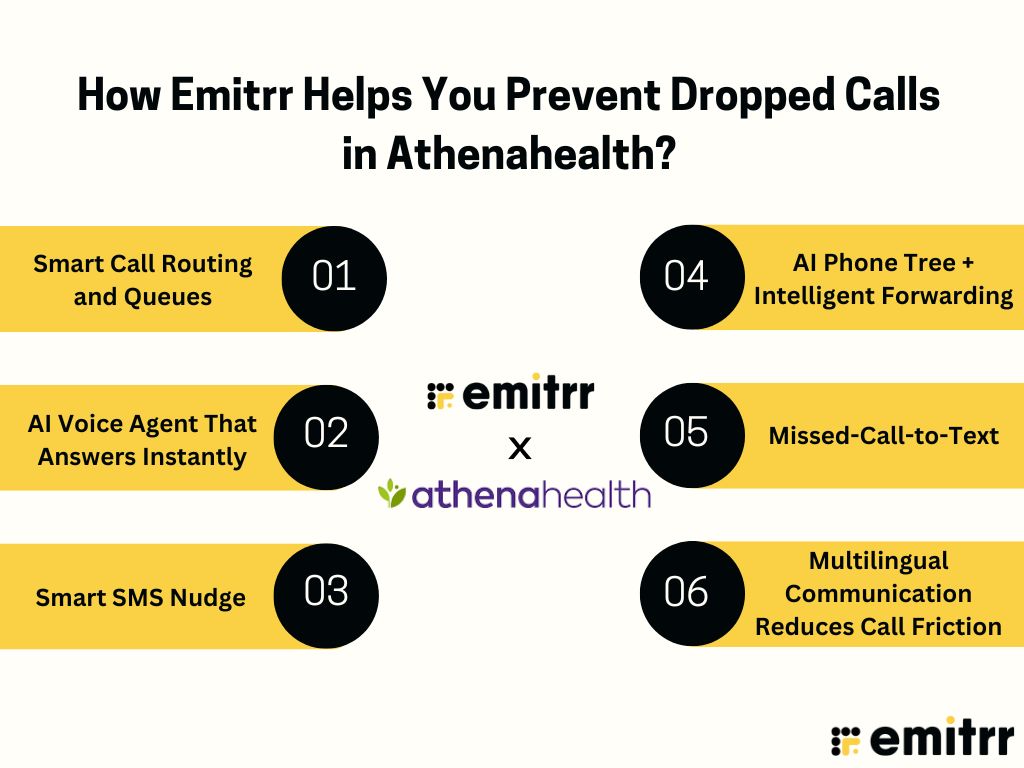
Here’s what Emitrr offers to help you prevent dropped calls in Athenaheath:
Smart Call Routing and Queues
Bouncing the caller between departments is a major reason for dropped calls, and calls that reach the correct person faster spend less time bouncing between extensions. Emitrr offers a round-robin call system where each incoming call is routed to one agent at a time in a predefined order, and if that agent doesn’t pick up in X seconds, the call goes to the next in line.
AI Voice Agent That Answers Instantly
Emitrr’s HIPAA-compliant AI agent can handle calls 24/7, book appointments, cancel, reschedule, and manage Level-1 inquiries without requiring additional staff. Because patients aren’t stuck waiting for a receptionist, the likelihood of mid-call disconnects drops significantly.
See what more AI voice agent can do for Athena users:
Smart SMS Nudge
Long call queues and hold times can frustrate patients and are one of the biggest reasons for dropped calls. Emitrr offers a smart SMS nudge to callers in a queue, asking them if they would rather take the conversation to text. This feature helps in reducing long call queues and thereby significantly reduces dropped calls.
AI Phone Tree + Intelligent Forwarding
Emitrr’s AI phone tree guides callers to the right department, while urgent calls can be routed instantly with AI call forwarding. This works because the shorter the navigation paths, the lower the exposure window for disconnects and call drops.
Missed-Call-to-Text
If a call is missed or dropped, Emitrr can instantly send an automated text saying, “Sorry we missed you! How can we help?” This keeps the patient engaged so they don’t give up.
Multilingual Communication Reduces Call Friction
Emitrr supports multilingual communication across voice and SMS, allowing patients to interact in their preferred language. When patients are given the option to communicate in their preferred language, it reduces confusion, call times, and repeated transfers that increase drop risk.
Best Practices to Keep Call Drop Rates Low
Here are best practices you should follow to keep call drop rates low in Athena EHR:
- Invest in Reliable Internet: Use high-speed, business-grade internet with backup connectivity to prevent sudden call disconnects.
- Prioritize Voice Traffic: Configure QoS settings so voice calls are not competing with heavy downloads or streaming.
- Use Healthcare-Grade VoIP: Choose a system like Emitrr, which is designed for high call volumes with intelligent routing and failover support.
- Implement an AI Voice Agent: Implement an AI voice agent to automate routine calls (appointments, FAQs, confirmations) and to prevent line congestion.
- Enable Smart Call Routing: Direct callers to the right department instantly to reduce transfers and long active-call durations.
- Turn On Missed-Call-to-Text: Give patients an immediate fallback so they don’t repeatedly call back and overload the system.
- Keep Hardware Updated: Make sure to replace old routers, headsets, or desk phones, they degrade call stability.
- Monitor Call Analytics: Monitor call analytics, identify patterns where call drops most, peak hours, and hold times to fix repeated issues.
- Train Front-Desk Teams: Train your front-desk team properly to lower the probability of mid-call disconnections.
- Communicate Proactively: Send reminders, schedule updates, and recall messages proactively to reduce inbound call spikes.
Frequently Asked Questions
No. Athenahealth is an EHR platform and requires a third-party VoIP integration to handle patient calls.
Dropped calls typically result from unstable internet, poor VoIP configuration, high call volumes, or lack of intelligent routing and backup workflows.
Yes. A healthcare-focused VoIP system with smart routing, AI call handling, and real-time analytics can significantly reduce call disruptions.
Emitrr stabilizes patient communication with AI voice agents, intelligent routing, missed-call-to-text automation, and proactive messaging, reducing call congestion and lowering the chances of disconnections.
Conclusion
Dropped calls are more than a technical inconvenience; they show gaps in your communication workflow. While Athenahealth manages clinical workflows effectively, preventing call disruptions requires you to add a smarter VoIP system on top of it.
By combining reliable connectivity, intelligent routing, and automation, solutions like Emitrr help practices move from reactive call handling to a patient-first communication system, where fewer calls drop, and more conversations get completed. Book a demo with Emitrr to see how it integrates with Athenahealth to reduce call friction and patient communication issues.


 4.9 (400+
reviews)
4.9 (400+
reviews)