
Introduction
Running out of your medications is not only frustrating but also stressful, whether it’s blood pressure pills, diabetes medication, antidepressants, or an inhaler, as you know, missing even a few doses can quickly affect your health or make symptoms worse.
But honestly, when this situation comes, most people feel stuck. Who do you call first? The pharmacy? Your doctor? Do you rush to urgent care or just wait and hope for the best? This guide explains emergency medication refill options, how to get an emergency medication refill fast, what to do when you suddenly run out of meds, how emergency medication refills work, which medications qualify, how to avoid this situation in the future, and more.
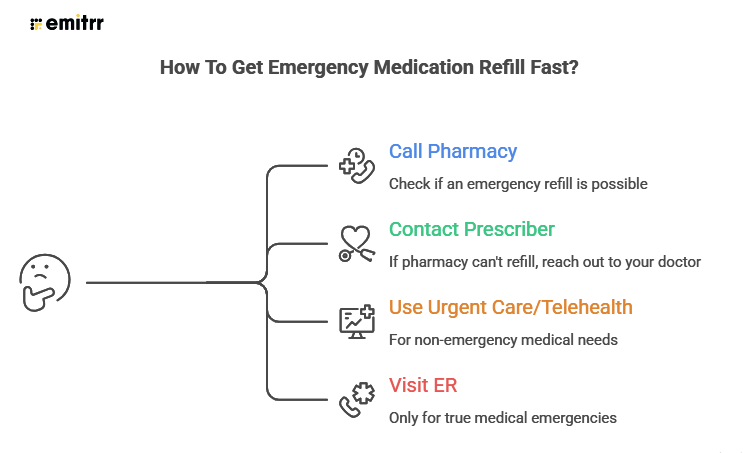
How to Get an Emergency Medication Refill Fast?
- Contact Your Pharmacy and Ask About an Emergency Refill
- Confirm Whether the Pharmacy Can Provide a Temporary Refill
- Contact Your Doctor or Prescriber if the Pharmacy Cannot Refill It
- Consider Using Urgent Care or Telehealth Services for a Quick Prescription
- Visit the Emergency Room Only if It Is a Serious Medical Emergency
Let’s walk through it step by step.
Quick Overview
An emergency medication refill allows U.S. pharmacists to dispense a short supply of non-controlled maintenance medications when a patient runs out and the prescriber cannot be reached. State laws determine how much can be provided, ranging from a 72-hour supply to 30 days or more in certain states. Patients typically need an existing prescription history and must request the refill directly from the pharmacy. To avoid refill emergencies, many healthcare practices now use automated reminders, follow-ups, and AI-powered communication tools that notify patients before prescriptions expire, reducing delays and improving medication adherence.
What Is an Emergency Medication Refill?
So, what’s an emergency medication refill, and how does it work when you suddenly run out? It refers to a short-term supply of your usual prescription that is meant to tide you over when you run out of your medications suddenly and are unable to reach your doctor right away. The goal is simple: to help you stay stable until you can get a full prescription or see your healthcare provider. Pharmacists and healthcare systems see this happen all the time, so there are laws in place for these urgent refills in specific situations, as an emergency medication refill helps avoid missed doses until your doctor is available.
Why You Might Need an Emergency Refill Quickly
Emergency medication refills usually don’t happen because of carelessness. Things happen, plans change, you get busy, or something unexpected pops up, and suddenly, you’ve run out of medication. But knowing what you should do when this happens helps you and keeps you away from missing doses and dealing with bigger health problems. Some of the common reasons for emergency medication refill are:
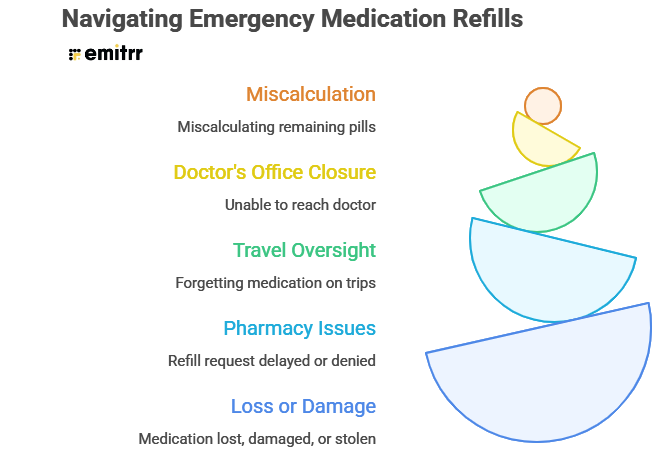
- You miscalculated how many pills you had left
- The doctor’s office is closed; maybe it’s the weekend, a holiday, or just after hours.
- You’re traveling and forgot to bring enough medication
- The pharmacy didn’t get your refill request, or it got delayed or denied.
- You lost your medication, damaged the bottle, or it was stolen
Step-by-Step: How to Get a Refill Right Away
Step 1: Call Your Pharmacy First
The first step is contacting your pharmacy for a pharmacy emergency refill option. They can help you in this situation by:
- Check if your prescription is still active and on record
- Confirm if any refills remain
- Evaluate if the emergency or short-term emergency prescription refill is allowed under local rules
- Contact your doctor for authorization
Pharmacists see these situations often and can usually tell you what is possible almost immediately. When you contact your pharmacy, to speed up the retrieval of your records, you need to have a few things ready:
✔ Medication name and dose
✔ Prescription number (if available)
✔ Your date of birth
✔ Last refill date
Step 2: Ask if an Emergency Refill is Allowed
In cases of emergency medical refill, when you are unable to visit your doctor, you can talk youe pharmacist andask if they can provide a short-term emergency prescription refill. In many regions, pharmacists can provide a short-term medication supply in a few situations, such as:
- The medication is for a chronic or maintenance condition
- Abruptly stopping it could cause harm
- You have a documented history of taking it
Note: Medications like opioids, certain stimulants, and some anti-anxiety drugs are really tightly controlled. For those, pharmacists are not permitted to give you emergency prescription refills without any confirmation from your doctor.
Step 3: If the Pharmacy Can’t Refill, Call Your Prescriber
If there are no refills left and you’re trying to refill a prescription without a doctor visit, you should call your healthcare provider.
- If you are unable to connect or it is after hours, you can leave a voicemail and request a call back
- You can also use your provider’s patient portal (if available) that is faster than calls
- Use your provider’s patient portal: often faster than calls
- You can also explain the timing for your next dose and the reason why you need it urgently
Many medical practices have a different department and rules for handling urgent prescription needs after hours. In some cases, a short electronic prescription can also be sent directly to your pharmacy.
Step 4: Use Urgent Care or Telehealth Services if Needed
If there are no refills left, and you’re trying to refill a prescription without a doctor visit, clinics and telehealth services can be effective alternatives. These providers can also provide a temporary “bridge prescription” after reviewing a few details, like:
- Your medication bottle or pharmacy records
- A list of current medicines, as well as doses
- Any recent clinic notes (if applicable)
- Your medical history, including any current symptoms
- The reason you ran out of your medicine
Step 5: Only Visit the Emergency Room If It’s a True Medical Emergency
Going to the ER is not recommended just for refills; it is not only expensive but also time-consuming. But if you’re experiencing severe health effects from missing medication, then you must head to the emergency department.

Emergency Medication Refill Laws by State: What’s Allowed and Where?
In the U.S., emergency prescription refills are not regulated federally but by individual states. These laws allow pharmacists to provide a temporary prescription refill or supply of non-controlled, maintenance medications in cases of emergencies.
United States: State-Level Emergency Refill Allowances
| Emergency Refill Quantity Allowed | States |
| Up to 72-hour supply | Alabama, Arkansas, Colorado, Connecticut, Georgia, Mississippi, New Hampshire, New Jersey, New Mexico, North Dakota, Ohio, Pennsylvania, Rhode Island, Tennessee, Utah, Washington |
| 7–15 day supply | Kansas, Maryland, Missouri, South Carolina, West Virginia |
| 30-day or longer supply | Arizona, Florida, Kentucky, Louisiana, North Carolina, Oklahoma, Oregon, Texas |
| Reasonable quantity (pharmacist’s discretion) | California, Delaware, Idaho, Indiana, Iowa, Montana |
| No explicit emergency refill law | Alaska, Hawaii, Illinois, Maine, Massachusetts, Michigan, Minnesota, Nebraska, Nevada, New York, South Dakota, Vermont, Virginia, Wisconsin, Wyoming, Washington DC |
Note: Irrespective of location, controlled substances are almost always excluded from emergency refill permissions and require direct prescriber authorization.
What Medications You Can (and Can’t) Get Quickly
Medications Commonly Approved for Emergency Refills
Pharmacies and providers are generally more flexible with medications that manage long-term or maintenance conditions, like
- Blood pressure and heart medications
- Diabetes medications, including insulin
- Asthma and COPD inhalers
- Thyroid medications
- Many antidepressants and mood stabilizers
Medications That Usually Require Doctor Authorization
Some medications under the law are not eligible for emergency prescription refills due to legal and safety restrictions, and for these medicines, you need to have a direct authorization from a licensed prescriber. A few such medications include:
- Opioid pain medications
- ADHD stimulant medications
- Benzodiazepines
- Certain controlled psychiatric drugs
How to Prevent Emergency Prescription Refills in the Future
Plan Ahead With an Emergency Supply
To avoid an emergency medication refill, you need to plan in advance. You can follow a few simple steps that can help in reducing such emergencies:
- You can request 90-day prescriptions when possible to reduce refill frequency
- You should sign up for your pharmacy’s automatic refill service.
- You can also use pharmacy apps or get text alerts, so that you have an idea when it’s time to refill.
- Ask about early refill windows covered by your insurance
Track Your Supply
One of the major mistakes patients make is waiting for the last day of the medication. Instead of waiting until you’re completely out. Set reminders for when you have about a week of meds left. You can use your phone calendar, an app, or your pharmacy’s alerts; a little planning goes a long way.
What To Do If You’re Traveling or Out of Town
Travel is a common reason for emergency prescription refill situations. If you’re away from home:
- You can ask your pharmacy if they can transfer your prescription to a nearby location
- You can also check if they offer mail delivery or a courier service.
- Refilling early before extended trips is also an ideal choice.
How Tools Like Emitrr Help Prevent Emergency Medication Refill Requests
When we talk about reasons for emergency medication refill, we get to know that it does not occur because people are careless. It usually happens because of missed reminders or broken communication loops. That’s where tools like Emitrr for medication refill communication play a crucial role.
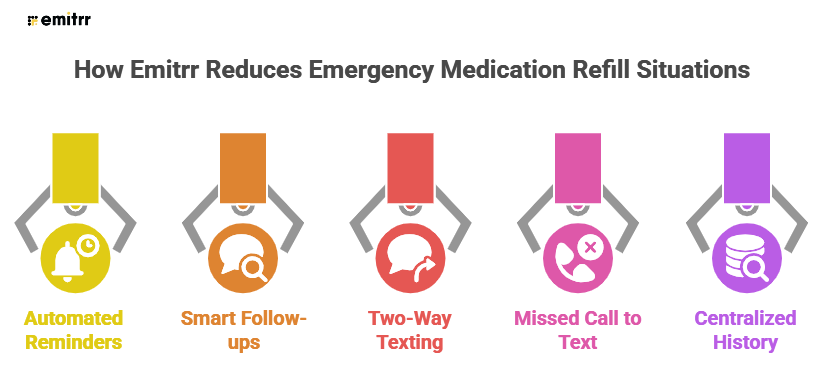
How Emitrr Reduces Emergency Medication Refill Situations
- Automated refill reminders for emergency medication refill prevention: With Emitrr, pharmacies and healthcare providers can send timely reminders before patients run out of medication, reducing last-minute panic and missed doses.
- Smart follow-ups: If a patient doesn’t respond to a refill reminder, Emitrr can automatically send a patient follow-up, preventing silent drop-offs that lead to emergency refills.
- Two-way texting with clinics or pharmacies: With the two-way texting feature, patients can quickly reply to confirm refills, ask questions, or flag issues without waiting on hold or navigating portals.
- Missed-call-to-text capability: If a patient calls after hours and no one answers, Emitrr can also convert that missed call into a text to ensure the refill request isn’t lost.
- Centralized communication history: Clinics and pharmacies can also see past refill conversations, reducing errors and speeding up approvals.
Conclusion
Running out of medication doesn’t have to turn into a crisis. Understanding emergency prescription refill rules, knowing when to contact your pharmacy, and planning ahead can protect your health and save unnecessary stress.
And honestly, it’s way easier to prevent emergencies than react to them. Emitrr helps clinics and pharmacies stay connected with patients through automated reminders, smart follow-ups, and two-way texting, so you don’t miss refills in the first place. Preventing an emergency medication refill situation starts with better patient communication and prescription refill reminders.
Want fewer refill emergencies and better medication adherence? See how Emitrr helps healthcare teams keep patients informed, proactive, and on track without added workload. Book a demo now!!
Frequently Asked Questions
How do I get an emergency supply of my medication?
There are a few steps that you can follow
- Contact your pharmacy for an emergency medication refill or emergency prescription supply
- Ask them if they can provide emergency prescription refills
- If the pharmacy can not provide the refill, call your provider
- urgent care clinics and telehealth services to refill a prescription without a doctor visit
- If nothing helps and it is serious, then only visit the ER
Can a pharmacy give emergency medication refills without a doctor’s approval?
Yes, in certain conditions, patients can refill a prescription without a doctor’s immediate approval, but they are not allowed to provide controlled substances without any direct prescriber authorization.
How many times can you get an emergency prescription refill?
Emergency prescription refills are intended for unexpected and occasional situations and not for routine use. Most pharmacies limit how often emergency medication refills can be provided and may deny repeat requests without prescriber follow-up.
How many days’ supply can I get as an emergency prescription refill?
There is no definite answer to this, as it differs from state to state. On one hand, some states allow for only a 72-hour supply, and on the other, some permit 7–15 days, 30 days, or a reasonable quantity based on the judgment of the pharmacist.
Are controlled substances eligible for emergency medication refills?
No. Medicines that are under the controlled substances category, such as opioids, stimulants, and benzodiazepines, need a direct authorization from a licensed prescriber.
Does insurance cover emergency medication refills?
Insurance coverage isn’t the same everywhere. During official emergencies, some insurance plans relax their refill rules. Outside of emergencies, you may need to pay out of pocket for a short supply.
How can I avoid needing emergency medication refills in the future?
Using refill reminders, setting early alerts, enrolling in auto-refills, and maintaining consistent communication with your pharmacy or clinic can significantly reduce emergency refill situations.
Can technology really help prevent emergency medication refills?
Yes. Automated reminders, follow-ups, and two-way texting help patients stay ahead of refills and resolve issues before they become emergencies.

 4.9 (400+
reviews)
4.9 (400+
reviews)