
Introduction
Prescription refill requests are often treated as routine work. A patient needs a medication, the request comes in, and someone on the team takes care of it. On paper, it appears to be a straightforward process. In day-to-day clinic operations, it rarely stays that way.
What makes refill requests exhausting is not their complexity, but their frequency and inconsistency. The same task gets repeated, re-entered, and rechecked across multiple roles. Over time, this cycle creates constant background pressure rather than a single obvious problem.
None of this feels dramatic in the moment, but it slowly wears teams down.
In this blog, we look at how automated refill requests bring structure to an otherwise scattered process and how that shift plays a meaningful role in reducing staff burnout.
Why Manual Prescription Refill Workflows Lead to Staff Burnout
The factors below explain why manual prescription refill workflows place ongoing strain on front-desk and clinical teams.
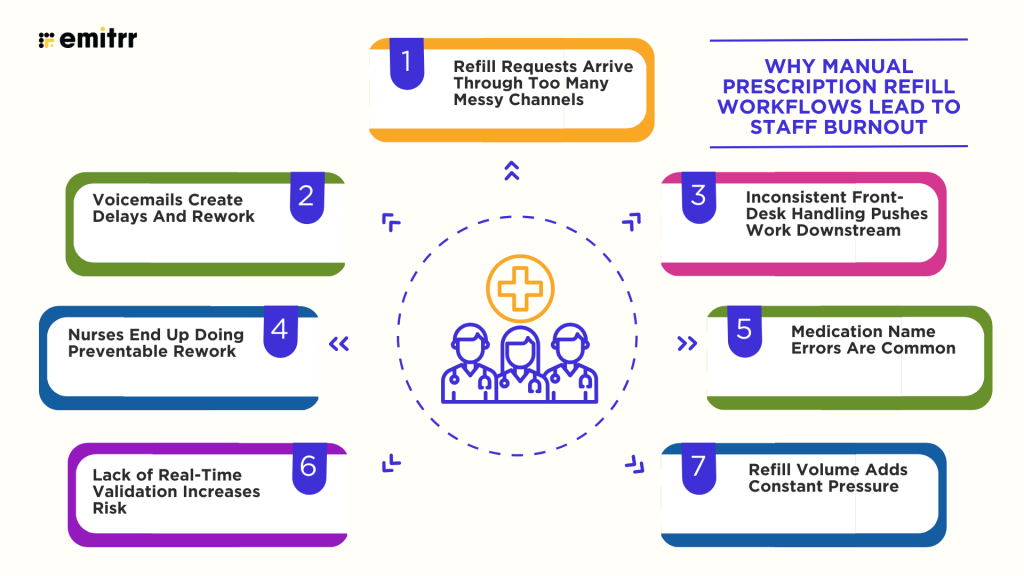
Refill Requests Arrive Through Too Many Messy Channels
Prescription refill requests enter clinics through phone calls, voicemails, patient portal messages, and then must be manually moved into the EHR. On their own, each channel seems manageable. Together, they create fragmentation. Information arrives in different formats, at different times, and with different levels of clarity.
Issue: Each channel requires someone to manually interpret the request and re-enter details into another system. Voicemails must be listened to. Athenahealth Patient Portal messages must be read and decoded. Live calls interrupt ongoing work. There is no single intake path or standardized structure.
Impact on staff: Front-desk teams spend large portions of the day switching context and transcribing information. Nurses later receive requests that lack clarity or consistency. What should be a quick administrative step turns into repeated handoffs and avoidable follow-ups.
Voicemails Create Delays And Rework
Voicemails appear convenient because patients can leave requests anytime. In practice, they introduce uncertainty and delays.
Issue: Messages often miss key details such as patient identifiers or medication names. Calls may cut off mid-message. Medication names are unclear or incorrect. Some voicemails contain partial information that cannot be used safely.
Impact on staff: Staff must stop the refill process to call patients back. Patients miss calls, leave new voicemails, or call again. This creates loops that slow down refills and increase frustration on both sides.
Voicemail-based refill intake forces staff to listen, interpret, and reconstruct requests that were never complete to begin with. Even with transcription, the burden stays on staff to decide what the patient meant and what to do next.
Watch how an AI voice agent captures refill details in real time, confirms unclear information, and removes voicemail loops from the refill workflow.
Inconsistent Front-Desk Handling Pushes Work Downstream
Refill handling depends heavily on who answers the call or reviews the message.
Issue: Some front-desk staff create structured refill requests. Others log generic cases instead. The decision often depends on training, experience, or comfort level rather than defined rules.
Impact on staff: Nurses receive cases that require conversion into refill requests. This shifts administrative cleanup work to clinical staff and delays review. The inconsistency increases the workload without improving safety.
Nurses End Up Doing Preventable Rework
When refill requests are not captured correctly at intake, nurses become the final fix.
Issue: Nurses must re-enter patient information, determine eligibility, confirm medication details, and decide routing. These steps repeat work that should have been completed earlier.
Impact on staff: Clinical time gets consumed by administrative correction. This adds mental load and reduces time available for patient-facing tasks.
Medication Name Errors Are Common
Medication requests rely heavily on patient recall.
Issue: Patients mispronounce or misremember medication names. Some request medications prescribed by outside providers or medications that have been discontinued.
Impact on staff: Staff must investigate each request, check records, and follow up with patients or providers. Every error adds another layer of verification and delay.
Lack of Real-Time Validation Increases Risk
Manual workflows lack immediate system checks.
Issue: There is no instant confirmation that a medication is active, prescribed by the clinic, or eligible for refill. Refill requests and clinical review requests look similar at intake.
Impact on staff: Teams move cautiously, knowing mistakes carry risk. Automation feels difficult to introduce without safeguards, which keeps clinics stuck with manual processes.
Refill Volume Adds Constant Pressure
Refill requests arrive steadily, regardless of staffing levels or time of day.
Issue: High call volume related to prescription refill requests blends into total call traffic and rarely slows down, even during peak hours.
Impact on staff: Interruptions stack up across shifts. Even small inefficiencies repeat hundreds of times each month, creating sustained pressure that contributes to burnout.

What Are Automated Prescription Refill Requests?
Automated prescription refill requests replace unstructured messages with a guided, system-driven intake process. Instead of relying on open-ended phone calls or messages, refill requests are captured through AI-powered voice or text interactions that follow a consistent flow.
Patients request refills through a phone call or text message. An AI system responds in real time and asks specific questions, such as patient identifiers, medication name, and refill intent. Each question follows a defined sequence, so critical details are not skipped or left unclear. The system captures responses accurately and organizes them into a complete refill request.
AI automation removes the need for staff to listen to voicemails, interpret partial information, or retype details into another system. Requests enter the workflow already structured, readable, and ready for review. This reduces back-and-forth with patients and prevents missing or incorrect data at the intake stage.
Because every request follows the same logic, automated refill systems create consistency across channels and staff roles. Whether the request starts as a call or a text, it moves through one standardized path. This ensures refill requests are clearly distinguished from clinical review requests and routed appropriately without manual sorting.
For practices that request prescription refills using Athenahealth, structured intake becomes even more important. Clean, consistent refill requests align better with Athenahealth workflows and reduce downstream cleanup.
For practices already working within Athenahealth, this same approach can be applied directly to their existing refill workflows. Athenahealth refill automation can help capture requests consistently, organize the information staff need, and reduce the repetitive follow-up involved in processing each request.
Emitrr supports Athenahealth integration, ensuring automated refill requests move into the system in an organized, review-ready format without manual re-entry.
In practice, automated prescription refill requests turn refill intake from a reactive, interruption-driven task into a predictable process that supports both staff efficiency and patient clarity.
Watch this video to see how AI-powered refill intake reduces manual calls by up to 40% –
Real-World Use Cases for Automated Refill Requests
Automated refill requests fit into many clinic environments, not just large health systems. From solo practices to high-volume clinics, the value shows up in everyday scenarios where staff time is limited and interruptions are constant.
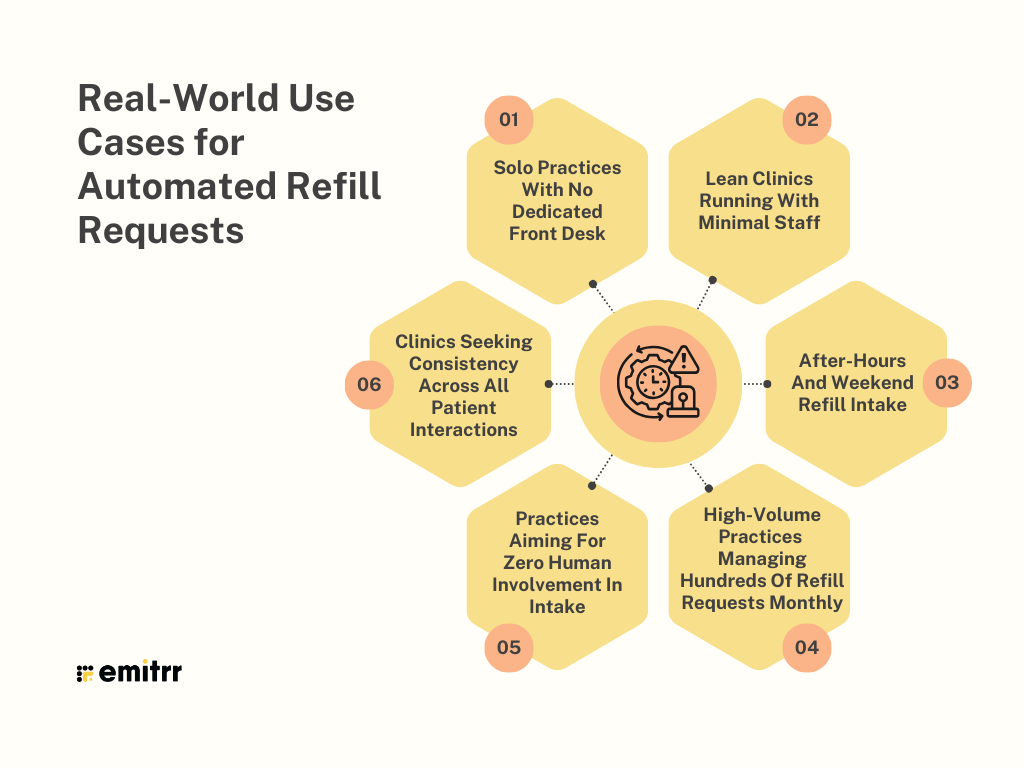
- Solo Practices With No Dedicated Front Desk
In small or solo practices, refill calls often go directly to the provider or a shared phone. An AI refill agent can handle refill intake entirely on its own, capturing patient details, medication information, and refill intent through voice or text. Requests reach the provider in a structured format, without phone interruptions or manual follow-ups.
- Lean Clinics Running With Minimal Staff
Clinics with one or two front-desk staff members often struggle to balance calls, walk-ins, and administrative work. Automated refill requests remove refill calls from the phone queue altogether. The healthcare AI agent manages intake without human involvement, while staff focus on in-clinic patients and higher-priority tasks.
- After-Hours And Weekend Refill Intake
Refill requests do not stop when clinics close. Automation ensures refill requests are captured accurately after hours, without relying on voicemails. When staff return, requests are already organized and ready for review instead of waiting in a voicemail inbox.
- High-Volume Practices Managing Hundreds Of Refill Requests Monthly
In clinics receiving large refill volumes, even small inefficiencies multiply quickly. Automated intake standardizes every request, reducing variation and preventing incomplete submissions. This lowers the number of follow-up calls and shortens turnaround time.
- Practices Aiming For Zero Human Involvement In Intake
Some clinics intentionally design refill workflows where staff only review and approve, not collect information. AI agents handle the entire intake process, from first patient interaction to structured request creation, with no staff participation at the front end.
- Clinics Seeking Consistency Across All Patient Interactions
Automation ensures every patient receives the same set of questions and instructions. This removes differences caused by staff experience or training levels and keeps refill handling consistent regardless of who is on shift.
How Automated Refill Requests Reduce Staff Burnout
Staff burnout does not usually come from a single problem. It develops through ongoing interruptions, rework, and constant task switching. Below are the primary ways automated refill requests ease that burden by improving refill intake.
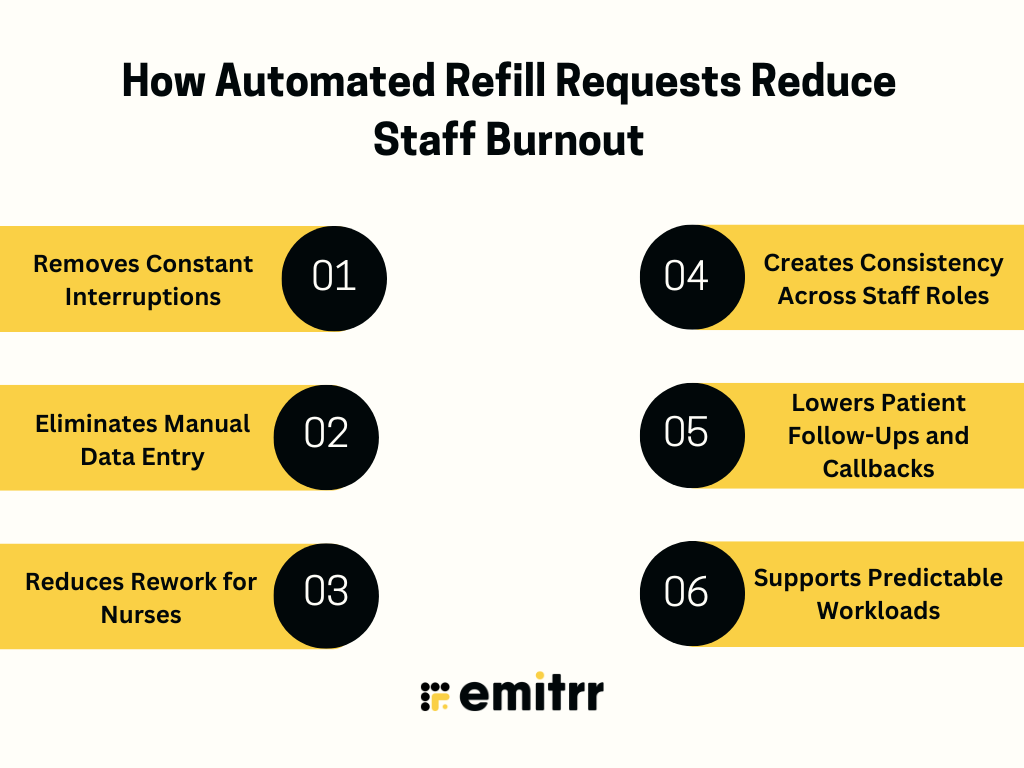
Removes Constant Interruptions
Automated refill intake keeps refill requests out of live phone queues and voicemail inboxes. Staff no longer pause ongoing work to capture refill details. Fewer interruptions mean better focus and a steadier pace throughout the day.
Eliminates Manual Data Entry
Structured intake captures patient and medication details upfront, so clinics can automate prescription refill requests without replacing their EHR, and staff do not need to listen, interpret, or retype information from messages. This removes one of the most repetitive and draining parts of refill handling.
Reduces Rework for Nurses
When refill requests arrive complete and properly categorized, nurses spend less time correcting or rebuilding requests. Their work shifts from administrative cleanup to clinical review, which feels more purposeful and manageable.
Creates Consistency Across Staff Roles
Every refill request follows the same intake flow, regardless of channel or timing. Staff no longer depend on individual training or judgment to decide how a request should be logged. Consistency lowers friction between teams.
Lowers Patient Follow-Ups and Callbacks
Clear intake reduces missing information and incorrect requests. Patients receive fewer callbacks, which cuts repeat calls and follow-up messages. Fewer follow-ups mean fewer interruptions for staff.
Supports Predictable Workloads
With refill requests entering through a standardized system, volume becomes easier to anticipate and manage. Staff spend less time reacting and more time moving through work at a predictable pace.
Explore an AI healthcare agent vs an AI receptionist in action and see why phone calls and handoffs are no longer needed –
Key Challenges and Implementation Considerations
Prescription refill automation works best when introduced with clear guardrails. Clinics need defined rules, controlled rollout, and visibility into how refill requests move through the system.
The following factors are critical to a successful rollout –
Clear separation between refill and review requests: Clinics must define which medications qualify for straight refills and which require clinical review. Without this clarity, automation can create confusion instead of efficiency.
Gradual rollout with low-risk medications: Starting with a limited medication set reduces risk and builds trust in the system. This approach gives teams time to adjust before expanding automation further.
Alignment with existing workflows: Automation must fit into how staff already review and approve refills. Poor alignment can create parallel processes that increase work instead of reducing it.
Staff awareness and role clarity: Teams need to understand what the system handles and where human review begins. Clear boundaries prevent duplicate work and unnecessary intervention.
Ongoing monitoring and refinement: Refill patterns change over time, including telehealth prescription refill requests. Clinics should review automation outcomes regularly to adjust rules, routing, and intake questions as needed.
Prescription Refill Automation Checklist
Before automating prescription refill requests, clinics should ensure the workflow is designed to reduce manual work without introducing risk. This checklist outlines the key elements needed to create a reliable, staff-friendly refill automation process.
✓ One standardized intake path for all refill requests
✓ Required patient identifiers captured at intake
✓ Structured medication name and refill intent capture
✓ Clear distinction between refill requests and clinical review requests
✓ Defined routing rules based on medication and eligibility
✓ Limited staff involvement at the intake stage
✓ Visibility into refill volume and request status
✓ Ability to review, adjust, and expand automation over time
Improve Operational Efficiency and Workflow with Emitrr’s Automated Prescription Refill Requests
Forget juggling voicemails, callbacks, and half-filled refill messages. Let your staff focus on decisions, not data collection. With Emitrr, prescription refill intake runs in the background, fully structured, and ready for review before anyone on your team steps in.
Nearly 80 percent of prescription refill requests follow predictable patterns and can be handled through automated intake. Emitrr’s HIPAA-compliant AI agent captures those requests end-to-end through voice or SMS, without staff involvement. Practices using Emitrr see up to a 40 percent reduction in front-desk refill call volume, while providers continue reviewing refills exactly as they do today.
The impact becomes clearer in real-world settings. Niagara Falls Urgent Care streamlined refill and intake workflows with Emitrr, saving 90+ manual staff efforts by removing repetitive intake work from daily operations. Instead of managing scattered refill messages, the team reviews clean, structured cases that move forward without delay.
The result is not faster staff or tighter schedules. It is fewer interruptions, fewer escalations, and refilled workflows that stay under control even during peak hours and after hours.
With Emitrr, practices can achieve:
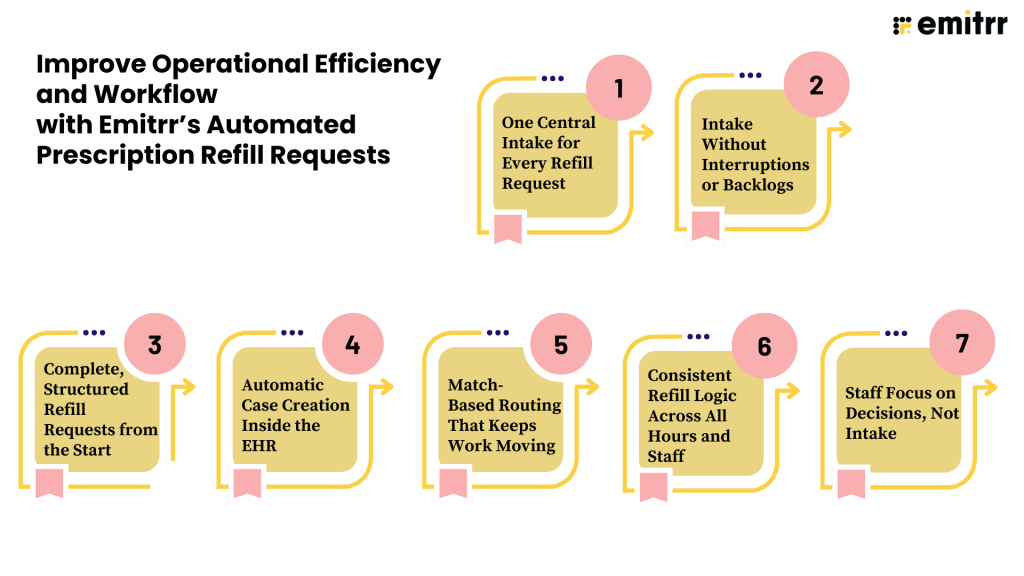
One Central Intake for Every Refill Request
Emitrr replaces multiple refill entry points with a single, AI-driven intake flow. Instead of phone calls, voicemails, and portal messages landing in different places, all refill requests begin with Emitrr’s AI agent through voice or SMS, making SMS based prescription refill requests reduce call volume in healthcare in a measurable way.
Patients follow a guided interaction that captures the same information every time. Refill intent stays clear from the start, which prevents requests from being misrouted or overlooked. This alone reduces delays that often turn routine refills into urgent situations
Intake Without Interruptions or Backlogs
The AI agent answers refill calls directly and manages intake around the clock. Staff no longer stop their work to pick up refill calls or listen to voicemails. After hours, intake continues without pause.
By the time staff review requests, everything is already captured and organized. No voicemail queues are waiting to be cleared, and no refill requests are sitting unseen overnight.
Complete, Structured Refill Requests from the Start
Emitrr’s AI collects patient identifiers, medication name, dosage, frequency, and preferred pharmacy through a guided conversation. If information is unclear, the AI confirms it immediately, reinforcing the role of a prescription refill reminder at the moment the request is made.
Each refill request produces a structured summary along with the full transcript and call recording. Requests arrive complete the first time, which removes callbacks, follow-ups, and guesswork.
Automatic Case Creation Inside the EHR
Once intake is complete, Emitrr automatically creates a case inside the EHR with all refill details attached. Staff do not re-enter information or reconstruct context from messages.
This shifts staff work from transcription to review. Nurses and providers see refill requests exactly as they need them, ready for decision-making.
Match-Based Routing That Keeps Work Moving
Emitrr applies match-based logic before routing refill requests forward. Details are checked against existing patient and medication data and clinic-defined rules.
Requests that align move ahead without delay. Requests that do not align are flagged clearly for review. This approach protects safety while preventing valid refill requests from stalling unnecessarily.
Consistent Refill Logic Across All Hours and Staff
Manual refill workflows vary based on who takes the call or reads the message. Emitrr removes that variation. The AI follows the same intake logic every time, regardless of business hours or staffing changes.
Consistency reduces errors, prevents missed requests, and keeps refill handling reliable even during busy periods.
Staff Focus on Decisions, Not Intake
Emitrr does not replace provider review. It removes the intake burden that slows everything down before review even begins.
Staff spend less time chasing details and more time moving refill requests forward. Over time, this leads to fewer escalations, fewer emergency refill situations, and a workflow that feels controlled rather than reactive.
Frequently Asked Questions
Refill intake can be automated, but clinical decisions stay with providers. Emitrr’s AI handles information collection and routing, while providers continue reviewing and approving refills as usual.
Most emergency refill situations happen due to delays or missing information. Automated intake captures complete details immediately and routes requests correctly, so valid refills do not stall.
No. Automation removes repetitive intake work. Staff remain responsible for review, approvals, and patient care.
Yes, when guardrails are in place. Emitrr follows structured intake rules and flags anything unclear for staff review instead of moving it forward automatically.
Key Takeaways
- Manual refill intake, not clinical review, drives most delays and staff burnout
- Refill requests become urgent when intake is incomplete, scattered, or delayed
- Most prescription refill requests follow predictable patterns and do not need staff-led intake
- AI-powered refill intake removes transcription, callbacks, and rework
- Standardized intake prevents routine refills from turning into emergency requests
- Emitrr automates refill intake while keeping the provider review unchanged
- Clinics using Emitrr see measurable reductions in refill-related call volume
- Consistent intake logic reduces errors caused by staff training differences


 4.9 (400+
reviews)
4.9 (400+
reviews)