
Introduction
From patient records and referrals to prescriptions and billing documents, fax remains widely used because of its simplicity and legal acceptance.
However, what many healthcare organizations overlook is that faxing is not automatically HIPAA compliant. Without proper safeguards, faxing can expose Protected Health Information (PHI) and lead to serious compliance violations.
While most providers are aware of major risks like cyberattacks or ransomware, the real danger often lies in small, overlooked mistakes like sending a fax to the wrong number, leaving documents unattended, or failing to maintain audit logs.
These seemingly minor issues can result in data breaches, financial penalties, legal consequences, loss of patient trust, and more!!
In this guide, we’ll break down real HIPAA fax violations, explain why they happen, and show you exactly how to prevent them so your organization can stay compliant and secure.
Real Examples of HIPAA Fax Violation
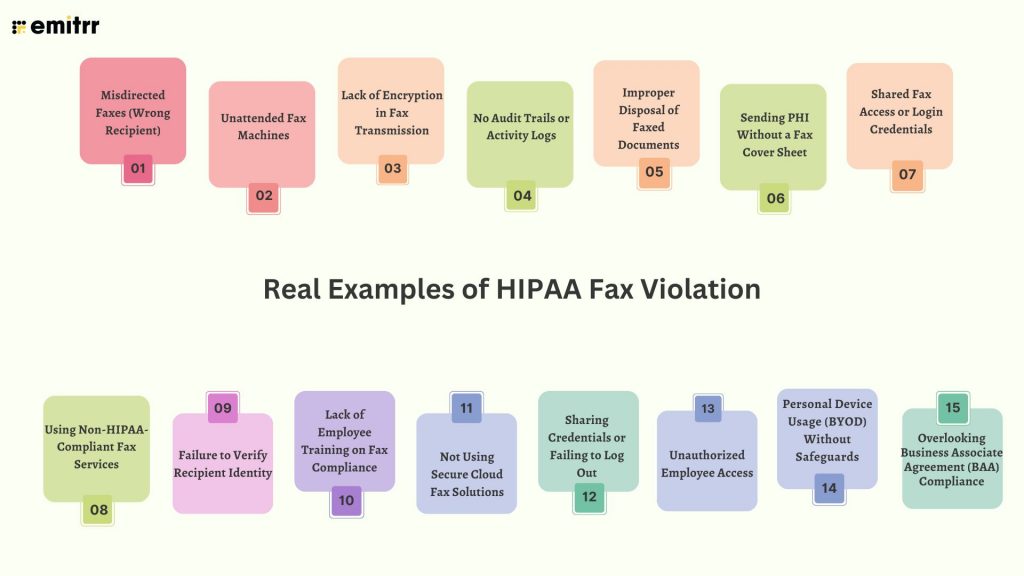
Misdirected Faxes (Wrong Recipient)
What It Is
Sending PHI to the wrong fax number due to manual entry errors or outdated contact information.
Why It Happens
- Typing errors (even one wrong digit)
- Lack of verification before sending
- Outdated or incorrectly stored numbers
How to Avoid It
- Always double-check fax numbers before sending
- Use pre-programmed or verified contacts
- Implement confirmation steps before transmission
This is one of the most common HIPAA fax violations and also one of the easiest to prevent.
Unattended Fax Machines
What It Is
Printed faxes containing PHI are left in open trays where unauthorized individuals can access them.
Why It Happens
- Fax machines are placed in shared or public areas
- Staff forgetting to retrieve documents
- Lack of access control
How to Avoid It
- Place fax machines in restricted areas
- Assign responsibility for document retrieval
- Use digital or cloud fax solutions to eliminate paper output
Lack of Encryption in Fax Transmission
What It Is
Traditional fax machines transmit PHI without encryption, making data vulnerable during transmission.
Why It Happens
- Use of outdated fax technology
- Lack of awareness about encryption requirements
How to Avoid It
- Switch to encrypted cloud fax solutions
- Ensure all transmissions are secure and compliant
- Avoid analog faxing for sensitive information
No Audit Trails or Activity Logs
What It Is
Organizations cannot track who sent, received, or accessed a fax.
Why It Happens
- Traditional fax machines don’t log activity
- No monitoring systems in place
How to Avoid It
- Use systems with built-in audit logs
- Track timestamps, users, and document history
- Regularly review logs for unusual activity
Improper Disposal of Faxed Documents
What It Is
Discarding PHI documents in regular trash or failing to wipe digital storage devices.
Why It Happens
- Lack of disposal policies
- Ignoring digital data stored in fax machines
How to Avoid It
- Shred all physical documents containing PHI
- Wipe or destroy digital storage devices
- Partner with certified disposal vendors
Sending PHI Without a Fax Cover Sheet
What It Is
Faxing sensitive information without a confidentiality disclaimer or recipient details.
Why It Happens
- Staff skipping steps to save time
- No standardized faxing process
How to Avoid It
- Always use HIPAA-compliant fax cover sheets
- Include disclaimers and intended recipient information
- Make cover sheets mandatory in workflows
Shared Fax Access or Login Credentials
What It Is
Multiple employees use the same login credentials or have unrestricted access to fax systems.
Why It Happens
- Convenience
- Lack of role-based access controls
How to Avoid It
- Assign unique login credentials
- Implement role-based access control (RBAC)
- Monitor access logs regularly

Using Non-HIPAA-Compliant Fax Services
What It Is
Using free or unsecured online fax tools that do not meet HIPAA standards.
Why It Happens
- Cost-saving attempts
- Lack of vendor due diligence
How to Avoid It
- Choose HIPAA-compliant fax providers
- Ensure a Business Associate Agreement (BAA) is in place
- Verify encryption and security features
Failure to Verify Recipient Identity
What It Is
Sending PHI without confirming the identity of the recipient organization or individual.
Why It Happens
- Rushed workflows
- Lack of verification protocols
How to Avoid It
- Confirm recipient details before sending
- Use call-back verification for sensitive data
- Maintain updated contact directories
Lack of Employee Training on Fax Compliance
What It Is
Staff are unaware of HIPAA fax rules, leading to repeated errors.
Why It Happens
- Infrequent or outdated training
- No real-world scenario-based education
How to Avoid It
- Conduct regular HIPAA training sessions
- Include fax-specific compliance modules
- Use real-life violation examples for better understanding
Not Using Secure Cloud Fax Solutions
What It Is
Continuing to rely on traditional fax machines instead of secure, modern solutions.
Why It Happens
- Resistance to change
- Lack of awareness of better alternatives
How to Avoid It
- Adopt cloud-based faxing systems
- Ensure encryption, access control, and audit logs
- Integrate faxing with EHR systems
Sharing Credentials or Failing to Log Out
What It Is
Employees share login credentials or leave systems unlocked, allowing unauthorized access to PHI.
Why It Happens
- Busy workflows and time constraints
- Convenience of shared access
- Lack of strict access control policies
How to Avoid It
- Prohibit password sharing through clear policies
- Enable automatic screen lock and session timeouts
- Train staff to log out or lock systems when not in use
Unauthorized Employee Access
What It Is
Staff accessing patient records without a legitimate work-related reason (e.g., viewing records of friends, family, or public figures).
Why It Happens
- Curiosity or personal interest
- Lack of monitoring or audit systems
- Weak access controls
How to Avoid It
- Implement role-based access control (RBAC)
- Monitor audit logs regularly
- Enforce strict disciplinary policies for violations
Personal Device Usage (BYOD) Without Safeguards
What It Is
Using personal devices (phones, tablets, laptops) to access or transmit PHI without proper security measures.
Why It Happens
- Convenience and flexibility of personal devices
- Lack of formal BYOD policies
- Use of unsecured Wi-Fi or apps
How to Avoid It
- Enforce encryption and password protection
- Use Mobile Device Management (MDM) solutions
- Enable remote wipe capabilities
- Define clear BYOD usage policies
Overlooking Business Associate Agreement (BAA) Compliance
What It Is
Failing to ensure that third-party vendors handling PHI comply with HIPAA requirements or have signed a Business Associate Agreement (BAA).
Why It Happens
- Misunderstanding of who qualifies as a business associate
- Assuming vendors are compliant without verification
How to Avoid It
- Identify all vendors handling PHI
- Ensure a signed BAA is in place
- Regularly review vendor security practices
How to Strengthen Overall HIPAA Fax Compliance
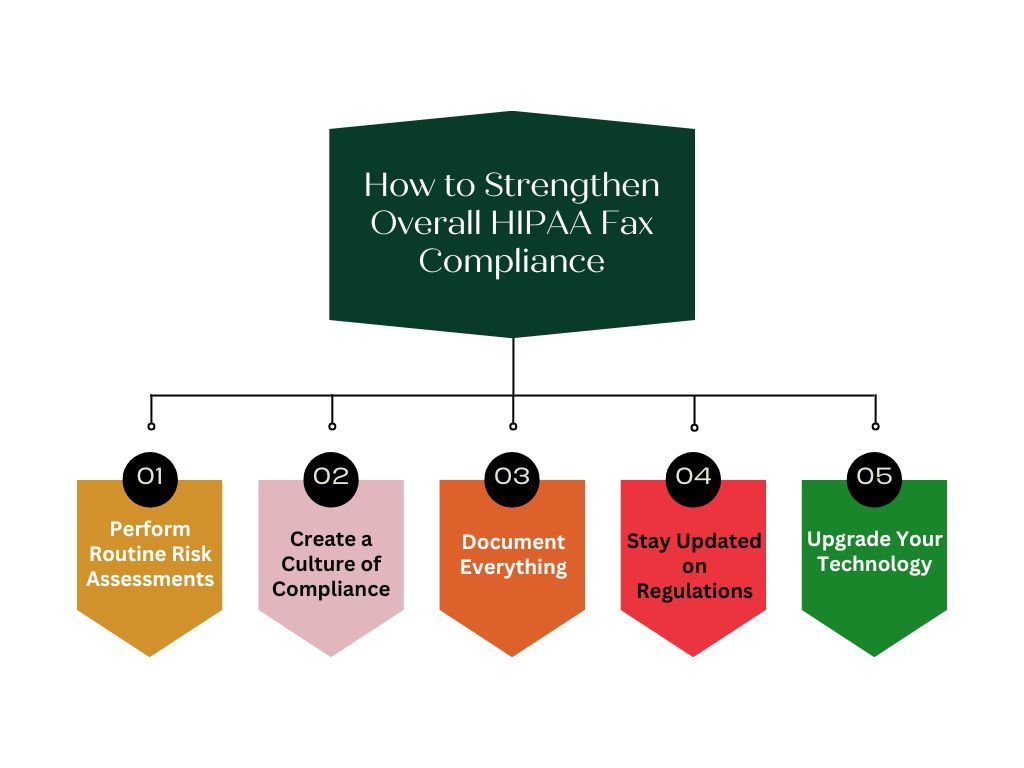
Perform Routine Risk Assessments
Regular HIPAA risk assessments are essential for identifying gaps in your faxing processes before they lead to violations. These assessments help uncover vulnerabilities such as misdirected faxes, lack of encryption, or weak access controls. By evaluating both technical and administrative safeguards, organizations can take corrective actions early and strengthen their overall HIPAA fax security. Conducting assessments annually or after system updates or incidents ensures continuous compliance and better protection of PHI.
Create a Culture of Compliance
Building a culture where every team member prioritizes data privacy is critical for HIPAA compliance success. This means going beyond policies and encouraging accountability at all levels of the organization. When staff understand the importance of secure faxing in healthcare and feel responsible for protecting PHI, the chances of human error decrease significantly. Leadership should reinforce compliance through regular communication, recognition of best practices, and clear consequences for violations.
Document Everything
Proper documentation is a cornerstone of HIPAA fax compliance. Healthcare organizations must maintain detailed records of policies, procedures, employee training sessions, and any incidents involving PHI. This documentation not only helps track improvements but also serves as proof of compliance during audits or investigations.
Stay Updated on Regulations
HIPAA regulations and industry standards continue to evolve, especially with advancements in digital communication. Staying informed about updates to the HIPAA Privacy Rule and Security Rule is essential to avoid compliance gaps. Healthcare providers should regularly review regulatory changes, attend compliance training sessions, and update internal policies accordingly.
Upgrade Your Technology
Outdated fax systems are one of the biggest barriers to achieving secure fax healthcare systems. Traditional machines often lack encryption, audit trails, and access controls, making them vulnerable to breaches. Upgrading to modern, cloud-based fax solutions can significantly enhance security by offering features like encrypted transmission, automated workflows, and real-time tracking.
How Emitrr Helps Prevent HIPAA Fax Violations
If you want to eliminate fax-related risks, switching to a secure platform like Emitrr can make a significant difference.
Emitrr offers:
Encrypted faxing to protect PHI during transmission
Encrypted faxing ensures that all data is securely transmitted, preventing unauthorized access during transfer. This is essential for maintaining secure fax healthcare communication and meeting HIPAA fax compliance requirements.
Built-in audit logs for complete visibility
Audit logs automatically track all fax activities, including user actions and timestamps. This improves accountability and supports monitoring, making it a key part of HIPAA compliance and fax security in healthcare systems.
Automated workflows to reduce human errors
Automation streamlines fax processes by reducing manual steps like number entry and document handling. This minimizes mistakes and strengthens secure fax healthcare systems while improving operational efficiency.
Role-based access controls for secure usage
Role-based access ensures that only authorized personnel can access or send PHI based on their job roles. This enhances data protection and aligns with HIPAA security requirements for controlled access.
Seamless EHR integrations for efficient operations
Integration with EHR systems allows healthcare providers to send and receive faxes directly within their existing workflows. This improves productivity while maintaining HIPAA-compliant faxing and secure data exchange.
Conclusion
HIPAA fax violations are often not the result of major failures—but small, everyday mistakes that go unnoticed until it’s too late. From misdirected faxes and lack of encryption to poor training and outdated systems, these risks are more common than most healthcare providers realize.
The key to avoiding these violations is taking a proactive approach. By implementing secure processes, training your staff, and adopting modern fax solutions, you can protect patient data and maintain compliance. Remember, HIPAA compliance isn’t just about avoiding fines; it’s about building trust and safeguarding sensitive information.
Ready to eliminate fax risks and ensure HIPAA compliance? Book a demo with Emitrr today and upgrade to a secure, modern faxing solution.


 4.9 (400+
reviews)
4.9 (400+
reviews)