
Introduction
“Automate refills” tends to mean two very different things depending on who’s saying it. To a nervous provider, it can sound like a system quietly approving medications on its own. To an exhausted front-desk team, it sounds like finally not having to type the same patient details into three systems for the tenth time that day.
The honest version sits closer to the second one. Prescription refill automation isn’t about removing clinical judgment from the process. It’s about removing the repetitive administrative work that surrounds that judgment, so requests arrive complete, get routed to the right person automatically, and patients aren’t calling twice to check on something nobody’s gotten to yet.
This guide breaks down exactly what can and can’t be automated in a refill workflow, how automated triage, reminders, and follow-ups actually work, and how to roll automation out without creating new problems for your staff or your patients.
AI Summary
- Prescription refill automation removes manual work from intake, matching, routing, and communication, not from the clinical decision to approve a medication.
- Some parts of the refill process, like request capture and status updates, automate well. Others, like controlled substance approvals, should never be fully automated.
- Automated triage and routing work by applying documented rules consistently, something manual review can’t guarantee at volume.
- A practice is ready to automate refills when its protocols are already written down and consistent, not when it’s hoping automation will create that consistency for them.
- The realistic outcome of refill automation is a smaller, sharper set of exceptions for staff to review, not an empty queue.
What “Automating” a Refill Request Means
Automation, in this context, means using rules, structured data capture, and in some cases AI, to handle the repetitive parts of moving a refill request from intake to resolution, without a staff member manually touching every step.
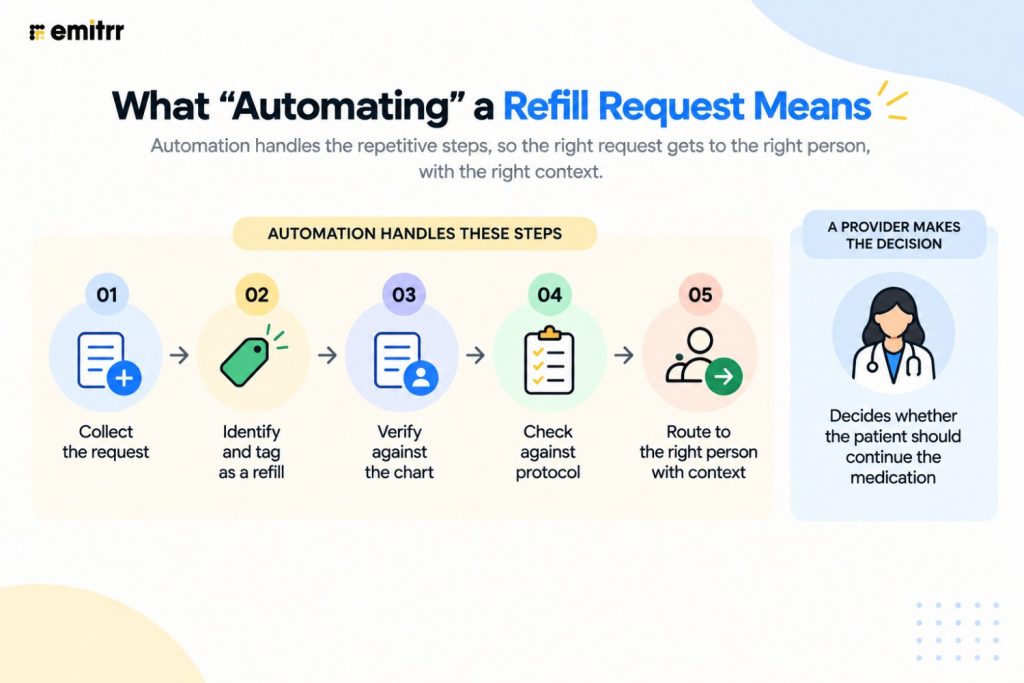
What it does not mean is a system deciding, on its own, whether a patient should keep taking medication. That decision stays with a provider. The distinction matters because a lot of hesitation around refill automation comes from picturing the wrong thing: an algorithm silently authorizing prescriptions. That’s not what functioning refill automation does, and any tool that claims otherwise is worth being skeptical of.
What automation actually changes is who, or what, handles the steps before that decision: collecting the request, tagging it (identifying it as a refill in the first place, whether from a keyword in a text or a structured form field), verifying it against the chart, checking it against protocol, and getting it in front of the right person with the context they need.

Which Parts of the Prescription Refill Process Can Be Automated
Several stages of the refill process are largely mechanical and automate well:
- Request capture. Collecting the patient’s identity, medication, dosage, and pharmacy details through a structured call, text, or form, rather than a staff member transcribing a voicemail.
- Identity and chart matching. Confirming the request corresponds to an actual patient and an active medication on their chart.
- Eligibility checks against documented protocol. Verifying visit recency, refill count, and monitoring requirements using rules the practice has already defined.
- Routing to the correct queue or provider. Sending the request to the right person based on medication type, urgency, or provider of record, without someone manually deciding each time.
- Transmission of approved refills to the pharmacy. Sending the electronic prescription once approval is confirmed.
- Status notifications to patients. Letting the patient know their request was received, is pending, or has been approved, without a separate outbound call.
| Refill Stage | Can Be Automated | Requires a Human |
| Request capture | Yes | |
| Identity/chart matching | Yes | |
| Protocol-based eligibility check | Yes | |
| Routing to the right queue | Yes | |
| Clinical approval decision | Yes | |
| Controlled substance review | Yes | |
| Pharmacy transmission (post-approval) | Yes | |
| Patient status updates | Yes | |
| Exception handling | Yes |
What Should Never Be Fully Automated
Some parts of the refill process need a person, not because the technology can’t handle the mechanics, but because the decision carries clinical or regulatory weight that shouldn’t sit with a rules engine alone.
- Controlled substance approvals. These require individual clinician review, EPCS-compliant identity verification, and often a PDMP check. No refill automation should auto-approve these.
- Patients overdue for a visit or labs. If protocol says a follow-up is due before continuing a medication, that gap needs a person’s attention, not a bypass, though automated appointment scheduling can at least make it easy for the patient to get on the calendar once that’s flagged.
- Dose changes or anything outside standard protocol. A request that doesn’t match what’s already on the chart is exactly the kind of thing automation should flag, not resolve on its own.
- Requests the system can’t confidently match to a chart. If identity or medication matching comes back uncertain, that ambiguity should route to staff rather than get forced through.
- Final clinical sign-off. Whatever else is automated upstream, the actual approval remains a provider’s call.
A useful way to think about it: automation should get every eligible piece of information in front of the right person as fast as possible. It shouldn’t be making the call itself on anything with real judgment attached.
How Automated Prescription Refill Request Triage and Routing Decide What Needs a Human
Triage automation works by applying the same rules to every request, consistently, rather than relying on whoever happens to be reviewing it that day. Typical rule logic includes:
- Medication type. Controlled substances route to a clinician automatically; routine maintenance medications can move through a faster, lower-touch path.
- Last visit or provider of record. Requests are matched to the patient’s actual prescribing provider or care team, rather than landing in a generic queue.
- Urgency or safety flags. A patient indicating they’re out of medication today, or a request tied to an acute rather than chronic condition, gets prioritized differently than a routine renewal.
- Confidence of the chart match. If the system can clearly match the request to an existing patient and active medication, it proceeds. If not, it’s flagged rather than guessed at.
This is where a rule engine does the heavy lifting: applying the practice’s own defined criteria the same way every time, regardless of volume or which staff member is on shift. Once a request is routed, the assigned staff member or provider gets a notification rather than having to check a queue to find out something’s waiting, and if nobody acts within a set window, it reassigns or escalates automatically instead of sitting untouched.
How Automated Prescription Refill Reminders Work
A meaningful share of urgent, same-day refill requests exist because nobody reminded the patient before they ran out. Automated refill reminders work off the patient’s actual refill history and medication supply, not a generic calendar reminder:
- The system tracks when a patient is due to run low based on their prescribed quantity and fill date.
- A reminder goes out before the supply runs out, giving the patient time to request a refill without urgency.
- If the patient doesn’t respond, a follow-up reminder goes out on a set cadence rather than depending on staff remembering to check.
The practical effect is fewer “I’m out today” calls landing on an already busy day, and fewer situations where a patient goes without their medication because nobody flagged it in time.
How Automated Follow-Up and Status Updates Reduce Call Volume
Most “just checking on my refill” calls share the same root cause: the patient submitted a request and heard nothing back. Without a status update, silence reads as “forgotten,” so the patient calls to confirm someone is actually working on it. Each of those calls interrupts staff for a question the system already has the answer to.
Automated status updates close that gap by notifying the patient at each meaningful point:
- When the request is received
- When it’s approved and sent to the pharmacy
- When it’s denied or needs more information
- When a visit is required before it can move forward
Two-way texting makes this practical without adding staff workload, since updates go out automatically and patients can reply if they have a question, rather than staff having to place an outbound call for every status change. Practices that put this in place consistently see a meaningful drop in refill-related call volume, simply because patients aren’t left guessing.
Want to see what this looks like in practice? Watch how an AI prescription refill agent can reduce call volume by up to 40%.
Is Your Prescription Refill Process Ready to Automate?
Automation works best on top of a process that’s already reasonably consistent. Layering it onto a workflow that’s undocumented or inconsistent tends to automate the confusion along with everything else.
Signs your practice is ready:
- Refill eligibility protocols are written down, not just known informally by experienced staff
- Intake already collects the same core fields regardless of channel
- The majority of refill volume is routine maintenance medications rather than controlled substances
- Staff can describe, consistently, what makes a request auto-eligible versus one that needs review
Signs you should fix the process first:
- Eligibility rules exist only in someone’s head, and different staff apply them differently
- Intake varies wildly depending on who answers the phone, a version of the same fragmented communication problem that shows up across patient intake generally
- A large share of refill volume involves controlled substances or complex cases
- Charting is inconsistent enough that matching a request to the right medication isn’t always straightforward
If most of the second list sounds familiar, it’s worth documenting protocol and standardizing intake before automating anything, since automation applied to an undocumented process just makes inconsistency faster.
How to Roll Out Prescription Refill Automation Without Disrupting Staff
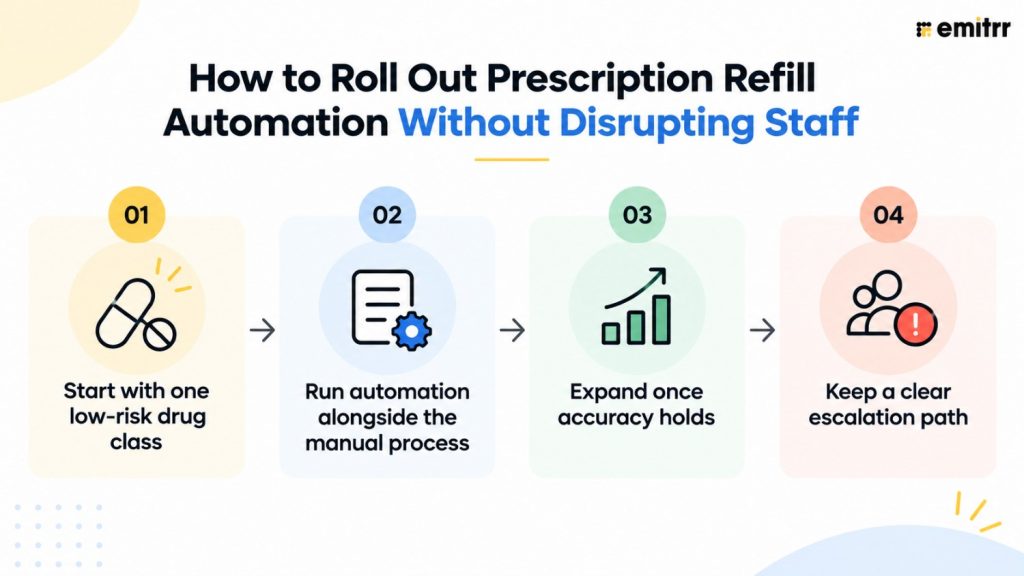
- Start with one low-risk drug class. Pick a category of routine, non-controlled maintenance medications rather than trying to automate everything at once.
- Run automation alongside the manual process. Let the system process requests in parallel with staff review before it’s the only thing handling that class of refills, so you can catch mismatches before they affect a patient.
- Expand once accuracy holds. Once the automated path is reliably matching and routing correctly, extend it to additional drug classes or request types.
- Keep a clear escalation path. Anything the system can’t confidently resolve, whether that’s a chart mismatch, an unclear request, or a flagged exception, needs an obvious, fast route back to a person.
This staged approach is slower than flipping automation on for everything at once, but it’s what keeps a rollout from turning into a new source of errors on top of the old ones.
What Changes for Staff Once Prescription Refills Are Automated
The shift isn’t fewer refills to think about. It’s a different kind of refill work.
Instead of processing every request from scratch, staff spend their time reviewing what’s been flagged: the controlled substance that needs sign-off, the patient overdue for a visit, the request the system couldn’t confidently match. The repetitive clicking, retyping, and phone tag that used to eat most of the day gets absorbed by a HIPAA-compliant AI agent, leaving staff with a smaller, more meaningful set of decisions rather than an endless queue of routine ones.
That’s a real change in the work, not just a reduction in volume, and it’s usually the part practices notice most once automation has been running for a few weeks.
Watch the video to see 16 front desk tasks your team doesn’t have to handle manually.
Key Takeaways
- Refill automation targets intake, matching, routing, and communication, never the clinical decision to approve a medication.
- Request capture, eligibility checks, routing, and status updates automate well; controlled substances, overdue patients, and ambiguous matches should always go to a human.
- Automated triage works by applying the same defined rules to every request, which manual review can’t guarantee once volume increases.
- A practice is ready to automate once its protocols are documented and consistent, not before.
- The result of automation is a smaller set of flagged exceptions for staff to review, not an empty refill queue.
FAQs
Prescription refill automation is the use of rules, structured intake, and AI to handle the repetitive administrative steps in processing a refill request, such as capturing details, checking eligibility, routing, and notifying patients, without removing the clinical approval decision from a provider.
Routine maintenance medications with stable eligibility criteria and no controlled substance involvement are the safest starting point. These typically make up a large share of refill volume and carry the lowest clinical risk if something needs correcting early on.
No. Controlled substance refills should always go to an authorized clinician for individual review, given DEA scheduling rules, EPCS identity verification requirements, and PDMP checks that apply to these medications.
No. It removes repetitive administrative work, so staff and providers spend their time on the requests that actually need judgment, rather than retyping information or chasing missing details on routine ones.
They’re timed to a patient’s actual refill history and medication supply, sending a reminder before the patient is expected to run out, with a follow-up reminder if there’s no response, rather than relying on a generic recurring alert.
Conclusion
Prescription refill automation works best when it’s understood for what it is: a way to handle the repetitive, low-judgment parts of the refill process consistently, so the parts that genuinely need a person’s attention get there faster and with better context. Start with a process that’s already documented, automate the routine cases first, and keep a clear path back to a human for everything else.
Book a demo to see how Emitrr automates refill intake, routing, and follow-up for practices like yours.


 4.9 (400+
reviews)
4.9 (400+
reviews)