
Introduction
“A single HIPAA violation can cost you thousands or even millions of dollars.”
That’s not an exaggeration; it’s the reality of non-compliance in today’s highly regulated healthcare environment. With patient data breaches on the rise and stricter enforcement than ever before, HIPAA penalties have become a serious financial, legal, and reputational risk for healthcare providers, practices, and even their vendors.
A single mistake, whether it’s an unsecured text message, unauthorized access to patient records, or improper data disposal, can trigger investigations, hefty fines, and long-term damage to your organization’s credibility. Beyond the immediate monetary loss, violations can lead to lawsuits, loss of patient trust, and even criminal charges in severe cases.
To fully understand the risks, it’s important to know that HIPAA violations fall into two main categories:
- Civil penalties – Financial fines imposed for non-compliance, even if the violation was unintentional
- Criminal penalties – Legal consequences, including fines and imprisonment, for willful neglect or malicious intent
These penalties are enforced by key regulatory bodies:
- The HHS Office for Civil Rights (OCR), which investigates complaints and enforces civil penalties
- The Department of Justice (DOJ), which handles criminal prosecutions for serious violations
In this guide, we’ll break down both civil and criminal penalties in detail, so you know exactly what’s at stake and how to avoid them.
What Happens When You Violate HIPAA?
A HIPAA violation typically follows a structured process:
Complaint → Investigation → Resolution or Penalties
- A complaint is filed with the HHS Office for Civil Rights, or a breach is reported
- The OCR investigates the issue, reviews policies, and assesses the severity
- Based on findings, the case is resolved, or penalties are applied
As highlighted by the American Medical Association, severe violations can lead to heavy fines, jail time, and long-term reputational damage.
Types of HIPAA Violations: Intentional vs Accidental
HIPAA violations don’t always happen due to malicious intent; many occur because of simple human errors or process gaps. However, whether intentional or accidental, every violation must be taken seriously and handled properly.
Intentional vs Accidental Violations
Not all violations are deliberate. Even organizations that generally follow HIPAA guidelines can make mistakes, such as unintentionally exposing Protected Health Information (PHI).
In cases of accidental violations:
- The issue must be reported internally, usually to the organization’s privacy officer
- The privacy officer evaluates the situation, determines the extent of the breach, and takes corrective actions to minimize risk
- If required, the incident must be reported to the HHS Office for Civil Rights
Failing to report a breach when required can itself lead to penalties.
Once reported, the OCR assesses the violation using the HIPAA penalty tier system. While unintentional violations often fall under Tier 1 (lack of knowledge), they can still be categorized under higher tiers depending on factors like negligence and response time.

Understanding Civil Penalties for HIPAA Violations
Civil penalties under HIPAA are monetary fines imposed by the HHS Office for Civil Rights when organizations fail to comply with privacy and security rules.
These penalties apply to:
- Covered entities (healthcare providers, insurers, clearinghouses)
- Business associates (vendors handling patient data on their behalf)
The amount you pay isn’t random; it’s determined by the severity of the violation and the level of negligence involved. The more avoidable the mistake, the higher the penalty.
HIPAA Civil Penalty Tiers (2026 Updated)
HIPAA violations are categorized into four tiers. Each tier reflects how responsible the organization was and how serious the consequences are.
| Tier | Level of Fault | Description | Example | Penalty Range (2026) |
| Tier 1 | Lack of Knowledge | You were unaware of the violation and couldn’t have reasonably prevented it | Accidental disclosure despite having safeguards in place | ~$145 to $36,505 per violation |
| Tier 2 | Reasonable Cause | You should have known about the risk but didn’t act | Staff not properly trained on HIPAA policies | Higher than Tier 1 |
| Tier 3 | Willful Neglect (Corrected) | Violation due to negligence, but fixed within 30 days | Ignoring encryption needs but correcting quickly after discovery | Significant penalties |
| Tier 4 | Willful Neglect (Not Corrected) | Serious negligence with no timely correction | Ignoring known compliance gaps | Up to ~$2.1M annually |
Breaking Down the Tiers (Simple Explanation)
- Tier 1 (Least Severe): You genuinely didn’t know and had reasonable safeguards in place. Penalties are lowest here.
- Tier 2: You should have known something was wrong. This usually points to weak internal processes like poor training or outdated policies.
- Tier 3:You ignored compliance requirements, but took action quickly once the issue was discovered. This reduces the penalty, but it’s still serious.
- Tier 4 (Most Severe): You knew about the risk and did nothing. This is where penalties skyrocket and long-term damage begins.
Factors That Influence Civil Penalty Amounts
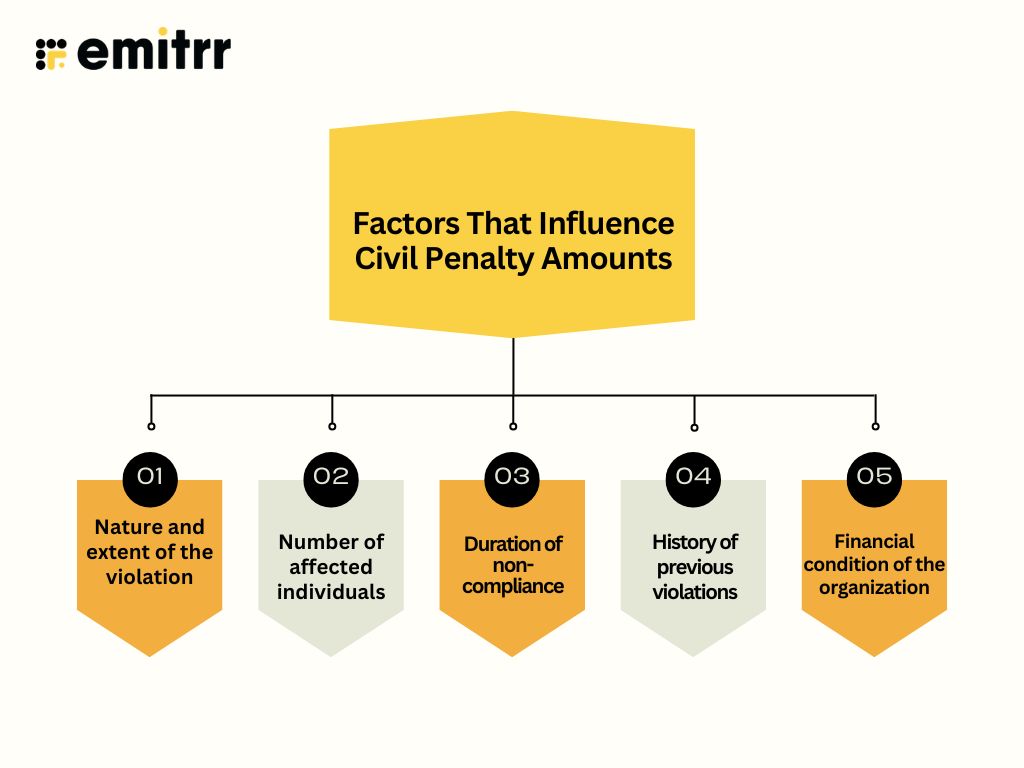
Even within these tiers, the final penalty amount can vary significantly. The HHS Office for Civil Rights evaluates multiple factors before deciding the fine:
- Nature and extent of the violation: This looks at how serious the breach was and the type of data exposed (e.g., basic info vs. highly sensitive health records). Larger, more harmful violations involving sensitive PHI typically lead to higher penalties.
- Number of affected individuals: The more people impacted, the greater the risk and damage caused. A small, isolated incident is treated very differently from a large-scale data breach affecting thousands.
- Duration of non-compliance: OCR assesses how long the issue persisted before being addressed. Violations that are ignored or left unresolved for extended periods attract stricter penalties.
- History of previous violations: Organizations with past HIPAA violations are seen as higher risk. Repeat non-compliance signals poor internal controls and often results in harsher fines.
- Financial condition of the organization: OCR considers the organization’s ability to pay when determining penalties. While fines may be adjusted for smaller practices, compliance is still mandatory regardless of size.
Why This Matters
Civil penalties are not just fines; they’re a reflection of how seriously your organization takes patient data protection. Even small gaps in compliance can quickly escalate into large financial liabilities if left unaddressed.
What Are Criminal Penalties for HIPAA Violations?
While most HIPAA violations result in civil fines, criminal penalties come into play when the violation involves serious wrongdoing. These cases are handled by the Department of Justice (not the HHS Office for Civil Rights).
Criminal penalties apply in situations involving:
- Intentional actions (not accidental mistakes)
- Fraud or deception
- Malicious misuse of Protected Health Information (PHI)
These cases are much rarer but far more severe, often leading to heavy fines, imprisonment, and permanent career damage.
| Tier 1 | Basic Offense | Knowingly obtaining or disclosing PHI without authorization | Accessing patient records without a valid reason | Up to $50,000 fine + up to 1 year imprisonment |
| Tier 2 | False Pretenses | Accessing PHI through deception or false claims | Pretending to be authorized staff to access records | Up to $100,000 fine + up to 5 years imprisonment |
| Tier 3 | Personal Gain or Harm | Misusing PHI for profit, benefit, or to harm someone | Selling patient data or using it for identity theft | Up to $250,000 fine + up to 10 years imprisonment |
HIPAA Criminal Penalty Tiers Explained
HIPAA criminal violations are divided into three tiers based on intent and severity:
Tier 1: Basic Offense
This applies when someone knowingly obtains or discloses PHI without authorization.
- Example: Accessing a patient’s medical record without a valid reason
- Penalty:
- Up to $50,000 fine
- Up to 1 year imprisonment
Tier 2: False Pretenses
This involves accessing PHI under false claims, deception, or misrepresentation.
- Example: Pretending to be a healthcare provider or authorized personnel to gain access to records
- Penalty:
- Up to $100,000 fine
- Up to 5 years imprisonment
Tier 3: Intent for Personal Gain or Harm
This is the most serious level, where PHI is used for profit, personal benefit, or to harm someone.
- Example: Selling patient data, using it for identity theft, or blackmail
- Penalty:
- Up to $250,000 fine
- Up to 10 years imprisonment
Why This Matters
Criminal HIPAA violations go beyond compliance failures; they’re treated as federal offenses. Even a single intentional misuse of patient data can lead to jail time, making it critical for organizations to enforce strict access controls and ethical data handling practices.
Civil vs Criminal Penalties: Key Differences
Understanding the difference between civil and criminal HIPAA penalties is critical; they may stem from the same law, but the consequences are very different.
| Aspect | Civil Penalties | Criminal Penalties |
| Enforced by | HHS Office for Civil Rights | Department of Justice |
| Nature | Primarily monetary fines and corrective actions | Financial penalties plus imprisonment |
| Trigger | Negligence, lack of awareness, or failure to comply with HIPAA rules | Intentional misuse, fraud, or malicious handling of PHI |
| Frequency | More commonly, most HIPAA violations fall under this category | Rare, applied only in serious, intentional cases |
| Severity | Moderate to high, depending on impact and negligence | Very high, which can include jail time and a criminal record |
| Examples | Untrained staff, accidental data exposure, weak security controls | Selling patient data, identity theft, unauthorized access with intent |
Who Can Be Penalized Under HIPAA?
HIPAA compliance isn’t limited to just doctors or hospitals; anyone who handles Protected Health Information (PHI) can be held accountable.
- Healthcare Providers: This includes hospitals, clinics, dentists, therapists, and individual practitioners. If patient data is mishandled, whether through negligence or poor systems, they can face significant penalties.
- Health Plans: Insurance companies, HMOs, and government programs are responsible for protecting large volumes of sensitive patient data. Any breach or non-compliance can result in substantial fines due to the scale of information involved.
- Clearinghouses: These entities process and transmit healthcare data between providers and insurers. Because they act as intermediaries, they must ensure data is securely handled at every stage.
- Business Associates: Third-party vendors that access PHI are equally liable. Even if they’re not directly providing care, they must comply with HIPAA regulations.
- Employees (in criminal cases): Individuals can be personally prosecuted if they intentionally misuse PHI. Employees involved in fraud, data theft, or unauthorized access can face fines and imprisonment.
How to Avoid Civil and Criminal HIPAA Penalties
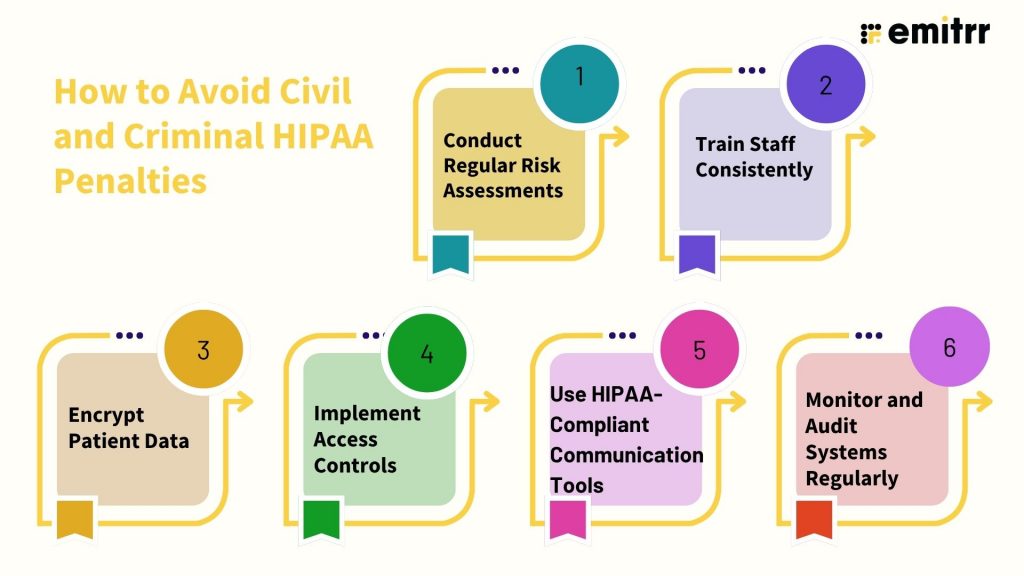
Avoiding HIPAA penalties isn’t just about compliance; it’s about building secure, consistent processes across your organization. Here are key actions you should take:
- Conduct Regular Risk Assessments: Identify vulnerabilities in your systems, workflows, and data handling practices. Proactively fixing gaps reduces the chances of violations and shows regulators you’re taking compliance seriously.
- Train Staff Consistently: Many violations happen due to human error. Regular HIPAA training ensures your team understands what’s allowed, what’s not, and how to handle patient data safely.
- Encrypt Patient Data: Encryption protects PHI both in transit and at rest. Even if data is intercepted or accessed, encryption makes it unreadable and significantly reduces risk.
- Implement Access Controls: Limit data access based on roles and responsibilities. Not every employee needs full access; restricting it minimizes the chances of misuse or accidental exposure.
- Use HIPAA-Compliant Communication Tools: Avoid unsecured channels like standard SMS or personal email. Instead, use platforms designed for healthcare communication that offer encryption, HIPAA audit trails, and compliance safeguards.
- Monitor and Audit Systems Regularly: Continuous monitoring helps detect suspicious activity early. Regular audits also ensure your policies are being followed and highlight areas that need improvement.
How Emitrr Helps You Stay HIPAA-Compliant
Staying HIPAA-compliant isn’t just about avoiding penalties; it’s about creating a secure, consistent, and error-free communication system. Emitrr is built to help healthcare organizations manage patient communication safely while reducing compliance risks.
A Fully Secure Communication Foundation
Emitrr ensures that all communication, whether it’s texting, calling, or webchat, is protected with end-to-end encryption. Data is secured both in transit and at rest, eliminating common vulnerabilities. It also offers signed BAA agreements, which are essential when using any third-party platform for handling PHI. This creates a strong compliance foundation from day one.
Smarter Patient Conversations (Without Compliance Risks)
With Emitrr, you can enable two-way texting, allowing patients and staff to communicate freely without exposing sensitive information. One standout capability is converting inbound calls into text-based, trackable conversations, ensuring nothing gets lost and everything stays documented. Patients can respond easily and securely, reducing missed communications and unnecessary phone calls.
Built for Healthcare Workflows
Emitrr fits directly into your existing systems by integrating with EHRs and healthcare CRMs. You can send appointment reminders, lab results, and updates using pre-built templates that ensure consistency and compliance. This reduces manual work while making sure every message follows a standardized, secure format.
Control, Visibility, and Audit Readiness
HIPAA compliance requires control, and Emitrr delivers it through role-based access, ensuring only authorized users can view specific data. Alongside this, it provides delivery tracking, activity logs, and full audit trails, giving you complete visibility into every interaction. This makes it easier to monitor usage, detect risks early, and stay prepared for audits.
Flexible Communication for Modern Teams
Whether it’s one-on-one conversations or group messaging, Emitrr supports multiple communication formats while staying compliant. Teams can access the platform via desktop or mobile, making it easy to stay connected without compromising data security. This flexibility ensures smooth operations across locations and devices.
AI That Works Within HIPAA Boundaries
Emitrr’s AI capabilities are designed specifically for healthcare, with HIPAA-safe workflows and compliant scripting. This means you can automate conversations and processes without worrying about improper handling of PHI. It helps scale communication while keeping everything within regulatory limits.
Frequently Asked Questions
HIPAA penalties vary based on the severity of the violation. Civil penalties can range from a few hundred dollars to over $2 million annually, while criminal penalties can include fines and imprisonment in serious cases.
Civil penalties are usually financial fines imposed for non-compliance or negligence, enforced by the HHS Office for Civil Rights. Criminal penalties, enforced by the Department of Justice, apply when there is intentional misuse of patient data and can include jail time.
Yes, even accidental violations can lead to penalties. While they may fall under lower tiers (like lack of knowledge), organizations are still expected to report, investigate, and resolve them promptly.
HIPAA is primarily enforced by the HHS Office for Civil Rights for civil violations, while the Department of Justice handles criminal cases involving fraud or intentional misuse of PHI.
You should immediately report the incident internally, assess the impact, take corrective action, and determine whether it needs to be reported to regulatory authorities. Quick action can significantly reduce penalties.
Yes, employees can face personal consequences in criminal cases. According to the American Medical Association, individuals involved in intentional misuse of PHI can face fines and imprisonment.
Organizations can avoid penalties by implementing strong security measures, training staff regularly, using HIPAA-compliant communication tools, and conducting ongoing audits and risk assessments.
PHI includes any information that can identify a patient and relates to their health condition, treatment, or payment details, such as medical records, lab results, insurance data, and even appointment information.
Yes, business associates who handle PHI on behalf of healthcare providers are equally responsible for maintaining HIPAA compliance and can face penalties if they fail to do so.
Emitrr helps by providing secure, encrypted communication, role-based access controls, audit trails, and HIPAA-compliant messaging features, reducing the risk of violations while improving patient communication.
Conclusion
HIPAA compliance isn’t optional; it’s a critical responsibility that directly impacts your financial stability, legal standing, and patient trust. As we’ve seen, violations can lead to anything from minor fines to multi-million dollar penalties and even criminal charges.
But the real takeaway is this: most HIPAA violations are completely preventable. They often stem from gaps in processes, lack of training, or using non-compliant communication tools, not intentional wrongdoing.
That’s why the focus shouldn’t just be on understanding penalties; it should be on building systems that prevent violations in the first place.The easiest way to reduce your risk is by adopting tools designed for compliance from the ground up. Platforms like Emitrr help you secure patient communication, automate workflows, and stay audit-ready without adding complexity to your operations. Want to know more? Book a demo now!!


 4.9 (400+
reviews)
4.9 (400+
reviews)