
Introduction
In today’s rapidly evolving healthcare landscape, artificial intelligence (AI) is no longer a futuristic concept but a powerful tool transforming patient care and operational efficiency. From streamlining administrative tasks to offering personalized patient support, AI agents are proving invaluable. However, as these intelligent systems handle sensitive patient information, ensuring HIPAA compliance becomes paramount. Ignoring these regulations can lead to severe penalties, reputational damage, and a breach of patient trust.
So, how can healthcare organizations confidently integrate AI agents while safeguarding Protected Health Information (PHI)? This comprehensive checklist breaks down the essential considerations for implementing HIPAA-compliant AI agents, ensuring you navigate the complexities of patient data with confidence.
Understanding HIPAA and Its Relevance to AI Agents
First, let’s clarify what HIPAA is all about. The Health Insurance Portability and Accountability Act (HIPAA) is a U.S. law enacted in 1996. Its primary goal is to protect patient health information and ensure it’s handled securely and privately. Think of it as the rulebook for keeping patient data safe and confidential.
For healthcare providers, insurers, and any entity that handles patient data, HIPAA dictates:
- What they can do with patient information.
- Who they can share it with.
- How they must protect it.
This includes a vast array of data, collectively known as Protected Health Information (PHI). PHI is any information that can identify a patient and relates to their health, care, or payment for healthcare. This encompasses:
- Personal Identifiers: Name, phone number, email address, home address, date of birth, Social Security number, and even unique identifying numbers like medical record numbers.
- Health Information: Medical records, diagnoses, lab results, prescriptions, treatment plans, and appointment details.
- Payment and Insurance Information: Insurance details, billing records, and payment history for medical services.
Crucially, even something as seemingly innocuous as an appointment reminder text, like “Hey Sarah, your appointment is tomorrow,” constitutes PHI because it contains an identifier (Sarah’s name) linked to health-related information (an appointment).
When AI agents are deployed in healthcare, they invariably interact with and process PHI. This makes understanding and adhering to HIPAA’s core rules – the Privacy Rule, Security Rule, and Breach Notification Rule – absolutely critical. Failure to comply can result in hefty fines, legal action, and irreparable damage to an organization’s reputation. The U.S. Department of Health and Human Services provides extensive resources detailing these regulations.

The Core HIPAA Rules and AI Agents: A Closer Look
To ensure your AI agents are compliant, let’s examine how the core HIPAA rules apply:
1. The Privacy Rule: Who Can Access What?
This rule governs how PHI is used and shared. For AI agents, this means:
- Limited Access: The AI agent should only access the minimum necessary PHI to perform its designated function. For instance, an AI chatbot designed for appointment scheduling doesn’t need access to a patient’s full medical history.
- Patient Rights: Patients have rights regarding their data, including the right to access their records and request corrections. Your AI system should facilitate these rights where applicable.
- Purpose Limitation: PHI should only be used for legitimate healthcare operations, treatment, or payment purposes.
2. The Security Rule: How is PHI Protected?
This rule focuses on protecting electronic PHI (ePHI). It mandates three types of safeguards:
- Administrative Safeguards: This includes implementing policies and procedures for risk assessments, staff training on data security, and access management. For AI, this means ensuring the AI vendor has robust security protocols and that your internal team is trained on how to use the AI tool compliantly.
- Physical Safeguards: This involves securing the physical environment where data is stored and accessed, such as controlling access to servers and devices. While less direct for AI agents, it pertains to the infrastructure hosting the AI.
- Technical Safeguards: This is where AI agents have a significant impact. It requires implementing measures like:
- Encryption: All data transmitted to and from the AI agent, and data stored by it, must be encrypted both in transit and at rest.
- Access Controls: Implementing strong authentication and authorization mechanisms to ensure only authorized users and systems can access PHI. This includes role-based access controls (RBAC) so the AI only accesses what’s necessary for specific roles.
- Audit Logs: Maintaining detailed logs of all access and activity related to PHI. This is crucial for tracking who did what, when, and why.
3. The Breach Notification Rule: What If Something Goes Wrong?
This rule requires organizations to notify affected individuals, the government, and sometimes the media if unsecured PHI is breached. For AI agents, this means:
- Detection and Reporting: The AI system and its supporting infrastructure must have mechanisms to detect potential breaches.
- Incident Response: Having a clear plan in place to respond to and report breaches promptly, typically within 60 days of discovery.
Your HIPAA Compliant AI Agent Checklist
Now, let’s translate these rules into actionable steps for your AI agent implementation.
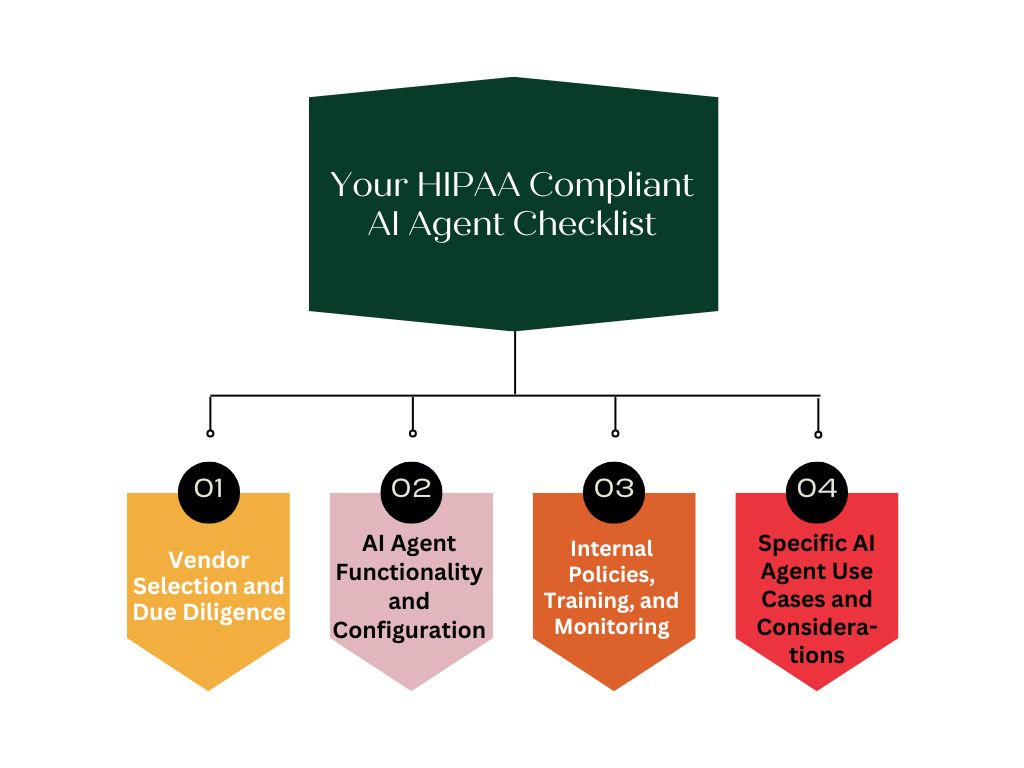
I. Vendor Selection and Due Diligence
This is arguably the most critical first step. Remember, under the HIPAA Omnibus Rule, vendors handling PHI (known as Business Associates) are directly liable for compliance.
- [ ] Business Associate Agreement (BAA): Ensure the AI vendor is willing and able to sign a comprehensive BAA. This legal document outlines the responsibilities of both parties regarding PHI protection. Without a BAA, you cannot legally share PHI with the vendor.
- [ ] Vendor’s HIPAA Compliance: Thoroughly vet the vendor’s security practices, certifications (e.g., SOC 2, ISO 27001), and track record. Ask for documentation on their security policies, risk assessments, and data handling procedures.
- [ ] Data Encryption Standards: Verify that the vendor uses robust encryption protocols (e.g., AES-256) for data both in transit and at rest.
- [ ] Access Control Mechanisms: Understand how the vendor manages user access to their platform and, consequently, to your PHI. Look for features like multi-factor authentication (MFA) and role-based access control (RBAC).
- [ ] Audit Trail Capabilities: Confirm that the AI platform provides detailed, immutable audit logs that capture all access and actions related to PHI. This is vital for compliance and incident investigation.
- [ ] Data Location and Residency: Understand where the vendor stores your data. Some regulations may have specific requirements about data residency.
- [ ] Incident Response Plan: Review the vendor’s incident response plan to ensure it aligns with HIPAA’s Breach Notification Rule requirements.
II. AI Agent Functionality and Configuration
Once you’ve selected a compliant vendor, focus on how the AI agent itself is configured and used.
- [ ] Minimum Necessary Principle: Configure the AI agent to access and process only the PHI absolutely required for its intended function. Avoid granting broad access. For example, if using an AI Virtual Receptionist, ensure it only accesses scheduling and basic contact information, not full clinical notes.
- [ ] Data Minimization: Design the AI’s interactions to collect and retain the least amount of PHI necessary. Purge or de-identify data when it’s no longer needed, according to your retention policies.
- [ ] Purpose Specification: Clearly define and document the specific purposes for which the AI agent will use PHI.
- [ ] Consent Management: If the AI agent will be used for patient communications (e.g., appointment reminders, follow-ups), ensure a robust consent management system is in place. This includes obtaining explicit patient consent for communication via specific channels (like SMS) and providing clear opt-out mechanisms. Tools for online scheduling software for pharmacies often integrate consent features.
- [ ] De-identification/Anonymization: Where possible, utilize AI features that work with de-identified or anonymized data, especially for analytics or training purposes.
- [ ] Secure Data Input/Output: Ensure any interfaces where PHI is entered into or outputted from the AI agent are secure and encrypted.
III. Internal Policies, Training, and Monitoring
Compliance is an ongoing process, not a one-time setup.
- [ ] Updated Policies and Procedures: Review and update your organization’s internal policies to include guidelines for the use of AI agents, data handling, and security protocols.
- [ ] Staff Training: Conduct comprehensive training for all staff who interact with or manage the AI agent. This training must cover HIPAA regulations, the AI’s capabilities and limitations, secure usage practices, and incident reporting procedures. A good HIPAA-compliant voicemail script is a good starting point for understanding compliant communication.
- [ ] Access Reviews: Regularly review who has access to the AI platform and the data it processes. Remove access for individuals who no longer require it.
- [ ] Regular Audits and Monitoring: Continuously monitor the AI agent’s activity through its audit logs. Perform periodic audits to ensure ongoing compliance and identify any potential security gaps or policy violations. Consider tools like call center speech analytics software to monitor interactions for compliance issues, though ensure these tools themselves are HIPAA compliant.
- [ ] Incident Response Plan Integration: Ensure your organization’s overall incident response plan is updated to include scenarios involving AI agents and that staff know how to report potential breaches.
- [ ] Vendor Performance Monitoring: Periodically reassess the AI vendor’s compliance and performance against the BAA and your organization’s standards.
IV. Specific AI Agent Use Cases and Considerations
Different AI applications require specific compliance checks:
- [ ] AI Chatbots/Virtual Assistants: Ensure they clearly identify themselves as AI. Verify they do not store conversational PHI beyond what’s necessary and are encrypted. * Implement escalation paths to human agents for complex or sensitive queries.
- [ ] AI for Clinical Decision Support: Requires rigorous validation of AI algorithms for accuracy and bias. Strict controls on who can access AI-generated clinical insights. * Clear documentation of how AI recommendations are used alongside clinician judgment.
- [ ] AI for Administrative Tasks (e.g., Billing, Scheduling): Focus on secure data integration with existing systems (EHR/EMR). Ensure AI’s access is strictly limited to relevant administrative data. Platforms offering online scheduling software for medical device companies often have built-in compliance features.
- [ ] AI for Patient Monitoring: Requires robust consent and clear communication about data collection and usage. Secure transmission and storage of potentially large volumes of patient data.
The Importance of Proactive Compliance
Implementing HIPAA-compliant AI agents isn’t just about avoiding penalties; it’s about building and maintaining patient trust. Patients entrust healthcare providers with their most sensitive information, and demonstrating a commitment to protecting that data is fundamental.
According to a Pew Research Center survey, a significant portion of Americans are concerned about the security of their health information when using digital health tools. By prioritizing HIPAA compliance in your AI strategy, you not only mitigate risk but also enhance your organization’s reputation and foster stronger patient relationships.
Moreover, robust compliance practices can actually enable innovation. By establishing secure frameworks, organizations can confidently explore new AI applications that improve patient outcomes and operational efficiency. For organizations focused on growth, maintaining a strong compliance posture is essential for securing partnerships and serving a broader client base. Companies offering VoIP software for nonprofits and other sectors often face similar data protection challenges.
Navigating the Future with Confidence
The integration of AI in healthcare is accelerating, and with it comes the increased responsibility of safeguarding patient data. By adhering to this comprehensive checklist, healthcare organizations can confidently deploy AI agents that are not only powerful and efficient but also fully compliant with HIPAA regulations. Remember, proactive compliance, thorough vendor vetting, and continuous monitoring are the cornerstones of responsible AI adoption in healthcare. Embracing these principles ensures you can leverage the transformative power of AI while upholding the trust and privacy your patients deserve.
Frequently Asked Questions (FAQs)
Not necessarily. While many AI functionalities can be implemented compliantly, the underlying platform and the vendor’s commitment to security are crucial. A truly HIPAA-compliant AI solution requires a secure infrastructure, robust encryption, strict access controls, and a willingness to sign a Business Associate Agreement (BAA) from the vendor.
If your AI agent is involved in a data breach involving PHI, you must follow HIPAA’s Breach Notification Rule. This typically involves notifying affected individuals without unreasonable delay (and no later than 60 days after discovery), reporting the breach to the U.S. Department of Health and Human Services (HHS), and potentially notifying the media if the breach affects more than 500 residents of a state or jurisdiction.
Due diligence is key. Request their BAA, inquire about their security certifications (like SOC 2), ask for details on their encryption methods, access controls, and audit logging capabilities. Review their policies and procedures, and consider conducting your own risk assessment of their services.
Yes. Appointment reminders often contain PHI, such as the patient’s name and the date/time of their appointment. Therefore, any system used for sending these reminders, including AI-powered ones, must be HIPAA compliant. This involves secure transmission, proper consent, and audit trails.
A BAA is a contract between a healthcare provider (Covered Entity) and a vendor (Business Associate) that outlines how the vendor will protect PHI on behalf of the Covered Entity. For AI agents handling PHI, a BAA is a mandatory requirement under HIPAA to ensure the vendor is legally obligated to comply with privacy and security rules.
If the data is properly de-identified according to HIPAA standards, it may not be considered PHI and therefore would not require a BAA or full HIPAA compliance for its use in research. However, the process of de-identification itself must be robust and follow specific HIPAA guidelines. If there’s any risk of re-identification, HIPAA rules still apply.
Key Takeaways
- HIPAA is Non-Negotiable: Protecting Protected Health Information (PHI) is a legal and ethical requirement in healthcare.
- AI Agents Handle PHI: Be aware that AI tools, by their nature, often process sensitive patient data.
- Vendor Due Diligence is Crucial: Always sign a Business Associate Agreement (BAA) and thoroughly vet AI vendors for their security practices and HIPAA compliance.
- Implement the Minimum Necessary Principle: Configure AI agents to access only the PHI essential for their function.
- Encryption and Access Controls are Key: Ensure data is encrypted in transit and at rest, and that access is strictly controlled and logged.
- Audit Trails are Essential: Maintain detailed logs of all AI activity involving PHI for accountability and investigation.
- Training and Policies are Vital: Educate staff on compliant AI usage and update internal policies accordingly.
- Proactive Compliance Builds Trust: Demonstrating a commitment to HIPAA not only avoids penalties but also strengthens patient relationships and organizational reputation.


 4.9 (400+
reviews)
4.9 (400+
reviews)