
 4.9 (400+
reviews)
4.9 (400+
reviews)
Introduction
Dental radiology has shifted from being film-based imaging to digital X-rays. Digital X-rays have resulted in a significant improvement in image quality and workflow efficiency. Yet, the interpretation of dental X-rays is still very much dependent on human capacity, which may differ according to experience and workload.
Today, AI (Artificial Intelligence) is revolutionising the way dental experts evaluate radiographs. AI employing machine learning and computer vision can recognise tendencies, pinpoint irregularities, and be the first to identify illnesses. Usually, its work is done at a faster pace and more reliably than humans.
Considering the increasing number of patients, staff difficulties, and the need for faster results, AI is becoming a must-have in modern dental practices. Using an example of the Emitrr platform, the diagnosis of a patient is guaranteed to be more accurate through texting, scheduling, and AI-powered communication, plus all of these are compatible with the radiographic workflows.
Use Cases of AI in Dental Radiology
Artificial Intelligence has revolutionised the process of dental x-ray analysis and decision-making, making diagnostics quicker, more accurate, and capable of performing an increasing number of tasks automatically. Here are some of the key AI applications in dental radiology now:
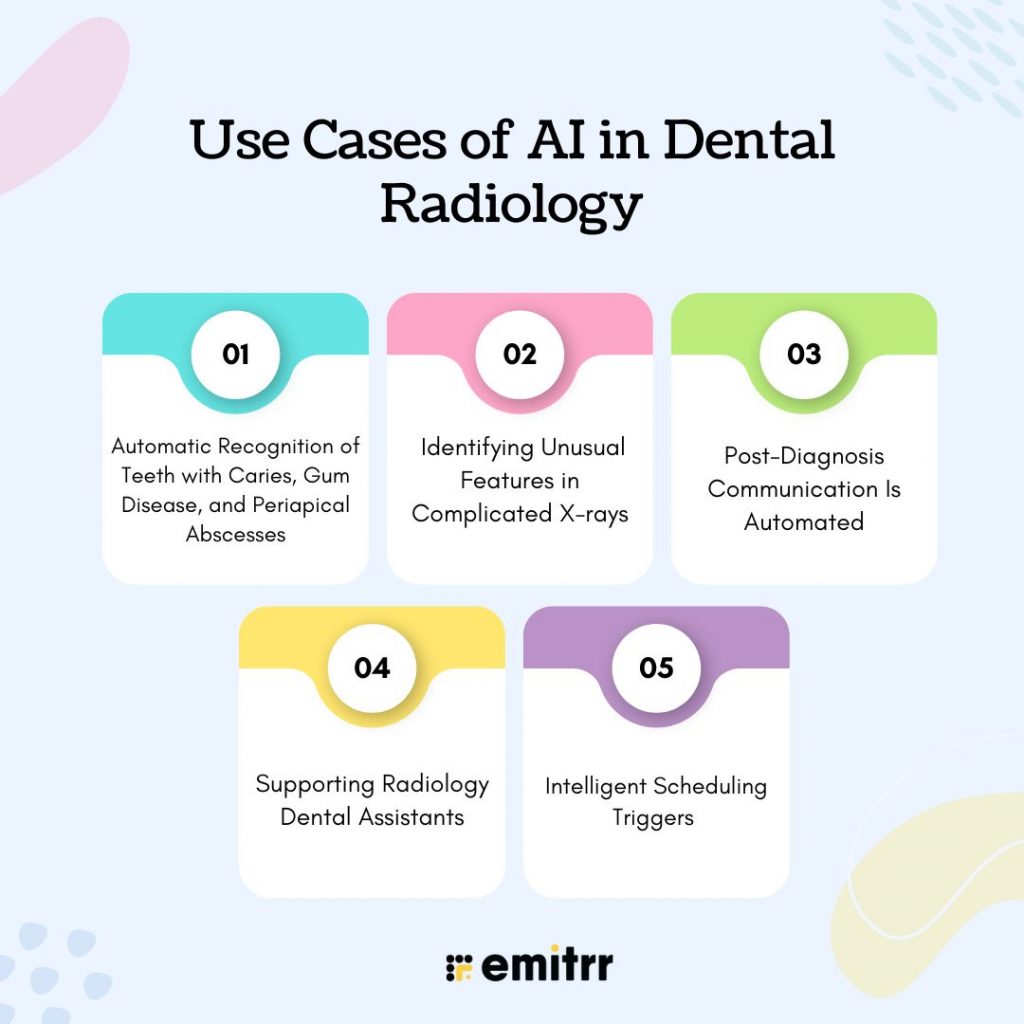
1. Automatic Recognition of Teeth with Caries, Gum Disease, and Periapical Abscesses
AI models that have been trained on numerous annotated radiographs are capable of recognising early signs of dental caries, periodontal disease, and periapical infections with great accuracy. They serve as an additional pair of eyes for the doctors, enabling them to find problems that can be overlooked in regular checks, especially in busy dental offices.
2. Identifying Unusual Features in Complicated X-rays
For the case of multi-rooted teeth or overlapping anatomical structures, it can be hard to interpret tooth X-rays manually. AI algorithms are excellent at pointing out very faint abnormalities such as bone loss, cysts, or radiolucent lesions; thus, the human can concentrate more on those areas, and his/her clinical judgment is not hindered.
3. Post-Diagnosis Communication Is Automated
After the identification of the ailment, AI applications, including Emitrr’s Dental Texting, allow offices to send automated, HIPAA-compliant messages to their patients. These messages can be with the treatment reminder, educational follow-up, or payment link to set the stage for post-visit engagement to be much simpler.
4. Supporting Radiology Dental Assistants
The use of AI in radiology has the effect of diminishing the mental work of dental assistants since it is able to rapidly carry out the pre-processing of images, suggest possible diagnoses, and indicate the most important parts. Not only does this increase the accuracy, but it also assists in the reduction of interpretation fatigue in clinics that have a large volume of patients.
5. Intelligent Scheduling Triggers
It is important to note that the use of AI is not only for the purpose of diagnosis; it is also beneficial in the improvement of operational workflows. For example, Emitrr, among others, makes use of the diagnostic outcomes to activate several automated schedules.

Benefits of AI in Dental Radiology
Using artificial intelligence in dental radiology significantly transforms the way modern dental practices engage with patients, conduct diagnoses, and facilitate training. Here are some of the most important benefits that include increasing accuracy and automating administrative workflows:
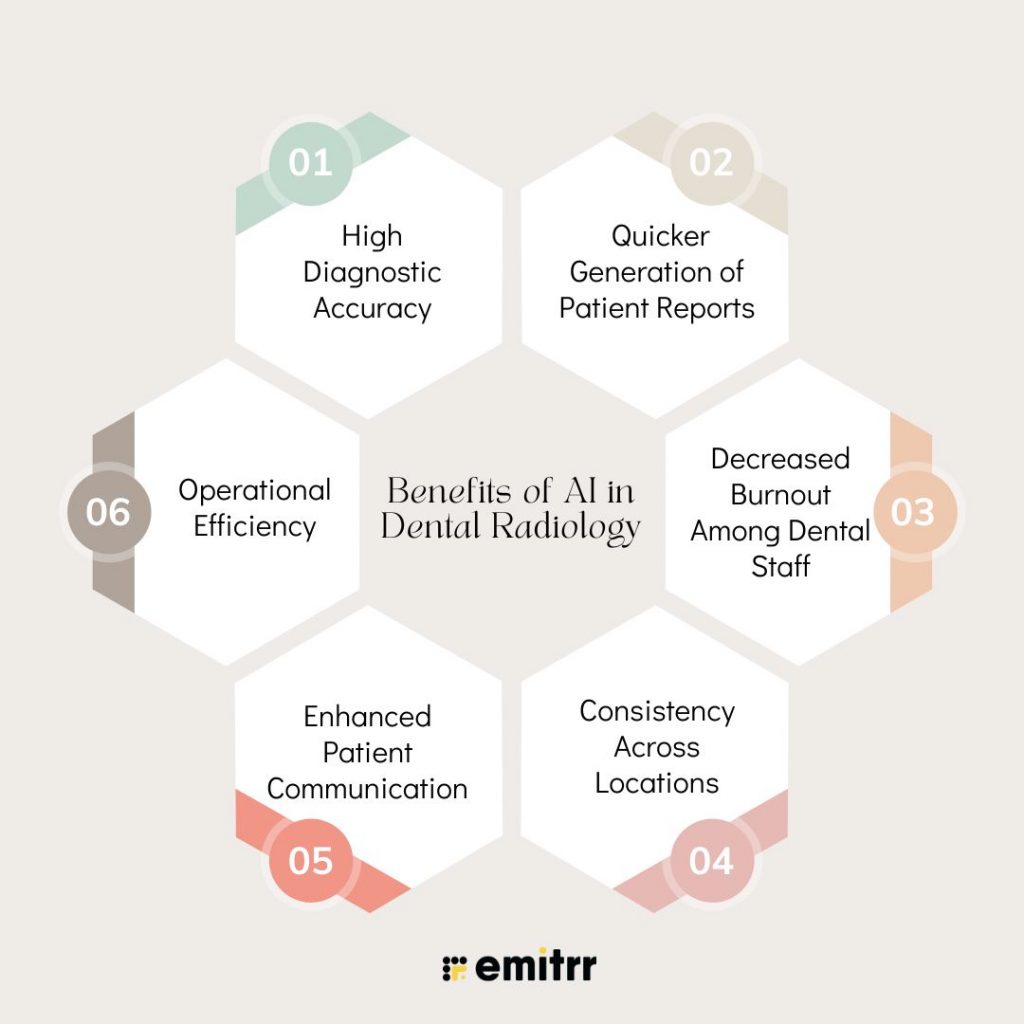
1. High Diagnostic Accuracy
Machine learning algorithms developed on vast collections of dental X-rays annotated by experts can recognise initial indications of caries, bone resorption, periapical lesions, and other dental diseases with decision-making capabilities equal to those of experienced radiologists. In some situations, AI systems even go beyond human clinicians, particularly when it comes to spotting very faint or early-stage mistakes.
2. Quicker Generation of Patient Reports
AI facilitates the diagnostic process by analysing radiographic data instantly. This not only reduces waiting time but also enables dentists to decide quickly and with more confidence, especially in busy or emergency care situations, where this can be very beneficial.
3. Decreased Burnout Among Dental Staff
AI may complete the repeated image reviews and make sure areas of concern are obvious. Radiology dental assistants can thus focus on more meaningful work like patient care, communication, and chairside support, because the support given is in line with the support expected to be given.
4. Consistency Across Locations
AI guarantees that human error disappears, conditional on the effect of one’s experience or fatigue. The benefits of AI in this case are extremely valuable when the diagnosis and intervention of Dental Support (or Service) Organisation or multiple-location clinics should be consistent in quality and delivery of care at scale.
5. Enhanced Patient Communication
AI-driven dental receptionists and automated texting tools that are implemented by Emitrr, such as AI-powered dental receptionists, are used for diagnosis, discussion, treatment plan, follow-up instructions and reminders instantly. Engagement is increased, reduced no-shows, and case acceptance rates are improved.
6. Operational Efficiency
The Diagnostic results can be directly connected with scheduling triggers, appointment workflows and practice management systems using AI tools like Emitrr’s Dental Scheduling Software, which helps to save time and energy during the front office work. This allows the staff to focus on other tasks, lessens the chances of errors and raises the productivity of the practice.
Challenges and Limitations of AI in Dental Radiology
It is beyond doubt that AI in dental radiology brings revolutionary benefits, but its adoption on a large scale is not a bed of roses. It is a matter of dental clinics that they have to be very cautious while dealing with several clinical, operational, and ethical aspects before committing to the use of AI in their diagnostic workflows completely.
High Initial Implementation Costs
The use of high-tech AI-powered radiology instruments usually means a big upfront investment in specialised software licenses, hardware upgrades (e.g., more powerful workstations), and staff training. On one hand, smaller or independent practices can face this initial capital outlay challenge on the downside, whereas on the upside, long-term return on investment (ROI) can be favourable.
Data Privacy and HIPAA Compliance
AI systems inherently process and analyse vast volumes of sensitive patient data, including protected health information (PHI). Ensuring strict HIPAA-compliant workflows and robust protection against potential data breaches is paramount. Cloud-based AI tools, in particular, must adhere to stringent security standards and employ advanced encryption to safeguard patient records effectively.
Performance Limitations in Complex or Rare Cases
AI models have a set of limitations that derive directly from the quality of good data and the variety they learn from. Also, in the case that these clinical situations are high in complexity, unusual, or very rare, i.e., instances of bone morphological abnormalities, minor congenital defects, or very rare pathologies, AI systems can misidentify the signals, result in false positives/negatives, be unable to detect subtle pathology at all. Besides being the main cause of “edge cases”, these situations still require diligent human oversight to make an accurate diagnosis.
Dependence on High-Quality, Labelled Training Data
The creation of AI algorithms that can identify and localise dental diseases from radiographs with high accuracy and reliability depends on annotated images in the thousands, sometimes even millions. If there are any biases, inconsistencies or limited data in the foundational datasets, the AI’s performance could be severely impaired, and inaccurate outputs may even be generated. This is especially the case if the AI is used across diverse patient populations or for conditions that are underrepresented.
Ethical and Legal Risks of Misdiagnosis
Although reporting very high accuracy rates, AI software is also not perfect and, at times, can generate false positives or false negatives. In the absence of careful and knowledgeable human scrutiny, over-reliance on AI-generated reports might unintentionally contribute to unwarranted overtreatment or, more seriously, missed diagnoses. This would present substantial ethical problems and malpractice risks. Dental practitioners must always maintain the ultimate decision-making authority and accountability for patient care.
Traditional vs AI-Based Dental Radiology
Understanding the evolution from traditional radiology methods to AI-enhanced diagnostics reveals the true value of artificial intelligence in dental practice. Below is a side-by-side comparison of key factors:
| Criteria | Traditional Dental Radiology | AI-Based Dental Radiology |
| Accuracy | Depends on clinician experience; subject to fatigue or human mistake | Sustains high-precision, consistent analysis through trained algorithms |
| Speed | Manual interpretation takes hours | Provides real-time analysis, dropping diagnostic turnaround to minutes |
Cost | Lower initial capital cost; greater labour costs in the long term | Higher upfront cost, long-term benefits through automation, and fewer staffing requirements |
| Patient Communication | Based on manual phone calls and follow-ups | Automated updates, appointment reminders, and post-diagnosis messages through AI tools |
| Scalability | Grows only with additional personnel and physical facilities | Cloud-based and scalable, very easily at many practice sites |
How Does AI-Based Communication in Dental Radiology Differ from Traditional Communication?
AI has not only altered the way dental X-rays are interpreted, but it has also brought changes in the way clinics interact with patients before, during, and after their visits.
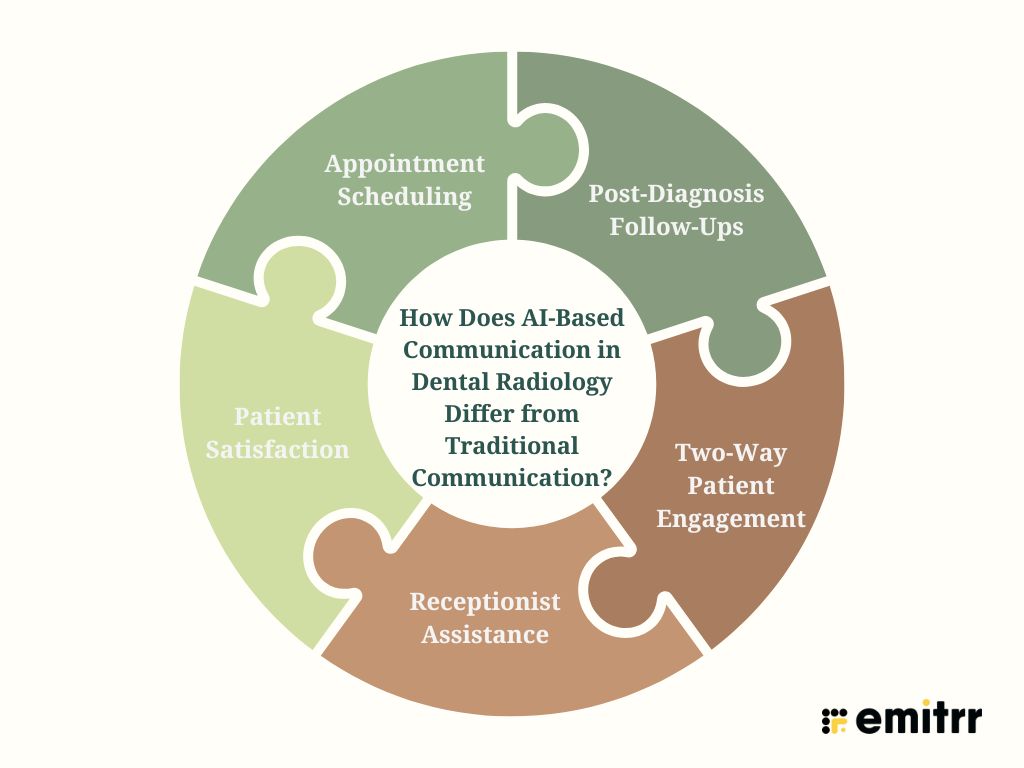
Appointment Scheduling
Traditional: Front-desk staff entered the information manually; however, it was prone to errors or double-booking.
AI-Driven: Emitrr’s Dental Scheduling Software is an easy-to-use tool which facilitates various dental departments in keeping track of their appointments and getting rid of all the hassles. This way, not only is time saved, but appointments are triggered by the diagnostic need, and hence, no-shows are kept to a minimum.
Post-Diagnosis Follow-Ups
Traditional: Here, staff took the responsibility of calling or emailing the patient, hence causing the work to be often delayed due to manual efforts.
AI-Driven: Platforms such as Emitrr can provide all these services and do it faster by sending out the automated follow-up messages, treatment reminders, or consent forms after the analysis of the X-ray is done.
Two-Way Patient Engagement
Traditional: This type of communication is normally one-way via landline calls or paper forms.
AI-Driven: Texting, which takes place in real-time two-way form, gives patients the possibility to do different things like confirming, rescheduling and cancelling.
Receptionist Assistance
Traditional: It depends on human receptionists doing multiple tasks.
AI-Driven: Tools such as Emitrr’s AI Dental Receptionist address frequent inquiries, rescheduling appointments, and billing queries autonomously.
Patient Satisfaction
Traditional: Limited supply, extended wait times, communication delays.
AI-Driven: Instant response, greater personalisation, and 24/7 engagement enhance satisfaction and loyalty.
Where AI Overtakes Humans in Dental Radiology
Although AI hasn’t become a substitute for dental professionals, it is still the case that there are some particular areas where it shines such capability in terms of efficiency, speed, and consistency. The following are the areas where artificial intelligence is far beyond human capability in dental radiology:
1. High-Volume Image Analysis
AI uses algorithms to quickly perform thousands of dental X-ray reviews and is very accurate to the point of being consistent. This is ideal for DSOs or big clinics that have a very high number of patients.
2. Detecting Subtle or Early-Stage Pathologies
Trained on extensive data, AI models can detect early caries, bone loss, and abnormalities not visible to human eyes, especially in situations which are borderline or complex.
3. Round-the-Clock Communication & Follow-Up
Texting dental AI has capabilities such as Emitrr, which operates the facilities of automation of the medical appointment reminders, media notifications, and follow-up, therefore, uninterrupted patient communication 24/7 without human intervention.
Where Humans Overtake AI in Dental Radiology
Despite the fact that artificial intelligence has a growing role in dentistry, human beings are still very important in areas that require empathy, ethical judgment, and understanding of the situation.
1. Patient Context and Medical History
According to human practitioners, radiographs can be understood in the light of the patient’s symptoms, medical history, behavioural signs, and lifestyle; thus, they can produce an interpretation.
2. Ethically Complex Decisions
In situations like over-treatment as a major concern, incidental discoveries, or financial limitations, human dentists are more considerate and better-trained to make a decision that is not only based on diagnostic insights but also ethical responsibility.
3. Emotional Intelligence During Consultations
A diagnosis explanation, calming an anxious patient, or even giving bad news requires the energy of compassion, empathy, and clear communication; thus, none of them can be provided by AI. Gaining trust and rapport is still human nature, which is dental care’s most powerful factor.
AI is great for speed, large-scale operations, and pattern recognition, whereas human dentists are better in the areas of subtle clinical judgment and patient relationships.
Why Dental Practices Need AI Now
Artificial intelligence in dental imaging has become a reality rather than a dream. In the course of significant demand and staffing obstacles, AI grants organisations the power to grow effortlessly, upgrade diagnostics, and deepen the patient experience.
Addressing Staff Shortages
There is an increasing lack of skilled dental radiologists and assistants all over the world, especially in Tier 2 and Tier 3 cities. Hence, AI comes in. The latter one can carry on any routine work, such as initial X-ray assessment, thus, the clinicians can do more hands-on care.
Managing Increased Patient Volume
Hospitals both in rural and urban areas are facing the fact that more patients are coming to them than before. Nevertheless, with the help of AI tools, scalable diagnostics and communication are ensured no matter the situation, i.e., the number of human resources will be limited or not.
Meeting Modern Patient Expectations
Nowadays, a patient puts several expectations upon a dentist: a quick diagnosis, transparency, and perfect communication. Besides, AI makes it possible for there to be instantaneous analysis of radiographs and the treatment plan to be finalized faster, which leads to trust and satisfaction.
Boosting Engagement and Revenue
Platforms such as Emitrr’s AI Dental Receptionist and Dental Texting leverage follow-ups, reminders, and updates automation, thus resulting in:
- Lower cancellation rates
- Increased acceptance of treatments
- Higher patient engagement
Why Emitrr is the Ideal AI Platform for Dental Practices
Emitrr is the perfect solution for dental clinics that want to upgrade their operations and increase patient engagement. The AI communication platform of Emitrr is designed specifically for dental professionals. Intelligent automation and seamless integrations allow practices to save time, cut down on no-shows, and improve patient satisfaction across the board.
AI Dental Receptionist
The AI Dental Receptionist of Emitrr automates the front-end communication, which includes appointment confirmations, insurance queries, and post-visit follow-ups with zero manual effort. The regular usage of the chatbot ensures uninterrupted availability so that clinics can be responsive even when it is outside of business hours.
Watch the video below to see the Emitrr Voice Agent in action:
Dental Texting
The Dental Texting of Emitrr allows clinics to automate the personalized messages for recalls, reminders, and treatment updates. The platform not only improves the patient communication aspect but also makes case acceptance easier and highly reduces no-show rates.
AI-Powered Dental Scheduling
The Dental Scheduling Platform of Emitrr uses AI to coordinate diagnostics with appointment flows. Besides following up with patients after a flagged X-ray via message or automating the rescheduling step if an appointment is missed, Emitrr makes sure that the patients have a smooth treatment journey experience.
Multilingual Capabilities
Communicate efficiently with cross-cultural patients by AI-assisted conversations in many tongues, thus making it easier to gain the patient’s confidence, eliminate language barriers, and increase services to the community.
Seamless Integration
Emitrr connects with your dental practice management systems (PMS) and imaging software in an effortless way. This guarantees a minimal interruption during installation and a smooth workflow that goes from reception to radiology.
What’s New: AI Text Enhancement Features Now Available
Emitrr’s Professional Plans come with the latest AI-powered text tools that enable dental staff to produce smarter, quicker, and more considerate communication with less effort.
- Help Me Write: It automatically generates the full text of a message from a brief description (for example, a lab update, a request for insurance).
- Enhance:
- Make it Crisp: It gathers the long answers and changes them into precise, clear messages.
- Make it Empathetic: A friendly and professional tone will be added for sensitive conversations.
- Suggest a Reply: This provides the most suitable replies instantly for incoming texts, considering the context (e.g., confirming emails, patient queries, follow-ups).
These characteristics are designed for dental professionals who deal with a large number of customer interactions every day and are still available only on Emitrr’s Professional Plans.
Emitrr is not only a connector of your practice, but it also transforms it. Emitrr, being a smart automation tool, is perfect for clinics that aim to save time, lessen the burden of running the practice, and enhance the patient experience, all of which these facilitated by intelligent automation, from dental texting and AI scheduling to multilingual replies and smart reception.
Future Trends: What’s Next in AI for Dental Radiology
The role of AI in dental radiology is increasing exponentially beyond mere image interpretation, as AI stays on its trajectory of rapid development. The future is in highly interconnected systems that not only improve diagnostic accuracy but also treatment and patient care, as well as the easy switching of practice among practitioners.
3D CBCT image analysis using deep learning
AI models are rapidly improving in handling 3D CBCT scans (Cone-Beam Computed Tomography). This paves the way for diagnosing indeed root cracks, bone density that is not uniform, missing teeth, and the most suitable location for the implant with the highest accuracy, the most in-depth insight possible through automated segmentation and volumetric analysis.
Federated learning across clinics to improve accuracy
Federated learning is a technology that enables dental clinics to work together in improving AI models without having to send them patient data. This approach respects privacy and, therefore, is a powerful instrument for reaching a higher level of diagnostic accuracy for several groups, all while keeping the HIPAA and GDPR principles.
AI-assisted robotic treatment planning
Shortly, AI may become a decisive factor in the support of the dental operations done by robots, as it will be the one to create the most personalised treatment plans from the radiographic data. This will result in higher surgical accuracy, the lowering of risk, and consequently, the reaching of ultimate patient satisfaction, especially in complicated or painful procedures.
Predictive patient health dashboards linked with AI imaging
Dental practices will be able to install real-time dashboards communicating signs of periodontal disease, bone loss, or implant complications, by combining AI-powered radiographic analysis with patient history and risk models. Such systems will allow for the identification of potential warning signs before fashioning interventions and thus the improvement of long-term outcomes.
FAQs
Definitely. AI systems that have been trained on vast data sets documented by humans have demonstrated diagnostic results that match those of expert radiologists. Besides being quite good at locating caries, evaluating bone loss, and recognising periodontal disease, they also provide consistent results across different clinics.
No, not completely. AI is created to be a helper for dental assistants, and not a substitute. It carries out tasks of a repetitive nature, such as noticing if there are any irregularities or taking care of the follow-up activities; thus, your team will have more time for patient care, education, and clinical decision-making.
AI texting platforms like Emitrr guarantee that they are HIPAA compliant and secure. On the other hand, at every point, a qualified clinician should be the one to make the final diagnostic decision. These tools are the most effective when they are used to improve communication, like scheduling, sending reminders and post-care, instead of clinical expertise.
benefit. High-volume clinics gain speed and diagnostic consistency, while smaller teams enjoy reduced admin workload and improved patient communication without needing to hire additional staff.
Conclusion
AI is on a journey of bringing a new face to dental radiology, that is to say, new ways plus patient communication to quick diagnostics. Due to the increasing work volume and constantly rising patient expectations, AI gives speed, accuracy. Integrating AI into your practice is now more effortless than ever with Emitrr’s AI Dental Receptionist, Smart Scheduling, and HIPAA-compliant Texting. Delegate routine tasks to AI and free up your team’s time for more patient-centric work. Be the first to lead the AI revolution with Emitrr!