
 4.9 (400+
reviews)
4.9 (400+
reviews)
Introduction
The logistics and delivery sector is constantly active, managing numerous shipments, strict delivery timelines, and fluctuating road conditions. Overseeing different drivers, vehicles, storage facilities, and clients can be rather challenging to ensure that all parties stay informed and connected. Traditional communication methods—like phone calls, chaotic text messages, and multiple email threads—often lead to misunderstanding, missed details, and costly delays. As customer expectations for speed and transparency rise, these obsolete methods can no longer fulfill the needs of modern logistics.
This is where AI is making a substantial impact. By analyzing communication patterns and processes, AI helps logistics teams predict challenges, make better decisions, and maintain smooth operations. Instead of just automating simple tasks, AI has the ability to recognize patterns, anticipate issues, and provide essential updates to the relevant people at the ideal time. This leads to fewer unforeseen occurrences, faster responses, and a more reliable delivery experience for everyone involved.
One sector experiencing a significant enhancement from AI is team communication, whether via calls, texts, or online platforms. AI-powered solutions are streamlining the distribution of real-time updates, enhancing collaboration among different teams, and ensuring customers are kept informed, all while reducing manual work. This more intelligent method of communication enables dispatchers, drivers, and support personnel to collaborate more effectively, resulting in reduced mistakes and improved overall service.
In this article, you’ll discover how AI in dispatch and logistics is helping businesses become more connected, agile, and customer-focused.
Why Do Dispatch and Logistics Need AI?
Shipping and logistics focus on moving goods quickly and smoothly from one place to another. Nevertheless, with many drivers, vehicles, routes, and clients to manage, situations can become complex rapidly. Conventional work methods, like making phone calls, sending handwritten messages, or using paper timetables, often lead to misunderstandings, delays, and mistakes. As customers expect faster deliveries and real-time updates, these traditional methods just aren’t enough anymore.
AI addresses these issues by enhancing communication and decision-making significantly. It can analyze vast quantities of data, such as historical delivery durations, present traffic conditions, and weather forecasts, to assist teams in planning improved routes and circumventing delays. Rather than waiting for problems to arise, AI can identify issues beforehand, such as alerting when a vehicle requires maintenance or when a route might be congested. This results in fewer unexpected events and increased timely deliveries.
Most importantly, AI makes it easier to keep everyone in the loop. Drivers, dispatchers, and clients can obtain timely, accurate updates, be it a note about a postponed delivery or a call concerning a route modification. This fosters trust among customers and enables teams to collaborate more effectively. In the rapidly evolving landscape of today, the application of AI in dispatch and logistics is not merely advantageous; it is increasingly vital for maintaining a competitive edge and ensuring customer satisfaction.
Benefits of AI-Powered Communication in Dispatch and Logistics
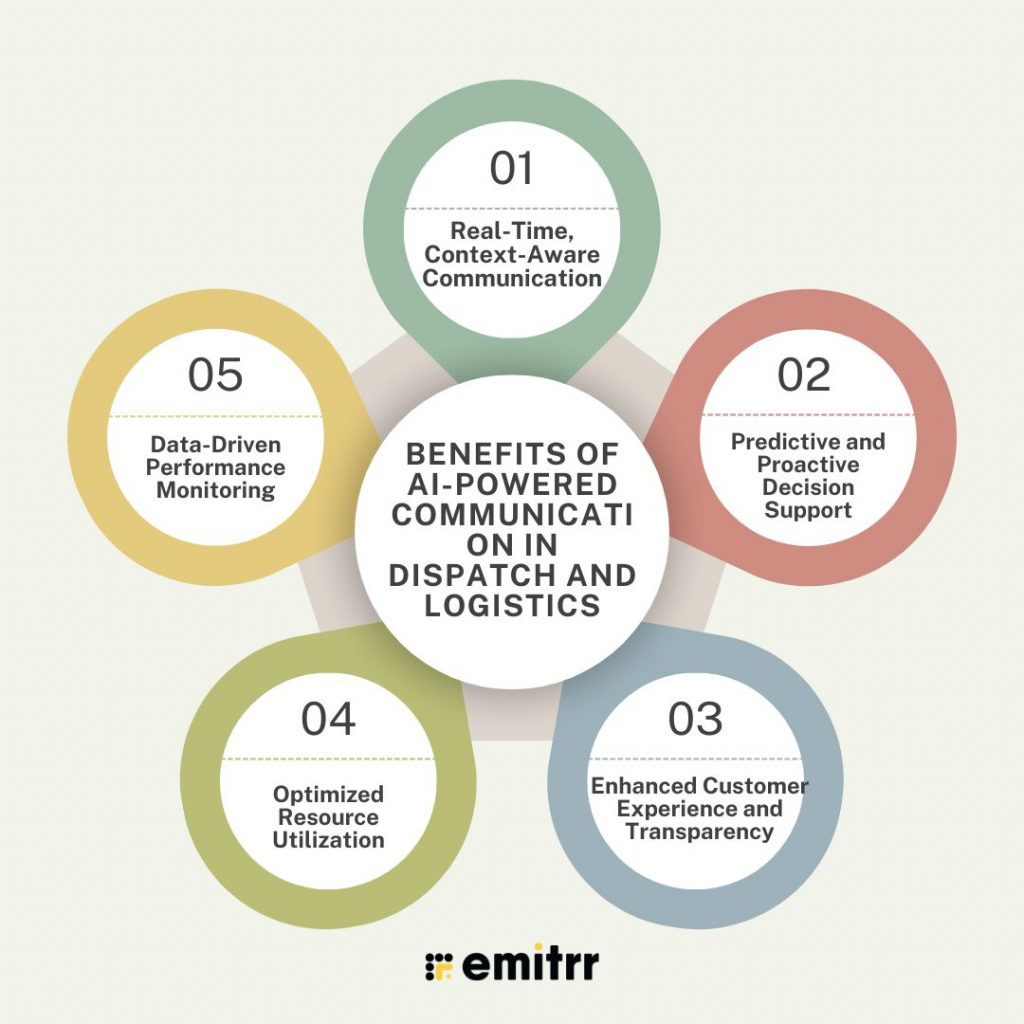
Real-Time, Context-Aware Communication
AI allows teams to communicate crucial updates instantly through texts, calls, and smart agents. In case of a traffic delay, weather issue, or unexpected change, all are quickly notified. This indicates that drivers, dispatchers, and customers stay updated, reducing confusion and mistakes. Automated alerts for emergencies or delays allow teams to react quickly and avoid bigger problems. With everyone connected in real time, deliveries happen faster and with fewer unforeseen problems.
Predictive and Proactive Decision Support
AI keeps a close watch on vehicle data, like engine performance and mileage, to predict when maintenance is needed. Instead of waiting for a breakdown, AI notifies drivers and operations teams beforehand, allowing them to schedule maintenance before any problems occur. This anticipatory strategy aids in preventing unforeseen issues and expensive repairs. By utilizing automated notifications and reminders, AI ensures that all maintenance tasks are addressed. Teams can better organize their schedules, keep more vehicles in service, and reduce downtime. This not only reduces costs but also aids in keeping deliveries timely and customers happy
Enhanced Customer Experience and Transparency
AI agents are available 24/7 to respond to customer inquiries, providing immediate information on shipments. Customers are quickly informed if there is a change or delay in the delivery schedule. This fosters trust as customers are consistently informed about the status of their orders. Personalized messages show customers they are appreciated, not merely a statistic. Prompt and effective communication ensures customer satisfaction and increases the likelihood of them using your service again.
Optimized Resource Utilization
AI connects the appropriate drivers, vehicles, and shipments according to the current conditions. When a truck is unable to continue or a new order is received, AI quickly assesses the best method to adjust the routes. This reduces needless trips and empty miles, saving time and fuel costs. Dynamic updates guarantee that every vehicle and driver is used most efficiently. Enhanced resource management results in lower costs and a more reliable service for everyone.
Data-Driven Performance Monitoring
AI collects and organizes all communication and delivery details in one place. Managers can instantly access live dashboards that show important metrics and trends. This helps in recognizing problems early and finding ways to improve existing practices. Groups can base their decisions more on data instead of just depending on guesses or intuition. Continuous monitoring leads to enhanced performance and helps the business become stronger over time.

Use Cases: AI in Dispatch and Logistics
Dynamic Route Planning and Real-Time Re-Routing
Communication tools powered by AI assist dispatchers and drivers in predicting traffic congestion, adverse weather conditions, and modifying delivery priorities. As circumstances shift, AI swiftly evaluates the optimal new paths and directs drivers effectively via dispatch messaging, phone calls, or app alerts. This enables drivers to adjust their routes as necessary, guaranteeing prompt deliveries and reducing stress for everyone involved. Simultaneously, automated notifications inform both clients and internal groups about changes in projected arrival times or modifications to the route. This continuous flow of information keeps everyone informed, fosters trust, and helps prevent misunderstandings or unnecessary communications. By having AI oversee these updates, processes turn more adaptable, effective, and trustworthy
Predictive Maintenance and Fleet Health Alerts
AI keeps a close watch on vehicle data, like engine performance and mileage, to predict when maintenance is needed. Instead of waiting for a breakdown, AI notifies drivers and operations teams beforehand, allowing them to schedule maintenance before any problems occur. This proactive approach helps avoid unexpected challenges and costly repairs. Through the use of automated alerts and reminders, AI guarantees that every maintenance task is attended to. Teams can organize their schedules more effectively, maintain more vehicles in operation, and minimize downtime. This not only reduces costs but also aids in keeping deliveries timely and customers happy
Automated Task Assignment and Load Allocation
AI eliminates the uncertainty of pairing shipments with appropriate drivers and vehicles. It swiftly analyzes real-time information on vehicle capacity, driver position, and delivery timelines to allocate tasks effectively. Once a match is made, the system promptly sends out notifications and clear instructions to the staff, guaranteeing that everyone is aware of the upcoming actions. This smart allocation approach speeds up distribution, reduces human errors, and ensures that resources are used most effectively. By automating these choices and communications, teams can concentrate on tackling larger challenges while AI manages the essential yet routine details
Proactive Customer Engagement
AI agents and virtual assistants are available around the clock to handle common customer questions, such as “Where is my order?” or “When should I expect delivery?” These smart agents that comes with dispatch VoIP phones provide instant, accurate replies and can issue proactive notifications about any changes or delays in delivery, keeping customers informed without requiring them to ask. When a customer encounters a more complicated issue, the AI can promptly hand over the case to a human team member, guaranteeing tailored support when needed. The smooth integration of automated and human assistance results in improved service, increased customer satisfaction, and fewer missed messages.
Anomaly Detection and Risk Alerts
AI continually analyzes communication and shipping information to identify irregularities such as unforeseen delays, potential fraud, or missing shipments. Once a problem is identified, it quickly notifies the appropriate teams, enabling them to respond rapidly and resolve issues before they worsen. This proactive notification system assists companies in avoiding major issues and guarantees smooth operations. By analyzing previous events, AI continuously enhances its ability to identify risks, thereby improving the overall safety and reliability of the logistics process
Inventory and Demand Forecasting Communication
AI foresees when inventory amounts are either excessively low or too high by examining ordering trends and existing stock. It subsequently conveys restocking or redistribution guidelines to warehouse and logistics teams, aiding in the avoidance of both stockouts and overstock scenarios. These prompt notifications enable teams to respond swiftly to maintain inventory levels, minimize waste, and ensure customer orders are consistently completed. AI-driven communication keeps everyone aligned, enhancing efficiency and minimizing expensive errors
Automated Regulatory Compliance Notifications
AI oversees all regulations and documentation necessary for safe, legal deliveries, covering driver hours, hazardous materials, and customs documentation. It monitors compliance in real time and offers proactive alerts to drivers, dispatchers, and managers about impending deadlines or missing information. This assists companies in sidestepping penalties, holdups, and legal issues by ensuring that nothing significant is missed. Automated notifications help maintain organization and guarantee that compliance activities are executed efficiently and punctually.
Real-Time Collaboration for Multi-Modal Shipments
AI coordinates communication between all the different parties involved in moving shipments by road, rail, air, or sea. It offers live updates and straightforward guidance to carriers, ports, customs, and logistics teams, ensuring that everyone is informed about what’s occurring at each step. This integrated communication aids in preventing handoff delays, minimizes confusion, and guarantees that shipments transition seamlessly from one transport mode to another. AI simplifies and streamlines complex, multi-modal logistics by ensuring that all stakeholders are connected
AI Agents for Billing Communication and Dispute Resolution
AI agents oversee delivery logs, delivery confirmation notifications, and customer interactions to identify discrepancies or possible billing problems. When discrepancies arise, the AI contacts drivers, customers, or personnel to obtain clarification and promptly collect any necessary information. These representatives oversee the resolution process from beginning to end, providing status updates and document requests through SMS, email, or phone calls. AI agents improve their ability to prevent similar problems in the future by analyzing past conflicts. This results in quicker, more transparent conflict resolution, enhanced understanding, and increased trust between logistical suppliers and their clients.
Challenges of AI in Dispatch and Logistics

Integration with Legacy Systems
Numerous logistics firms rely on outdated computer systems that struggle to integrate with modern AI technologies. This complicates the ability of AI to access the data it needs or to share information seamlessly. To achieve the best results, companies need to either upgrade their systems or find ways to merge both traditional and modern technologies. In the absence of effective integration, data may remain isolated or become inconsistent, hindering productivity and diminishing the advantages of AI.
Data Quality and Trust
AI relies on quality data to provide valuable insights. If the data is incorrect, outdated, or lacking, AI could provide poor suggestions. This may lead to errors and diminish people’s confidence in AI. To address this, businesses need to maintain their data accurately and ensure it is current. Routine evaluations and training ensure that AI operates effectively and individuals have confidence in its recommendations.
Change Management and Workforce Adoption
Transitioning to AI-based communication can be challenging for employees accustomed to traditional methods. Some individuals may feel doubts or concerns regarding new technology. To help, companies need to train staff and offer assistance throughout their learning journey. Leaders need to demonstrate how AI simplifies tasks rather than merely modifying them. When employees observe that AI helps save time and minimize errors, they are more inclined to embrace and utilize it.
Security and Compliance
AI communication handles lots of sensitive information, so protecting data is very important. Businesses need to adhere to regulations regarding privacy and security to protect customer and company data. This entails utilizing robust security measures, frequently assessing systems, and remaining informed about regulations. Guarding data fosters confidence and allows businesses to utilize AI without encountering issues. This edition maintains clarity and simplicity, addressing all your points in a manner that’s straightforward and applicable for companies in dispatch and logistics.
The Future: AI-Driven Communication Ecosystems in Logistics
Autonomous, Self-Learning Communication Agents
In the future, AI agents will independently manage everyday communication. They will gain insights from each message, call, or email and improve as time goes on. These intelligent agents will inform drivers of new routes, respond to customer inquiries, and issue alerts without constant human intervention. This enables teams to focus on essential tasks as AI handles everyday communication. As these AI agents keep learning, they will improve in precision and utility. They will not just tackle problems but will foresee possible occurrences and respond swiftly. This will help logistics companies function more effectively and tackle issues more promptly
End-to-End Visibility and Predictive Collaboration
AI will connect everyone involved in the supply chain-from drivers and warehouse workers to customers and managers. All of them will see real-time updates and predictions in one place. This aids teams in collaborating more effectively, identifying issues promptly, and resolving them before they lead to delays. When everything is linked, there will be less unpredictability. AI will not only monitor shipments but also alert regarding potential delays or problems in advance. In this manner, everyone can organize more effectively and maintain timely deliveries
Hyper-Personalized and Contextual Engagement
AI will deliver messages and updates tailored to the individual’s needs and circumstances. For instance, a driver may receive an instant route adjustment notification, whereas a customer gets a shipping status update. AI will understand which information is most beneficial and deliver it in the most effective manner for each individual. Such personal interactions foster trust and make individuals feel appreciated. AI will comprehend factors such as location and urgency, ensuring that messages remain pertinent and useful
Sustainability and Efficiency Gains
AI will help logistics companies become greener by cutting down on wasted trips and idle time. It will identify the optimal paths to conserve fuel and lower emissions. Real-time updates result in fewer unwarranted journeys and improved vehicle utilization. This not only benefits the environment but also reduces expenses. Businesses can monitor their energy consumption and discover methods to enhance their practices, resulting in more sustainable and efficient operations.
See what more you can do with an AI communication tool like Emitrr:
How Emittr Empowers Dispatch and Logistics Through AI Communication
- Emittr’s AI-driven texting, calling, and VOIP platform delivers real-time, predictive, and personalized communication for logistics teams.
- Centralizes updates, automates routine interactions, and provides actionable insights to optimize workflows and decision-making.
- Bridges fragmented communication, ensuring all stakeholders-from drivers to customers-receive the right information at the right time, every time.
Frequently Asked Questions
AI streamlines logistics by optimizing routes, managing inventory, automating order processing, and predicting demand to boost efficiency and reduce costs.
AI improves delivery by optimizing schedules, predicting delivery times, validating addresses, and providing real-time tracking and updates for customers and teams.
AI in shipping enables smarter route planning, predictive maintenance, cargo load optimization, and even supports autonomous navigation for safer, more efficient operations.
AI helps freight forwarders by automating carrier matching, predicting shipping times, optimizing routes, consolidating shipments, and providing real-time tracking and cost calculations.
Conclusion
AI in dispatch and logistics is changing how the industry works by making everything faster, easier, and smarter. It helps businesses plan better routes, avoid delays, handle tasks automatically, and keep everyone informed with real-time updates. This means deliveries happen on time, teams work better together, and customers are happier. AI is becoming a key part of running smooth and efficient logistics operations.
To get the best results, you need a platform that brings all these AI tools together and supports you whenever you need help. That’s where Emitrr comes in. With 24/7 support and easy-to-use communication features, Emitrr helps your business run smoothly and solve problems quickly.
So, why wait? Book a demo today and see how Emitrr can improve your dispatch and logistics operations.