
 4.9 (400+
reviews)
4.9 (400+
reviews)
Introduction
Artificial Intelligence (AI) is no longer a futuristic concept confined to labs or private corporations; it’s becoming an essential part of government transformation. As the complexity of governance increases, so does the need for intelligent systems that can process vast amounts of data, predict patterns, and assist in faster, more accurate decision-making. Around the world, AI is being infused in core public services like policy-making, citizen grievance redressal, infrastructure development, and fraud detection. These applications of AI are helping governments to serve citizens better, rationalize internal processes, and provide proactive, data-driven solutions.
By shifting from conventional workflows and embracing AI selectively, the public sector is not only enhancing service delivery but also making sure to earn the public trust by enhancing transparency and responsiveness.
Need for AI in the Government Sector
The government sector today is confronted with a more refined setting, from rising citizen expectations to information overload. The sheer quantity and speed at which public information is being generated necessitate new ways that traditional systems cannot keep pace with effectively. That is where artificial intelligence (AI) is emerging as a game-changer.
Data Overload, Insight Deficit
Governments generate vast quantities of data daily from citizen interactions, IoT sensors, public records, and so on. Most of this public data, however, remains untapped. AI can extract meaningful patterns and insights from this unstructured data, allowing decision-makers to move from reactive governance to predictive and proactive governance.
Increased Demand, Limited Workforce
As populations rise and civic demands increase, public requirements such as healthcare, infrastructure, transport, and welfare also increase. But the government workforce has not been upgraded proportionally. Intelligent automation and digital assistants, AI technologies, enable governments to provide more effective services to more citizens without proportionate increases in the workforce.
Transparency and Fiscal Efficiency
AI can be used to help with data audits, identify discrepancies in money reports, and also alert to potential compliance issues. This enhances integrity in governance as well as optimizes resources, so that taxpayers’ money is spent effectively.
Real-Time Decisions for Critical Challenges
From pandemics to forecasting natural disasters or streamlining metro city traffic, government agencies need real-time insight to ensure the citizens are not in distress. AI enables faster, data-driven decision-making through outcome modeling, scenario forecasting, and ongoing data stream analysis.
Key Challenges in Government Operations (Pre-AI)
Before AI technologies, most of the government ministries were affected by structural operational inefficiencies that worked against the delivery of public services and policy enforcement. They were introduced by outmoded infrastructure and manual practices that were not suited to the existing governance pace.
Legacy systems and manual processes
Much of the government still functions on legacy IT platforms that are non-agile and non-integrated. The legacy systems limit the sharing of information among departments and slow the pace of modernization of citizen services. Without timely access to correct information, it is hard to make timely, well-informed decisions.
High administrative burden and repetitive tasks
Government officials are usually bogged down with work such as completing forms, stamping permits, responding to elementary questions, or processing claims. All these time-consuming tasks take away focus from strategic thinking and hamper the delivery of services to the people.
Lack of predictive systems for policy or disaster response
Traditional systems are mostly backward-looking; they record what has already happened but are of little value in predicting what is just around the corner. This limits the ability of a government to predict public demand, predict crises, or change policies in real-time in response to shifting trends.
Slow citizen query resolution and document processing
Without automation, it takes days, even weeks, to reply to citizens’ grievances, verify documents, or issue government certificates. Manual processes not only delay processes but also lead to backlogs, reduced public satisfaction, and increased operating expenses.
How AI Solves the Public Sector Challenges
| Challenge | How AI Helps |
| Manual data analysis | AI-enabled NLP software driven by Artificial Intelligence (AI) could be used to automatically extract, classify, and summarize huge amounts of data within minutes, making it possible for decision-makers and policymakers to obtain faster access to vital information. |
| Citizen complaints overload | AI chatbots and virtual assistants, positioned at the heart of public helplines and portals, provide users with unparalleled, consistent service throughout the day, answer mundane queries, and at the same do so faster than humans do. |
| Fraud and compliance risks | Machine learning, when used in risk detection, can be programmed to locate abnormal patterns and, when found to automatically warn of any malfunctions that a financial and regulatory system might have, and in doing so reduce the risk and increase the transparency of governance. |
| Traffic and infrastructure planning | When AI is implemented in geospatial analysis, this technology, together with artificial intelligence systems, can inform us about the traffic, help us with the prediction of the maintenance requirements, and help urban developers plan and manage sustainable cities. |
| Policy-making | Sentiment analysis software and simulation software powered by artificial intelligence are instrumental in crafting policies for governance that are not only efficient but also fair, thus being able to not only produce the most likely policy outcomes but also be able to ascertain the public opinion of the policies. |
Benefits of AI in Government
Artificial Intelligence (AI) is increasingly contributing to the functioning of governments. It’s transforming how they provide services, handle resources, and interact with citizens. With AI automating routine tasks and facilitating rapid decision-making, smarter and more responsive governance is the way forward.
Reduced costs and improved scalability
AI streamlines government operations, removing time-consuming, labor-intensive processes. This leads to enormous cost savings and allows government agencies to be able to effectively extend their services in order to meet increasing demands from citizens.
Enhanced decision-making through predictive analytics
With its ability to process massive volumes of data quickly, AI allows governments to make better, data-driven decisions that benefit everyone. Predictive analytics helps them to predict future trends. For example, during the early stages of a flu season, AI can identify regions likely to experience a surge in cases, allowing health agencies to allocate vaccine supplies, increase staffing at healthcare facilities, and launch targeted public awareness campaigns before the peak hits.
Real-time citizen engagement and feedback
Government agencies can utilize AI-powered chatbots and platforms to engage with citizens around the clock. These tools provide instant responses to inquiries and concerns, enhancing public interaction. They also enable citizens to give instant feedback, so that public services remain attuned to their requirements.
Increased transparency and accountability
AI enables transparency by facilitating real-time tracking and auditing of government operations. This means that there will be responsible handling of public finances and governmental actions remain transparent for oversight, checking corruption, and building faith among the public.
Efficient resource allocation and planning
AI takes current trends into account and predicts coming needs to allow for better allocation of resources. For instance, it can rearrange the allocation of medical supplies according to expected increases in patients or allocate public safety officers strategically where most attention will be required.

Key Areas Where AI is Used in Government
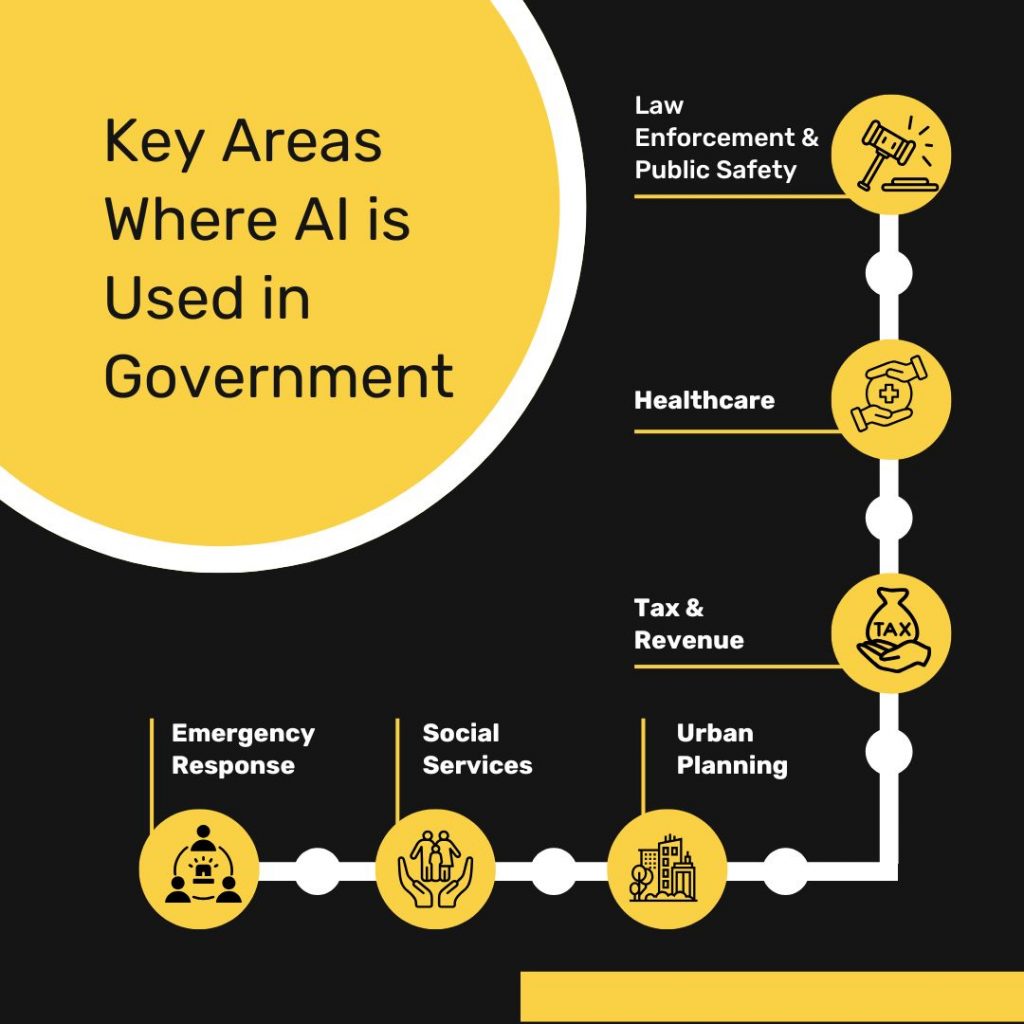
Law Enforcement & Public Safety
- How AI is Being Applied Today
AI is having a major impact on law enforcement by aiding agencies in enhancing surveillance video analysis, detecting crime patterns, and implementing early warning crime prediction. Leveraging deep learning in the form of machines, AI is able to forecast illegal deeds and even prevent them from happening. The addition of facial recognition technology also enables the police to easily catch the enemy. Companies like Coram are leading the way in integrating AI-driven technologies with cloud based video surveillance, providing law enforcement with real-time remote access, smarter analytics, and faster incident response.
- Benefits of AI
- AI’s predictive capabilities enable police to identify potential crime hotspots and allocate resources more effectively.
- Automating data analysis and trend identification can significantly speed up investigations, helping solve cases more quickly.
- With real-time surveillance powered by AI, law enforcement can react faster to potential threats, improving overall public safety
- Challenges of AI
- AI can sometimes exacerbate pre-existing biases in the training data and, thus, be unfair.
- The fact that the use of facial recognition technology has many questions about individual privacy and the risk of surveillance without consent.
- Future Trends
- AI will get accurate with the crime prediction, extending the AI policing model to the world of the Internet of Things.
- New technologies like AI-powered live video surveillance systems will be increasingly used, leading to a reduction in response time for public safety teams dealing with urgent issues.
Healthcare
- How AI is Being Applied Today
AI is revolutionizing healthcare, especially in diagnostics and patient care. It helps medical professionals analyze complex images (like MRIs and X-rays), identify health issues faster, and even suggest treatment options. Some of the major benefits of AI utilization in healthcare include data analysis for early detection of diseases and thus achieving better patient outcomes through the provision of real-time treatment. Besides, AI tackling of comprehensive and time-consuming tasks such as paper work would allow the medical personnel to be equipped fully for their main responsibility of taking care of the patient.
- Benefits of AI
- AI can be used in the healthcare provision sectors to execute the realization of patient-driven medical operations from scheduling to monitoring, taking new appointments, and giving a report.
- AI will continue to perfect the prevention and management of chronic diseases by generating customized treatment plans based on patients’ health profiles.
- Challenges of AI
- The most essential problem of the security of electronic health information remains in the domain of AI-bound healthcare as these systems become an integral part of it.
- The main challenge for AI implementation in healthcare is the scale and complexity of the healthcare systems. This is coupled with the time and financial resources needed to achieve AI in this field of medicine.
- Future Trends
- Artificial intelligence (AI) will be an integral part of the telemedicine system, and its future trend in remote consultations and diagnostics will be seen more frequently.
- With innovative data modeling and simulation techniques, AI systems will play the leading role in medical innovations.
Tax & Revenue
- How AI is Being Applied Today
AI has great potential and can help tax authorities immensely in their work, such as decreasing the number of returns submitted, finding differences, and ensuring compliance. AI is effective in fraud finding by studying the vast data of finance.
- Benefits of AI
- AI can observe patterns that are likely indicating fraudulent activity and help to assure the equitable collection of taxes.
- AI also makes it possible to ensure the coherence of tax records by comparison of the data and, consequently, to manage with the problems, thus errors in the records become fewer.
- AI not only gears up auditing procedures but also changes the way people working in the field of audit act. It results in people becoming experts in the resolution of more complicated problems.
- Challenges of AI
- The use of artificial intelligence in making tax decisions could challenge the fairness aspect of technology, especially if the algorithms are not explainable to the public.
- Keeping financial information safe while new technologies like AI take up tax processing is of great importance in normal business proceedings, but in the current climate, it has become even more critical.
- Future Trends
- The utilization of AI to the greatest extent will enable the government to gain maximum knowledge and have a better understanding of tax revenue, which can result in increased accuracy for budget forecasts.
- There is an expectation of advanced AI auditing solutions that embody not only accelerated processes but also superior precision.
Urban Planning
- How AI is Being Applied Today
AI is at the heart of city development plans and is also the key mover and shaker in the construction of smart cities and more. It is AI that empowers traffic management to be resource-frugal and energy-efficient, AI that leads to revamps in the city’s layout and thus, benefits from more efficient and greener transportation, and other sectors. AI-based systems also play their part in the collection of data that is then transformed into actions ,reducing waste, a capable infrastructure, and thus, a better life, saying nothing of the much-needed reduction in waste and the establishment of a suitable future economy.
- Benefits of AI
- Traffic congestion is eased by the analysis of traffic patterns, which lead to shorter travel times.
- The objective of the energy and water sectors lies in the use of the most important resources in an optimized way, which is done by AI, and this network is characteristic of the reduction in waste.
- Community planners are now better informed to foresee further population needs due to AI, which, in turn, guarantees a city moving toward sustainability.
- Challenges of AI
- With the pervasive spread of IT systems in the city, the exorbitant expenditure, technical requirements to the extent of the talent dilemma involved are the primary questions that need to be tackled.
- That smart cities are increasingly collecting data, thereby, leading to a profound change in the way services and infrastructure are governed is raising doubts about surveillance and public privacy.
- Future Trends
- Real-time waste disposal and transportation in that scenario will be the highest levels of efficiency achieved by AI.
- AI will continue to play a key role in reducing the environmental impact of cities, focusing on green energy and resource conservation.
Social Services
- How AI is Being Applied Today
AI is helping social services provide faster, more efficient assistance to those in need. By analyzing data, AI can identify individuals or families that require immediate support, making aid distribution more targeted and effective.
- Benefits of AI
- AI can make it easy for people to get help immediately, thus they will not have to wait for a long time to be assisted. E.g., the AI system can connect a homeless person with an available shelter.
- AI makes it possible for social services to not only identify where needs are the greatest, but also allocate corresponding resources in an efficient and precise manner.
- AI has the ability to find out which claims are not genuine, thus making it a guarantee that benefits are claimed by the rightful persons only.
- Challenges of AI
- Protecting the private data of the aid recipients is a hard task but necessary as part of such relief efforts.
- AI technologies have to take into account that they should not be programmed with unintentional biases that make them discriminatory to the unprivileged sectors of the society.
- Future Trends
- AI could eventually fully manage the distribution of social benefits, making the process more efficient and less prone to human error.
- AI will be used to predict individuals at risk and offer support before crises occur.
Emergency Response
- How AI is Being Applied Today
AI has made the provision of emergency response more effective through the synthesis of data from various sources to predict and handle crises. Be it a natural disaster or a public safety issue, the intervention of AI can drastically simplify the process of giving help where it is most needed.
- Benefits of AI
- AI is able to conduct an analysis of historical and real-time data to foretell natural disasters such as floods or earthquakes. AI not only employs machines to dispatch and distribute resources but also assists in shortening the disaster response time.
- AI ensures that resources are allocated smartly, minimizing waste and maximizing impact.
- Challenges of AI
- Low-quality data may result in the wrong predictions. That, in turn, can lead to a further deepening of a crisis.
- In conditions of high risk, people might be skeptical of relying entirely on automatic systems, which is troubling for the acceptance of AI techniques.
- Future Trends
- AI will be the backbone to manage the live data during disasters, which in turn helps to get quicker and/or more reliable decision-making in real-time.
- AI models will become more highly accurate not only in predicting but also in protecting and preparing for future crises.
AI in Government vs Traditional Systems
| Feature | AI-Driven Government | Traditional Government |
| Speed | Uses data processing in real-time to quickly analyze situations and make decisions, thus speeding up service delivery and responsiveness. | Depends entirely on manual work and follows a sequential flow of tasks, which results in delays of the processing itself and the decisions taken. |
| Cost | It will be beneficial for the company in the long run if it eliminates routine responsibilities through automation, proper utilization of the resources, and the elimination of manual errors. | In general, the operational expenses are higher due to the imperative of human labor, the use of paperwork, and the possibility of low productivity. |
| Scalability | Prepared in such a manner as to be flexible in any direction of growth, it will not result in inefficiency in the workforce or even the need for more personnel while still being able to maintain a large or fluctuating population with a reasonable amount of service. | Many times, the increase in the capacity of the service leads to huge costs due to the hiring of more staff, the construction of more buildings to house them, and the expansion of systems manually. |
| Transparency | There are clear steps towards increasing the depth of transparency through a detailed record of processes and decisions in digital format, which somehow make audits and the accountability process easier when practiced within set ethical boundaries. | There are minimal steps towards increasing transparency by implementing digital records of processes, thus hindering continuous real-time tracking and comprehensive auditing and, as a result, making the accountability process more cumbersome and time-consuming. |
| Accuracy | Repetitive data analysis certainly gets a 100% accuracy rate, and it is also good at distinguishing intricate patterns and generating practical solutions from big data sets. | On the other hand, the possibility of human error in data entry, analysis, and interpretation leads to the drawing of less accurate insights and, hence, the making of wrong decisions. |
Where AI Overtakes and Where Humans Excel in Government
| Task/Function | Best Suited For | Why |
| High-Volume Data Analysis & Summarization | AI | AI is very good at doing, as well as storing, and interpreting big amounts of data, doing things that are humanly impossible. |
| Routine, Repetitive Communication | AI | One of the most widespread and efficient applications of AI is to automate regular communication via chatbots and the like, thus replacing humans and making agents available to cope with more cognitive tasks. |
| Multilingual Communication & Translation | AI | Technology has already achieved great success in this matter, making translation and eradication of linguistic barriers possible, thus making AI an irreplaceable tool for multilingual public services’ purposes. |
| Complex Ethical Reasoning & Policy Interpretation | Human | The ethical side of things, the understandable policy interpretation, and the realization of the social impact require the human judgment that AI lacks, and the empathy and the right context awareness, which are only human qualities. |
| Building Community Trust & Empathy-Driven Interactions | Human | Government officials’ dialogue with citizens, in situations that are very touchy and fraught with emotions, should be based on the human aspects of trust and understanding of differences in culture. The emotions play a central part in it, respectively. |
| Oversight, Accountability, & Final Judgment | Human | Ensuring ethical standards, transparency, legal compliance, and public trust in decision-making processes necessitates human oversight and accountability. |
| Innovation & Creative Problem-Solving | Human | While it is true that AI can provide recommendations and do the data analysis part, creativity, conceptual thinking, and the creation of pilot studies which are specific to a certain context, are the strong points of people. |
| Handling Novel & Unforeseen Situations | Human | The AI, trained on past data, may not have relevant experience. The situations requiring not only human capabilities like shared adaptability, critical thinking, and reason responsiveness, but also the new and ambiguous scenarios, are well suited for users’ strengths, while AI may not be able to face this challenge effectively. |
Why Emitrr is Ideal for AI in Government Communication
Emitrr’s newly launched AI Text Enhancement features bring powerful, citizen-first communication tools into your messaging workflows — helping government agencies improve engagement, responsiveness, and service quality at scale.
Here’s what is now available!
- Help Me Write: Creates a full-fledged message right from a hint. Perfect to rapidly address citizens’ issues or to make internal communication drafts.
- Enhance Message Tone:
- Make it Crisp: By reloading, the system automatically shortens and hardens the old one in use.
- Make it Empathetic: Improves the tone by imparting a friendly and a more citizen-like characteristics to the voice.
- Suggest a Reply: Smart AI-generated suggestions based on the latest incoming message in an active conversation — ideal for fast, consistent, and context-aware replies.
Please note: These features can be used only if you have the Emitrr Professional Plans. Demo videos are available upon request.
See what more Emitrr’s AI SMS agent can do:
Enhanced Citizen Access & 24/7 Support
It has been made possible by SMS and voice automation through which the Automation gives a 24-hour approach to communication with external partners, updates, reminders, and complaints are routed in real-time.
Bridging Language Divides with Robust Multilingual NLP
Communication across different languages is now simple and easy, thanks to the new NLP technology.
Seamless Integration with Existing Government Infrastructure
Emitrr works with existing systems (CRM, helpdesks, case management tools) for smooth implementation and operational continuity.
Unwavering Commitment to Compliance and Security
All necessary HIPAA, GDPR, and government-grade standards — data and the citizens’ interactions are safe and traceable.
Demonstrated Impact on Service Delivery
With Emittr, it is apparent that there was a drop in call volumes, faster services were now available, and the increase in customer happiness and satisfaction.
Ethical Concerns and Regulations
Bias in AI Algorithms
When AI starts moving into the functions of government, dealing with the danger of biased algorithms comes as a top priority. AI models are fed with data, and when the data mirrors the wrong social picture, the AI will amplify the biases by generating unfair outcomes in domains like law enforcement, resource allocation, and hiring
Data Privacy
The utilization of AI for governmental purposes more often requires the gathering and processing of the data of the citizens, which is quite a big issue. The protection of privacy is a fundamental concern, and it cries for the implementation of strong and reliable regulatory frameworks to prevent the infringement upon individual freedoms and the potentially more harmful moving of personal data
Job Loss Fears
The automation potential of AI can result in the building of concerns in the public sector about the loss of jobs, especially with matters relating to administrative and routine work.
Transparency
Being unable to see how some AI algorithms work can create problems in their usage as the process of understanding and accountability is stopped. Therefore, it is important to have an AI that can be explained, and citizens can be the eyes and ears of the system for quality assurance and contesting issues.
The Future of Artificial Intelligence in the Public Sector
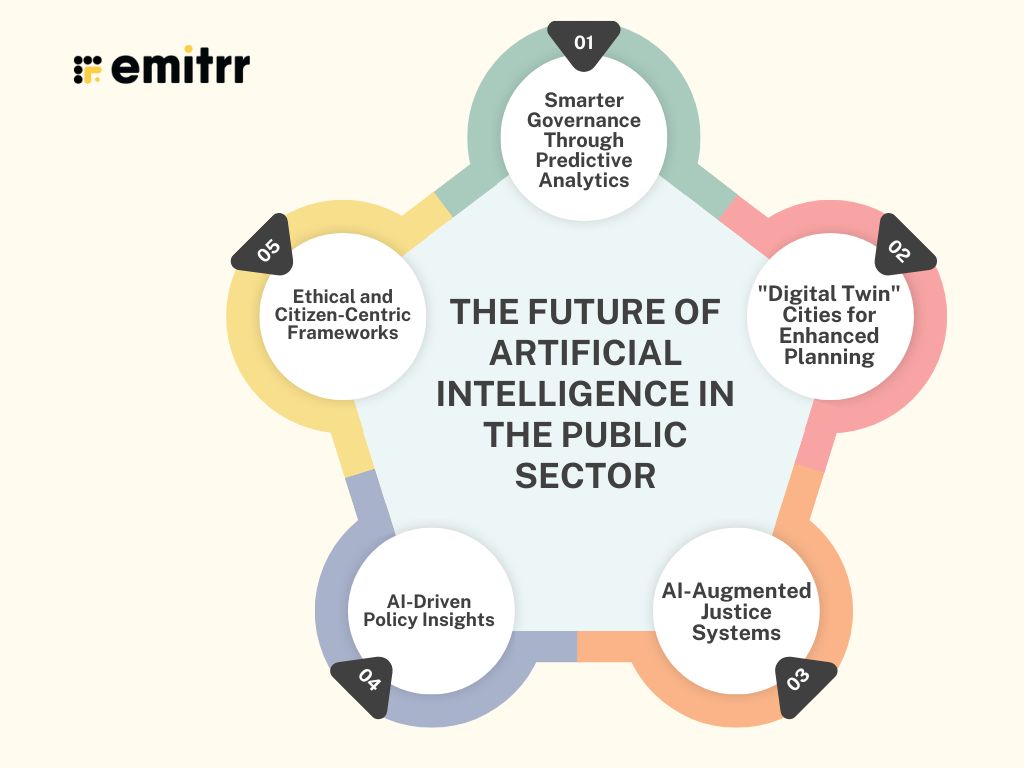
Smarter Governance Through Predictive Analytics
AI could contribute to improving governance by making good use of predictive analytics. The state can employ it to study the current situation, prognosticate the demand of services, distribute budget effectively, and come up with decisions about public resource that are not only informed but also better.
“Digital Twin” Cities for Enhanced Planning
The idea of “digital twin” cities represents one of the most advanced technological applications of urban planning and disaster control. By creating virtual copies of the city, authorities and stakeholders can conduct simulations of changes in the infrastructure, the flow of traffic, and response to emergency events, and as a result, it will make the city both safer and more efficient.
AI-Augmented Justice Systems
AI tools can assist in various aspects of the justice system, such as legal research and the automation of routine processes, potentially reducing backlogs and improving efficiency. However, it remains vital to maintain human oversight in critical judicial decisions to ensure fairness and uphold the principles of justice.
AI-Driven Policy Insights
The idea is that governments can combine a number of economic indicators and the potential effect of various policies through the use of AI systems. If true, this could bring about more agile and data-driven economic decision-making, making the government’s interventions more successful.
Ethical and Citizen-Centric Frameworks
The effective use of AI in public administration depends very much on how well ethical and citizen-centric guidelines are implemented. Those governments that have planned for the future will make sure that fairness, inclusiveness, and transparency are present in the life cycle of the development and implementation of AI applications so that technology serves the benefits of all citizens.
FAQs about AI in Government
AI can result in lower costs through automation, increased scalability of services, better decision-making through data analysis, real-time citizen participation, greater transparency and accountability, and better resource allocation.
AI chatbots can offer 24/7 customer service, multilingual communication breaks down the barriers, automate processes, fast-track the provision of services (e.g., document processing, eligibility checks), and personalized information can be provided to citizens.
Major considerations are reducing bias in algorithms, data privacy and security, defining clear accountability for AI output, facilitating transparency and explainability of AI systems, and involving the public in deliberations regarding AI uptake.
Small towns can begin with easily accessible AI-based chatbots for citizen queries, apply AI to simple data analysis of local patterns, investigate AI tools for resource scheduling optimization (e.g., waste collection, public transport), and partner with regional or state programs to share resources and knowledge.
AI for Crime Prediction in Uttar Pradesh Police – Uttar Pradesh (UP) Police has made use of an AI-driven solution to analyze past crime data to detect likely places of crime concentration. It deploys machine learning algorithms to foresee places and locations where a type of crime has a high chance of being committed and enable the police to anticipate beforehand and distribute forces and patrol in advance.
Conclusion
As AI continues to revolutionize public sector work, prescriptive adoption is no longer an option—it’s a necessity. Emitrr’s AI-powered communication solutions offer government agencies the opportunity to become more citizen-focused, effective in service, and trusted through transparency and consistency.
By adopting intelligent automation today, you’re not just becoming more efficient—you’re paving the way for open, participative, and forward-looking governance.
Be part of the AI revolution with Emitrr. The future of public service is smart, responsive, and citizen-centric.