
 4.9 (400+
reviews)
4.9 (400+
reviews)
Introduction
Heating, ventilation, and air conditioning repair was never a high-skill occupation that it wasn’t. Technicians have applied experience, mechanical devices, and analytical troubleshooting over the decades to keep systems running. The early decades were fixed in the guise of looking at gauges and valves, hearing unusual sounds, and locating faults trial-and-error. With advancing technology, electronic thermostats and computer controls appeared on the scene, and technicians needed to acquire new skills and operate new devices.
And now, once more, the industry is transforming. Artificial intelligence is taking center stage in the HVAC repair business. Not a matter of replacing the touch with machines. But a question of calling upon software-based intelligence that processes mountains of data, recognizes patterns, and helps technicians diagnose, repair, and maintain systems.
With the advent of smart homes, smart appliances, and customers requesting energy efficiency, AI is no longer an option. For HVAC technicians, the use of AI means working smarter, delivering faster results, and staying in business in a profession that is moving rapidly toward automation and data-driven maintenance.
Role of AI for HVAC Technicians
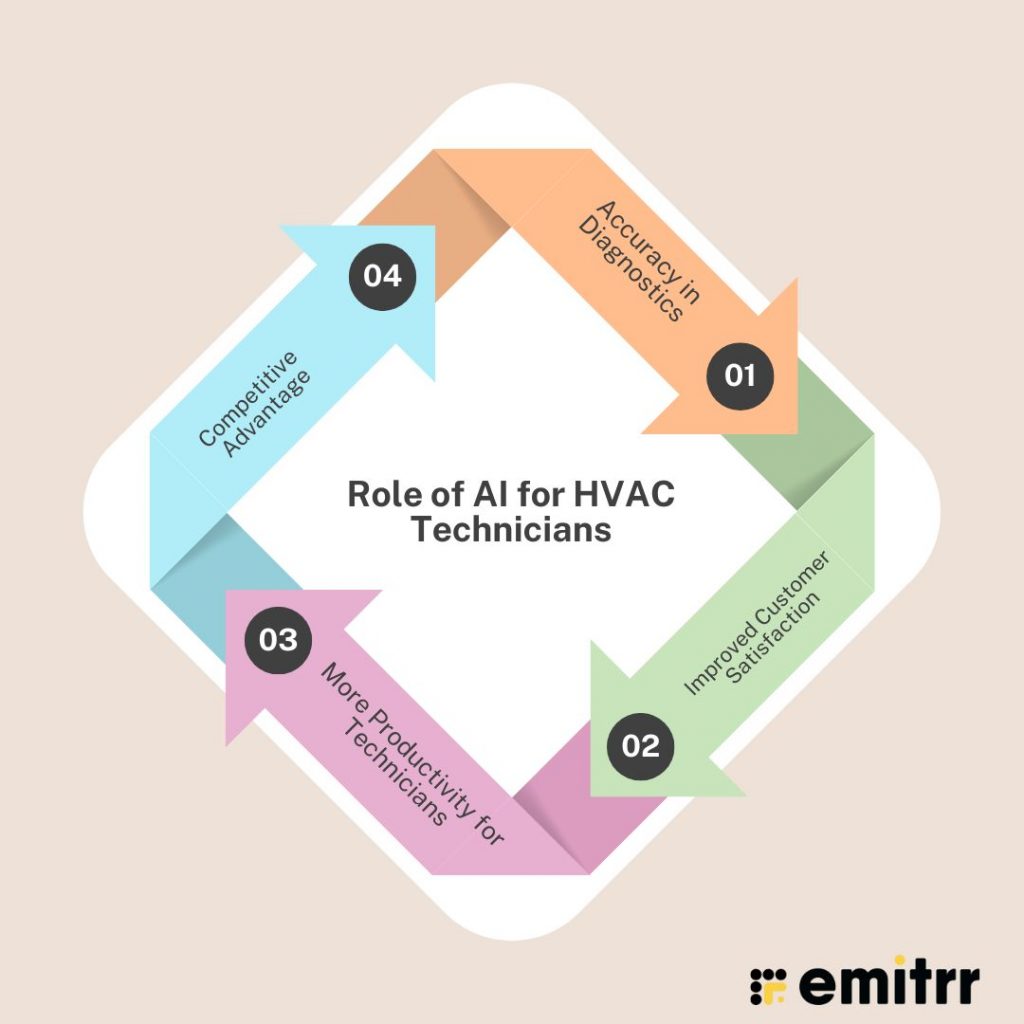
Accuracy in Diagnostics
AI in HVAC delivers accuracy that was difficult to achieve using traditional methods. Instead of testing each part individually, AI software can scan data quickly and suggest the likely cause. Such precision eliminates wastage of time, decreases revisit rates, and builds confidence with customers.
Improved Customer Satisfaction
Quick and fast service is no longer an extra benefit; it is normal. AI enables providing technicians with preventive maintenance through failure prediction before it occurs. Customers experience less breakdown, less interruption, and better faith in the expertise of the technician.
More Productivity for Technicians
Much of the redundant work in HVAC service, such as data recording, performance monitoring, and planning, can be automated. This allows technicians to focus on technical work requiring hand skills. The result is higher productivity without more physical effort.
Competitive Advantage
AI-based HVAC companies are industry leaders. Customers increasingly insist more forcefully on smart systems that are energy-saving and provide reliable results. Technicians who have access to AI technology are best equipped to offer these advanced solutions, and their companies reap a competitive edge.

Use Cases of AI in HVAC
AI is now no longer a theory. AI is already being implemented in HVAC service to create immediate impact on customer experience and technician processes.
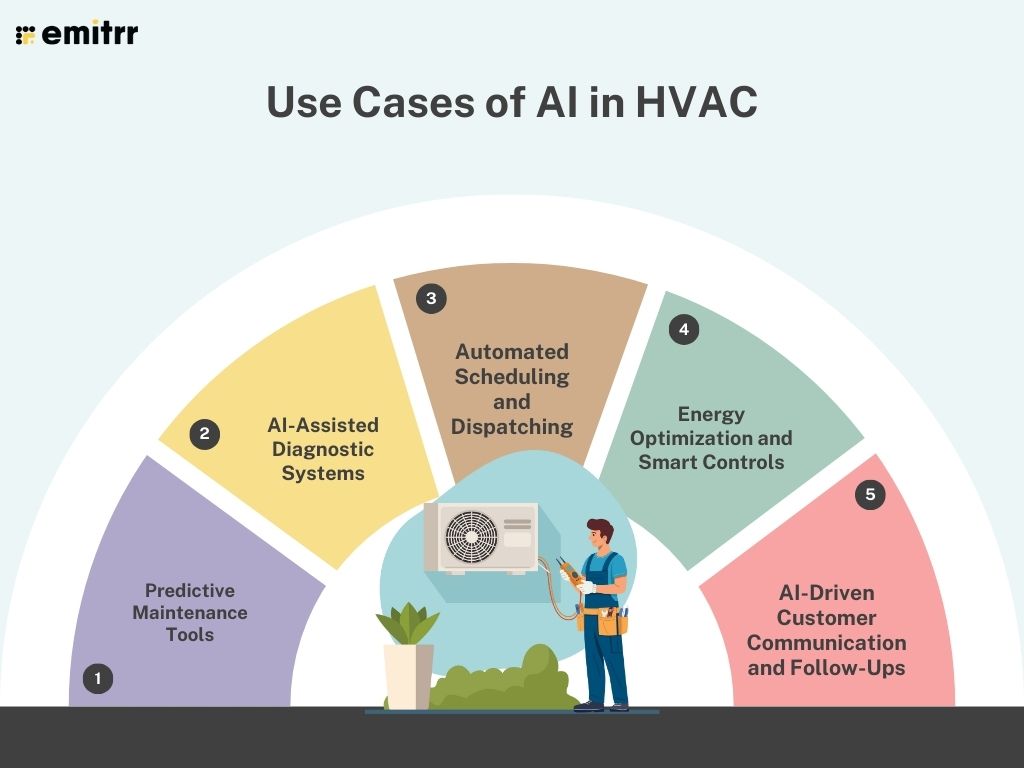
Predictive Maintenance Tools
Predictive maintenance systems also employ sensors that monitor the equipment at all times. AI recognizes what is going on based on the data and if a component is beginning to fail or efficiency is declining. This allows the technician to respond ahead of the failure occurring. Preventive repairs maintain equipment lifespan, reduce emergency calls, and save customers money.
AI-Assisted Diagnostic Systems
When something is going wrong, diagnostic tools powered by AI examine sensor data and service histories. Instead of flinging hours at attempting each possible cause, the technician receives a list of most likely causes. This speeds service calls, increases first-time fix rates, and reduces frustration for technicians and customers alike.
Automated Scheduling and Dispatching
AI scheduling software pairs customers’ appointments with open techs, with travel time and capability in mind. That is efficient routes and no dead time. For techs, that equates to less workday wars. For customers, that equates to less waiting and more reliability.
Energy Optimization and Smart Controls
Intelligent controls driven by AI learn users’ habits and climatic conditions to deliver comfort and reduce utility bills. Installation, configuration, and maintenance of the device need HVAC professionals, and the AI promises them to operate efficiently in the long term. The utility bill is reduced for customers, and technicians gain a reputation as green technology providers.
AI-Driven Customer Communication and Follow-Ups
AI extends the experience during and after real repair as well. Computerized systems are able to send follow-ups, appointment reminders, and confirmation messages. Others can remind customers even for scheduled maintenance due dates. The frequent interactions serve to boost loyalty and customer relations.
Challenges in AI Adoption for HVAC Technicians
AI holds promise, but to integrate it into the day-to-day work of HVAC is not a matter of flipping a switch. Technicians who have built careers based on tools, gauges, and years of field expertise now face the beginnings of a whole new style of learning. The technology is powerful, but the path there has hurdles that cannot be ignored.
Adapting to a New Learning Curve
A decade-long engineer who figured out a system by hearing a motor whine or feeling the vibration of a pipe might be stumped by a screen of graphs and prediction reports. The art was always touch and feel, and now it’s about learning to navigate dashboards and trust algorithms. For many, that transition is like learning the trade all over again. Workshops and training courses are not just a case of learning new buttons to press; they are a matter of rebuilding confidence in a sector where judgment has always been acutely personal.
The Burden of Upfront Costs
AI solutions are not free, and to a small HVAC company, even the lowest subscription fee or latest diagnostic tool will look like an enormous leap. Business owners often wonder if such investments do indeed pan out or whether it is more sensible to stick with what works. The reality is that AI typically ends up saving them money in the long run, but that upfront cost is often a sticking point. Owners must weigh dreams against financial reality and decide how they will start without overburdening their budgets.
Old Systems Meeting New Technology
The majority of existing HVAC installations in residences and businesses were not designed to interact with intelligent platforms from the start. An expert may install sensors or monitor devices only to discover that the system is too old to respond. This gives an unwanted frustration both to the consumer and the professional, who would have expected silky smooth results. Transcending the bridge from older technologies to new AI tools may require creative solutions, conservative updates, or in some instances, the uncomfortable conversation that replacement is perhaps the sole solution.
Job Security Worries
Whenever new technology enters a trade, there is a whisper of fear: will it replace me? For HVAC technicians, there is that fear. If AI can predict failures and schedule maintenance, what remains for the guy on the job site? The fact is, AI can analyze data but it can’t slither into an attic on a sweltering summer day, remove a compressor, or earn the homeowner’s trust. The problem isn’t jobs lost but how people perceive things. Technicians must view AI as an ally that handles the mundane work, allowing them to focus on the high-skill work they alone can perform.
Keeping Pace with Rapid Change
Technology doesn’t stand still. AI software launched this year could already be outdated in a couple of seasons. For technicians who are already getting used to one system, the constant rate of change can be draining. There is no end to learning, and that scares professionals who are already working long hours. The challenge in this case is sustainability, how to make continuous training a part of the job instead of an additional overload on top of it.
Best Practices for Implementing AI into HVAC Workflows
While there are challenges, AI can be implemented in HVAC service that makes sense and feels intuitive. The secret is to think of it as a partner, not a takeover. When properly implemented, AI complements the technician’s work and enables businesses to work more efficiently. These practices can help find that balance.
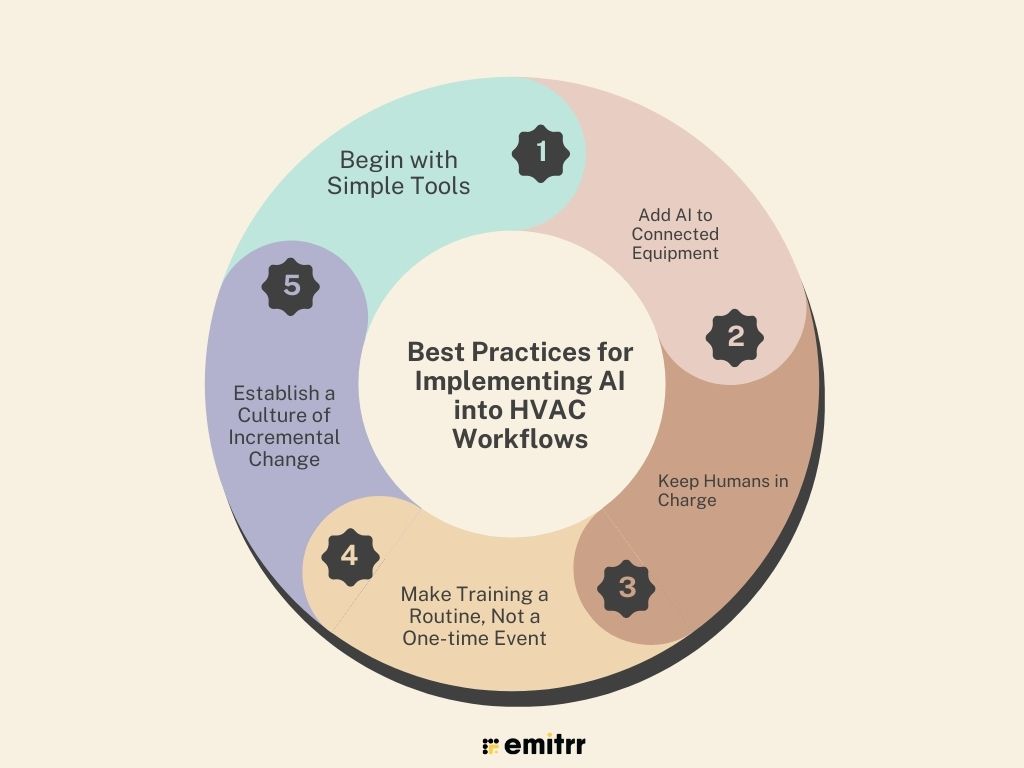
Begin with Simple Tools
There is no need to plunge headlong into the most advanced AI systems. Start small, perhaps with an AI-powered scheduling aide or diagnostic software, so technicians can mess around without fear. These first steps create comfort and familiarity. Then, as the team is comfortable, more advanced tools can come in. It is the difference between trying one’s toe in the water versus going in headfirst.
Add AI to Connected Equipment
Data is what AI lives on. The more, the merrier. When techs couple AI with IoT-enabled systems, such as smart thermostats, internet-connected sensors, and monitoring equipment, they unlock the full potential of energy optimization and predictive maintenance. That cross-pollination of connected equipment and AI delivers technicians with accurate, real-time information they can act on in the moment.
Keep Humans in Charge
No matter how advanced AI becomes, the customer still wants reassurance from a human. AI will provide a solution, but the technician decides if it works in the real world. This human touch maintains the service as human. It ensures that judgment, ethics, and personal responsibility are incorporated into every repair and install. AI will provide a map, but the technician is the driver.
Make Training a Routine, Not a One-time Event
When a company does adopt AI, the first round of training is merely the beginning. Software is revised, functions are polished, and entirely new platforms emerge. Technicians need ongoing opportunities to learn in order to stay useful. Formal training isn’t necessary every time; it could be something as simple as a weekly meeting where the group shares new discoveries. The point is to keep information up to date so no one falls behind.
Establish a Culture of Incremental Change
Implementation of AI works if it feels like a natural component of the job, rather than a sudden imposition. Those businesses that incorporate technology incrementally, define the benefits clearly, and involve technicians in the process establish trust. Over time, AI becomes the new normal in everyday life rather than something imposed on top. It is this incremental culture that gets suspicion to convert to acceptance, and eventually, to enthusiasm.
How to Use Emitrr for AI-Powered HVAC Service
AI can be very intimidating for techs who like mechanical devices over software. Emitrr bridges the gap by wrapping AI in elements that are intuitive and sensible, not overwhelming. It simplifies everyday tasks, delights customers, and makes the entire service process run more smoothly.
Smart Scheduling
One of the greatest time-wasters in HVAC service is off-visit. Emitrr’s scheduling software uses artificial intelligence such that technicians spend more time working and less time idle. Looking at availability, travel time, and service requirements, the tool fills the calendar most efficiently. The result is fewer lost hours and more completed jobs per day.
Automated Communication
Missed calls and response delay are usually frustrating to customers. Emitrr avoids frustrating the customer with automatic confirmations, reminders, and follow-ups that the client receives. The system makes sure that every client knows when the technician will arrive and is reminded ahead of time. This not only increases the satisfaction of customers but also reduces the occurrence of last-minute cancellations.
Seamless Integration
Technicians already use field service and dispatching software. Emitrr does not get them to abandon those systems but works in conjunction with them. With this integration, schedules, job information, and customer data flow seamlessly between systems. Technicians can focus on the real install or repair instead of wrestling with incompatible software.
Analytics and Insights
Behind each service call finished lies data to improve. Emitrr aggregates this data and presents it in a clear way to managers and technicians. Measurements such as job length, first-time fix rate, and customer satisfaction scores enable trends to be identified. With these facts, companies make informed decisions that lead to better efficiency and happier customers.
How to React to AI-Generated Insights and Customer Feedback
AI may indicate trends and predict problems, but the technician knows the complexity of the problem. The effectiveness of AI insights comes only when combined with human intuition. Addressing the situation well as a reaction to these insights guarantees customers are served and feel reassured by the service offered.
Join AI with Human Judgment
AI may point to a given unit not being up to par, but it is the technician sitting in front of the system that can determine the actual issue. The optimal result comes when AI is utilized as a set of extra eyes and not a replacement. Technicians may validate AI suggestions through their experience in the field and then decide on the best action to take.
Act on Predictions
When AI alerts about future breakdown or performance decline, it is a chance to prevent a greater problem. Correcting these predictions in advance saves the customer the inconvenience and the company from emergency calls. Staying on top of AI alerts also builds trust, as customers observe that issues are solved before they happen.
Use Feedback for Training
Every remark of criticism is a story of what did work and what could have worked better. Emitrr’s AI identifies customers’ remarks and concludes underlying themes, such as communication failures or delay. Instead of treating them as criticism, technicians can use them as lessons. Over time, this feedback-based learning shapes better skills and greater customer trust.
Case Study: AI in Action for HVAC Technicians
When one of the smallest HVAC firms in an area wanted to experiment with AI, its aim was not to replace the technicians but to equip them with improved tools to manage their growing workload. The firm began with the implementation of AI-based scheduling software and diagnostics. Initially, there was some resistance. Most of the technicians were accustomed to dealing with hands-on mechanical systems and not so much computerized tools. They facilitated this process with training sessions, and before long, the results began to materialize.
Emergency calls fell by almost thirty percent. Predictive maintenance ensured that issues of tomorrow were identified before they became midnight breakdowns. Rather than rushing from one emergency call to another, technicians liked to have the time of day to schedule appointments and do things right.
Completion time of the services was enhanced by twenty percent. The diagnostic tools enabled the technicians to quickly identify problems, which eliminated the trial-and-error method that is prone to wasting valuable hours. Guessing took less time, and more time was left for repair.
Customers noticed. With quicker service, fewer callback visits, and accurate repairs, satisfaction rates soared. It wasn’t a numbers question for the technicians—it was a question of trust. Homeowners and business owners started viewing them as trusted professionals who could deliver day in, day out.
The company had a valuable lesson. AI is not the enemy of skilled labor. It is a partner which removes the repetitive guesswork and allows technicians to master the trade they love the most.
FAQs
No. AI cannot replace the experience of the hands of the technicians. It supports them by reducing repetitive tasks, enhanced diagnostics, and reduced specialized work.
The cost at first may be prohibitive, but starting with something as straightforward as scheduling software makes it affordable. Down the road, the time saved by being more efficient and the reduction in emergency calls cover the cost.
AI minimizes downtime, sends timely reminders, and predicts potential breakdowns ahead of time. This leads to faster service, reduced repeat service, and happy customers.
Some of those older systems may not directly integrate with AI software, but solutions are constructed so most will integrate by conforming to the existing configurations through the use of ingenious add-ons and retrofitting.
Start small with easy-to-use tools such as automated scheduling or communication platforms. As becoming comfortable, transition to predictive diagnostics and advanced analytics.
Conclusion: The Road Ahead for HVAC Technicians and AI
AI is no longer on the horizon. It’s already here in HVAC service and it’s revolutionizing how technicians work behind the scenes. From smart diagnosis to enhanced scheduling and enhanced customer communication, AI is turning into a pragmatist software that maximizes technician efficiency.
The future is not built on change overnight. The optimum approach to success is incremental adoption. Start small with tools that make each day easier and incrementally build up as confidence grows. The transformation does not need to be daunting, it can be achieved step by step at a pace that is tolerable both to business and technicians.
Firms embracing AI first are placing themselves at the forefront of business. They are not only learning to adjust to change, they are making history as they prepare to shape how HVAC service will be performed in the future. For technicians, it means a future where their skill set is enriched, their work streamlines, and their customers are served better.
The future is not robots taking away jobs from human beings. It is human beings making themselves smarter tools to perform their tasks more effectively with precision, efficiency, and empathy.