
 4.9 (400+
reviews)
4.9 (400+
reviews)
Introduction
Your business relies on effective communication each day—customer calls, support questions, important notifications, all traversing complex telecom systems. But what happens when those networks slow down, calls drop, or customer inquiries pile up faster than your team can handle?
In a world where time is valuable, delays and disruptions not only annoy customers, they can result in considerable losses for your company and damage your reputation.
At present, telecom networks are more intricate than ever, comprising millions of devices, swift connections, and rising security risks. Clients also expect prompt, personalized support and flawless service at any time. Traditional communication systems struggle to fulfill these demands, compelling companies to exert significant effort to maintain quality and efficiency. Communication solutions powered by AI have transitioned from future concepts to essential tools that enable telecom companies and businesses to operate their networks more intelligently, respond to customers more quickly, and protect data effectively. This results in more efficient operations, fewer issues, and increased time to concentrate on expanding the business.
Currently, telecom requires AI-driven VoIP as it can enhance call quality automatically, route calls to the appropriate individual, and resolve problems before they arise. Through managing everyday operations and providing immediate assistance, AI-leveraged VoIP enables telecom firms to enhance their services and remain competitive in today’s rapidly evolving landscape.
This article explores the ways AI is transforming telecommunications to enhance communication for businesses like yours. You will discover how AI can simplify repetitive tasks, predict and address network issues in advance, and offer personalized customer experiences, enabling you to spend less time on problem management and more time on reaching your goals.
Why does the Telecommunication Industry Need AI Communication?
The telecommunications sector encounters numerous significant difficulties currently. Customers anticipate rapid responses and seamless service; however, telecom networks have become increasingly complex, managing millions of simultaneous calls, messages, and devices. Companies struggle to maintain operations efficiently, resolve issues rapidly, and ensure that all receive the assistance they require. On top of that, cyberattacks and fraud are always a risk, and companies must protect sensitive customer data while following strict rules and regulations. Managing these complex networks, handling huge amounts of data, and keeping up with fast-changing customer needs is difficult, especially as 5G and new technologies expand. Conventional systems frequently face prolonged wait times, ineffective problem-solving, and increasing risks to network security and privacy, highlighting the urgent necessity for the telecom sector to adopt more intelligent solutions, such as AI, to tackle these issues.
AI communication addresses these issues by automating and enhancing numerous essential processes. AI-driven systems can oversee networks in real-time, anticipate and resolve problems before they affect services, and enhance network performance autonomously. AI virtual assistants in customer support deliver immediate answers to frequent inquiries, decreasing wait times and allowing human agents to concentrate on more complex matters. AI enhances security by swiftly identifying unusual activities and possible threats, enabling telecom firms to better safeguard their networks and customer information.
Furthermore, AI enables telecom providers to operate more efficiently and reduce costs. By automating routine tasks and improving decision-making with data-driven insights, AI helps companies use their resources better and deliver higher-quality services. This is especially important as telecom networks grow larger and more complex, and as competition intensifies. In short, AI communication is essential for telecom companies to overcome current industry challenges, improve customer satisfaction, and maintain reliable, secure, and cost-effective operations.
Benefits of AI Communication for the Telecommunication Industry
Predictive Call Quality Optimization with AI Agents
AI agents keep an eye on your network and call quality all the time, fixing problems before they affect your calls. This means fewer dropped calls, less delay, and clearer conversations. They also reduce background noise and manage bandwidth smartly, so your calls stay professional and smooth. This helps your teams and customers stay connected without interruptions, while your IT staff spends less time troubleshooting.
Personalized VOIP Experiences through Intelligent Insights
AI analyzes user behavior and preferences, subsequently utilizing this data to enhance decision-making. It can route calls to the appropriate individual swiftly, deliver personalized greetings, and provide assistance according to the circumstances. This accelerates each call and enhances the personal touch, enabling your business to address issues swiftly and ensure customer satisfaction
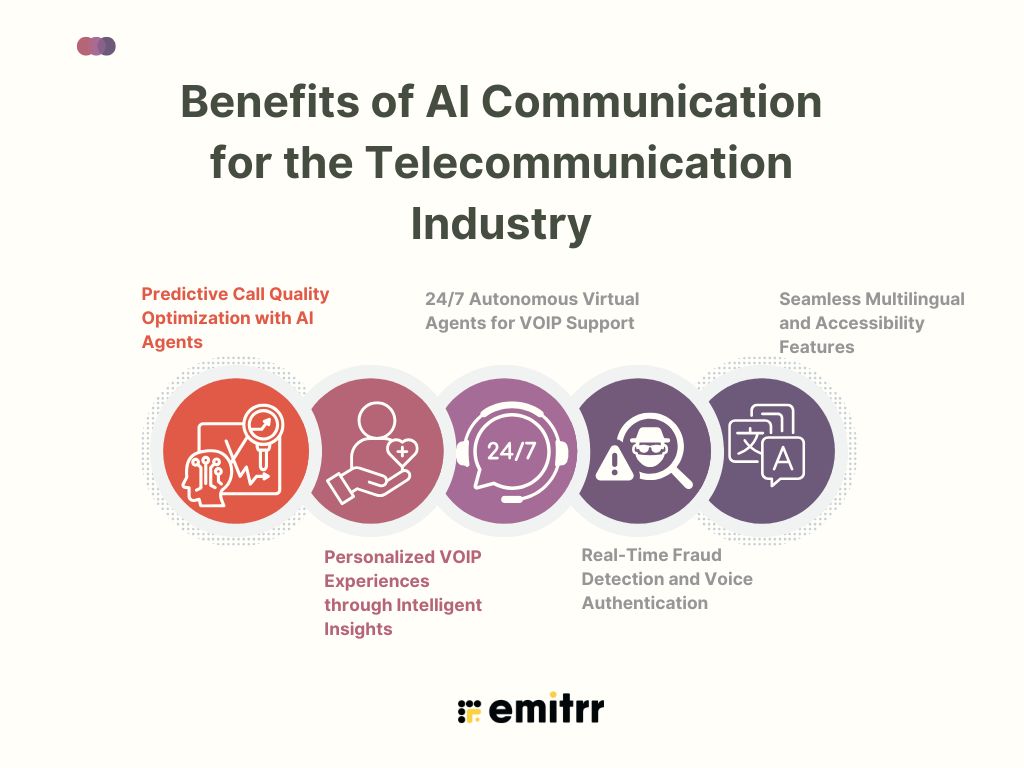
24/7 Autonomous Virtual Agents for VOIP Support
AI virtual assistants are available all day and night to answer common questions, fix simple issues, and manage accounts. They help reduce waiting times and free up your human agents to focus on more complex tasks. By handling routine work automatically, these AI helpers save your business time and money while giving customers fast and reliable support.
Real-Time Fraud Detection and Voice Authentication
AI watches your VOIP calls closely to spot anything unusual and uses voice recognition to confirm who is calling. This helps stop fraud and unauthorized access right away, protecting your business and customer information. With AI keeping your calls safe, you can build trust and avoid costly security problems.
Seamless Multilingual and Accessibility Features
AI makes it easy to talk with people who speak different languages by translating calls instantly and turning speech into text. It also helps those with hearing difficulties join conversations smoothly. This means your business can reach more customers around the world and make sure everyone feels included and understood.

Use Cases For AI in the Telecommunication Industry
AI-Driven Smart Call Routing and Prioritization
AI agents evaluate the caller’s intent, background, and present situation to direct VOIP calls to the most suitable agent or department. This intelligent routing minimizes wait times and prevents unnecessary transfers, streamlining customer interactions for increased speed and ease. By focusing on urgent or high-priority calls, companies can guarantee that important matters receive prompt attention. This enhances customer satisfaction while also increasing agent productivity by aligning skills with caller requirements, resulting in improved first-call resolution rates
Proactive Troubleshooting and Self-Healing VOIP Networks
AI continuously monitors network health and detects technical issues like jitter, echo, packet loss, or connectivity drops before they impact users. It can independently modify network settings or reboot services to resolve issues without human involvement. This self-repair feature decreases downtime and lessens the requirement for manual problem-solving, conserving time and operational expenses. For companies, this translates to more dependable communication, reduced complaints, and an enhanced reputation for service excellence.
Sentiment Analysis and Contextual Assistance During Calls
AI analyzes the tone, speed, and word selection in VOIP calls to grasp the caller’s feelings—whether they are joyful, irritated, or perplexed. The real-time sentiment analysis enables the system to offer agents useful recommendations or elevate calls to supervisors when necessary. It assists agents in delivering empathetic responses and pertinent information, enhancing customer satisfaction. With time, companies can analyze this information to pinpoint frequent challenges and enhance their team’s training, resulting in improved communication
Automated Call Transcription and Analytics
AI transcribes every call accurately and quickly, turning conversations into searchable text. This makes it easy to review calls for quality assurance, training, or dispute resolution. In addition to transcription, AI identifies important insights like frequently asked questions, typical complaints, and customer preferences. These insights assist companies in recognizing patterns, enhancing products and services, and maintaining adherence to legal and industry regulations. Automated reporting conserves time and delivers actionable information that drives smarter decision-making.
AI Agents for Enhanced Security and Compliance in VOIP
AI agents actively monitor VOIP traffic for unusual patterns that may indicate fraud, hacking, or unauthorized access. They use voice biometrics and behavioral analysis to verify caller identities and prevent impersonation. AI also ensures that calls follow security policies and regulatory requirements, automatically flagging any violations. This helps businesses avoid costly fines and data breaches while protecting sensitive customer information. Strong AI-driven security builds trust with clients and supports a safer communication environment.
Challenges of AI Communication Adoption in the Telecommunication Industry
Integration of AI Agents with Existing VOIP Infrastructure
Bringing advanced AI agents into older VOIP systems isn’t always easy. Many telecom companies still use legacy infrastructure that wasn’t designed for modern AI tools. This means updates or changes can be slow, costly, and sometimes disruptive to daily operations. Businesses often need to invest in new hardware or software, and the process may require careful planning and technical support to avoid service interruptions.
Ensuring Data Privacy and Secure Voice Communications
As AI agents handle and analyze large amounts of voice data, keeping this information private and secure becomes a big concern. Telecom companies must follow strict privacy laws and protect sensitive customer conversations from hackers or leaks. This involves using strong encryption, regular security checks, and making sure AI systems only access the data they absolutely need. Failing to do so can lead to legal trouble and loss of customer trust.
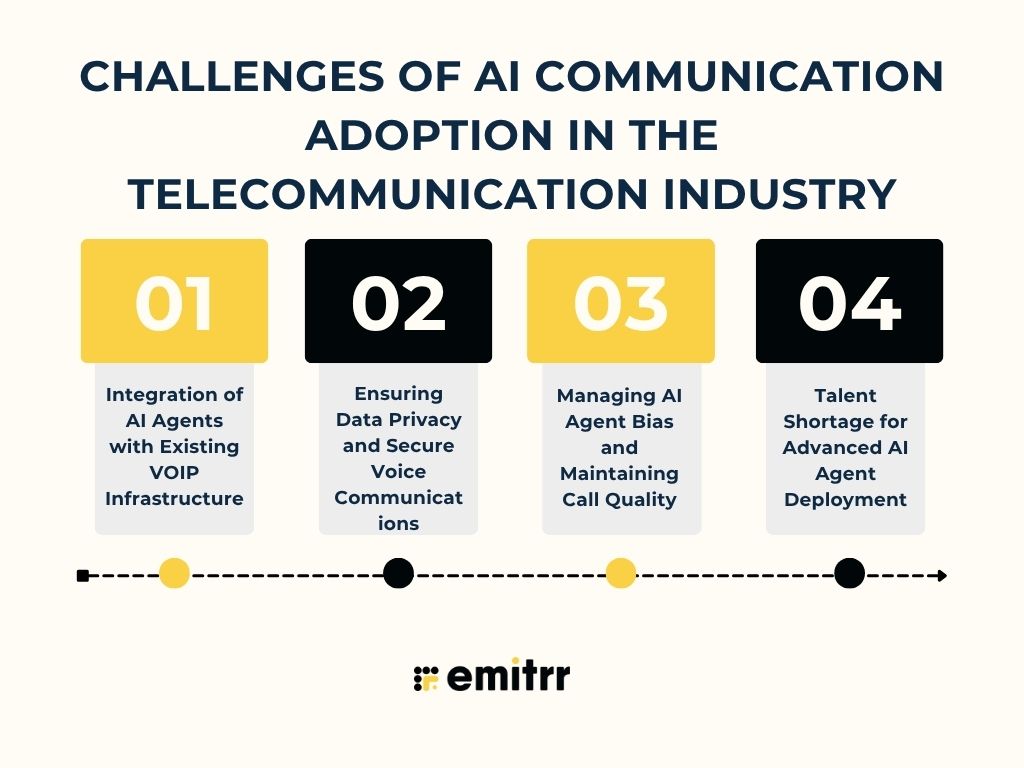
Managing AI Agent Bias and Maintaining Call Quality
AI agents learn from data, and if that data isn’t fair or balanced, the AI can develop biases—treating some users differently or misunderstanding certain accents or languages. At the same time, it’s important that AI doesn’t affect call quality or user experience. Telecom companies need to regularly check and update their AI systems to ensure they are fair, accurate, and provide consistently good service for everyone.
Talent Shortage for Advanced AI Agent Deployment
Developing, installing, and managing sophisticated AI agents requires special skills that are in short supply. There aren’t enough experts who understand both telecom systems and advanced AI technology. This talent gap can slow down AI adoption and make it harder for companies to get the most out of their investments. Businesses may need to invest in training or partner with technology providers to fill these skill gaps.
Where Human Communication Should Still Be Prioritized?
Handling Complex or Emotionally Sensitive VOIP Calls
Some conversations are too complex or sensitive for AI to handle alone. When customers are upset, dealing with a crisis, or facing unique situations, human agents can listen, show empathy, and make thoughtful decisions. People are better at understanding emotions and reading between the lines, which is crucial for resolving issues that go beyond standard scripts or automated responses.
Oversight and Escalation for Critical VOIP Issues
While AI can solve many problems quickly, there are times when an issue is too complicated or important to leave to automation. In these cases, AI should immediately pass the call to a human expert who can take control, investigate further, and provide reassurance. This human oversight ensures that customers feel heard and valued, especially when their concerns are urgent or high-stakes.
Relationship Building and Strategic Negotiations Over VOIP
Building strong business relationships and handling negotiations require trust, understanding, and flexibility—qualities that humans excel at. Whether it’s discussing a new partnership, resolving a dispute, or closing a major deal, human communication adds a personal touch that AI simply can’t replicate. These interactions benefit from real-time feedback, creative thinking, and the ability to adapt to changing situations, all of which are key to long-term business success.
How Emittr Helps the Telecommunication Industry with AI-driven Communication?
The telecommunications industry faces a critical challenge: managing massive volumes of customer interactions across multiple channels while maintaining quality service. Traditional fragmented approaches—juggling separate platforms for calls, texts, emails, and VOIP—create frustrated customers and overwhelmed support teams. Emittr’s AI-driven communication platform transforms this chaos into streamlined, intelligent customer engagement.
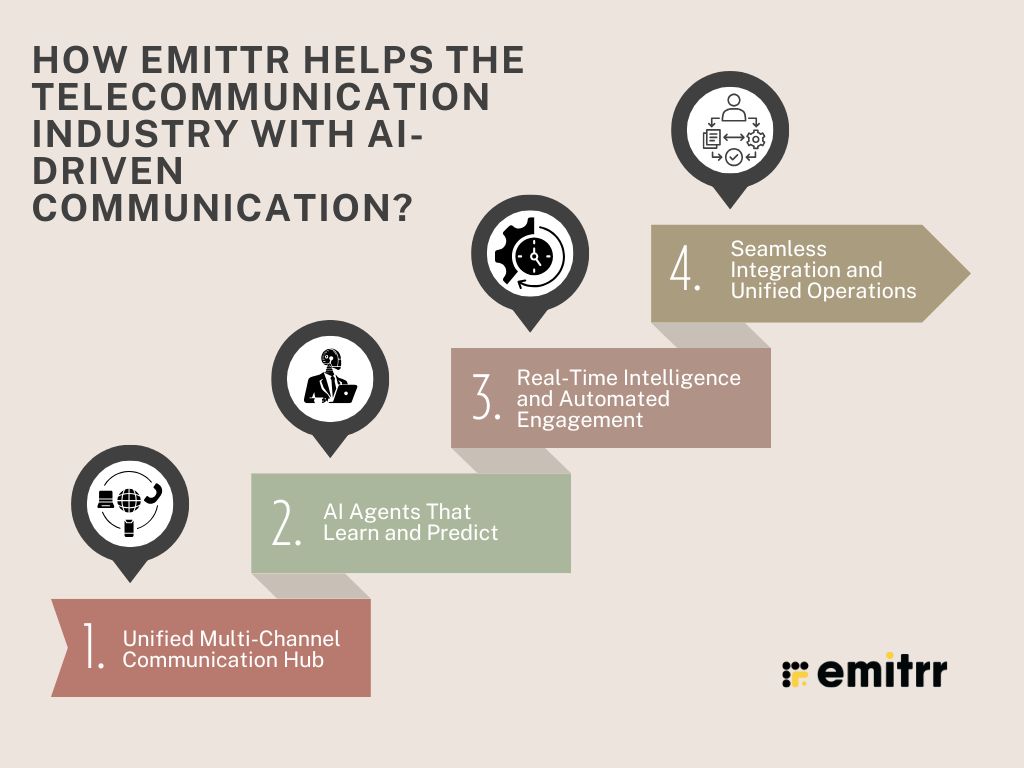
Unified Multi-Channel Communication Hub
Emittr centralizes texting, VOIP, calls, and emails into one powerful dashboard, all powered by AI agents. This eliminates the need for telecom support teams to switch between multiple platforms. Your agents can handle a customer’s call, respond to their follow-up text, and send detailed emails—all from the same interface. The result? Faster resolution times and seamless customer experiences that keep your clients satisfied.
AI Agents That Learn and Predict
What makes Emittr exceptional is its AI agents that learn from every interaction to personalize outreach, predict customer needs, and optimize workflows. For telecom companies, this means proactively reaching out during network maintenance, automatically escalating technical issues to specialists, and predicting service problems before customers even notice them. The AI continuously improves, making your communication smarter over time.
Learn more about what Emitrr’s AI agent can do:
Real-Time Intelligence and Automated Engagement
Emittr provides real-time alerts and insights that dramatically improve staff responsiveness and client experience. During service outages, the platform automatically triggers personalized notifications across all channels, reducing support ticket floods. The automated customer engagement feels personal while handling routine inquiries, freeing your human agents to focus on complex technical issues that require expertise.
Seamless Integration and Unified Operations
The platform integrates effortlessly with existing wellness management systems, CRM platforms, billing systems, and network monitoring tools. This creates unified operations where customer data, service records, and communication history work together harmoniously. No system overhauls required—Emittr enhances your existing infrastructure without disruption.
All in all, Emittr offers enterprise-level AI communication capabilities at telecom-friendly pricing, making it ideal for companies of all sizes. The platform delivers end-to-end customer support, scales effortlessly with your business growth, and streamlines workflows through unified communication. With robust third-party integration capabilities and AI that actually learns from your specific customer base, Emittr transforms communication from a cost center into a competitive advantage.
The telecommunications industry is evolving rapidly, and AI-driven communication isn’t just an option—it’s essential for staying competitive. Emittr provides the intelligent, affordable solution that meets today’s challenges while preparing your business for future growth.
The Future of AI Communication in the Telecommunication Industry
AI-Powered Personal Customer Experience
In the future, AI will help telecom companies give each customer a more personal and helpful experience. It will learn what customers like and need, so it can answer questions faster, fix problems before they happen, and make calls and messages feel more natural. This means customers will be happier and more loyal, while companies can handle more calls without extra staff.
Smarter Networks and Better Connections with 5G
AI will also help manage the growing number of devices and faster 5G networks. It will watch over the network all the time, fixing problems quickly and making sure calls and internet stay fast and clear. AI will also keep networks safe from hackers. Telecom companies that use AI well will offer better service, save money, and be ready for the future.
FAQs for AI for Telecommunication Industry
AI helps telecom companies improve networks, answer customer questions, fix problems before they happen, and make calls and messages smarter.
The AI market in telecom is growing fast, worth about $840 million now and expected to reach nearly $3 billion in a few years.
AI will make communication faster, smarter, and safer, helping companies give better service and save money.
Yes, AI helps telecom companies work better, keep customers happy, fix issues quickly, and protect against fraud.
Conclusion
AI is now essential for telecom companies that want to deliver top-quality service and keep up with the fast pace of the industry. By bringing AI into communication systems, telecom providers can solve big problems like network outages, slow customer support, and security threats—while making sure every call, message, and connection runs smoothly. With AI, telecom operations become more reliable, efficient, and easier to manage, even as networks grow and customer demands increase.
To get the most out of these benefits, it’s important to choose a solution that offers real-time monitoring, instant support, and strong security—so your network is always up and running, day or night. That’s where Emitrr comes in. Emitrr’s AI-powered platform gives telecom companies 24/7 network monitoring, rapid responses to customer needs, and powerful tools to keep every connection secure and efficient.
Ready to take your telecom operations to the next level? Book your demo with Emitrr today and discover how easy it is to upgrade your network and customer service with smart, always-on AI communication.