
 4.9 (400+
reviews)
4.9 (400+
reviews)
Introduction
In today’s fast-paced world, instant communication is key, and text messaging has become a dominant force. From personal chats to business updates, we rely on SMS for quick and convenient information exchange. But when it comes to healthcare, where patient privacy is paramount, a crucial question arises: are text messages HIPAA compliant? The answer, as with many things in healthcare, is nuanced. While standard text messaging is generally not HIPAA-compliant, there are secure, HIPAA-compliant solutions that allow healthcare providers to leverage the power of texting.
The Health Insurance Portability and Accountability Act (HIPAA) is a U.S. law enacted in 1996 to set national standards for protecting sensitive patient health information from being disclosed without the patient’s consent or knowledge. It’s a critical piece of legislation that governs how healthcare providers, insurance companies, and their business associates handle Protected Health Information (PHI). PHI is any data that can identify a patient and relates to their past, present, or future physical or mental health condition, healthcare services, or payment for healthcare. This includes names, phone numbers, email addresses, medical records, appointment details, insurance information, and billing data.
When healthcare organizations communicate with patients, especially via digital channels, they must ensure that these communications adhere to HIPAA’s strict privacy and security rules. This is where the convenience of text messaging clashes with the stringent requirements of HIPAA.
Key Takeaways
- Standard SMS messaging is not HIPAA compliant due to a lack of encryption, audit trails, and secure access controls.
- HIPAA protects Protected Health Information (PHI), which includes any identifiable health-related data.
- HIPAA compliance requires adherence to Privacy, Security, Breach Notification, and Enforcement rules.
- HIPAA-compliant texting platforms offer end-to-end encryption, secure authentication, audit logs, and BAAs.
- Features like text alert software and text blast software can be HIPAA-compliant when provided by a secure platform.
- Texting landlines can be enabled for secure communication with the right technology.
- Effective panel management with text messaging and compliant text marketing for insurance and healthcare is possible with secure solutions.
- Non-compliance with HIPAA can result in severe financial penalties, legal action, reputational damage, and business disruption.
- Choosing a vendor that readily provides a BAA and demonstrates robust security is vital.
- Implementing a HIPAA-compliant communication strategy involves both technology and robust policies.

Understanding the HIPAA Framework
Before diving into the specifics of text messaging, it’s essential to grasp the core tenets of HIPAA. The law is built upon several key rules designed to safeguard patient data:
The Privacy Rule
This rule sets the foundation for how patient health information is used and shared. It grants patients significant rights over their health information, including the right to access their records, request corrections, and know who has accessed their data. For healthcare providers, the Privacy Rule dictates that PHI can only be shared for specific purposes, such as treatment, payment, or healthcare operations, and only the minimum necessary information should be disclosed. For instance, a front desk employee shouldn’t have access to a patient’s entire medical history if their role only requires scheduling information.
The Security Rule
This rule specifically addresses electronic Protected Health Information (ePHI) and mandates the implementation of administrative, physical, and technical safeguards to protect it.
- Administrative Safeguards include policies for risk assessments, security management processes, and access control management.
- Physical Safeguards involve securing physical access to electronic systems and devices.
- Technical Safeguards are perhaps the most relevant to digital communication and include measures like encryption, secure login protocols, and audit logs that track who accesses information and when.
The Breach Notification Rule
This rule requires covered entities and their business associates to notify affected individuals, the Department of Health and Human Services (HHS), and sometimes the media in the event of a breach of unsecured PHI. The notification must typically occur without unreasonable delay and no later than 60 calendar days after the discovery of a breach.
The Enforcement Rule and Omnibus Rule
The Enforcement Rule outlines the penalties for HIPAA violations, which can range from substantial fines to criminal charges in severe cases. The Omnibus Rule, enacted in 2013, updated HIPAA to strengthen patient protections, increase penalties, and notably, extend liability to Business Associates – third-party vendors that handle PHI on behalf of covered entities. This means that companies providing services like communication platforms to healthcare providers are directly responsible for ensuring their services are HIPAA compliant.
Why Standard Text Messaging is NOT HIPAA Compliant
The convenience of standard SMS (Short Message Service) is undeniable. It’s ubiquitous, simple, and fast. However, the underlying infrastructure of standard SMS is not designed with the robust security measures required by HIPAA. Here’s why:
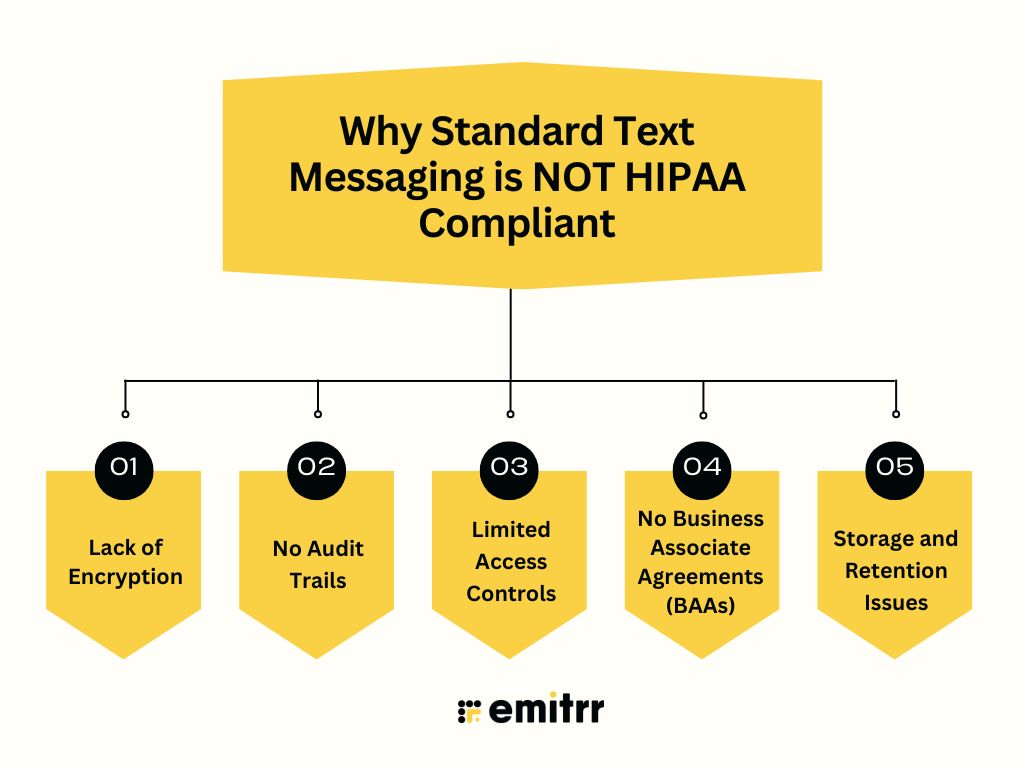
- Lack of Encryption: Standard SMS messages are typically transmitted unencrypted across cellular networks. This means that messages can potentially be intercepted by third parties, leading to unauthorized access to sensitive patient information. Imagine sending a text with a patient’s diagnosis; if it’s intercepted, that’s a major HIPAA violation.
- No Audit Trails: HIPAA compliance often requires detailed logs of who accessed what information, when, and why. Standard SMS platforms do not provide this level of auditability. There’s no way to track who sent a message, who received it, or if it was accessed inappropriately.
- Limited Access Controls: HIPAA mandates that access to PHI be restricted to authorized personnel. Standard texting doesn’t have built-in role-based access controls. Anyone with access to a phone could potentially view messages, regardless of their authorization level.
- No Business Associate Agreements (BAAs): For a vendor to handle PHI, they must sign a Business Associate Agreement (BAA) with the healthcare provider. Standard SMS providers typically do not offer BAAs, as their services are not designed for healthcare data. Without a BAA, the healthcare provider remains liable for any breaches that occur.
- Storage and Retention Issues: HIPAA requires specific data retention policies and secure storage for PHI. Standard text messages are often stored on personal devices or on carrier servers with varying security protocols and retention periods, making it difficult to ensure compliance.
Consider a simple appointment reminder. If a clinic texts a patient, “Hi [Patient Name], your appointment with Dr. Smith is tomorrow at 10 AM,” this message contains PHI: the patient’s name (an identifier) and the appointment detail (health-related). If sent via standard SMS, it lacks encryption, audit trails, and secure access controls, making it a potential HIPAA violation.
The Rise of HIPAA-Compliant Texting Solutions
The good news is that the healthcare industry has recognized the demand for convenient communication and the necessity of HIPAA compliance. This has led to the development of specialized HIPAA-compliant texting platforms. These solutions are built from the ground up with security and privacy at their core, offering features that directly address HIPAA requirements.
These platforms essentially provide a secure channel for sending and receiving text messages that contain PHI. They act as a digital bridge, allowing healthcare providers to communicate with patients via text while maintaining the integrity and confidentiality of their health information.
Key Features of HIPAA-Compliant Texting Platforms
When evaluating a HIPAA-compliant texting platform, look for the following essential features:
- End-to-End Encryption: All messages sent and received are encrypted, both in transit and at rest, ensuring that only authorized parties can read them.
- Secure User Authentication: Robust login procedures, often including multi-factor authentication, ensure that only authorized staff can access the platform.
- Role-Based Access Control (RBAC): This feature allows administrators to define specific roles for users, limiting their access to only the information and functionalities necessary for their job. This aligns directly with HIPAA’s “minimum necessary” principle.
- Audit Trails and Activity Logs: Comprehensive logs track all actions performed within the platform, providing an auditable record of communication and access for compliance purposes.
- Business Associate Agreements (BAAs): Reputable HIPAA-compliant communication platforms will readily offer and sign BAAs, demonstrating their commitment to HIPAA compliance and sharing liability.
- Secure Data Storage: PHI is stored on secure, HIPAA-compliant servers with robust data protection measures.
- Consent Management: These platforms often include tools to manage patient consent for receiving text communications, a key aspect of the Privacy Rule. Patients can easily opt-in or opt-out of messages.
- Secure Messaging Interface: The platform provides a dedicated interface for sending and receiving messages, rather than relying on standard phone texting apps.
For example, Emitrr offers a HIPAA-compliant communication platform that addresses these needs. Features like secure two-way messaging, automated appointment reminders, and a centralized inbox help healthcare providers communicate effectively while staying compliant.
Use Cases for HIPAA-Compliant Texting in Healthcare
The benefits of secure texting extend across various aspects of healthcare operations:
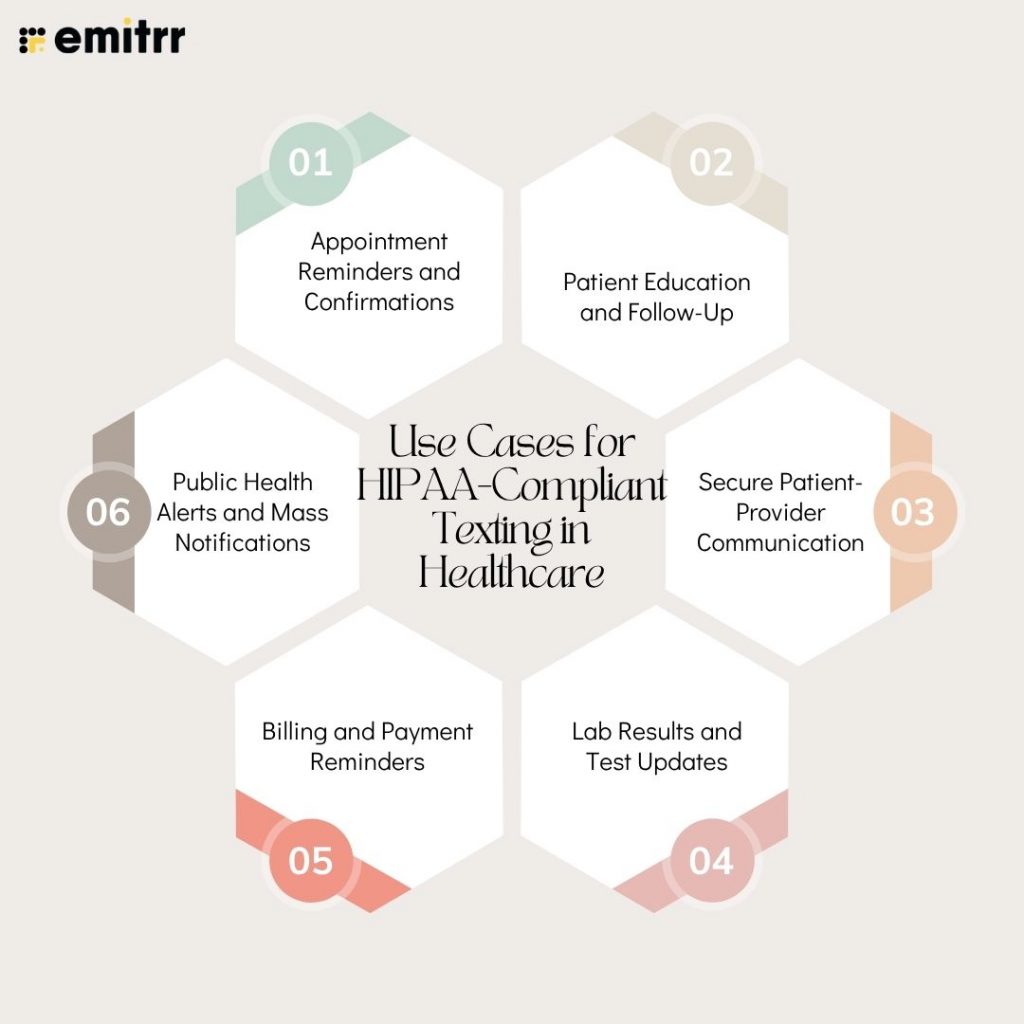
Appointment Reminders and Confirmations
This is one of the most common and impactful uses. Sending timely, secure appointment reminders via text can significantly reduce no-show rates, which cost the healthcare industry billions of dollars annually. A HIPAA-compliant system ensures that these reminders, which contain PHI, are sent securely.
Patient Education and Follow-Up
Healthcare providers can use secure messaging to share educational materials, post-procedure instructions, or follow up with patients after appointments or hospital stays. This proactive engagement can improve patient outcomes and satisfaction.
Secure Patient-Provider Communication
Patients can use these platforms to ask non-urgent questions, request prescription refills, or share updates with their care team securely, without needing to make a phone call or wait for an email response. This enhances patient convenience and accessibility.
Lab Results and Test Updates
While sensitive results might still require a phone call or secure portal message, less critical updates or notifications that results are ready can be sent via secure text, prompting patients to check their portal or schedule a follow-up.
Billing and Payment Reminders
Securely sending billing statements or payment reminders can improve revenue cycle management for healthcare organizations.
Public Health Alerts and Mass Notifications
For larger-scale communication, a text alert software or text blast software that is HIPAA compliant can be used to send urgent health information or public safety alerts to specific patient populations.
Texting Landlines: Expanding Communication Options Securely
Another important consideration is the ability to text-enable landline numbers. Many patients may still prefer to be contacted on their landline, or a clinic might have a central phone number that receives calls. Modern communication solutions can now text-enable these traditional landline numbers, allowing for two-way conversations via text. When implemented within a HIPAA-compliant framework, this extends the reach of secure communication without compromising patient privacy. This is particularly useful for smaller practices or those with established landline infrastructure.
Panel Management and Patient Engagement
Effective panel management with text messaging can revolutionize how healthcare providers manage their patient populations. By segmenting patients based on health conditions, demographics, or upcoming needs, providers can send targeted, relevant messages. For example, reminders for annual check-ups for diabetic patients or invitations to flu shot clinics can be sent efficiently and securely through a HIPAA-compliant system. This personalized approach enhances patient engagement and promotes preventative care.
Email vs. Text: Choosing the Right Channel
While both email and text are digital communication methods, they have different strengths and weaknesses, especially in a healthcare context. The comparison between email vs text highlights the unique advantages of texting for immediacy and engagement, provided it’s done compliantly. Emails can sometimes be overlooked or end up in spam folders, while texts often have higher open rates and elicit quicker responses. However, the security of email can also be a concern, and just like SMS, standard email is not inherently HIPAA compliant. HIPAA-compliant platforms ensure that both channels, when used, meet the necessary security standards.
Text Marketing for Healthcare: A Compliant Approach
The concept of “text marketing” might seem at odds with the sensitive nature of healthcare. However, when approached compliantly, it becomes a powerful tool for patient outreach and engagement. Text marketing for insurance and healthcare providers focuses on providing value, such as health tips, wellness reminders, or information about new services, rather than purely promotional content. Crucially, any such communication must be opt-in, adhere to communication preferences, and be delivered through a HIPAA-compliant channel. This ensures that patient engagement efforts are ethical and legally sound.
The Importance of Choosing the Right Vendor
For healthcare organizations, selecting a communication platform vendor is a critical decision. It’s not just about functionality; it’s about trust and compliance. A vendor that doesn’t prioritize HIPAA compliance poses a significant risk. This is why understanding the vendor’s security protocols, their willingness to sign a BAA, and their overall commitment to protecting PHI is paramount.
Consequences of Non-Compliance
The penalties for failing to comply with HIPAA are severe and can have devastating consequences for a healthcare organization:
- Heavy Financial Penalties: Fines can range from $100 to $50,000 per violation, with annual caps reaching $1.5 million or more per violation category. These fines are levied based on the level of culpability, from unintentional violations to willful neglect.
- Legal Action and Criminal Charges: In cases of intentional misuse or disclosure of PHI, organizations and individuals can face civil lawsuits from affected patients and even criminal charges, including imprisonment.
- Government Investigations: Regulatory bodies like the Office for Civil Rights (OCR) will investigate breaches and non-compliance, which can involve extensive audits, mandatory corrective actions, and significant disruption to operations.
- Mandatory Breach Disclosure: If a breach occurs, organizations are legally obligated to notify affected patients and HHS. This public disclosure can lead to significant reputational damage.
- Reputation Damage: Beyond fines and legal issues, a data breach erodes patient trust, which is the bedrock of any healthcare relationship. Negative publicity and loss of confidence can have long-term financial repercussions.
- Business Disruption: Investigations, mandatory system overhauls, and retraining can bring day-to-day operations to a standstill, diverting resources and slowing down growth.
- Loss of Partnerships and Contracts: Healthcare providers may terminate contracts with non-compliant vendors, and securing new partnerships can become impossible if compliance is not demonstrated.
Ensuring Compliance: A Checklist Approach
To navigate the complexities of HIPAA compliance in communication, healthcare organizations should adopt a proactive approach. A checklist, aligned with HIPAA’s core rules, can be invaluable:
1. Privacy Rule Compliance
- Limit Access: Ensure only authorized staff can access PHI.
- Minimum Necessary: Share only the essential information required for a specific task.
- Patient Consent: Obtain explicit consent for communication methods and content.
- Opt-Out Options: Provide clear and easy ways for patients to opt out of communications.
Emitrr Features: Role-Based Access Control (RBAC), Consent Management, Patient Communication Preferences.
2. Security Rule Compliance
- Encryption: Implement end-to-end encryption for all communications.
- Secure Access: Use strong authentication methods and secure login procedures.
- Audit Trails: Maintain detailed logs of all system activities.
- Data Protection: Ensure data is encrypted both in transit and at rest.
Emitrr Features: End-to-End Secure Messaging, Data Encryption, Secure User Authentication, Audit Logs & Activity Tracking.
3. Breach Notification Rule Compliance
- Detection: Have mechanisms in place to detect potential breaches quickly.
- Reporting: Establish clear protocols for reporting breaches internally and externally.
- Incident Logs: Maintain records of any security incidents or breaches.
Emitrr Features: Audit Trails, Access Logs, Alerting/Monitoring capabilities.
4. Enforcement Rule Compliance
- Documentation: Maintain thorough documentation of policies, procedures, and safeguards.
- Demonstrate Compliance: Be prepared to present evidence of compliance during audits.
- Cooperation: Cooperate fully with any regulatory investigations.
Emitrr Features: Detailed Reporting & Logs, User Access History.
5. Omnibus Rule Compliance
- BAAs: Sign Business Associate Agreements with all vendors handling PHI.
- Vendor Vetting: Ensure all third-party vendors are themselves HIPAA compliant.
Emitrr Features: Business Associate Agreement (BAA) Support, Secure API Integrations.
6. Communication-Specific Compliance
- Secure Platforms: Use dedicated, HIPAA-compliant communication tools.
- Avoid Personal Devices: Prohibit the use of personal phones or unsecure apps for PHI.
- Two-Way Secure Messaging: Ensure any two-way communication is encrypted.
Emitrr Solution: HIPAA-Compliant Texting Platform, Two-Way Secure Messaging, Centralized Inbox.
Frequently Asked Questions (FAQs)
No, sending appointment reminders via standard SMS is generally not HIPAA compliant because regular SMS lacks the necessary encryption, audit trails, and access controls required to protect Protected Health Information (PHI). Even seemingly simple information like a patient’s name and appointment time constitutes PHI.
A Business Associate Agreement (BAA) is a contract between a healthcare provider (covered entity) and a business associate (a third-party vendor that handles PHI on their behalf). It outlines the responsibilities of the business associate in protecting PHI and ensures they comply with HIPAA regulations. It’s crucial because it legally binds the vendor to HIPAA standards and shares liability.
Ensure your organization provides and mandates the use of HIPAA-compliant communication platforms, such as those offering secure messaging and text alert software. Implement clear policies prohibiting the use of personal devices or non-compliant apps for discussing PHI. Regular training on HIPAA regulations and secure communication practices is also essential.
PHI includes any information that can identify an individual and relates to their past, present, or future health condition, healthcare services, or payment for healthcare. Examples include names, addresses, dates of birth, phone numbers, email addresses, medical records, diagnoses, treatment plans, and insurance information.
Using a HIPAA-compliant platform is a critical step, but it’s not the only requirement. You must also implement appropriate administrative, physical, and technical safeguards, train your staff, have clear policies and procedures, and ensure you have signed BAAs with your vendors. Compliance is an ongoing process, not just a product feature.
Yes, with the right technology, you can text-enable landline numbers. This allows patients to send and receive text messages on a traditional landline phone number. However, this capability must be integrated into a HIPAA-compliant communication system to ensure that any PHI exchanged remains secure.
Conclusion: Prioritizing Security in Patient Communication
The question “Are text messages HIPAA compliant?” is best answered by understanding that standard texting is not, but secure, HIPAA-compliant texting solutions are. For healthcare providers, embracing digital communication is no longer optional; it’s essential for patient engagement, operational efficiency, and modernizing care delivery. However, this adoption must be done with a rigorous focus on patient privacy and data security.
By understanding HIPAA’s requirements and leveraging platforms designed for compliance, healthcare organizations can harness the power of text messaging to improve patient care, enhance communication, and build stronger, more trusting relationships with their patients. The key lies in choosing the right tools and implementing them responsibly, ensuring that convenience never comes at the expense of privacy.