
 4.9 (400+
reviews)
4.9 (400+
reviews)
Healthcare organizations today are under constant pressure to move faster, stay compliant, and protect sensitive patient data all at the same time. Yet, many still rely on outdated communication methods that slow down workflows and increase security risks.
Faxing continues to play a critical role in healthcare data exchange, but traditional fax machines often create more challenges than they solve—think delays, manual errors, and limited accessibility.
This is where cloud fax is changing the game. In this blog, we’ll explore how cloud fax works, why it’s becoming essential for healthcare providers, the benefits it offers, the risks to watch out for, and how to ensure full HIPAA compliance.
What Is Cloud Fax?
Cloud fax (also known as online fax or digital fax) is a modern solution that allows healthcare providers to send and receive faxes over the internet instead of using physical fax machines and phone lines.
Instead of relying on bulky hardware, cloud fax platforms use secure servers to handle fax transmissions digitally. Documents are sent through web portals, mobile apps, or integrated systems like EHR/EMR platforms, making the entire process faster, more secure, and easier to manage.
How Does Cloud Fax Work?
While different providers may offer slightly different workflows, the core process of cloud faxing remains the same. Here’s a clearer, more detailed breakdown of how it works:
STEP 1: Document Upload
The process begins when a user uploads a file—such as a PDF, image, or document through a secure web portal, mobile app, email-to-fax feature, or an integrated system like an EHR/EMR.
This eliminates the need for physical paper or a fax machine, making document handling faster and more efficient.
STEP 2: Secure Transmission
Once the document is uploaded, it is encrypted and transmitted to a cloud-based fax server. This step is critical for maintaining data privacy and security, especially in industries like healthcare where sensitive information (PHI) is involved.
Advanced cloud fax solutions use strong encryption protocols to ensure that the data remains protected during transit.
STEP 3: Delivery Handling
The cloud fax system intelligently determines how to deliver the fax based on the recipient’s setup:
- If the recipient is also using cloud fax, they receive the document digitally via a secure portal, email notification, or app alert.
- If the recipient is using a traditional fax machine, the cloud fax service converts the digital file into a fax-compatible format and transmits it over standard telephone lines.
This hybrid capability ensures seamless communication between modern digital systems and legacy fax infrastructure.
STEP 4: Access & Storage
Once delivered, received faxes are stored securely in the cloud. Users can access them anytime from any device, making it easy to retrieve, download, forward, or integrate them into existing workflows.
Most cloud fax services also offer features like audit trails, search functionality, and organized storage to improve efficiency and compliance.
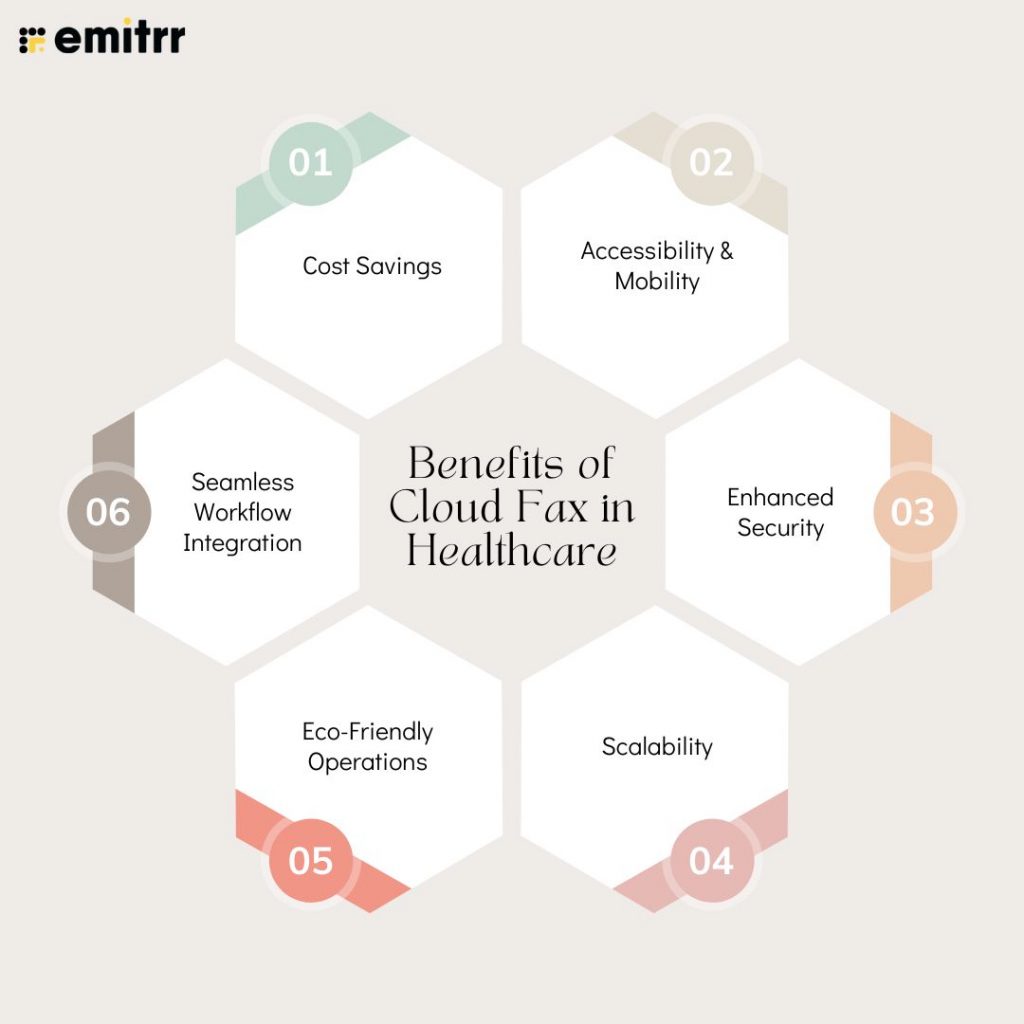
Benefits of Cloud Fax in Healthcare
Cost Savings
Traditional fax machines come with hidden costs: hardware, maintenance, paper, ink, and dedicated phone lines. On top of that, staff time is wasted waiting for faxes to send or receive. Cloud fax eliminates inefficiencies like hardware or maintenance costs, consumables like paper or toner. It also helps in faster transmission, improving staff productivity
Accessibility & Mobility
Healthcare professionals are always on the move. With traditional fax machines, accessing documents requires physical presence.
Cloud fax enables sending/receiving faxes from anywhere, instant access via mobile or desktop, and better collaboration across teams and locations. This is especially useful for telehealth, remote care, and multi-location practices.
Enhanced Security
One of the biggest risks with traditional faxing is unauthorized access. Documents can sit unattended on machines, exposing sensitive patient data. Cloud fax improves security through end-to-end encryption (in transit and at rest), user authentication, and role-based access and secure digital storage. These features significantly reduce the risk of data breaches and unauthorized access to Protected Health Information (PHI).
Scalability
Traditional fax systems are limited; you can only send one fax at a time per line. Scaling requires additional machines and infrastructure. Cloud fax solutions offer flexible plans based on usage, the ability to send multiple faxes simultaneously, and easy upgrades as your practice grows. This makes it ideal for both small clinics and large hospital networks.
Eco-Friendly Operations
Healthcare organizations generate a significant amount of paper waste. Cloud fax supports sustainability by eliminating paper usage, reducing ink and energy consumption and supporting digital record-keeping. It’s a simple yet effective way to reduce your environmental footprint.
Seamless Workflow Integration
Modern healthcare relies heavily on digital systems like EHRs, CRMs, and practice management software. Cloud fax integrates with EHR/EMR systems, billing and insurance platforms, and communication tools. This ensures smoother workflows, fewer manual steps, and reduced chances of errors.

HIPAA Compliance and Cloud Fax
HIPAA Compliance and Cloud Fax
For healthcare providers in the U.S., maintaining compliance with the Health Insurance Portability and Accountability Act is non-negotiable especially when transmitting Protected Health Information (PHI). While cloud fax solutions offer a more modern and efficient way to send documents, they are not automatically compliant. The level of security and safeguards built into the platform determines whether a cloud fax service meets HIPAA requirements.
A cloud fax solution is considered HIPAA-compliant when it includes the following critical components:
Encryption
All data must be encrypted both in transit and at rest. This ensures that sensitive patient information remains protected from interception during transmission and unauthorized access when stored. Strong encryption protocols are the foundation of secure cloud faxing.
Access Controls
Robust access controls ensure that only authorized personnel can view, send, or manage sensitive documents. Features like role-based permissions, multi-factor authentication (MFA), and secure logins help prevent unauthorized access and reduce internal risks.
Audit Trails
A compliant cloud fax system maintains detailed activity logs that track every interaction with a document, who sent it, who accessed it, when it was viewed, and any actions taken. These audit trails are essential for accountability, monitoring, and proving compliance during audits.
Business Associate Agreement (BAA)
Any cloud fax provider handling PHI must sign a Business Associate Agreement (BAA) with the healthcare organization. This legally binds the provider to follow HIPAA regulations and ensures they are equally responsible for safeguarding patient data.
Secure Storage
Stored faxes must be protected with advanced security measures such as data encryption, regular backups, and secure cloud infrastructure. This prevents data loss, breaches, and unauthorized retrieval while ensuring information is always accessible when needed.
Without these safeguards, even a cloud-based fax solution can become a compliance risk rather than a secure alternative. Choosing a provider that prioritizes HIPAA compliance not only protects patient data but also safeguards your organization from costly penalties, legal issues, and reputational damage.
Best Practices for Secure Cloud Faxing
To maximize the benefits of cloud fax while minimizing risks, healthcare organizations should follow these essential best practices:
- Conduct a Risk Assessment: Regularly evaluate your current workflows to identify security gaps and compliance risks.
- Enable Multi-Factor Authentication (MFA): Add an extra layer of protection beyond passwords by requiring a second form of verification.
- Use End-to-End Encryption: Ensure your cloud fax provider encrypts data both during transmission and while stored.
- Train Staff Regularly: Employees are often the weakest link in security, making regular training crucial.
- Monitor and Audit Activity: Continuously track fax activity through logs and audit trails to maintain accountability.
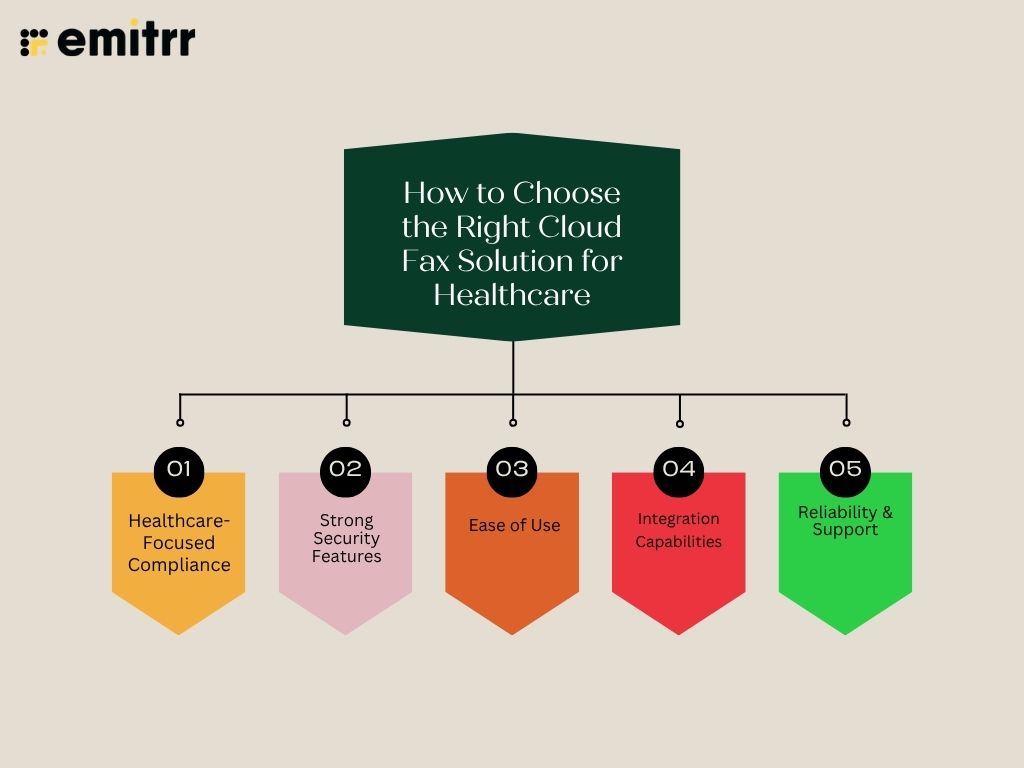
How to Choose the Right Cloud Fax Solution for Healthcare
Not all cloud fax solutions are designed with healthcare in mind. Choosing the right platform requires looking beyond basic functionality and focusing on compliance, security, and long-term scalability. Here’s an improved and more comprehensive checklist:
Healthcare-Focused Compliance
Make sure the platform is built specifically to meet Health Insurance Portability and Accountability Act requirements. It should offer a signed Business Associate Agreement (BAA) and follow strict protocols for handling PHI.
Strong Security Features
Look for end-to-end encryption, role-based access controls, multi-factor authentication (MFA), and detailed audit logs. These features ensure that sensitive data remains protected at every stage.
Ease of Use
The platform should be intuitive and easy to navigate for both clinical and administrative staff. A complicated system can slow down workflows and increase the risk of user errors.
Integration Capabilities
Seamless integration with EHR/EMR systems is essential for efficient workflows. This allows staff to send, receive, and store faxes directly within existing systems without switching platforms.
Reliability & Support
Choose a provider known for high uptime and dependable performance. Responsive customer support is equally important, especially when dealing with time-sensitive healthcare communications.
Key Features to Look for in a Healthcare Cloud Fax Solution
Beyond compliance and usability, the right cloud fax platform should offer features that improve efficiency, security, and workflow automation. Here are the essential features to prioritize:
End-to-End Encryption: Ensure all fax data is encrypted both during transmission and storage. This protects sensitive patient information from breaches and unauthorized access.
Audit Trails & Activity Logs: A robust system should track every action sent, received, viewed, or failed faxes. This ensures accountability and helps during compliance audits.
EHR/EMR Integration: Look for seamless integration with your existing systems so faxes can be sent, received, and stored directly within patient records, reducing manual work.
Automated Workflows: Advanced platforms allow automation like auto-routing, retries, and scheduled faxing. This reduces manual intervention and speeds up operations.
Delivery Confirmation & Notifications: Real-time alerts and confirmations ensure that critical documents are successfully delivered. This is especially important in time-sensitive healthcare communication.
Cloud Storage & Easy Retrieval: Secure cloud storage allows you to access, search, and retrieve faxes anytime. Many platforms also offer tagging and organization features for better document management.
Multi-Device Accessibility: Users should be able to send and receive faxes from desktops, tablets, or mobile devices. This enables remote work and improves accessibility across locations.
Scalability & Volume Handling: The system should handle increasing fax volumes as your organization grows without performance issues. Cloud fax solutions are designed to scale easily.
Why Emitrr Is a Smart Choice for Cloud Fax in Healthcare
If you’re looking for a solution that goes beyond basic faxing and truly modernizes healthcare communication, Emitrr stands out as a powerful, all-in-one platform. It’s built specifically to meet the needs of healthcare providers, balancing security, compliance, efficiency, and patient experience in one seamless system.
With Emitrr, you get:
- HIPAA-compliant cloud faxing for secure document exchange
Safely send and receive sensitive patient information with built-in encryption, access controls, and compliance safeguards, so you never have to worry about PHI exposure. - Secure texting and calling alongside fax for omnichannel communication
Manage patient conversations across multiple channels from a single platform, ensuring faster responses and a more connected patient experience. - EHR/EMR integrations for seamless workflows
Eliminate manual data entry and streamline operations by integrating fax directly into your existing healthcare systems, keeping everything synced and accessible. - Automation tools to reduce manual work
Automate repetitive tasks like document routing, notifications, and follow-ups, freeing up staff time to focus on patient care instead of administrative work. - Centralized communication dashboard to manage everything in one place
Get complete visibility into all your communications, fax, text, and calls through a single, easy-to-use interface.
Conclusion
Cloud fax is no longer just a convenience; it’s becoming a necessity in modern healthcare. It addresses the limitations of traditional faxing while improving security, efficiency, and scalability.
However, the key to success lies in choosing the right solution and following best practices to ensure compliance and data protection.
If you’re ready to modernize your healthcare communication without compromising on security, now is the time to switch to cloud fax.Looking to simplify secure communication in your practice?
Explore how Emitrr can help you streamline faxing, messaging, and patient communication all in one place. Book a demo today and see the difference for yourself.