
 4.9 (400+
reviews)
4.9 (400+
reviews)
Introduction: The Strategic Development of AI Agents
In many psychiatric practices, artificial intelligence in psychiatry is no longer limited to scheduling or chatbots. AI practices now have the capabilities of “shadow assistants” observing interactions and identifying subtle behavioral changes. For example, an AI psychiatry assistant tracks how frequently the patient reschedules and possible fluctuations of speech during intake as potential early indicators of an upcoming mood episode.
Another finding is that patients are often more at ease after constant contact with virtual psychiatric assistants for administrative tasks. By the time they meet the psychiatrist (hopefully), patients may be more comfortable, discuss their condition, and share more early on, almost as if the patient has been assisted by a familiar voice throughout their process.
AI practices in the psychiatry and mental health space have mostly focused on diagnostics, administrative efficiencies, and enhancing patient engagement. However, the previously outlined behaviors present more therapeutic attributes and implications when AI regulates workflows and transforms the practice.
The organization Emitrr, founded on HIPAA-compliant AI agents for psychiatry practices, is evidence of this; they support mental health organizations with scheduling, call taking, reminders, and secure two-way communications with added AI functions, which automate summary workflows. Psychiatrists can focus on delivering clinical care, while patients remain supported throughout all steps of care engagement.
Importance of AI Agents in Psychiatry Practices
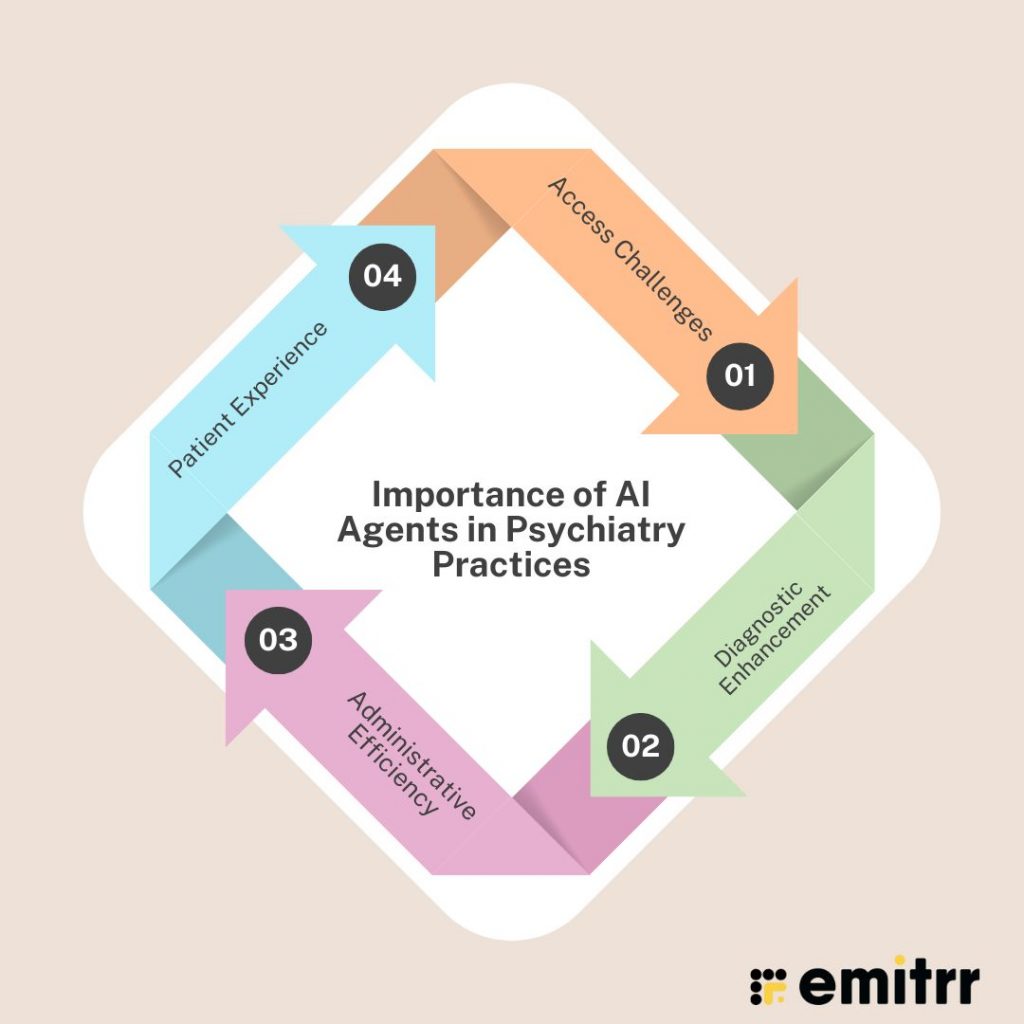
Access Challenges
There are simply not enough psychiatrists; the WHO estimates a median of 13 per 100,000 in high-income countries, and at fewer than 1 per 100,000 in low-income countries. AI psychiatry software is HIPAA compliant and is useful to fill those gaps and to provide scaled and smart support for communities that are under-resourced, providing triage, reminders, and follow-ups.
Diagnostic Enhancement
AI tools for psychiatric evaluations are now able to analyze the speech, facial expressions, and digital behavior of the patient. Some AI models can predict suicide attempts fairly accurately within a week’s timeframe (92% accuracy). This type of clinical decision support for a psychiatrist enhances clinical judgement; in a sense, it would be like an objective data-driven second opinion.
Administrative Efficiency
Psychiatrists spend upwards of 25-30% of their time doing clerical work. Psychiatry automation combined with AI will reduce complexity with scheduling, handle missed calls, and reduce workload by automating intake, and reducing work by upwards of 36%.
Patient Experience
Conversational AI and AI-enabled mental health monitoring are able to bridge the gap so patients do not have to go without support between visits. Patients report that they felt more “heard” when an AI checked in with them following a session, which in turn lessened the patient experience of isolation and provided engagement.
Real World Applications: Examples of AI Agents in Action
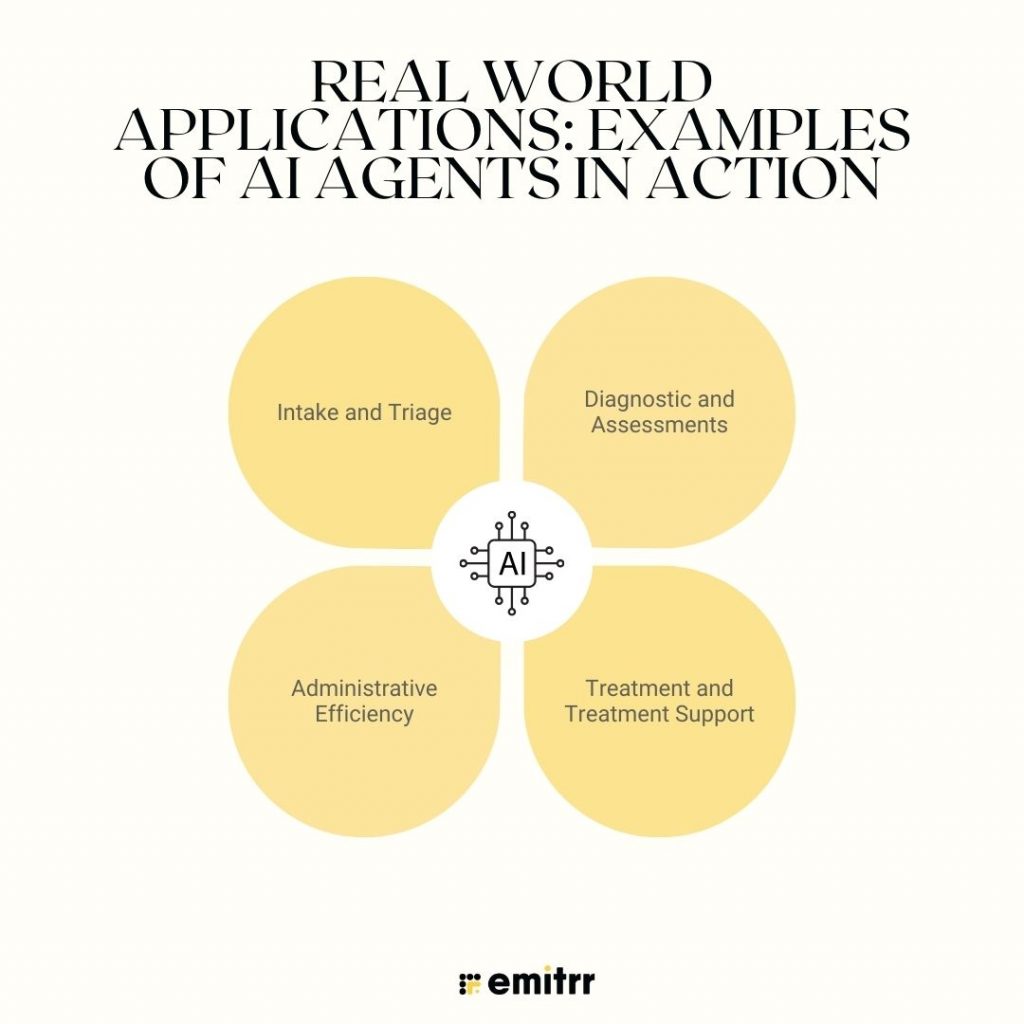
Intake and Triage
- Automated Follow-up of Missed Calls: AI texted patients immediately after a missed call with a booking link. Clinics that have automation like this report being able to recover up to 25% of missed calls.
- Pre-Appointment Data Collection: AI-enabled psychiatry tools (both on the patient and clinician side) provide a better starting point for the psychiatrist by gathering data on current symptoms, medication history, risk level, etc.
Diagnostic and Assessments
- Predictive Analytics: AI as a tool to improve outcomes in therapy, uses patient history and lifestyle activities to catch early warning signs of risk. Some tools predict relapse and hospitalization up to weeks in advance.
- Sentiment and Voice Analysis: AI offered for psychiatry assessments can capture minute changes in tone and phrasing in live telehealth sessions. Acting as an unbiased observer, this AI supplements a psychiatrist’s clinical impression.
Treatment and Treatment Support
- Personalized Interventions: AI-assisted therapy support can design treatment plans based on adherence, docking with the client’s genetics, and trying to understand the influence of lifestyle decisions.
- Virtual Coaching: These AI psychiatry assistants can offer Cognitive Behavior Therapy (CBT)-based chat any time, mindfulness tips, journaling prompts, etc., which give continuity of care between engagement with live sessions.
Administrative Efficiency
- Automated Scheduling & Reminders: With HIPAA-compliant AI therapy assistants, patients can book themselves online, receive automated reminders, and complete the intake process electronically. No more patients ignoring reminders!
- Billing and Revenue Cycle Management: AI can automate insurance verification, payment reminders, and billing queries, which improves cash flow by 18%.

Key Benefits of AI Agents in Psychiatry
The benefits of AI in the field of psychiatry extend beyond just automating repetitive work.
- Scalability and Access: AI provides more accessible treatment for underserved and rural patients by closing treatment gaps with scalable solutions to reach individuals at a rapid speed.
- Personalization Insights: AI can analyze patterns of speech or changes in individual behavior over time, which may give a psychiatrist necessary insight into ways to change their treatment.
- Operational Efficiency: AI-driven browsing, scheduling, and follow-up reminders can reduce clinician workload and significantly decrease no-show rates, making the practice more profitable, efficient for staff, and conducive to therapy.
- Improved Training and Coaching: AI-trained platforms can also expedite the training of new providers through real-time feedback and performance reports of therapy sessions.
- Data-Driven Care: AI-driven health analytics can also allow practices to work with claims-based algorithm specialists built in to track patterns in mental health monitoring that identify high-risk populations and individuals before a crisis.
Challenges and Ethical Considerations
The future of psychiatry with AI is uncertain, and navigating these challenges responsibly is paramount.
- Lack of Empathy & Human Nuance: The biggest concern is AI cannot simulate real human empathy, too. The AI Agent may misinterpret subtle emotional communication, while an AI agent is a powerful tool, it is not a complete substitute for therapy.
- Algorithmic Bias: AI models trained with non-diverse training data may replicate and even magnify existing biases. This will potentially impact clients from underserved populations, and this is especially important when designing to be equitable for all AI innovations in behavioral health.
- AI Psychosis Risk: For some individuals, extended exposure to conversational AI may negatively affect the way the brain processes reality. The risk of emerging delusional thinking or emotional desensitization is serious and will be a concern in evolving any AI transformation in behavioral healthcare.
- Regulatory Noncompliance: As of today, many of the AI psychiatry software that have HIPAA compliance are operating in a grey area of oversight. There needs to be more research and validation of the clinical implications and regulatory standards to better protect patients.
- Trust and Adoption: Patients and clinicians will understandably hesitate to put AI in place of human cognition, especially in such an intimate area of care as mental health is. Showing the case for AI being effective in psychiatric practices and proving the value of a HIPAA-compliant AI for psychiatry is important for mass adoption.
Best Practices for Implementing AI Agents in Psychiatry
To maximize the benefits of AI in psychiatry, practices should develop a thoughtful and intentional implementation plan.
- Integrate AI with Clinician Oversight: AI should be viewed as a support tool. AI assists the clinician in decision-making, but the human clinician will make the final decision. Clinical decision support for psychiatrists is to augment human-provided support, not replace it.
- Ensure the Datasets are Diverse: To address algorithmic bias practices should insist that AI systems are trained on diverse, representative patient data.
- Utilize Transparent Models: Clinicians will need some level of rationale when the AI recommends a course of action. The system should be more of a “glass box” than a “black box”, so that providers have confidence in what they gain from it.
- Utilize AI to Support, Not Replace, Human Connection: The primary responsibility of an AI psychiatry assistant is to perform administrative and routine tasks to allow the psychiatrist more quality time to create a strong therapeutic alliance.
- Implement Safeguards: Any platform that acts as an AI assistant for psychiatry should include safeguards, such as appointment limits; a clear pathway for the patient to escalate any crisis-related questions to a human.
- Track Key Metrics: Practices should track and report on no-show rates, staff time saved, patient engagement, etc., to track the performance of an AI-enabled mental health monitoring and iterate safely.
How Emitrr Supports Psychiatry Practices with AI Agents
Emitrr is one of the best examples of a platform that recognizes the psychiatric practice’s unique needs. An offering specifically designed to deliver a HIPAA compliant AI agent for psychiatry practices that supports clinicians without compromising patient trust or security.
- AI-enabled Scheduling and Call Handling: Emitrr’s AI functions as a trained assistant, reducing an organization’s call volume by up to 40%, allowing staff to free up an average of 4 hours a day. This is a significant advantage of AI in psychiatry practices that directly impacts a clinic’s bottom line and reduces burnout.
- AI Voice Agent for Level-One Call Handling (24/7): This AI will handle routine calls that just ask questions or book, cancel, and reschedule appointments and triage calls without human involvement at scale. This can save many front desks 100+ hours a month, and is vital to high-volume psychiatric practices, and represents a real-world implementation of automating workflow at scale.
- AI Receptionist for After-Hours Availability: Never miss a patient again. The AI will answer the phone outside of hours, or on weekends, and capture patient requests and offer scheduling options via a phone call. The AI scheduler then sends smart reminders to the patient, and if the patient were to no-show, a reminder that could keep the practice from losing fee-for-service revenue when no-shows are one of the largest hits in mental health.
- AI SMS Agent / (Two-Way, HIPAA-Safe): This is a HIPAA-compliant AI therapy assistant that automates appointment reminder messages and answers patient questions while following up with patients. It also includes a missed-call-to-text feature, which keeps the patient relationship and conversation going, turning an unlikely booking into an appointment on the same day.
- AI-Enabled Patient Engagement: As a HIPAA compliant virtual psychiatry practice, Emitrr’s AI virtual assistant has a full complement of tasks – identifying and instantly answering patient queries regarding treatment, logistics, or billing; sending personalized instructions for the visit, including pre-visit instructions; automating the feedback process; and keeping patients supported in between sessions with timely reminders and updates.
- Workflows Specific to Psychiatry: The Emitrr AI psychiatry software has HIPAA compliance and provides guidance and tooling specific to psychiatry, with scheduling online for mental health practices, and VoIP-enabled AI that surfaces patient records for incoming calls, which will increase speed and triage and reduce mistakes. This integration provides a HIPAA-compliant AI agent for psychiatry practices that understands the needs of the clinician.
Frequently Asked Questions
No. AI capabilities in psychiatry can incorporate their analysis of data to facilitate and assist in the diagnosis process, but they cannot make the diagnosis. An AI is a decision-support instrument for a human clinician and is not a replacement.
Yes, as long as it is within a HIPAA-compliant AI platform that has signed a Business Associate Agreement (BAA). AI platforms, such as Emitrr, encrypt any patient data to ensure privacy, protection and security of all patient information. This is a very important part of HIPAA compliance for mental health AI.
AI agents are established to follow certain escalation processes. If someone’s matter is highly sensitive or complicated, the AI would automatically pitch to a human staff member or a crisis hotline number.
No. The therapeutic relationship and clinical decision making will always be a human psychiatrist’s responsibility. AI vs human psychiatrist is a partnership, not a replacement; AI is designed to complete administrative work and deliver auxiliary support, which is the approach AI agents will help psychiatrists out in the end.
Pricing varies for AI agents. For example, Emitrr is a pay-as-you-scale pricing model, which is scalable and cost-effective for practices large or small; independent doctors, multi-doctor practices, and large mental health organisations would all benefit from the use of AI agents.
Yes. Automated reminders and an instant booking link sent to our patients through text will result in a smaller number of no-shows. Some practices reported a reduction in no-shows by 30 percent through using this kind of text reminder system, a very good summary to consider about AI’s role in reducing the number of no-shows that AI can help psychiatrists with.
Conclusion
The role of AI within today’s psychiatric care is no longer a hypothetical concept; it has become a reality. From AI psychiatry assistants that schedule appointments to AI-enabled mental health monitoring that detects early warning signs, these applications will change the way patients are cared for.
The advantages of AI-enabled psychiatry practice include enhanced access, fewer no-shows, improved patient participation, and a more detailed understanding of the clinical context. Importantly, we must remember: AI will never supplant the healing human connection that takes place in therapy; AI is here to enhance it.