
 4.9 (400+
reviews)
4.9 (400+
reviews)
Introduction
Call forwarding is super handy when you can’t answer the phone. You’ve probably asked yourself how do I forward my calls or played around with call-forwarding settings before heading into a meeting or stepping away from your desk.
But basic call forwarding has its limits. It simply sends the call to another number – no questions asked, no smarts involved. If the person on the other end can’t help, that’s a missed chance.
That’s where AI comes in. With enhanced call forwarding, calls don’t just get passed along – they’re handled smarter. In this blog, we’ll look at how AI transforms call forwarding into something faster, more helpful, and way more reliable.
What Is AI-Powered Call Forwarding?
Old-school call forwarding just sends a call to another number. That’s it. You set the rules, like forward to your mobile after a few rings, and hope for the best.
AI-powered call forwarding is a big upgrade. Instead of blindly rerouting calls, the AI actually listens, understands what the caller needs, and sends them to the right person, instantly. No button-pressing, no dead ends.
Let’s say someone calls and says, “I need to change my appointment.” The AI gets it, and either handles it or forwards it straight to your scheduler. It’s smart enough to check availability, look at caller history, and even recognize urgency.
In short, it’s like having a super helpful virtual receptionist who’s always on – making sure calls go to the right place every time. If you’re rethinking how to use call forwarding, this is a much smarter way to do it.
The Challenge with Traditional Call Forwarding
Old-school call forwarding does the job, but just barely. It often feels clunky, slow, and easy to mess up. Here’s why it’s no longer enough:
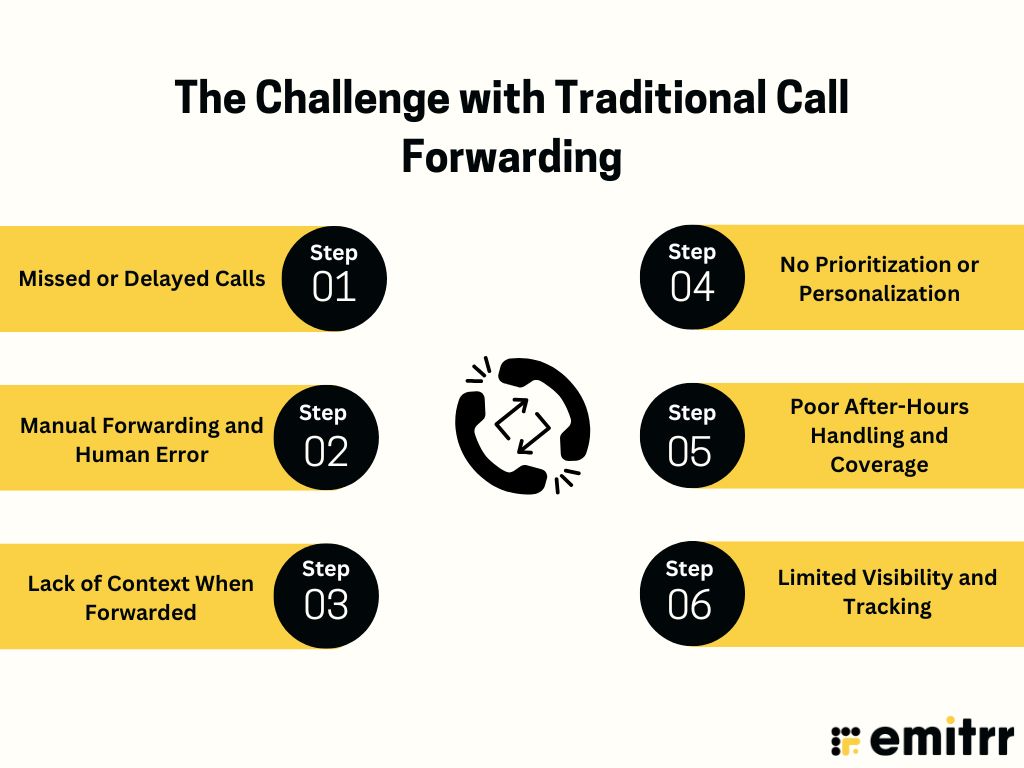
Missed or Delayed Calls
Just because a call is forwarded doesn’t mean someone picks up. If you’ve got bad signal or you’re busy, it might go to voicemail or worse, just drop. And let’s face it, most people won’t wait or call back. A missed call could mean a lost customer. Especially in high-stakes industries like legal or healthcare, missing one call can cost big. Traditional systems don’t help follow up, they just hope you catch it in time.
Manual Forwarding and Human Error
Sometimes, call forwarding isn’t automated at all. It’s just someone at the front desk transferring calls by hand. And people make mistakes. They might forward to the wrong number or forget to come back to a call. Even automatic call rules can mess up, like sending calls in circles or to old numbers. One small mistake, and your caller ends up in the wrong place or no place at all. Most old systems don’t have a backup plan.
Lack of Context When Forwarded
When a call gets passed on, the new person often doesn’t know what’s going on. The caller has to explain everything again, which is frustrating and slow. Modern systems pass along caller info-but traditional ones leave both parties starting from scratch.
No Prioritization or Personalization
In a basic system, every caller is treated the same. Whether it’s a first-time inquiry or your top client, they go through the same steps. There’s no way to flag VIPs or handle urgent calls faster. There’s also no way to personalize, like routing Spanish-speaking callers to a bilingual agent. It’s all one-size-fits-all. That can hurt relationships and cost you opportunities.
Poor After-Hours Handling and Coverage
Once your office closes, call forwarding usually sends everything to voicemail, or maybe your personal phone. That’s not sustainable, and most customers won’t wait around. They’ll just call the next business that picks up. And if someone calls with an emergency, they’re treated the same as a routine request. Without smart tools in place, businesses either lose leads or burn out their staff trying to cover off-hours. Traditional forwarding just can’t keep up after 5 PM.
Limited Visibility and Tracking
Basic call forwarding doesn’t tell you what’s happening on your phone lines. You don’t know how many calls you missed, how long they lasted, or what customers needed. You can’t track trends or spot problems. That means decisions are based on guesses, not data. Without insights, you’re flying blind. And that makes it hard to grow or improve your customer service over time.
Benefits of AI in Call Forwarding
Ever wish your calls could just magically go to the right person without anyone needing to press buttons or wait on hold? That’s exactly what AI call forwarding brings to the table. It’s not just faster – it’s smarter, friendlier, and way more efficient for both your team and your callers. Here’s how it helps:
Instant and Intelligent Call Transfers
No hold music, no phone tag, just direct, fast routing. AI listens to what the caller says, like “I need help with billing” and sends them straight to the right person. If the issue is urgent, the system knows to fast-track it. No waiting, no bouncing between departments. It’s like having a super-organized receptionist who gets it right every time. Everyone gets help quicker, and it shows in customer satisfaction.
Better Caller Experience and Faster Resolutions
Callers don’t need to repeat themselves or explain everything twice. AI not only sends calls to the right place but also shares helpful info with the agent before they even say hello. That means less time explaining and more time solving. Whether it’s smart scheduling, support, or sales, callers feel taken care of and your team looks super sharp in the process.
Reduced Human Workload and Errors
Let your team help people, not just transfer calls. AI handles the mundane stuff like sending calls to the right place or answering common questions. That means fewer mistakes, less stress, and more time for real work. It just works, every time.
Always-On Availability (After-Hours Support)
Your phones don’t sleep and now, neither can your service. AI can handle calls 24/7 without adding to your payroll. Whether it’s late at night or during a long weekend, the system can still help callers, take messages, or escalate urgent issues. That means you never miss a lead, no matter when they reach out.
Personalized Caller Routing
It’s not just call forwarding, it’s call forwarding that remembers people. AI knows repeat callers, preferred languages, and VIP clients. It can send Jane to the same rep she spoke with last week or fast-track an important customer to the right agent. Everyone gets a more personal, human experience, without your team having to think twice.
Improved Analytics and Reporting
Finally, you know what’s really happening on your phone lines. AI tracks call volume, reasons, durations, and outcomes, giving you insights you can actually use. Want to see what time most calls come in or which types of calls take longest? It’s all there. Plus, you can train your team better and fix issues faster with real data.
Higher Efficiency and Cost Savings
More calls handled, less overhead, it’s that simple. With smarter call routing and fewer errors, your team works faster and more effectively. You might even realize you don’t need to hire extra staff or pay for an answering service anymore. AI helps you grow without outgrowing your budget.
Here is how healthcare practices are using AI for their calling needs:
How AI Enhances Call Forwarding and What It Actually Does
Ever wonder how AI makes call forwarding feel smarter and smoother? Here’s how it works behind the scenes to make things faster and easier for everyone.
It Understands What People Say
AI listens like a good receptionist. Instead of asking callers to press buttons, it understands natural speech like “I need to change my appointment.” It gets the point and sends them to the right person, no confusion. If it needs more info, it asks simple questions. No stiff menus, just a friendly, helpful flow.
Predictive Forwarding Based on Caller Behavior
AI remembers past patterns to make smarter choices in the moment. The system doesn’t just react, it predicts. If someone calls every month to reorder supplies, the AI will learn that and automatically route them to the right department. It can also adjust routing based on time or trends (like more urgent calls on Monday mornings). The goal? To anticipate needs and act fast. Over time, these predictions get sharper, so the system keeps getting better at sending calls exactly where they need to go.
Skills-Based and Department-Specific Forwarding
It knows who’s best for the job and sends the caller there. AI systems match the caller’s needs with your team’s specific skills. Whether it’s routing tech questions to the right specialist or sending legal inquiries to the right attorney, the system pairs each call with the most qualified person. It can even shift routing based on performance like giving high-converting reps more sales calls. It’s smart, flexible, and makes sure callers talk to someone who really knows their stuff.
Real-Time Availability and Workload Detection
No more sending calls to someone who’s already slammed or out to lunch. AI checks who’s available right now and balances the load. If one agent’s busy and another is free, the system adjusts on the fly. For healthcare that could mean shorter patient wait times, better team efficiency, and no more endless ringing when someone’s away. It can even route overflow calls to other locations or offer a callback, all based on real-time staffing.
Sentiment and Urgency Analysis for Smart Prioritization
AI doesn’t just listen to words, it picks up on tone and emotion too. If someone sounds frustrated or says something urgent, the system notices. It can move that call to the front of the line or send it to the right person fast. This helps make sure serious or sensitive calls aren’t left waiting.
After-Hours Auto-Forwarding and Callback Scheduling
Your office may be closed, but your phone service doesn’t have to be. AI can take over after hours to help customers without needing live staff. It might answer basic questions, route urgent calls to on-call staff, or even schedule callbacks for the next morning. No more “leave a message” instead, it’s real service that keeps things moving, even when your team’s offline.
Integration with CRM and Calendar for Contextual Transfers
AI brings caller history and team schedules into the call, automatically. By syncing with your CRM, AI knows who’s calling and why. It can see open tickets, past conversations, and flag VIPs, then route calls accordingly. With calendar integration, it avoids sending calls to people who are unavailable and allows for online appointment scheduling in real-time. It makes every call smarter, faster, and more personal.
Omnichannel Continuity Across Calls, Texts, and Voicemails
It remembers the whole conversation, not just the call. AI connects the dots between voicemails, calls, and texts so nothing gets lost. If someone texts in and later calls, the AI picks up right where they left off. It can respond via text, follow up after a missed call, and keep all communication organized in one place. It’s one system, one conversation, across every channel.
Fraud Detection and Secure Call Verification
Smarter routing that also keeps your calls safe. AI can verify callers by voice or flag suspicious activity, such as robocalls or impersonators. It detects unusual behavior and redirects risky calls to security checks. This keeps sensitive info safe and blocks bad actors before they reach your team. For regulated industries, it’s a great layer of protection built right into your phone system.
Continuous Learning for Routing Optimization
The more it routes, the better it gets. AI doesn’t just work, it learns. Every call helps it fine-tune routing decisions. If it makes a mistake, it remembers. If certain phrases always lead to a certain department, it learns that too. Over time, your system becomes uniquely trained to your business and customer needs, always improving to get callers to the right place with less effort.

Key Features to Look For in AI Call Forwarding
If you’re thinking of upgrading to AI call forwarding, here’s what to look out for so you choose a system that actually makes your life easier.
HIPAA-Compliant and Secure Architecture
If you handle sensitive info, privacy isn’t optional – it’s a must. If you’re in healthcare or handle sensitive info, your call system needs to be secure. Look for HIPAA compliance, strong encryption, and protection for call logs and recordings. It’s not just a checkbox, it keeps you out of legal trouble and earns customer trust. A secure setup also means fewer surprises like outages or dropped calls.
Native CRM, EHR, and Calendar Integrations
The AI should connect seamlessly with your existing tools like CRMs, EHRs, and calendars. That way, it knows who’s calling, what they need, and when someone’s available to help. This makes forwarding more accurate and lets the AI do smart stuff like auto-schedule appointments or update contact records. Bonus: less copy-pasting for your team. A well-integrated system keeps everything synced – calls, context, and customer info.
Dynamic Call Rules and Low-Code Workflow Setup
You shouldn’t need an IT degree to manage call flows. Choose a system with drag-and-drop or toggle-based workflow builders. That means you can quickly set up smart rules like “after 5 PM, send urgent calls to my cell” or “VIP clients go straight to Sarah.” It’s flexible, fast, and easy to tweak when things change. A low-code setup keeps control in your hands and not your developer’s.
Smart Voicemail Detection and Callback Automation
Even if a call lands in voicemail, AI should know what to do next. Look for systems that transcribe voicemails, analyze their urgency, and either auto-respond or create callback tasks. It can even offer the caller a link to book a callback. This makes sure no message gets lost or forgotten. It’s like turning your voicemail box into a proactive assistant.
Human Escalation Controls and Supervisor Access
AI’s great, but humans are still essential. Your system should let callers easily ask for human help and give agents or supervisors a way to step in when needed. Supervisors should also be able to monitor calls live or after the fact, and help team members mid-call if needed. It’s all about having a safety net and maintaining quality control. You want tech that supports your team, not replaces them.
Scalability for Multi-Office or Remote Teams
Whether your team’s in one office or scattered across time zones, the system should handle it all. Look for support for multi-location routing, time zone adjustments, and remote access. Calls should reach the right person, whether they’re at a desk, working from home, or halfway across the country. A scalable platform grows with you, without breaking the bank.
Real-Time Dashboards and Performance Insights
Want to know how your phone lines are doing in real time? The system should show live call queues, wait times, and who’s handling what. Over time, it should give you analytics on call volume, resolution speed, agent performance, and more. These insights help you spot trends and fix bottlenecks fast. The more visibility you have, the better your phone operations run.
Custom Reporting and Data Analytics
Built-in dashboards are great, but custom reporting is where the real gold is. Choose a system that lets you filter data, build your own reports, and export everything you need. Whether it’s tracking call sources, conversion rates, or compliance logs, this flexibility helps you prove ROI and make smarter business decisions. You decide what metrics matter, and the system should deliver them.
When to Keep Humans in the Loop
AI is powerful, but it isn’t a complete replacement for human touch in every situation. Knowing when to involve human staff is crucial for maintaining great service and customer trust. Here are key times to make sure a person is on the line:
Sensitive or Emotional Conversations
Some calls just need a human touch. If someone is upset, grieving, or calling about a serious issue, it’s best to hand the conversation to a human. AI might be able to detect distress, but it can’t comfort someone or offer heartfelt apologies like a real person. For example, a family member calling a medical office in distress needs empathy, not automation. Make sure your system flags emotional keywords and cues so those calls go straight to a person who can help.
Complex Escalations or Multi-Department Transfers
Sometimes a call spans several departments or needs multiple decisions. Maybe it starts as a billing question, but turns into a tech issue and then a policy question. AI can do the first handoff, but humans are better at keeping the thread when things get messy. In these cases, a person should act as the point of contact, looping in others as needed to resolve the issue smoothly. It’s faster, less confusing for the caller, and more likely to get things resolved right.
First-Time or VIP Customer Calls
New customers are forming first impressions, don’t let it be a robotic one. It’s smart to let AI handle routing or intake, but get a human involved to build rapport and answer questions personally. The same goes for VIP clients or high-value leads. They expect personalized service and often want to talk directly to someone who knows their history. AI can help identify them and prioritize their call, but a human should pick it up and make them feel valued.
Service Recovery or Complaint Handling
When something has gone wrong and a customer is frustrated, it’s time for a human to step in. AI can detect anger or urgency, but it can’t apologize meaningfully or bend the rules when needed. A skilled human agent can turn a bad experience into a good one with empathy, judgment, and discretion. Make sure your AI knows how to flag complaints and route them quickly to a person who can take action and manage online reputation.
Training and Mentorship Scenarios
Even if AI can handle the call, sometimes you want your team to learn by doing. Letting new hires take simple calls helps them build confidence and develop their skills. You might have the AI do initial screening, then pass the call to a trainee with a mentor listening in. Or you could route certain types of calls to human reps during training blocks. AI is a great tool, but your team still needs hands-on experience to grow and stay sharp.
Best Practices for Implementing AI Call Forwarding
Rolling out AI call forwarding is a game-changer, but it works best when done thoughtfully. Here’s how to set your business up for success:
Define Clear Objectives and KPIs
Know what success looks like before you start. Are you trying to reduce missed calls? Speed up customer service? Save your team time? Set clear goals to help you stay focused and track whether the AI system is delivering results. Common KPIs include first-call resolution, call deflection rate, or reduction in after-hours staffing. With goals in place, you’ll be able to measure progress and justify your investment.
Start with a Pilot Department or Use Case
Don’t roll it out everywhere on day one. Start small with one department or a specific type of call, like support or after-hours inquiries. This lets you learn what works, catch bugs early, and refine before going company-wide. A focused pilot also helps staff adjust gradually and offers proof of value to share internally. Once it runs smoothly, you can scale with confidence.
Map Out Call Journeys and Escalation Paths
Before launching, take time to map out what different caller scenarios look like. Think about why people call, what they usually ask, and how their requests should be routed. Identify key moments where the AI should escalate to a human, like emotional conversations or policy exceptions. Creating a clear customer journey path helps avoid confusion and ensures a better experience. A visual call map also makes training and troubleshooting easier.
Train the AI with Real Caller Data
AI learns best from real-life examples, not just generic scripts. Feed it call recordings, transcripts, FAQs, and phrases your customers actually use. Include slang, abbreviations, or industry-specific terms to improve understanding. The more accurate and context-rich the data, the smarter and more helpful your AI will be. Think of it as onboarding a team member, give them the tools to succeed.
Communicate Changes to Staff and Customers
Keep everyone in the loop. Let your team know how the AI system works, what it’s handling, and how it affects their roles. Reassure them it’s a support tool, not a replacement. Share the benefits like less repetitive work, faster service, and fewer missed calls. Also, tell customers what to expect, like hearing a virtual assistant when they call. Transparency builds trust and eases the transition.
Track Metrics Like Call Resolution and Transfer Accuracy
Once the system is live, monitor how it’s performing. Track resolution rates to see if the AI is handling queries successfully. Measure how often it transfers calls to the right person the first time. Look at call duration, abandonment rates, and post-call satisfaction scores. These numbers help you spot problems early and guide system updates. Regular tracking ensures your AI stays helpful and effective.
Iterate and Optimise Using Feedback
Treat your AI like a living system, update it regularly based on what you learn. Ask your team and customers for feedback: Are there recurring issues? Confusing prompts? Missed handoffs? Use that input to tweak scripts, add FAQs, or improve routing. A/B test different flows or greetings to see what works better. Over time, small improvements make a big difference in experience.
Ensure Compliance and Regular Audits
If you’re in a regulated industry, compliance is non-negotiable. Make sure your AI meets standards like HIPAA, GDPR, or SOC 2, depending on your sector. Store call recordings securely, limit access, and automate data purges if needed. Schedule regular audits to catch issues early and verify that call handling aligns with legal and ethical standards. Keeping the system secure protects both your business and your callers.
How Emitrr Improves Call Forwarding
Emitrr brings all the benefits of AI-powered call forwarding to life – automating, personalizing, and simplifying the entire call experience. Here’s what makes Emitrr stand out:
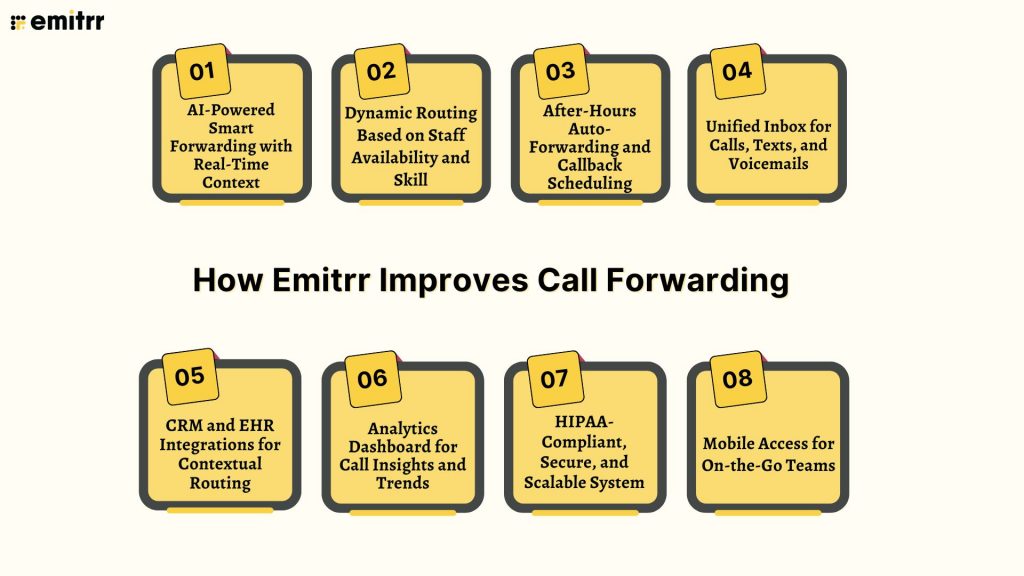
AI-Powered Smart Forwarding with Real-Time Context
Emitrr uses AI to forward calls based on what the caller is actually saying, not just where the call comes from. If someone says, “I want to reschedule my appointment,” Emitrr understands that and sends them straight to scheduling with context included. No cold transfers or repeat explanations. This real-time decision-making is powered by AI that can pull data from your CRM to know who’s calling and why. So every forwarded call goes to the right person, with the right info. That means faster resolutions and happier customers.
Dynamic Routing Based on Staff Availability and Skill
Not everyone is free all the time, and Emitrr gets that. It checks who’s available and who has the right skills before routing a call. So if your top salesperson is busy, it moves on to the next best person without missing a beat. You can even set rules like sending Spanish-speaking callers to Spanish-speaking reps. This ensures calls always go to someone who can actually help, reducing frustration for both customers and staff.
After-Hours Auto-Forwarding and Callback Scheduling
Even when your business is closed, Emitrr has your back. It can forward urgent calls to someone on-call or let the AI handle basic questions and book callbacks. Customers won’t hit a dead end, they’ll either get immediate help or a promise to follow up. And because Emitrr integrates with your calendar, it can even schedule appointments overnight. You’ll wake up to booked calls instead of missed opportunities.
Unified Inbox for Calls, Texts, and Voicemails
Emitrr keeps your team organized by putting calls, texts, and voicemails in one easy-to-use inbox. No more switching between apps or digging through voicemail systems. You see the whole conversation history with each customer, across all channels. That way, if someone calls, then texts, you’ve got the full picture. It helps your team respond faster and more accurately on the customer’s preferred channel.
CRM and EHR Integrations for Contextual Routing
Emitrr connects with your CRM or EHR to make every call smarter. When someone calls, the system can recognize their history, VIP status, language preference, or recent interactions. That info helps route the call correctly and gives your team context before they even say “hello.” It’s a great way to deliver more personalized service without adding manual work. Especially in healthcare, this means patients reach the right provider securely and efficiently.
Analytics Dashboard for Call Insights and Trends
Want to know when you’re getting the most calls or which ones turn into bookings? Emitrr’s analytics dashboard tells you. You’ll see call volumes, wait times, after-hours traffic, and more. It even helps you track how well the AI is working, like how many calls it resolves without human help. Use these insights to fine-tune staffing, update your scripts, or improve customer service. It’s like having a bird’s-eye view of your phone operations.
HIPAA-Compliant, Secure, and Scalable System
Emitrr is built with compliance and growth in mind. For healthcare practices, it’s fully HIPAA-compliant, so patient data stays safe. But it’s also designed to grow with your business, whether you have one office or 50. The cloud-based setup can handle high call volume without extra hardware. So you get peace of mind that the system is secure, reliable, and future-proof.
Mobile Access for On-the-Go Teams
Need to handle calls on the move? Emitrr has a mobile-friendly app so your team can stay connected from anywhere. Whether they’re in the field or working remotely, they can answer calls, reply to texts, and check voicemails, all from their phone. It keeps your team productive and responsive, even when they’re away from their desks. Plus, it all stays synced with the main system, so nothing slips through the cracks.
Future Trends in AI Call Forwarding
AI in telephony is rapidly evolving. Here’s what’s on the horizon for AI call forwarding:
Agentic AI for Full Call Flow Automation
AI is moving from being an assistant to acting as a fully autonomous agent. Future systems may handle entire customer interactions, from greeting to resolution, without human help. These AI agents will be able to book appointments, answer questions, and even authorize basic refunds. This means less hand-off and faster service. Businesses will likely still oversee these AI agents, but day-to-day calls could be largely automated.
Predictive Call Forwarding Based on Historical Patterns
Tomorrow’s AI will know why you’re calling, sometimes before you even speak. By analyzing past call data, trends, and behaviors, it will anticipate needs and forward calls accordingly. For example, if it knows calls after online orders are usually about shipping, it can jump straight to logistics. The system might even predict busy periods and adjust routing rules in advance. This makes call handling feel intuitive and ultra-responsive.
Generative AI for Real-Time Call Summaries and Handoffs
Generative AI can help by creating live call summaries and seamless handoffs. If a customer gets transferred, the next agent instantly sees a brief of what’s been said and what the caller needs. No more asking people to repeat themselves. It can also draft follow-up emails and internal notes, saving time.
Voice Biometrics for Personalised Caller Identification
In the near future, callers could be identified by their voiceprint. That means less time answering security questions and more personalized service from the get-go. The system recognizes your voice and pulls up your profile instantly. It could also detect if you’re upset and route you to a specialist. Voice ID adds both security and convenience to call routing.
AI-Driven Proactive Follow-Ups and Self-Service Options
Instead of waiting for calls, AI will follow up. If someone hangs up or misses a call, the system might text them right away to check in. It could also suggest self-service links via SMS to speed up resolutions. Over time, the AI will handle simpler tasks so humans can focus on complex ones. This makes support more efficient and proactive.
Integration with IoT and Smart Devices
Smart devices are becoming part of the call center. If your smart fridge detects a problem, it might auto-trigger a support call or guide you to help. When you call, the AI could already know what’s wrong via device data. This means faster, more accurate support with less explanation. It’s a new layer of context that makes AI routing even smarter.
Frequently Asked Questions
Just about any! It’s especially great for healthcare, salons, repair shops, and law firms, basically, any business where people call to book or ask questions. AI ensures no call gets missed, no matter the size of your team.
Emitrr gets what the caller wants in real time and instantly connects them to the right person. No bouncing around or long hold times. It’s like having a superfast, super-smart receptionist.
Totally. Emitrr answers calls when you’re closed, forwards urgent ones, books appointments, or leaves a helpful message. It’s your always-on, never-sleeps receptionist.
Yes! Emitrr is HIPAA-compliant and uses top-tier encryption and access controls. Whether you’re in healthcare or another industry, it keeps sensitive info safe and private.
Super fast. Many businesses are up and running the same day. Emitrr’s easy setup and helpful onboarding make it quick to launch, even if you start small.
Absolutely. It works with your current number, CRM, calendar, and more. That means personalized service, seamless logging, and no disruption to your existing setup.
Conclusion
Still wondering how do I forward my calls and texts to another number without dropping the ball? AI-powered platforms like Emitrr take the guesswork out of how to do call forwarding by using real-time intelligence to get callers exactly where they need to go. No more missed calls, endless ringing, or guessing how does call forwarding work – it’s smart, seamless, and actually helpful.
So if you’re tired of playing phone tag or losing leads after hours, it’s time to level up. Don’t let important calls slip through. Experience AI call forwarding with Emitrr and turn every ring into an opportunity! Book an Emitrr AI demo today!