
 4.9 (400+
reviews)
4.9 (400+
reviews)
Introduction
Healthcare organizations across the U.S. are facing an operational reality that continues to strain staff, frustrate patients, and slow care delivery, due to overwhelming call volume. The prescription refill request is among the top call drivers and one of the most common, redundant, and time-consuming activities dealt with by front-desk staff/clinical teams.
For the majority of practices, calls regarding refills represent a large percentage of daily phone volume. They are calling to refill medication, leave voice mails, follow up on pharmacy refill requests , or inquire about prescription renewal requests, and it’s often for medications that have been called in multiple times. This gently repeating cycle leads to bottlenecks, longer hold times, and staff reassignment away from more valuable patient care.
This guide explores why the traditional refill workflow is broken, how SMS-based refill requests dramatically reduce call volume, and how an AI-powered agent like Emitrr transforms refill management into an efficient, compliant, and patient-friendly experience.
The Hidden Cost of Prescription Refill Calls in Healthcare
An average U.S. medical clinic could have several thousand calls a month. An overwhelming majority of these calls are medication refill request phone calls, patients trying to order prescription refills online, or pharmacies calling in for a patient’s prescription from doctor offices.
Refill requests seem simple when you’re on the other end of the line, but that can’t be further from the truth. Staff are required to verify patient information, assess clinical eligibility, verify medication history, and collaborate with providers and pharmacies for each request. If these processes are manually performed over phone calls and voicemails, the rate of inefficiency and mistakes is high.
Why Refill Calls Overwhelm Front Desks
Front-desk staff at medical practices do much more than processors of incoming calls; they also schedule appointments, check in patients, verify insurance, coordinate referrals and patient documentation, and oversee day-to-day patient logistics. Amid the disruption caused by refill medication calls that now clog their phone lines, staff are scrambling to balance the cycle of repeat tasks and critical patient-facing work, creating constant operational pressure.
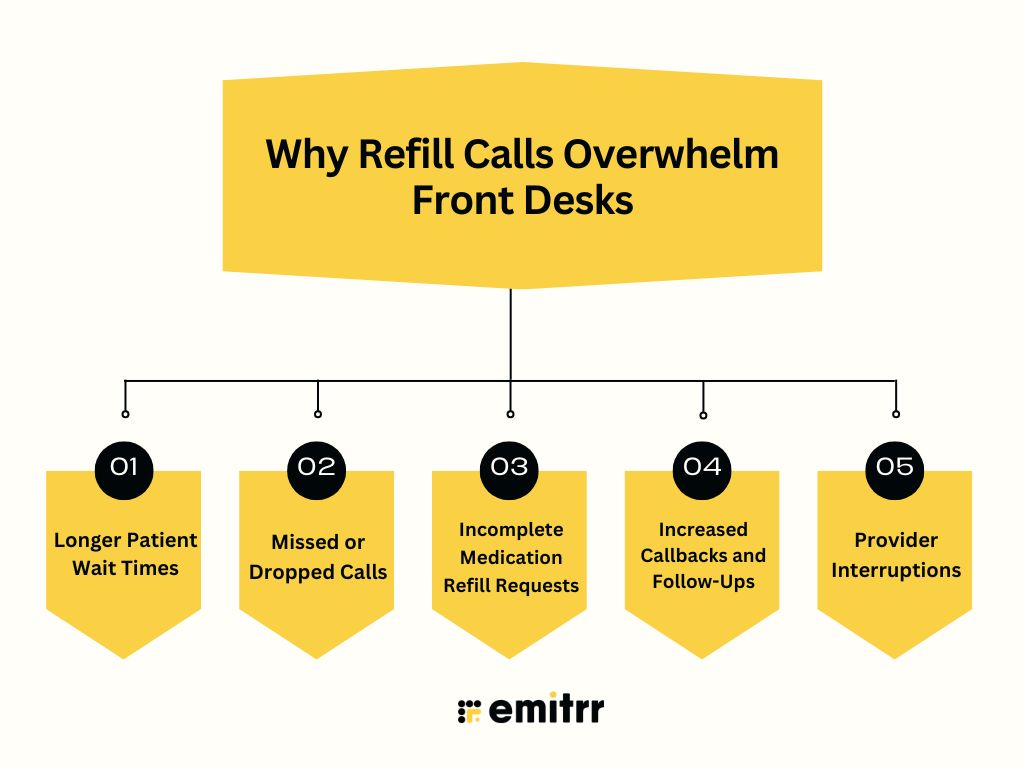
Longer Patient Wait Times
When front desks are busy fielding refill-related calls, other patients have longer wait times for appointments, billing questions, or urgent matters. “This is a bottleneck to receiving care and does not create patient satisfaction at either end of the equation.
Missed or Dropped Calls
Busy tones and dropped calls are more likely when the volume of voice being transmitted is high, particularly at peak times. Patients who phone in for a prescription refill repeatedly try to hang up and call back to increase phone activity /staff time.
Incomplete Medication Refill Requests
Phone calls and voice mails often do not include all the required information, such as the name of the medication, dose, or the preferred pharmacy. Staff members then spend extra time sleuthing those details to where they belong, disrupting the refill process and putting patients more at risk for errors.
Increased Callbacks and Follow-Ups
Due to the low closure rate of refill requests in a single call, agents have to undertake multiple outbound calls to confirm or advise on information. These callbacks increase rather than decrease daily call volume.
Provider Interruptions
Unscheduled refill requests often necessitate immediate provider involvement and interrupt the clinic day continuously. It is disruptive to the clinical workflow and usually leads to the provider losing time.
Together, these challenges create frustration for both staff and patients, not because refill requests are clinically complex, but because the workflow relies heavily on inefficient, phone-based processes.
The Standard Prescription Refill Process: (And Where It Falls Apart)
To figure out how SMS refill requests decrease call volume, we’ll want to look at the standard prescription refill process and determine which areas are inefficient.
Step 1: Patient Requests Refill
When patients need a prescription renewal, they often do so by calling the practice and leaving a message on the answering machine or by using the patient portal. This is immediately confusing, as patients do not know whether to use it and what information they will need to supply for the request to be right.
Many patients default to calling, even for routine refills, because it feels like the fastest option, unintentionally contributing to call congestion at the front desk.
Step 2: Clinic Receives the Request (Fragmented Across Channels)
Refill requests come to the clinic from disparate sources, including live telephone calls, voice mails, portal messages, and pharmacy refill requests by fax or electronic health records. There’s a lot of moving between systems required in order for agents to track these requests.
This fragmentation increases the likelihood of bottlenecks, forgotten refill requests, and double handling (especially if a patient has sent in multiple refill requests via different routes).
Step 3: Staff Manually Reviews the Refill Request
This is the most labor-intensive and error-prone step in the workflow. Staff must manually verify whether the patient is established, confirm medication eligibility, check appointment requirements, review labs or vitals, and assess controlled substance restrictions.
Each medication refill request becomes a manual investigation, often requiring chart reviews and coordination with clinical staff, significantly slowing down the process.
Step 4: Provider Approval or Denial
The provider then needs to accept or reject the refill request. Although this practice is essential for clinical safety, it frequently leads to additional communication, particularly when clarification or some sort of patient response is necessary.
Without triage, receiving doctors may get fragmented or unclear requests, adding additional delays.
Step 5: Pharmacy & Patient Notification
Assuming the refill request is approved, staff will need to process the prescription to the pharmacy and communicate with the patient. These notifications are manually performed, with the large volume of outbound calls structurally challenging and resource-intensive.
Step 6: Denials Trigger More Calls
When a refill is denied, patients are typically instructed to schedule an appointment or complete required labs. This almost always results in another inbound call, restarting the cycle of phone-based communication.
Why the Standard Workflow is Broken
The “Broken Step” in this process is almost always Step 3. When a staff member has to manually look into each patient’s request, they are spending 5–10 minutes per refill. Multiply that by 50 requests a day, and you’ve lost an entire employee’s productivity to administrative busywork.
Plus, when a patient leaves a message asking for refills on their prescription or if you need to call one in, they often forget to mention their date of birth, or- the exact name of the medication, or miss some much-needed information like leaving their phone number for the pharmacy. This results in endless rounds of “phone tag,” which only increases the number of calls.

The Solution: Moving From Voice to SMS
Text-based platforms enable patients to order a prescription refill through an ordinary text rather than taking 10 minutes during a phone call. If you can offload these requests to a digital channel, you also open up your phone lines for emergencies and new patient bookings.
How SMS-Based Refill Requests Work
- Patient Sends a Text: The patient sends a keyword like “REFILL” to the practice’s number.
- SMS Messages: An automated voice response is prompted to ask for the Medication name, pharmacy, and Date of Birth.
- Routing: The request automatically routes to the staff queue or dives down into your EHR workflow.
- Treatment Decision: Staff/Provider accept, reject, or escalate.
- Status Updates: The patient gets a text: “Your refill has been sent to the Walgreens on 5th Ave.”
This entire process happens without a single second spent on a phone call.
Enter the AI Agent: The Future of Refill Management
While basic SMS is good, an AI agent like Emitrr is the gold standard for reducing call volume. Think of the AI agent as a digital employee that never sleeps and never gets tired of asking for insurance details.
How an AI Agent Transforms the Request
When you implement an AI agent, it takes over the “intake” portion of the pharmacy request refill from the doctor process.
- Data Gathering: You teach the agent to gather the patient’s name, drug, dose, desired pharmacy, and DOB.
- EHR Integration (N/A with Sticky note): It is not a sticky, but a structured case in your EHR.
- Total Visibility: When a patient calls, the AI agent can take the call instead of one of your staff members, recording the conversation and giving your team a summary or full transcripts.
The “Match and Send” Efficiency
If the AI-extracted data matches patient information absolutely, then the system can “automatically” alert the pharmacy. If there is a discrepancy (like the patient requesting to refill the medication that’s out of refills), the AI creates an escalation case where staff reviews it again.
Why Emitrr Is the Most Effective Medicine Reminder and Refill Software
Emitrr is more than just a messaging app; it’s a holistic communication platform that makes sure you can request a refill of medication with no friction. Here’s why Emitrr is the solution you’ve been looking for in healthcare practices:
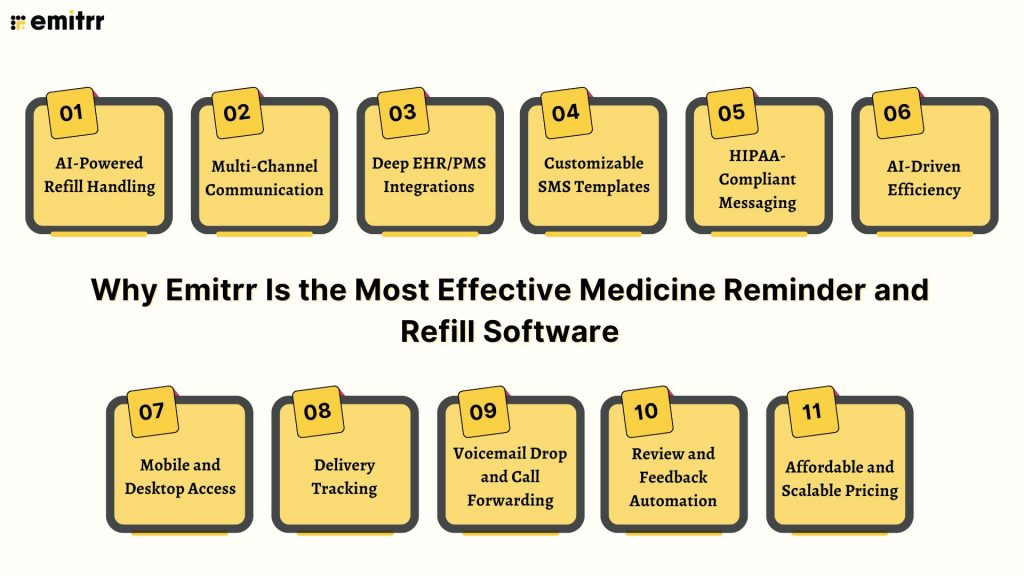
AI-Powered Refill Handling
Emitrr’s AI doesn’t just ping out a text; it can understand intent. It can differentiate between a patient seeking an online prescription refill and one inquiring about side effects, sending the latter to a nurse right away.
Multi-Channel Communication
Whether it’s a text, a phone call, or a web chat, Emitrr gathers all medication refill requests in a single place on one integrated dashboard for the end user. No more checking three different systems.
Deep EHR/PMS Integrations
Emitrr speaks to the systems you’re already using (Epic, Cerner, AthenaHealth, etc.). This has the user initiate a prescription refill request from a patient, but then this data flows where it should go automatically.
Customizable SMS Templates
Your practice is unique. You can create templates that sound like your brand, which can make patients feel as though they are getting custom care when they ask how to get a refill from their doctor.
HIPAA-Compliant Messaging
In healthcare, security is non-negotiable. Emitrr encrypts all county communications, including PHI, in accordance with the federal regulations.
AI-Driven Efficiency
The AI summaries allow doctors to review a prescription renewal request in seconds rather than minutes, identifying the core need without reading through long transcripts.
Mobile and Desktop Access
Your staff can control your pharmacy request a refill from the doctor queue from the front desk computer or tablet as they walk between exam rooms.
Delivery Tracking
Ever had a patient claim they never got a notification? Emitrr provides full delivery tracking, so you know exactly when the patient received their update.
Voicemail Drop and Call Forwarding
If a patient does opt for a call, Emitrr can also “text back,” so those forced to wait on the line instead of getting through can still refill medication using an encrypted link if they get busy signals.
Review and Feedback Automation
After the prescription refill is done, Emitrr can be programmed to automatically send a text requesting that you make a review, providing your practice with more of an online presence.
Affordable and Scalable Pricing
Unlike the old dinosaur enterprise software, Emitrr is priced fairly as you grow your practice, so it’s easy to show the ROI even on day one.
Frequently Asked Questions
Ans: Patients can ask for a refill by sending a text; no need to place a call to the clinic. Automated SMS captures important information (medication, DOB, pharmacy) and passes the request to the clinic or EHR for review. Patients’ treatment is updated with text updates that cut down on phone calls.
Ans: Yes. Several practices now offer patients the option to refill a prescription online or with a text message, just by replying to basic written prompts. This cuts out the hold times, accelerates refills, and takes the phone portion out of it.
Ans: Yes, as long as it’s treated via HIPAA-compliant media. These systems are secure and encrypted, so no patient information is shared, refill requests are received, and privacy measures are adhered to.
Ans: SMS pushes easily refilled requests out of phone calls and into automated text arrays. This cuts down on incoming calls, minimizes hold time, and frees up staff to fill new prescriptions instead of waiting to answer the phone.
Ans: Eligible patients can have most non-controlled, chronic medications refilled through their cell phone with text messaging. Controlled substances, given that their volume is smaller than other drugs and their use is more restricted, may still need to be reviewed/do in-person visits due to clinic policy.
Conclusion
The traditional phone-based prescription refill workflow is no longer sustainable. Too many calls, too much manual effort, and too much staff burnout, all for routine requests.
By shifting refill medication workflows to SMS and AI-driven handling, practices reduce call volume, improve efficiency, and deliver a better patient experience.
Emitrr makes this transition easy, legally sound, and scalable, transforming prescription refill requests into an automated digital process. Book a demo today.