
 4.9 (400+
reviews)
4.9 (400+
reviews)
Introduction
When it comes to healthcare practices, sharing medical records is a routine responsibility, but it is also one of the most compliance-sensitive tasks, as almost every record contains Protected Health Information, and even a small mistake can lead to HIPAA violations, legal exposure, hefty penalties, or loss of patient trust.
Here is when AthenaHealth comes in, as it offers multiple secure ways to send medical records, making it easier for practices to manage Athena medical records, coordinate care, and meet regulatory requirements. However, knowing how to send medical records in Athena, which method to use, and when to use it is critical for safe and efficient record sharing.
This is exactly what we are going to do; this blog is a comprehensive guide that explains AthenaHealth’s medical records sharing methods, HIPAA compliance requirements, common mistakes, and best practices.
So let’s get started!!
For Healthcare Providers: Sending Medical Records
- Open the Patient’s Chart in the Athenahealth System
- Find the Option to Share or Send Medical Records
- Select the Medical Records You Want to Send
- Choose a Secure Method to Send the Records
- Record and Document the Transfer in the Patient’s File
How To Send Medical Records In Athena?
For Patients: Sharing Your Medical Records
Step 1: Log in to the Athena Patient Portal
- Go to your provider’s AthenaHealth Patient Portal
- Enter your username and password
Step 2: Access Your Health Records
- Click on “My Health”
- Select “Health Records” or “Medical Records”
Step 3: Choose What You Want to Share
- Select a custom date range or choose All Time
- Pick specific documents (labs, visit summaries, medications) if available
Step 4: Select a Sharing Method
AthenaHealth offers multiple secure options:
- Download Records
- Generate a CCD (Continuity of Care Document)
- Save it securely and upload or share with another provider
- Direct Messaging
- Enter the recipient provider’s Direct Address
- Send records securely like an encrypted email
- Provider-to-Provider Sharing
- Use the Share option to send records directly to another healthcare organization
Step 5: Confirm and Send
- Review the details
- Submit the request or send the records
- Keep confirmation for your records
For Healthcare Providers: Sending Medical Records
Step 1: Open the Patient’s Chart
- Log in to athenaClinicals
- Search and open the patient’s profile
Step 2: Locate the Record-Sharing Option
- Go to the “Find” or “Chart” tab
- Select Medical Records or External Records
Step 3: Select Records to Share
- Choose only the minimum necessary information
- Avoid sharing the entire chart unless required
Step 4: Choose a Secure Delivery Method
- Direct Secure Messaging
- Fax (HIPAA-compliant)
- Portal sharing
- Export or print (for authorized requests)
Step 5: Document the Transfer
- Record when, how, and to whom the records were sent
- Ensure the action is logged for HIPAA audit purposes
Provider-to-Provider Automated Sharing (PRS)
Step 1: Ensure Patient Record Sharing Is Enabled
- AthenaHealth connects with CommonWell and Carequality
Step 2: Automatic Record Discovery
- When a patient visits, AthenaHealth automatically checks for external records
Step 3: Review and Reconcile Records
- Found records appear in the “Find” tab
- Reconcile medications, allergies, and conditions with one click
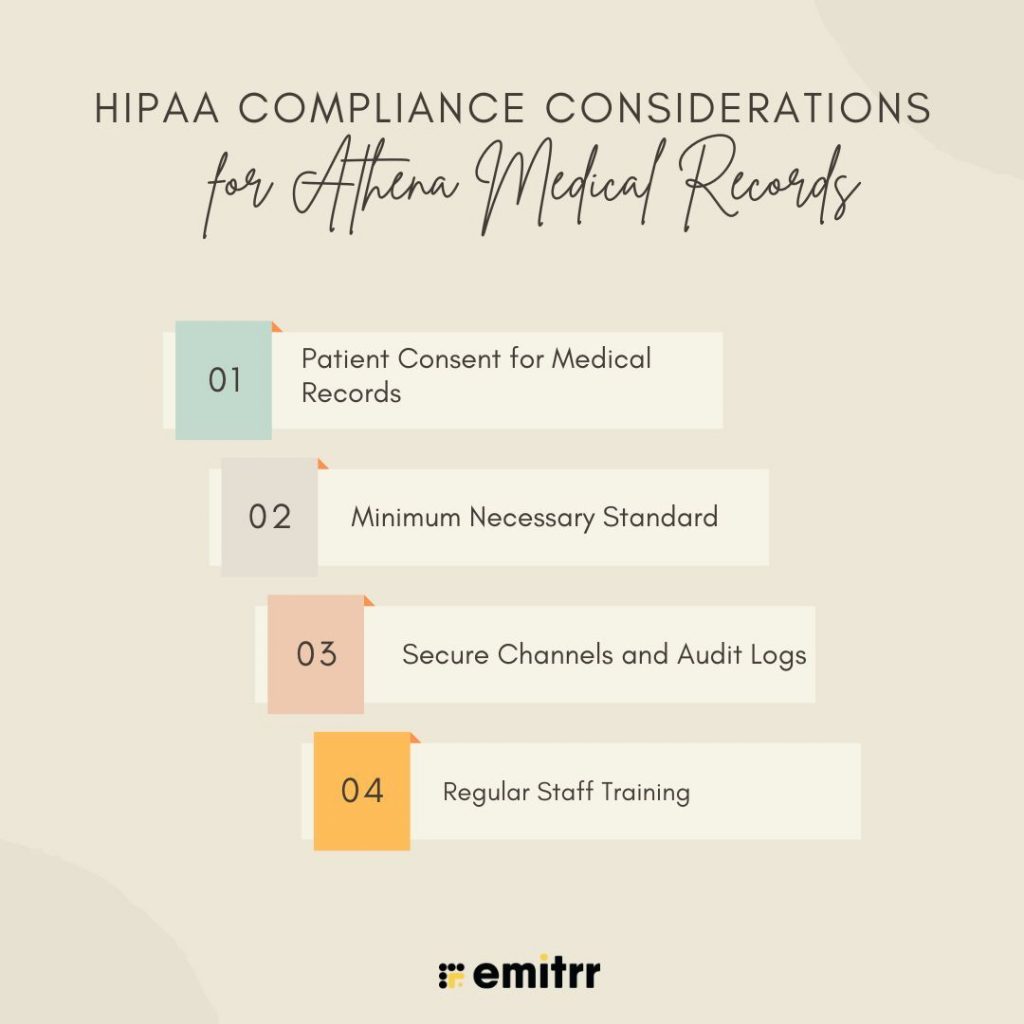
HIPAA Compliance Considerations for Athena Medical Records
Patient Consent for Medical Records
Documented patient consent is the foundation of compliant medical record sharing. Before releasing AthenaHealth medical records, practices must ensure patients understand what information is being shared, with whom, and for what purpose. Proper consent documentation protects patient rights while providing legal protection for the practice during audits or disputes.
Minimum Necessary Standard
HIPAA requires practices to follow the minimum necessary standard when sharing medical records. This means only the specific Athena patient records required for the request should be disclosed. Avoiding unnecessary data exposure significantly reduces compliance risk and strengthens secure medical record sharing in Athena.
Secure Channels and Audit Logs
Athena uses encrypted, access-controlled systems to protect patient data during transmission and storage. Every interaction is recorded through detailed medical record audit logs, allowing practices to track who accessed or shared information. These logs are critical for compliance monitoring, investigations, and regulatory reviews.
Regular Staff Training
Even the most secure systems can be compromised by human error. Regular staff training ensures teams understand HIPAA requirements, proper AthenaHealth record-sharing workflows, and secure patient data sharing practices. Continuous education reduces mistakes and reinforces accountability.
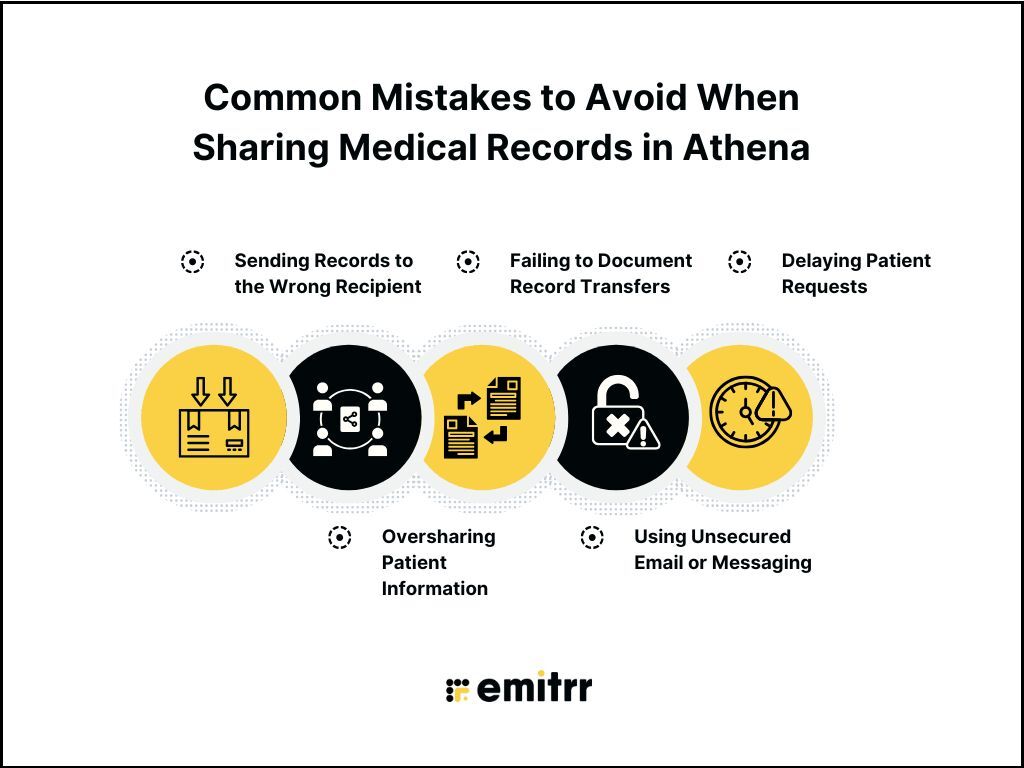
Common Mistakes to Avoid When Sharing Medical Records in Athena
Even with HIPAA-compliant tools, process gaps and manual errors can put patient data at risk. Understanding common mistakes helps practices proactively strengthen Athena medical record workflows.
Sending Records to the Wrong Recipient
Using outdated provider details, incorrect fax numbers, or selecting the wrong contact can result in Athena medical records being sent to unintended recipients. This is one of the most serious HIPAA violations and often occurs due to rushed workflows or lack of verification.
Oversharing Patient Information
Sharing full patient charts when only specific documents are required violates the HIPAA minimum necessary rule. Oversharing increases exposure risk and creates unnecessary compliance concerns.
Failing to Document Record Transfers
When AthenaHealth record transfers are not documented in the patient chart, practices lose audit visibility. Missing documentation can lead to compliance gaps during audits, insurance reviews, or legal inquiries.
Using Unsecured Email or Messaging
Standard email and personal messaging platforms do not meet HIPAA security requirements. Medical records should only be shared using secure, approved Athena channels or HIPAA-compliant tools.
Delaying Patient Requests
Slow responses to medical record requests negatively affect patient satisfaction and can lead to regulatory non-compliance. Timely handling is essential for trust and transparency.
Best Practices for Faster and Safer Athena Medical Record Sharing
Standardize Record-Sharing Workflows
Creating a standardized process for Athena medical record sharing helps practices maintain consistency across all requests. When staff follow the same steps for receiving, processing, and sending medical records, the risk of missed information or compliance gaps is reduced.
Double-Check Recipient Information
Before sending any medical records through AthenaHealth, it’s critical to verify recipient details such as email addresses, fax numbers, or portal access. Even a small error can result in a HIPAA violation or unauthorized disclosure of PHI.
Set Clear Timelines
Defining clear turnaround times for medical record requests improves transparency and reduces unnecessary follow-up calls. When patients and third parties know how long Athena medical records typically take to be shared, trust increases and administrative interruptions decrease.
Use Templates and Checklists
Using pre-approved templates and checklists simplifies medical record request management in AthenaHealth. Templates ensure all required fields, authorizations, and compliance elements are captured every time, while checklists help staff avoid missing critical steps.
Leverage Automation
Automation plays a key role in faster and safer Athena medical record sharing. Automated status updates, request tracking, and patient notifications reduce manual effort and administrative burden.

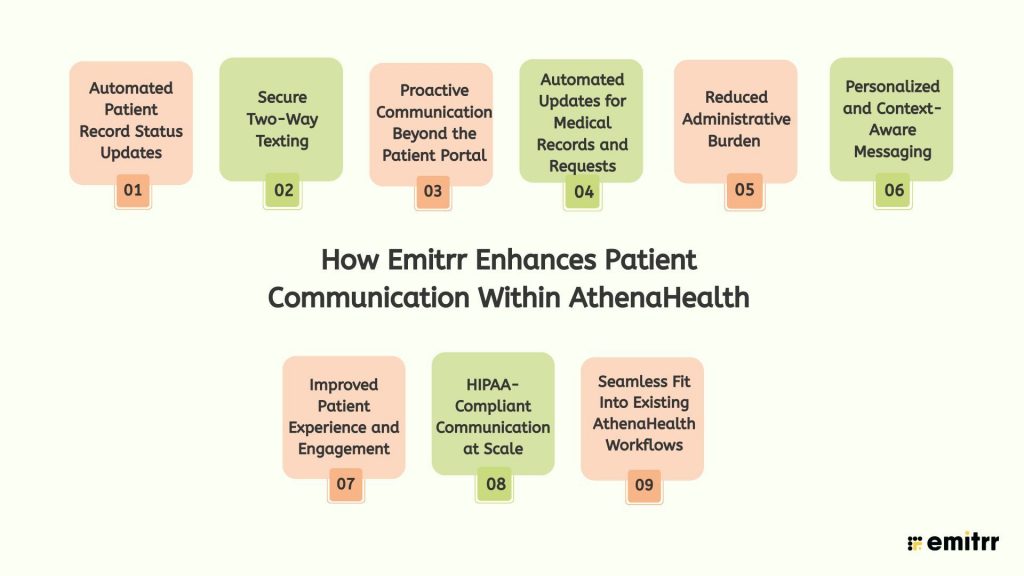
How Emitrr Enhances Patient Communication Within AthenaHealth
AthenaHealth is widely used for managing electronic health records (EHR), clinical documentation, scheduling, and billing. However, when it comes to ongoing patient communication, many healthcare practices still rely on manual calls, emails, or portal messages that patients often miss.
Emitrr here comes in handy as it improves patient communication within AthenaHealth by acting as a powerful communication layer that works alongside existing Athena workflows. Here are a few reasons why Emitrr is the best and HIPAA-compliant patient communication platform:
Automated Patient Record Status Updates
Emitrr automatically sends text notifications when medical record requests are received, in progress, or completed. These real-time updates reduce inbound calls, eliminate uncertainty, and improve transparency for patients.
Secure Two-Way Texting
Patients can confirm consent, ask questions, or clarify record requests using HIPAA-compliant texting for medical practices. Emitrr offers robust features and functionalities, which also include two-way texting that allows patients to reply and have real-time conversations in case of any questions, issues, or next steps. You can manage these conversations from a centralized dashboard to avoid any confusion, which also reduces back-and-forth phone calls.
Proactive Communication Beyond the Patient Portal
While AthenaHealth offers a patient portal, many patients do not log in regularly. Emitrr bridges this gap by delivering important updates through SMS, ensuring messages are seen and acted upon quickly. This improves response rates and keeps patients informed without requiring portal access.
Automated Updates for Medical Records and Requests
Emitrr automatically sends real-time text notifications when medical record requests are received, processed, approved, or completed in AthenaHealth. These automated updates reduce uncertainty, prevent repetitive patient follow-up calls, and improve transparency around Athena medical records.
Reduced Administrative Burden for Front-Desk Teams
When it comes to automating repetitive and manual tasks, Emitrr excels. Automating routine communication, such as record status updates, patient appointment reminders, follow-ups, and even automating prescription refill requests in Athenahealth to drastically reduce the call volume and administrative overload.
Personalized and Context-Aware Messaging
Emitrr also offers you the capability to customize your message based on patient type, request status, or care stage. Healthcare practices can also include details related to appointment details, record turnaround timelines, or portal instructions, which makes communication clear as well as relevant.
Improves Patient Experience and Engagement
Timely, clear, and proactive communication helps patients feel informed and supported. By keeping patients updated throughout their interactions with AthenaHealth, Emitrr improves patient satisfaction, builds trust, and reduces frustration caused by communication delays.
HIPAA-Compliant Communication at Scale
Emitrr knows the importance of being compliant in the healthcare industry, hence it adheres to all the necessary regulations, including HIPAA, and supports HIPAA-compliant texting, secure data handling, and controlled access.
Want to explore how healthcare practices can send text messages directly while working inside Athenahealth. Want to know more? Watch our YouTube video:
Seamless Fit Into Existing AthenaHealth Workflows
Emitrr improves patient communication without replacing AthenaHealth; it works as a companion. Healthcare businesses can continue using Athenahealth while Emitrr handles messaging automation, follow-ups, and patient engagement that creates a smooth and more efficient workflow.
Frequently Asked Questions (FAQs)
AthenaHealth gives healthcare practitioners the capability to share medical records securely through multiple ways, including patient portals, secure messaging, faxing, printing, mailing, and exporting records.
Athena Patient Portal is one of the most secure and safe options for medical record sharing. It allows patients to securely access their medical records online without exposing PHI through unsecured email or manual delivery methods.
Yes, Athenahealth also supports provider-to-provider record sharing through secure messaging, faxing, and record exports.
Yes, texting can be HIPAA-compliant if you are doing it through a secure, compliant, and healthcare-approved platform like Emitrr. Emitrr enables HIPAA-compliant two-way texting, ensuring patient consent, data encryption, and controlled access while improving communication speed.
Emitrr works alongside AthenaHealth as a communication platform; it does not replace the platform but improves the patient communication experience through automation and other advanced features.
Common mistakes when sharing medical records in Athena include sending records to the wrong recipient, oversharing unnecessary information, failing to document record transfers, using unsecured email, and delaying patient requests.
Platforms like Emitrr can be a game-changer when it comes to reducing the workload of front desk workers, as it offers robust automation and advanced AI capabilities that significantly reduce manual follow-ups and repetitive administrative tasks.
Yes, Athena Health maintains detailed audit logs that have all the records of who accesses the data, what changes have been made, sharing activity, user action, and more that are essential under HIPAA compliance.
Conclusion
Sharing medical records is a critical responsibility for healthcare practices—one that demands accuracy, speed, and strict adherence to HIPAA regulations. AthenaHealth provides secure and flexible methods to manage and share Athena medical records, but the overall experience often depends on how well communication is handled around these workflows.
Emitrr here helps healthcare organizations automate medical record updates, enable HIPAA-compliant two-way texting, and reduce front-desk workload while working seamlessly alongside AthenaHealth. Book a demo with Emitrr today and see how smarter, automated communication can transform your AthenaHealth workflows.