
 4.9 (400+
reviews)
4.9 (400+
reviews)
Introduction
Faxing has been a cornerstone of healthcare communication for decades. From sending patient records and prescriptions to sharing referrals and insurance documents, fax is still deeply embedded in everyday workflows.
But here’s the real question in 2026:
Is fax actually HIPAA compliant, or has the industry just been assuming it is?
Many healthcare providers operate under the belief that faxing is inherently secure. However, this assumption can lead to serious compliance risks. In reality, HIPAA does not automatically consider any communication method compliant, not even fax.
The truth is simple:
Fax can be HIPAA compliant, but only when used correctly and with the right safeguards in place.
In this guide, we’ll break down everything you need to know, including when faxing is allowed, the risks of traditional fax machines, and why modern cloud fax solutions are becoming the new standard.
Is Fax Really HIPAA Compliant? (Short Answer)
Let’s address the question directly.
Yes, fax can be HIPAA compliant, but it is not inherently compliant.
HIPAA does not certify or approve specific technologies like fax, email, or texting. Instead, it sets rules for how Protected Health Information (PHI) must be handled, transmitted, and stored.
This means compliance depends on:
- How you send the fax
- Who has access to it
- What safeguards are in place
- How risks are managed
So while faxing is legally permitted under HIPAA, it must meet strict requirements to actually be compliant.

What Makes a Fax HIPAA Compliant
For faxing to be compliant, organizations must implement safeguards across three key areas defined by HIPAA.
Administrative Safeguards
Administrative safeguards form the foundation of HIPAA compliance, focusing on the policies, procedures, and governance structures that dictate how Protected Health Information (PHI) is handled within an organization. These safeguards ensure that everyone, from front desk staff to leadership, understands their role in protecting sensitive patient data.
Staff training on HIPAA compliance
Regular and comprehensive training is essential to ensure that employees understand HIPAA regulations and how they apply to everyday tasks like faxing. Staff should be educated on identifying PHI, securely sending and receiving faxes, and recognizing potential risks such as misdirected transmissions.
Defined faxing protocols
Clear, standardized faxing procedures help eliminate ambiguity and reduce human error. These protocols typically include steps like verifying recipient numbers, using cover sheets with confidentiality disclaimers, and confirming successful delivery.
Risk assessments and audits
Routine risk assessments allow healthcare organizations to identify vulnerabilities in their faxing processes and broader communication systems. HIPAA audit trails help evaluate whether current practices align with HIPAA requirements and highlight gaps that need immediate attention.
Incident response plans
Even with strong safeguards, breaches or errors can still occur. An incident response plan outlines exactly how to handle such situations, whether it’s a misdirected fax or unauthorized access.
Physical Safeguards
Physical safeguards are designed to protect the physical infrastructure and environments where PHI is accessed, processed, or stored. These measures are especially important for traditional fax systems, which rely heavily on physical documents and hardware.
Fax machines are placed in secure locations
Fax machines should be positioned in controlled areas that are not accessible to the general public or unauthorized personnel. Placing them in open reception areas or hallways increases the risk of sensitive documents being seen or taken by unintended individuals.
Restricted access to authorized staff only
Access to fax machines and printed documents should be limited strictly to trained and authorized personnel. This reduces the risk of accidental exposure or intentional misuse of PHI and ensures accountability in handling sensitive information.
Proper disposal of printed documents
Physical documents containing PHI must be disposed of securely, typically through shredding or using certified disposal services. Throwing such documents in regular trash bins can lead to data breaches and serious compliance violations.
Prevention of unauthorized viewing
Measures such as using privacy screens, promptly collecting printed faxes, and avoiding unattended documents help prevent unauthorized individuals from viewing sensitive information.
Technical Safeguards
Technical safeguards are the backbone of modern HIPAA compliance, especially as healthcare communication increasingly shifts to digital platforms. These safeguards focus on protecting PHI through technology-driven controls and security mechanisms.
User authentication and access control
Only authorized users should be able to access fax systems, particularly digital or cloud-based ones. This is typically enforced through secure login credentials, multi-factor authentication, and role-based access controls, ensuring that employees only access the information necessary for their role.
Audit logs to track activity
Audit logs provide a detailed record of all system activity, including who accessed, sent, or received a fax and when. These logs are crucial for monitoring compliance, investigating incidents, and demonstrating accountability during audits.
Secure storage of documents
PHI must be stored in secure environments, whether in physical servers or cloud systems. This includes encryption, controlled access, and regular backups to ensure data integrity and availability while preventing unauthorized access.
Data protection mechanisms
Advanced security measures such as encryption (both in transit and at rest), secure transmission protocols, and automatic timeout features help safeguard PHI from interception or breaches.
The Biggest Risks with Traditional Fax Machines
Despite being widely used, traditional fax machines introduce several risks that can lead to HIPAA violations. While faxing is often perceived as secure, the reality is that outdated processes and manual handling make it highly vulnerable to errors and data exposure.
Misdialed Numbers
Sending PHI to the wrong recipient is one of the most common compliance breaches. A simple typo in a fax number can result in sensitive patient information being sent to an unintended party. Unlike digital systems with validation checks, traditional fax machines offer no safeguard against incorrect entries, making this a frequent and serious risk.
Unattended Fax Machines
Incoming faxes often sit in open areas, accessible to unauthorized individuals. In busy healthcare environments, documents may remain unattended for extended periods, increasing the chances of unauthorized viewing or access. This lack of control directly compromises patient privacy and violates HIPAA requirements.
Lack of Audit Trails
There is no way to track who accessed or sent documents. Traditional fax systems do not provide visibility into user activity, making it difficult to monitor compliance or investigate incidents. Without audit trails, organizations lack accountability and cannot prove adherence to HIPAA standards during audits.
Paper-Based Errors
Documents can be misplaced, lost, or improperly discarded. Physical handling of faxed documents introduces multiple points of failure—from papers being left on desks to being thrown away without proper shredding. These errors can easily lead to unintended data exposure.
Human Error
Most fax-related HIPAA violations are caused by simple mistakes, not cyberattacks. Whether it’s dialing the wrong number, forgetting to use a cover sheet, or leaving documents unattended, human error remains the biggest vulnerability in traditional faxing processes.
Why Traditional Fax Alone Is NOT Enough in 2026
Healthcare has evolved, but traditional fax machines haven’t.
In 2026, relying solely on legacy fax systems creates major compliance and operational gaps:
- No encryption of transmitted data
- No access control or authentication
- No real-time tracking or monitoring
- No scalability for modern workflows
- High dependency on manual processes
Additionally, proving compliance during audits becomes extremely difficult without logs or digital records. As a result, traditional fax is increasingly seen as outdated and risky.
Cloud Faxing: The Modern HIPAA-Compliant Approach
To overcome the limitations of traditional faxing, healthcare organizations are rapidly shifting toward cloud fax and online faxing solutions. These modern systems are purpose-built to meet HIPAA requirements while also improving speed, accessibility, and operational efficiency.
Unlike traditional fax machines that rely on manual processes and physical documents, cloud fax platforms digitize the entire workflow—reducing risk, improving control, and ensuring that sensitive patient information is handled securely at every step.
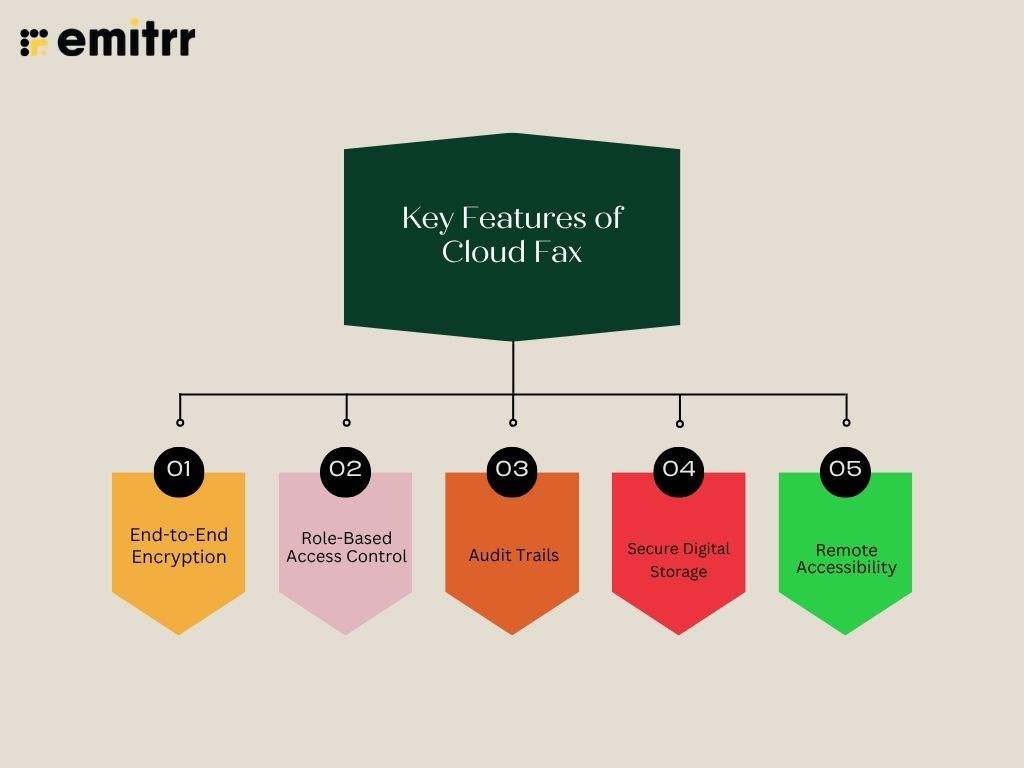
Key Features of Cloud Fax
End-to-End Encryption
Data is encrypted both in transit and at rest, ensuring that Protected Health Information (PHI) remains secure throughout its entire journey. This level of encryption prevents unauthorized interception and access, making it significantly more secure than traditional fax transmission methods.
Role-Based Access Control
Cloud fax systems allow organizations to define user roles and permissions, ensuring that only authorized individuals can view or send faxes. This minimizes internal security risks and ensures that employees only access the information necessary for their specific responsibilities.
Audit Trails
Every action, whether a fax is sent, received, viewed, or downloaded, is automatically logged. These detailed audit trails provide full visibility into system activity, making it easier to monitor compliance, investigate incidents, and confidently pass HIPAA audits.
Secure Digital Storage
By eliminating reliance on paper, cloud fax removes many of the risks associated with physical document handling. All files are securely stored in encrypted digital environments, allowing for quick, organized, and compliant access whenever needed.
Remote Accessibility
Cloud fax enables users to send and receive faxes from anywhere—whether in the clinic, working remotely, or across multiple locations. This flexibility supports modern, distributed healthcare teams without compromising on security or compliance.
HIPAA Compliance Checklist for Faxing
If your organization uses fax, here’s a quick checklist to ensure compliance:
- Business Associate Agreement (BAA) with your fax provider
- Encryption is enabled for all transmissions
- Role-based access controls in place
- Multi-factor authentication (MFA)
- Audit logs are enabled and monitored
- Secure storage and retention policies
- Recipient verification process
- Staff training on fax protocols
Fax vs Email vs Cloud Fax: Security Comparison
| Factor | Traditional Fax | Cloud Fax | |
| HIPAA Compliance | Conditional | Conditional | Strong (if configured) |
| Encryption | ❌ | Optional | ✅ |
| Audit Trails | ❌ | Limited | ✅ |
| Risk of Human Error | High | Medium | Low |
| Accessibility | Low | High | High |
| Scalability | Low | High | High |
Key Insight:
Neither fax nor email is inherently secure.
Modern cloud solutions offer the strongest balance of compliance and usability.
Common Myths About Fax & HIPAA
Myth 1: “Fax is automatically HIPAA compliant.”
False, Compliance depends on safeguards, not the technology itself.
Myth 2: “Fax is more secure than email.”
Not always, Unsecured fax machines can be just as risky as unencrypted email.
Myth 3: “Old fax machines are safe because they’re offline.”
False, Physical exposure and human error make them vulnerable.
Myth 4: “We’ve always used fax, so it must be compliant.”
Outdated thinking, Healthcare regulations, and risks have evolved significantly.
Best Practices for HIPAA-Compliant Faxing
To reduce risks and stay compliant, healthcare organizations must follow consistent and well-defined faxing practices. These best practices help minimize errors, strengthen security, and ensure that Protected Health Information (PHI) is handled responsibly at all times.
- Always verify recipient numbers before sending: Double-check fax numbers to ensure PHI is sent to the correct recipient. Even a small mistake can lead to serious compliance breaches.
- Use fax cover sheets with confidentiality disclaimers: Include a cover sheet that clearly states the sensitivity of the information. This adds a layer of protection and informs unintended recipients to act appropriately.
- Limit access to authorized personnel only: Ensure only trained and approved staff can access fax systems and documents. This reduces the risk of unauthorized exposure or misuse of PHI.
- Avoid using public or shared fax machines: Public or shared devices increase the chances of unauthorized access. Always use secure, organization-controlled fax systems for handling sensitive data.
- Regularly train staff on HIPAA compliance: Ongoing training keeps staff updated on best practices and evolving risks. It also reinforces accountability in handling patient information securely.
- Transition to secure digital or cloud fax system: Modern cloud fax solutions offer built-in security, tracking, and compliance features. They significantly reduce risks compared to traditional fax machines.
Why Emitrr Is a Smarter HIPAA-Compliant Fax Solution
If you’re looking to modernize your fax workflows without compromising on compliance, Emitrr offers a powerful, all-in-one solution built specifically for healthcare providers. It goes beyond basic faxing to create a seamless, secure, and fully integrated communication ecosystem.

HIPAA-Compliant Cloud Faxing
Emitrr ensures secure transmission of sensitive patient data with built-in compliance safeguards like encryption, access controls, and audit logs. This allows you to send and receive faxes confidently while meeting strict HIPAA requirements.
Omnichannel Communication
Beyond fax, Emitrr enables secure texting and calling from the same platform. This helps practices streamline patient communication, reduce delays, and improve overall patient experience.
EHR/EMR Integrations
Emitrr seamlessly integrates with your existing EHR/EMR systems, ensuring that faxed documents are automatically synced with patient records. This eliminates manual data entry and reduces administrative burden.
Automation Capabilities
Automate repetitive tasks like SMS appointment reminders, follow-ups, and document workflows. This not only saves time but also minimizes human error, one of the biggest causes of HIPAA violations.
Centralized Dashboard
Manage all patient communication from fax to SMS to calls in one unified interface. This improves visibility, reduces tool-switching, and helps your team stay organized and efficient.
Advanced Audit & Reporting
Track every interaction with detailed logs and analytics. These insights help with compliance audits, performance monitoring, and identifying areas for improvement.
Role-Based Access & Permissions
Control who can access, send, or view sensitive information with granular user permissions. This ensures that PHI is only accessible to authorized personnel.
Scalable & Cloud-Based Infrastructure
Whether you’re a small clinic or a multi-location practice, Emitrr scales with your needs. Its cloud-based setup eliminates the need for physical hardware and supports remote teams effortlessly.
Instead of juggling multiple tools, Emitrr brings everything together into a single, secure, and scalable communication hub, helping healthcare practices stay compliant, efficient, and future-ready.
Conclusion
So, is fax really HIPAA compliant?
The answer is nuanced. Fax is not inherently compliant, but it can be when used with the right administrative, physical, and technical safeguards in place. The challenge, however, lies in how faxing is implemented in real-world healthcare environments.
That’s why more healthcare organizations are transitioning to cloud-based fax solutions systems that combine compliance, security, and convenience in a way traditional methods simply cannot match.
If your practice is still relying on outdated fax systems, now is the time to rethink your approach. Modernizing your communication stack isn’t just about efficiency; it’s about reducing risk and staying compliant in an evolving regulatory environment.
Emitrr makes this transition seamless. With HIPAA-compliant cloud faxing, secure texting and calling, EHR/EMR integrations, automation, and a centralized communication dashboard, Emitrr helps you manage all patient communication securely in one place.
Ready to upgrade your fax workflows and stay fully compliant? Book a demo with Emitrr today and see the difference for yourself.
Frequently Asked Questions
Yes, but only if appropriate administrative, physical, and technical safeguards are in place.
Yes, faxing can still be HIPAA compliant if proper safeguards are followed. However, traditional fax machines often fall short compared to modern cloud fax solutions.
Traditional fax systems rely heavily on manual processes, making them prone to human error, misdirected faxes, and unauthorized access common causes of HIPAA violations.
A HIPAA-compliant fax solution must include safeguards like encryption, access controls, audit trails, secure storage, and proper administrative policies.
Yes, cloud fax solutions offer advanced security features such as end-to-end encryption, user authentication, and activity tracking, making them significantly more secure.
Most modern cloud fax solutions, like Emitrr, offer seamless EHR/EMR integrations to streamline workflows and reduce manual data entry.
The most common causes include misdialed numbers, unattended fax machines, improper document disposal, and general human error.
Emitrr provides HIPAA-compliant cloud faxing along with secure texting, calling, automation, and audit logs, helping healthcare providers stay compliant while improving efficiency.