
 4.9 (400+
reviews)
4.9 (400+
reviews)
Introduction
A patient calls to request a prescription refill and leaves a voicemail. Then they wait.
Hours or even days can pass before the request is processed. In many clinics, this is still the standard workflow. But voicemail-based prescription refill requests are slow, unstructured, and prone to errors, leading to delays, missed requests, and frustrated patients.
So where exactly does the process break down, and why does something so simple take so long? Let us break down in this guide.
AI Summary (Quick Takeaways)
- Voicemail-based refill requests are manual, unstructured, and prone to delays
- Clinics often face 24–72 hour turnaround times for simple refills
- Messages can be missed, lost, or incomplete, leading to follow-ups
- Staff spend hours each week just listening to and processing voicemails
- Patients receive no confirmation or real-time updates, causing frustration
- This leads to higher call volume, lower satisfaction, and operational inefficiency
- Automated systems enable instant intake, complete information capture, and faster processing
- Switching to digital workflows can reduce delays by 50–70% and improve patient experience
How Voicemail-Based Refill Requests Work Today
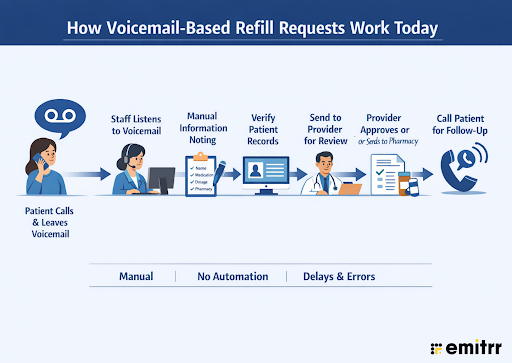
To understand the issue with voicemail-based prescription refill requests, let’s break down the typical prescription refill process in clinics that rely on voicemail:
- A patient calls the clinic and leaves a voicemail
- Front desk or staff later listen to the message
- They manually note down details (patient name, medication, dosage, pharmacy)
- They verify patient information in the system
- The request is routed to a provider for approval
- The provider processes it or sends it to the pharmacy
- Staff may call the patient back to confirm or ask for missing details
At first glance, this seems manageable. But every step here depends on manual effort. There is no structure, no automation, and no real-time tracking, leading to refill request delays in healthcare.
Key Problems with Voicemail-Based Prescription Refill Requests
Voicemail systems are not built for real-time processing. As request volume increases, delays become inevitable. Here are some key problems with voicemail-based prescription refill requests:
Prescription Refill Delays Due to Voicemail Backlogs
Voicemail isn’t real-time. Staff usually check messages in batches, so refill requests sit in queues before anyone even sees them. As call volume grows, backlogs become unavoidable.
In a typical clinic handling 80–100 calls a day, even 30–40 refill voicemails can quickly turn into hours of pending work, pushing turnaround times to 24–72 hours for routine medications.
Learn how to reduce prescription refill calls
Missed Prescription Refill Requests from Untracked Voicemails
Voicemail systems don’t track tasks, they just store messages. Once a message is heard, there’s no built-in way to ensure it was actually processedThis means requests can:
- Be marked as “heard” but not acted on
- Get buried during busy hours
- Be accidentally deleted or overlooked
Even a few missed messages can result in missed refill requests, which directly impacts patient care.
Incomplete Patient Information in Voicemail Refill Requests
Voicemails are often rushed and inconsistent. Patients may skip key details or speak unclearly, leaving staff to figure things out later. For example: “Hi, this is John… I need my blood pressure medicine… send it to my pharmacy.”
Now the staff has to:
- Identify the exact medication
- Confirm dosage
- Verify the pharmacy
This back-and-forth slows everything down and increases the chances of errors.
Staff Time Wasted on Manual Voicemail Processing
Every voicemail requires multiple manual steps, listening, noting details, verifying, and routing. It’s repetitive and time-consuming. If each voicemail takes just 3 minutes to process, 30 messages a day = 90 minutes daily, or 7+ hours a week spent on low-value tasks. That’s time that could be used for patient care or higher-priority work.
Poor Patient Experience Due to Lack of Refill Communication
From the patient’s side, voicemail feels like a black hole. They leave a message but get no confirmation, no timeline, and no updates. So what do they do? They call again.
This leads to:
- Repeat prescription refill calls
- Frustration and anxiety
- Lower trust in the clinic
Today, patients expect quick and clear communication, voicemail simply doesn’t meet that expectation.
The Hidden Cost of Voicemail-Based Workflows
At first glance, voicemail feels like a low-cost solution. There’s no new software, no setup, and no training. But in reality, it creates hidden operational, financial, and clinical costs that add up quickly.
High Administrative Cost from Manual Processing
Every voicemail requires multiple manual steps. This isn’t just inefficient, it’s expensive at scale. Let’s break it down:
- ~30 refill voicemails per day
- ~3 minutes per voicemail
That’s 90 minutes daily, or 7–8 hours per week spent only on voicemail handling. Over a year, that’s 350+ hours of staff time, essentially 9 full work weeks lost to a single workflow.
Increased Call Volume from Patient Follow-Ups
Voicemail creates uncertainty. Patients don’t know if their request was received or processed, so they call again. This leads to duplicate requests, follow-up calls and front desk congestion. In fact, in many clinics, 20–30% of inbound calls are repeat follow-ups, not new requests.
Delayed Care and Medication Non-Adherence Risks
When refill requests are delayed, patients may miss doses, especially those managing chronic conditions like hypertension, diabetes, or asthma. Studies show that medication non-adherence contributes to thousands of preventable hospitalizations annually and billions in avoidable healthcare costs.
Revenue Loss from Patient Churn and Leakage
Patients today expect fast, transparent communication. When refill requests are slow or unclear, trust drops which leads to patients switching providers, negative online reviews or lower lifetime value per patient. Even a 5–10% drop in patient retention can significantly impact long-term revenue for a practice.
No Visibility Means No Process Improvement
Since voicemail systems don’t provide data. Clinics can’t easily track:
- Refill turnaround time
- Number of pending requests
- Staff productivity
- Bottlenecks in the workflow
Without this visibility, there’s no way to improve performance.
Staff Burnout and Low Productivity
Repetitive, low-value tasks like listening to voicemails, replaying unclear messages, entering data manually, and calling patients back reduce job satisfaction and increase fatigue and staff burnout.

What a Better Prescription Refill Process Should Look Like
A modern prescription refill process should remove manual friction and make the experience faster for both patients and staff. Instead of scattered steps and voicemails, it should follow a clear, structured flow:
Capture Complete Request Information Upfront
The process should start with structured input, not voicemails. Patients should be guided to provide:
- Medication name
- Dosage
- Preferred pharmacy
- Any additional notes
Enable Instant, Real-Time Request Intake
Refill requests should be captured the moment they are submitted, without waiting for staff to check messages. This removes delays caused by voicemail backlogs, speeds & help streamline your prescription workflow.
Automatically Route Requests to the Right Team
Once submitted, requests should be instantly directed to the appropriate staff member or provider. No manual sorting or handoffs should be there.
Provide Real-Time Visibility and Tracking
Staff should have a clear view of:
- Pending requests
- In-progress requests
- Completed requests
So that there is improved accountability and clarity.
Step 5: Keep Patients Informed with Automated Updates
To reduce follow-up calls and improve patient trust, patients should receive:
- Instant confirmation when the request is submitted
- Status updates during processing
- Notification once the refill is completed
Step 6: Enable Two-Way Communication When Needed
If additional information is required, staff should be able to quickly reach out, and patients should be able to respond easily. This keeps communication fast and avoids unnecessary delays.
Step 7: Integrate with Existing Systems (EHR/Workflow Tools)
The refill process should connect with existing clinic systems to avoid duplicate data entry to ensure a smooth, efficient workflow without extra manual work.
How Automation Fixes the Problem with Voicemail-Based Prescription Refill Requests
Automation tools are designed to remove the inefficiencies created by voicemail-based workflows. Here’s how automation tools directly address the biggest problems caused by voicemail:
Automation Ensures Complete and Structured Refill Requests
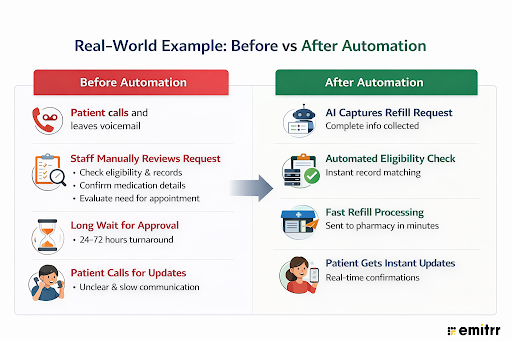
Automation tools replace unstructured voicemails with guided inputs, ensuring that every refill request includes all required details such as medication name, dosage, and pharmacy. This eliminates the need for guesswork or follow-up calls, helping staff process requests faster and with fewer errors.
See how AI agents reduce prescription refill calls in healthcare:
Automation Enables Real-Time Request Capture and Faster Processing
Unlike voicemail systems that rely on staff availability, automation captures refill requests instantly as they are submitted. These requests can be processed or routed immediately, significantly reducing delays and improving turnaround time for patients.
Automation Eliminates Missed or Lost Requests
Every request submitted through an automated system is logged and tracked, ensuring nothing gets overlooked or forgotten. This creates a reliable system where clinics can confidently manage high volumes without the risk of missing critical refill requests.
Automation Reduces Staff Workload and Manual Effort
By handling repetitive tasks like intake, documentation, and routing, automation reduces the burden on staff. This allows teams to focus on more important responsibilities, improving overall productivity without needing additional resources.
Automation Improves Patient Communication and Experience
Automation tools send instant confirmations and updates to patients, keeping them informed throughout the process. This transparency reduces uncertainty, minimizes follow-up calls, and builds trust through timely communication.
Real-World Example: Before vs After Automation
How Emitrr Helps Streamline Prescription Refill Requests
Emitrr replaces fragmented, manual refill workflows with a single AI agent. Instead of handling requests across calls, voicemails, and portals, the system captures, verifies, and routes everything in one flow, while following your clinic’s rules.
Here’s how the process actually works with Emitrr:
AI Agent Handles Refill Requests Across Calls, SMS, and Voicemail
Patients can request refills through a call, SMS, or voicemail. The AI agent interacts with the patient and collects all required details such as name, date of birth, medication, dosage, and preferred pharmacy.
If it’s a call or voicemail, Emitrr automatically generates a recording, transcript, and AI summary, so staff don’t have to listen to or interpret messages manually.
Complete Patient and Request Data Is Captured Upfront
The AI ensures that every request includes all necessary information before moving forward. Instead of incomplete voicemails, staff receive a structured request with all key details already filled in.
At this stage, a case is automatically created in the EHR, so nothing is lost or delayed.
AI Matches Request with Patient Records and Practice Rules
Once the request is captured, the system checks it against your existing records and workflows. It evaluates conditions like:
- Whether the patient is established
- Whether the medication is eligible for refill
- Whether an appointment, labs, or vitals are required
- Whether it’s a controlled substance
This removes the need for staff to manually review every request from scratch.
Requests That Match Criteria Are Processed Instantly
If the patient information and refill request meet your predefined rules, the request can be automatically forwarded for approval or directly sent to the pharmacy, depending on your workflow. This significantly reduces turnaround time for routine refill requests.
Exceptions Are Routed to Staff for Review (No Blind Automation)
If the system detects a mismatch, such as missing information, eligibility issues, or policy exceptions, it does not proceed automatically. Instead, the request is routed to a nurse or staff member for review, with all details, transcript, and summary attached. This ensures accuracy while still saving time on initial intake.
Patients Are Notified Automatically at Every Step
Patients receive updates when:
- Their request is submitted
- It is being processed
- It is approved and sent to the pharmacy
- Or if they need to schedule an appointment
This removes uncertainty and reduces follow-up calls.
End-to-End Visibility Without Manual Tracking
Every refill request is tracked from intake to completion within the system. Staff can see the status of each request, whether it’s approved, pending review, or requires patient action, without relying on voicemails or manual notes.
Instead of manually reviewing voicemails, verifying details, and routing requests, your team works with structured cases, AI summaries, and rule-based automation, with full control over exceptions.
If your current refill workflow involves multiple steps, delays, and manual checks, it’s worth seeing how this process can run automatically while still following your clinic’s rules.
Key Takeaways
- Voicemail-based systems lead to prescription refill delays due to manual processing and lack of real-time handling
- Clinics face frequent issues with missed refill requests and incomplete information from unstructured voicemails
- Staff spend hours each week managing calls, increasing healthcare workflow inefficiency and operational costs
- Lack of tracking and updates creates patient communication gaps in healthcare, leading to frustration and repeat calls
- A structured, automated approach ensures faster turnaround, fewer errors, and better patient experience
- AI-driven workflows capture complete data, apply rules, and route requests accurately, reducing manual effort significantly
- Clinics can improve efficiency, reduce delays, and streamline operations with an automated prescription refill system
Frequently Asked Questions
Prescription refill delays usually happen due to manual workflows, voicemail backlogs, incomplete patient information, and lack of real-time processing. Clinics relying on voicemail often take 24–72 hours to process routine refill requests.
Voicemail is not ideal for managing prescription refills at scale. It is unstructured, hard to track, and prone to missed or incomplete requests, leading to delays and inefficiencies in healthcare communication.
The biggest issues include delayed processing, missed refill requests, incomplete information, high staff workload, and poor patient communication. These problems make voicemail-based systems unreliable for handling high volumes.
Clinics can reduce delays by using structured, real-time systems like SMS-based requests or AI-powered tools that capture complete information, automate routing, and provide instant updates to patients.
In many clinics using manual or voicemail-based systems, refill requests take 24 to 72 hours. Automated systems can significantly reduce this turnaround time by enabling real-time processing.
Automation replaces manual steps with structured intake, instant request capture, smart routing, and real-time communication. This reduces errors, speeds up processing, and improves both staff efficiency and patient experience.
Yes, AI can collect patient information, generate summaries and transcripts, match requests with records, and route them based on predefined rules. It ensures accuracy while reducing manual workload for staff.
An ideal process should include structured data capture, real-time intake, automated routing, status tracking, and two-way patient communication—all integrated with existing clinic systems.
Conclusion
Voicemail-based prescription refill requests slow down clinics, create delays, and increase manual work. What seems simple on the surface leads to missed requests, longer turnaround times, and poor patient experience.
A structured, automated workflow changes this completely, capturing requests instantly, reducing errors, and keeping both staff and patients informed at every step.
If your clinic is still relying on voicemails for refill requests, it’s time to move to a faster, more reliable system. Book a demo with Emitrr to see how you can streamline your refill workflow and reduce delays.