
 4.9 (400+
reviews)
4.9 (400+
reviews)

Introduction
Reputation management isn’t a PR term. To optometrists, it’s the unseen force that influences patient opinion before the first eye exam is scheduled. Where trust and convenience are the keys to success, reputation holds the power to make or break a potential patient’s decision to come through the clinic door.
Optometry, as with much of the medical field, has turned patient-first, digital-first. The moment the eyes start to feel fuzzy, they are going to grab their phone and type in “best eye doctor near me.” What shows up next, including the ratings, reviews, and reputation, makes or breaks the decision.
As opposed to restaurants or hotels, medicine has an emotional vulnerability. Patients aren’t necessarily seeking service; they are seeking safety, comfort, and reassurance in a moment of confusion. For optometrists, who handle everything from routine check-ups to sophisticated vision impairments, trust is an absolute currency. And that trust starts online.
So what does reputation management actually entail here? It’s not about faking reviews or covering up imperfections. It’s about having genuine patient experiences, inviting feedback, and facing concerns in the open. It’s also about developing an online presence that reflects the warmth and professionalism provided within the clinic.
One review, positive or negative, can domino across platforms. Google, Healthgrades, Yelp, Practo, Zocdoc. Reviews are digital breadcrumbs that bring patients to your chair or to a competitor. But reputation management isn’t all about reacting; it’s also about being proactive. It takes systems, strategies, and sometimes intelligent tools to make sure that your online persona is identical to your in-person care.
Importance of Reputation and Review Management for Optometrists
Before patients believe your diagnosis, they believe your Google rating. That is not a brutal reality, it’s just the new norm.
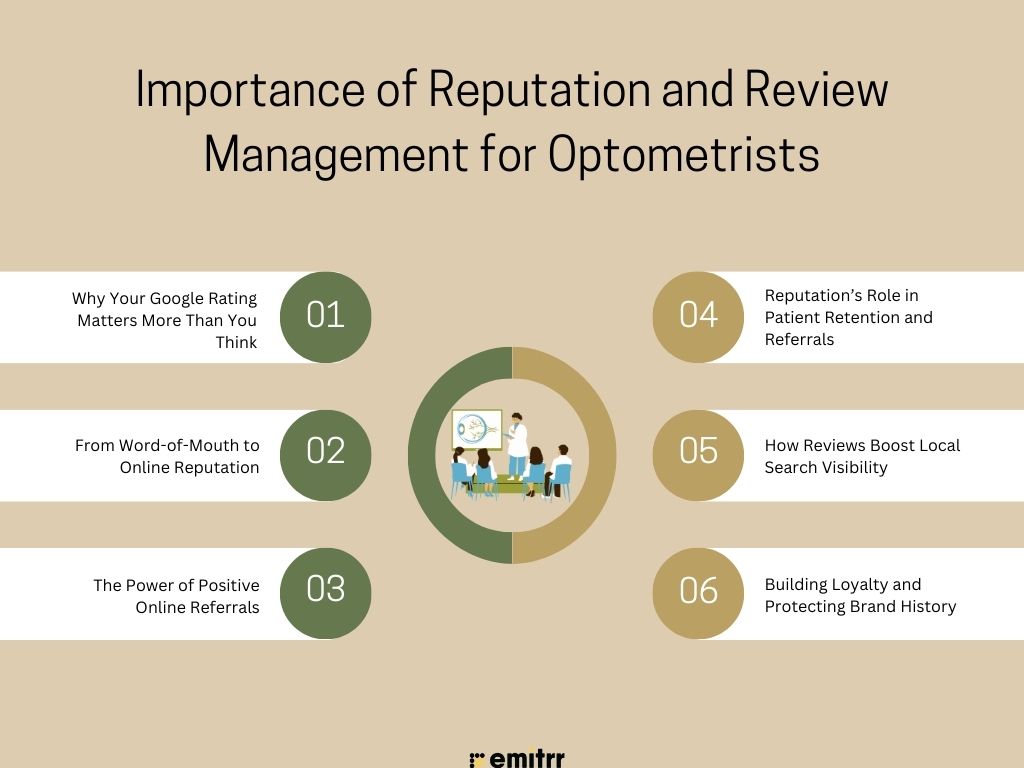
Why Your Google Rating Matters More Than You Think
In the competitive arena of eye care, reputation can make or break a full appointment book and a half-booked week. The statistics support it, which is 77% of patients look up online reviews prior to selecting a healthcare provider. For optometrists, where word-of-mouth once reigned supreme, online reviews now control that chain of trust.
From Word-of-Mouth to Online Reputation
Even with medical greatness, going unseen online is damaging. Particularly in city centers where patients have options on every corner. A good review is an online referral, and sometimes stronger than a word of mouth from a friend. They cut down on decision fatigue and provide instant authority.
The Power of Positive Online Referrals
Reputation has a direct effect on walk-ins, repeat visits, and referrals. Satisfied patients who are pleased with their Lasik consultation or prescription correction will come back, and bring others along, if their experience is supported by a clear online reputation. Reviews also assist in converting price-sensitive patients. When all physicians appear the same, the one whose feedback is most persuasive tends to prevail.
Reputation’s Role in Patient Retention and Referrals
And don’t forget Google’s algorithms. Improved ratings and reviews enhance your clinic’s visibility on local search, so more people see you without paying advertising. It’s a quiet but effective growth driver.
How Reviews Boost Local Search Visibility
Reputation is also instrumental in patient loyalty. Even if the patient relocates to another city, they are likely to post a review. That review becomes part of your brand history. On the other hand, a bad experience not followed through on can snowball into distrust, negative word-of-mouth, and loss of business.
Building Loyalty and Protecting Brand History
In effect, review and reputation management is not an after-visit checkbox. It’s a business strategy. For optometrists, it guarantees that the quality of care provided offline is reflected and amplified online.
Download free review request SMS templates and start building your practice’s online reputation.

Key Elements of Reputation and Review Management for Optometrists
1. Review Generation
Reviews aren’t a matter of luck. They are a matter of process. Following each appointment, there ought to be a process for asking patients for feedback, preferably when the visit is still top of mind. Whether via SMS, email, or patient portal, a courteous reminder can make a huge difference in review numbers.
2. Monitoring Platforms
Optometrists must stay on top of more than eyesight. Google Reviews, Healthgrades, Yelp, Zocdoc, and even Facebook remarks can shape perception. Tracking these sites guarantees nothing gets past them, whether it’s a compliment or an issue.
3. Responding to Reviews
Each review is worth a response. Acknowledge the positive, respond to the negative, and remain neutral with elegance. Responses indicate that the practice is concerned, not so much about the feedback, but about the individual behind it.
4. Patient Communication Systems
Post-visit automated messages can simplify review acquisition. Systems that have integration points for EMRs or scheduling systems can initiate personalized messages soliciting feedback, saving time while ensuring consistency.
5. Brand Consistency
Your online reputation must mirror what patients feel in person. That means consistent NAP (Name, Address, Phone Number) on directories, fresh photos, correct business hours, and consistent messaging across all platforms.
6. Social Proof and Storytelling
Reviews, before-and-after images, or video clips of patient stories (with permission) tell a story. They are shared experiences that make your practice more human.
7. Internal Feedback Loop
Reviews are not vanity metrics. They provide operational insight. If several patients complain about wait times, it’s an actual issue, and not just a rep issue.
Together, all these make up a full-spectrum reputation approach. One that balances proactive review creation with reactive response and internal tweaks.

Challenges in Optometrist Reputation and Review Management
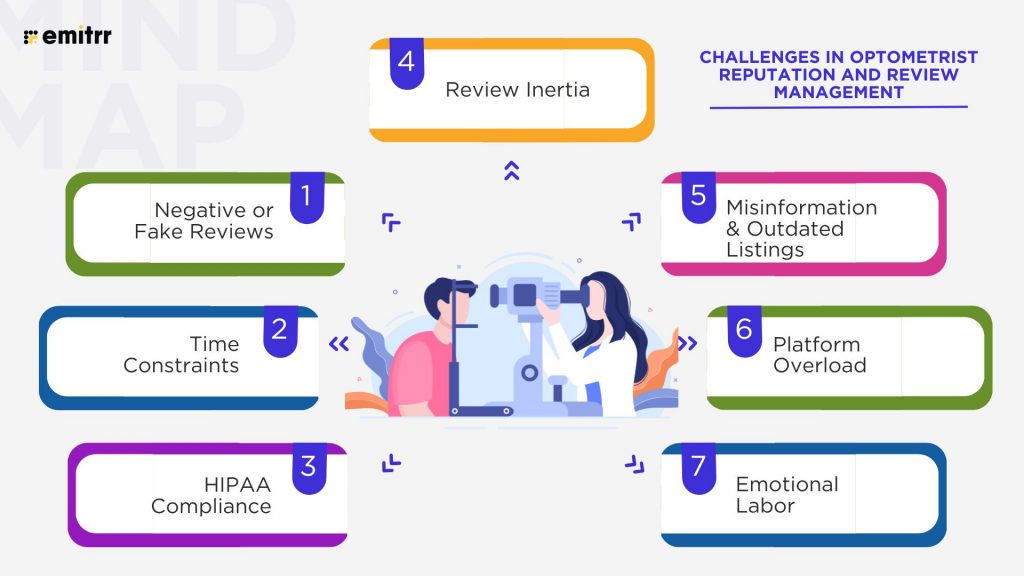
1. Negative or Fake Reviews
A single angry former employee or the fake profile of a competitor can devastate your rating. Too often, most websites do not make it simple to erase fake reviews. Optometrists feel helpless when addressing unjust criticism.
2. Time Constraints
Operating a clinic already takes too much time. Throwing review management into the equation seems daunting. Most optometrists lack a full-time member of their staff to keep an ear on and answer online buzz.
3. HIPAA Compliance
When reacting to reviews, you can’t disclose patient information, even if the patient previously shared it. Expressing “we apologize for the cataract problem” can get a provider in trouble. Walking this thin line involves subtlety and training.
4. Review Inertia
Angry patients are more likely to leave a review than happy ones. This colors online perception unless deliberate steps are taken to counter it. Even satisfied patients sometimes forget to leave reviews unless prompted.
5. Misinformation & Outdated Listings
Incorrect clinic hours, incorrect phone numbers, repeat listings, these mistakes damage credibility. More seriously, they annoy patients who might assume the clinic is sloppy or unprofessional.
6. Platform Overload
Google isn’t the only location where patients post reviews. Juggling Yelp, Zocdoc, Facebook, Healthgrades, and specialty sites can be a whack-a-mole game, particularly in the absence of a centralized platform.
7. Emotional Labor
Handling negative comments, particularly unfair or hostile remarks, can emotionally strain physicians and staff. Physicians and staff may internalize criticism, affecting morale and patient communication.
Overcoming them isn’t about doing it all by hand. It’s about employing the proper tools, enforcing boundaries, and designing a workflow that puts reputation management on autopilot.
Best Practices for Optometrist Reputation and Review Management
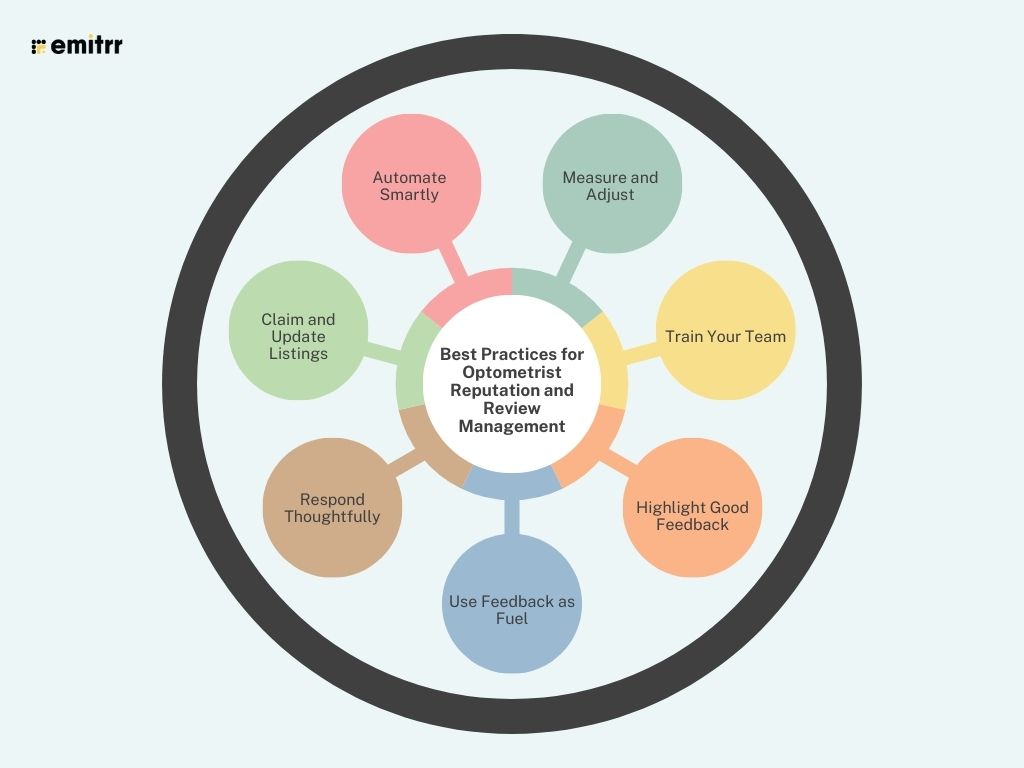
Automate Smartly
Use systems that send review requests through SMS or email as soon as a patient exits the clinic. Catch it while memory is hot, and make it seamless; a single click to write a review. Steer clear of long forms or logins.
Claim and Update Listings
Each listing is a candidate for a patient entry point. Google Business Profile is not negotiable, but don’t disregard Zocdoc, Practo, Yelp, and specialty directories. Maintain consistency in contact information, hours of the clinic, and services provided. Insert genuine photos—not logos or generic images.
Respond Thoughtfully
All reviews, including the frustrating ones, merit a response. Thank satisfied patients with kindness. Respond to disgruntled ones with compassion. Don’t paste responses. Be humane, professional, and not defensive.
Use Feedback as Fuel
Seek out trends. Is everyone repeatedly talking about the friendly receptionist or lengthy wait? That’s your signal, either boost or correct. Reviews are not public relations; they are business diagnostics in disguise.
Highlight Good Feedback
Make good reviews work for you. Put them online, post them on social media, and use them in promotional materials. Let satisfied patients do their own marketing.
Train Your Team
Each patient encounter, from initial contact to last goodbye, is part of your online reputation. Educate your front desk personnel on how to respond to questions graciously, follow up in a timely manner, and deflect complaints discreetly before they’re posted publicly.
Measure and Adjust
Monitor your average rating, review volume, response time, and recurring themes. What gets measured gets managed. Reputation management isn’t a one-time clean-up. It’s a living, breathing ecosystem.
Download free review request SMS templates and start building your practice’s online reputation.
How an Optometrist Can Better Online Reputation and Reviews with Emitrr
Emitrr provides optometrists with a method for automating the management of reputation without sacrificing the personal touch. It operates much like a virtual front-desk staff; one which never happens to forget to request a review.
Automated Review Requests
As soon as a patient checks out, Emitrr automatically sends a personalized message via SMS or email requesting that they review. This automation lightens staff work and increases review numbers with ease.
Centralized Dashboard
Emitrr consolidates all review sites into one screen, for instance Google, Yelp, Facebook, and so on. This helps clinics respond quickly and identify patterns without tabbing.
Listing Management
It takes a full-time job to keep business listings current on all platforms. Emitrr does that too. It keeps your NAP (Name, Address, Phone number) current in all directories, which prevents errors that anger patients and damage SEO.
HIPAA-Compliant Messaging
Emitrr ensures that every communication, whether a review response or feedback loop, is completely HIPAA-compliant. You can respond to the review without breaking privacy rules, which is essential in a medical environment.
Pre-Review Surveys
Not everything has to be made public. Emitrr has survey tools that gather patient information anonymously. This provides optometrists with an opportunity to address problems before they turn into online grievances.
Integration with Practice Management Systems
Emitrr integrates with several EMRs and scheduling software, simplifying automated workflows and customized messaging without duplication of data.
Essentially, Emitrr makes reputation management plug-and-play. For busy optometrists, that means more time spent caring for patients and less time chasing reviews—yet still harvesting the online benefits.
How to Answer Online Reviews
For Good Reviews
You must always reply. And sincerely thank the reviewer. You should also reinforce what they liked. For instance: “We are delighted that you felt so well cared for with your eye exam. Dr. Mehta and our staff loved hearing your feedback.”
For Bad Reviews for Hospitals
Try never to dismiss them. You must validate the experience, apologize if appropriate, and propose to talk further in private. For example: “Sorry to hear about your experience. We would appreciate the opportunity to discuss this directly and make it right. Please call our office manager at [number/email].”
For Neutral or Vague Reviews
You must interact. For instance, ask them how their visit might have been improved. Demonstrate receptivity to feedback. Example: “Thank you for coming in. We are always trying to get better; please tell us how we can make your next visit better.”
Tone Tips
- Be empathetic, not defensive.
- Short and nice.
- Never bring up personal health information, whether or not the patient does. That is a HIPAA violation.
- Don’t use scripts. Even templates must sound personalized.
Replying to reviews isn’t only about optics; it confirms prospective patients that you hear and that you care, whether the feedback is positive or negative.
Case Study: Optometrist Reputation and Review Management
Here is a real case study, to understand how optometrist reputation and review management of Emitrr is helping businesses.
Citryn Marketing has only healthcare clients; aiding clinics, practices, and providers in enhancing how they interact with patients. Yet with all their marketing expertise, they were reaching a few important stumbling blocks. A lot of their customers were not being able to create online reviews, share good communications with patients, and minimize expensive no-shows. The majority of the communication was done manually, and it just wasn’t possible to scale it.
They required something intelligent. Something that would be able to bring review generation, communication, and operations together, without requiring an entire new team to run it. That is when Emitrr stepped in.
The Game-Changer: Emitrr
After Citryn implemented Emitrr across the client base, things moved quickly. Here is how they utilized the platform:
- Automated review requests were sent to patients immediately following appointments; no chasing, no forgetting.
- Mass text messaging enabled clinics to reach patients more effectively than calls or emails.
- A centralized dashboard provided their clients with complete visibility into patient communication and review trends.
- Voicemail and SMS were managed effortlessly; conversations occurred smarter, faster, and with fewer efforts.
What Transpired within 8 Months
- 200% increase in reviews: Increased reviews equated to increased online presence and credibility for their healthcare clients.
- 1,500+ reviews new: Positive ones, to be specific, directly affecting improved Google rankings and patient trust.
- 70% increased conversion via texting: Patients responded much more to SMS compared to calls or emails.
- 50,000+ text interactions handled: That is thousands of tiny moments that were once overlooked or unmeasured.
- 4,000+ voicemails returned: No more patient issues falling between the cracks.
- 90% reduction in cancellations and no-shows: Automated reminders and confirmations kept calendars tight.
- Real-time insights: Customers were able to respond to live information, making strategy tweaks without guessing.
Why It Worked
Citryn took full advantage of Emitrr’s full-stack capabilities, but a few made the greatest impact:
- Automated post-visit review collection eliminated the operator error from review gathering.
- Bulk texting capabilities enabled clinics to communicate with hundreds of patients with a single click.
- Unified communication systems provided teams with one location to handle it all.
- The analytical dashboard uncovered precisely what was working and where they needed to improve.
The Bigger Picture
This wasn’t merely about accumulating five-star reviews. Emitrr assisted Citryn’s clients in establishing actual relationships with patients, generating more efficient clinic workflows, and recovering precious time. It made communication a competitive advantage and improved the quality of care in the process.
For Citryn, it was about being able to provide something concrete to their healthcare clients: quantifiable growth, happier patients, and an infinitely stronger online presence.
FAQs
Think about the last time you tried a new restaurant, you probably checked Google first, right? Patients do the same for eye care. Before they even step into your clinic, they’re already forming an opinion based on what they see online. Your ratings and reviews are the “handshake” that happens before you actually meet them.
Most happy patients do mean to leave a review; they just forget. The trick is to catch them in the glow of a good appointment. A quick, friendly SMS or email right after their visit (“We’d love to hear how we did!”) works wonders. Make it easy with one click.
First, take a breath. One bad review won’t sink you, but ignoring it might. Reply with kindness, acknowledge their concern, and invite them to talk privately so you can make it right. Keep it professional, avoid defensiveness, and never share any personal health info.
Google is your main stage. But patients also check Healthgrades, Yelp, Zocdoc, Practo, and even Facebook. Think of each one as a different doorway into your practice. Keep them all clean, accurate, and welcoming.
Imagine having a super-organized, never-tired assistant who sends review requests, updates your listings, replies to feedback, and keeps everything HIPAA-safe, without you lifting a finger. That is Emitrr. It frees you to focus on patients while quietly building your online reputation in the background.
Conclusion
Optometry is about trust. Patients don’t go into a clinic because of your diplomas on the wall; they go in because someone they trust recommended you. Or because they read a review that felt genuine, warm, and comforting. That is the silent force of reputation.
In a world in which one Google search can make or break a patient’s choice, reputation and review management is not a nicety. It’s an essential aspect of practice growth. But here is the thing, it’s not about collecting five-star ratings like medals. It’s about building a consistent, valuable experience that patients will tell their friends about. It’s about appearing in every interaction, online and offline, with the same care and professionalism you use during your eye exams.
This is where technology is a helper, not a substitute. Emitrr, for instance, is not only a tool, it’s an invisible team member who works behind the scenes. It does the follow-ups you intended to send, the reminders that minimize no-shows, the texts that put patients at ease and let them know you care. It assists clinics like yours in establishing a reputation not only on competency, but on responsiveness, warmth, and dependability.
So whether you are a solo optometrist juggling appointments, or a growing clinic trying to stand out, don’t ignore what your patients are saying online. Because your next appointment might just come from a stranger who read someone else’s story. Make sure it’s a good one.