
 4.9 (400+
reviews)
4.9 (400+
reviews)
Communication in healthcare practice is generally important, but in optometry, with repeat visits and long-term patient relationships being the standard, it’s essential. But so many optometrists still are dependent on phone contact and paper reminders. In today’s digital age, that just doesn’t work anymore. Patients are busy, unavailable by phone, and certainly not waiting by their landline for a check-up reminder.
This is where texting, or SMS, enters the picture. It’s quick, discreet, and amazingly effective. Texting is no longer just for personal conversations; it’s revolutionizing the way healthcare professionals, particularly optometrists, keep in touch with their patients. From reminding a patient of their eye test to checking pickup on a prescription, to a post-visit reminder, texting is becoming a must-have tool in today’s optometry arsenal.
With smartphone dominance in our age, when everyone opens their messages minutes after receiving them, texting presents a mobile-first solution for communication that reaches patients where they live.
Significance of Texting for Optometrists
When was the last time you picked up a call from an unknown number? I bet you let it ring and continued with your day. But a text message? You likely read that within seconds. That is what today’s patients do too.
Since the onset of COVID-19, patient expectations regarding healthcare communication have changed dramatically. Patients now want things to be quick, easy, and touchless. They no longer accept lengthy hold times or ignored voicemails. Texting addresses these needs squarely.
For optometrists, this change is an opportunity. Whether it’s decreasing appointment no-shows, decreasing call volumes, or simply providing a more enjoyable patient experience, SMS is a game-changer. It’s not merely a method of communicating with patients; rather, it’s a strategy for making the whole practice efficient.
Benefits of Texting for Optometrists
Texting is not only convenient, it’s an incredibly useful tool that can transform all facets of your optometry practice. From enhanced patient reliability to alleviating the workload of your staff, SMS delivers a genuine, tangible advantage that smooths the way and makes it more patient-centric. Here is how texting can meaningfully impact:
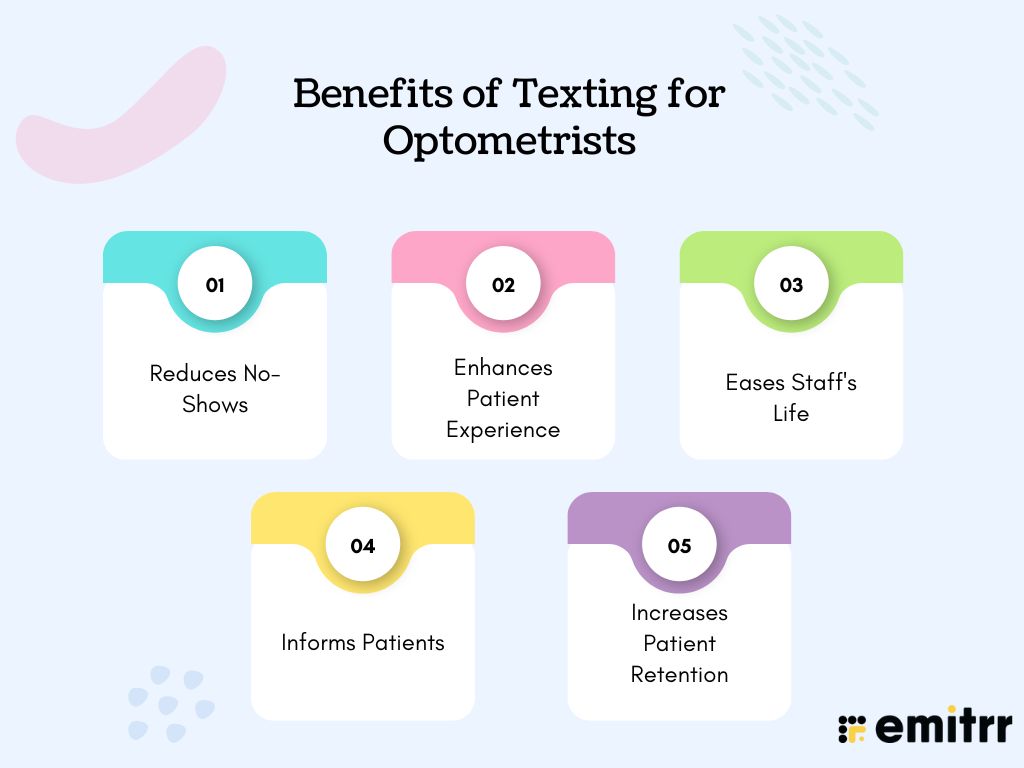
1. Reduces No-Shows
No-shows can drain your calendar and damage revenue. With on-time automated reminders, usually 24 to 48 hours before an appointment, patients are less likely to miss their eye exam or contact lens appointment. Easy rescheduling options included in the reminders can prevent last-minute cancellations.
2. Enhances Patient Experience
Patients nowadays appreciate convenience and responsiveness. Whatever it is, like a prompt “Your appointment is tomorrow at 2 PM” or “Your glasses are ready for pickup,” receiving a timely message through text keeps the interaction hassle-free. It indicates that your clinic values patients’ time and establishing loyalty.
3. Eases Staff’s Life
Front-desk staff balance a lot, from taking calls to signing in patients. Texting eliminates repetitive communication (such as reminders, confirmations, and simple FAQs) from their plate. With automation taking care of the mundane, your team can concentrate on providing great face-to-face care.
4. Informs Patients
Texting facilitates easy, proactive outreach with health reminders. From the annual checkup to contact lens reorder and post-procedure follow-up, SMS keeps your patients on schedule with their eye care, without them having to make the first call.
5. Increases Patient Retention
Consistent communication keeps your practice top of mind. Patients who receive regular, relevant updates from your clinic are more likely to return, refer others, and remain loyal to your services. Texting helps nurture that ongoing connection in a low-effort, high-impact way.

Use Cases of Texting for Optometrists
Texting is capable of doing so much more than reminding patients of appointments. Used strategically, SMS is a useful communication tool that streamlines operations and increases patient satisfaction. The following are some of the best ways optometrists can utilize texting:
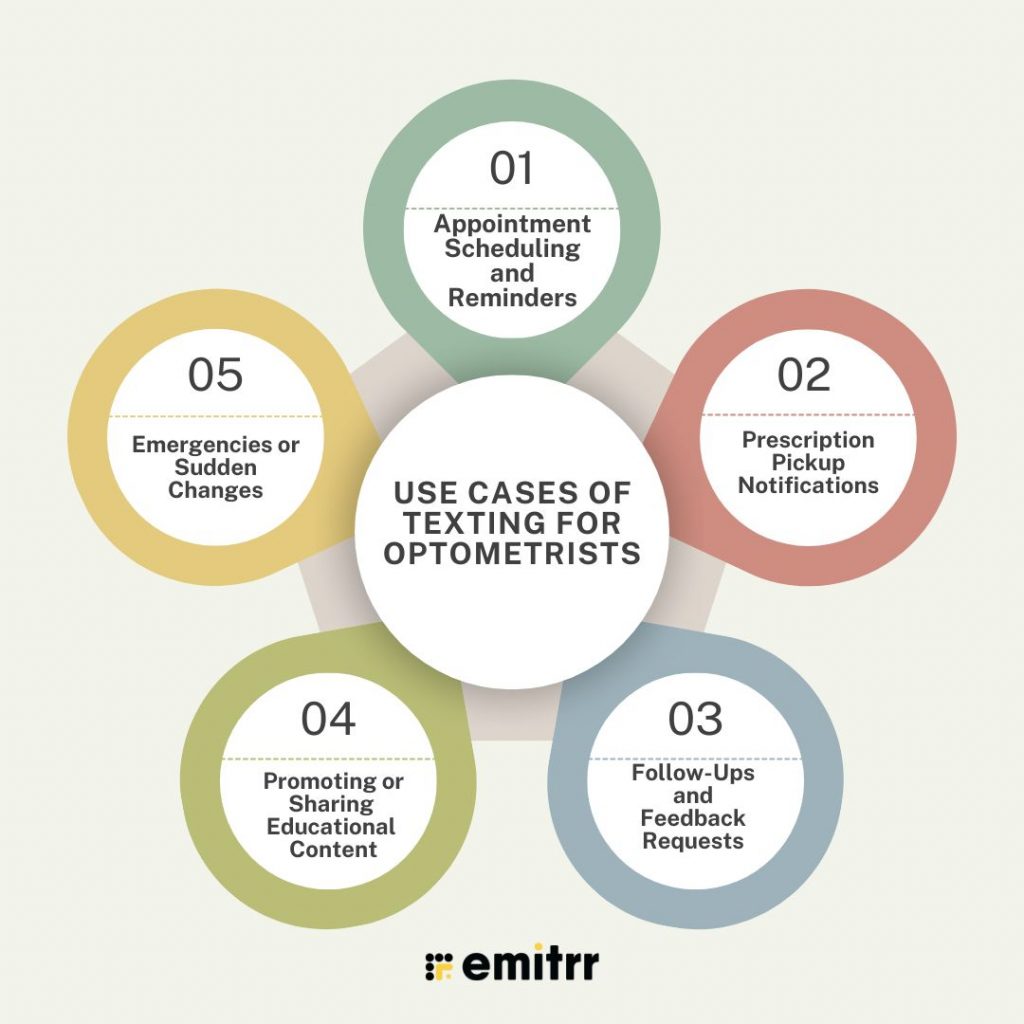
1. Appointment Scheduling and Reminders
Patients do not have to phone in and hold for confirmation or rescheduling of appointments. With a “Reply YES to confirm or NO to reschedule” message, you make the scheduling effortless, freeing time for the clinic and patient.
2. Prescription Pickup Notifications
Avoid calling for no reason with a rapid, courteous message such as, “Your contact lenses are ready for pickup.” It’s quicker, more efficient, and enjoyed by patients who have hectic schedules.
3. Follow-Ups and Feedback Requests
A brief follow-up message, like “How was your experience with us today?” serves to reinforce patient care and provides an opportunity for feedback. It not only reinforces relationships but also provides you with useful information to enhance your service.
4. Promoting or Sharing Educational Content
Informing patients about eye health or offering occasional promotions (e.g., “20% off frames this week!”) through text keeps them aware without overwhelming them. Practised judiciously and with care, promotional texts can strengthen value and visibility.
5. Emergencies or Sudden Changes
Sudden staff absences, weather-related disruptions, or technological failures occur. When they do, texting is the fastest method for informing patients about schedule changes, reducing confusion and irritation.
Get the Free PDF: Ready-to-Use SMS Scripts for Eye Clinics
Best Practices for Texting in Optometry
Texting can transform patient communication, but only if used thoughtfully. As with any professional tool, there are etiquette rules and legal boundaries to follow. These best practices ensure your messages are welcomed, effective, and compliant with healthcare standards.
1. Get Consent First
Before you can send that first message, you require your patient’s express consent. It is not only good etiquette, it’s required by law. According to HIPAA (Health Insurance Portability and Accountability Act) and TCPA (Telephone Consumer Protection Act), patients need to opt in first before you call them by SMS. Therefore, HIPAA texting is crucial.
Make this step simple by adding a checkbox on intake forms or online registration portals. Describe the reason, such as appointment reminders, prescription reminders, or follow-up messages. This establishes expectations and prevents any legal issues down the road.
2. Be Concise and Straightforward
Your patients are probably reading your text in line or during a lunch break, so make it brief and uncomplicated. Don’t use medical terminology or lengthy descriptions.
For instance, try something like, “Hello, this is just a reminder from our office about your future ocular health assessment appointment scheduled for…”
Be concise and direct with language that is respectful of your patient’s time and won’t confuse them.
3. Automate Where Possible, Personalize When Necessary
Automation can save your staff hours of tedium, but don’t overlook the personal touch. Patients still respond to individualization. A message that reads “Hi Jamie, your glasses are ready!” comes across as more personal than “Your prescription is ready.”
Use automation software such as Emitrr to program reminders and notifications, but personalize templates with names, appointment kinds, and precise time schedules. This blend of efficiency and compassion assists in establishing better patient relationships.
4. Send Texts at the Right Time
Timing is everything in text messaging in healthcare. Text too early and risk waking someone up. Text too late and risk it feeling intrusive or worse, being ignored. Try sending texts during typical business hours, usually between 10 AM and 4 PM.
And don’t forget about the message type. Reminder messages for appointments are ideal to send a day ahead, roughly mid-morning. Text reminders for picking up prescriptions can be sent in the early afternoon, after they are most likely to be able to pop in.
5. Make the Conversation Two-Way
Healthcare texting need not be yelling into a vacuum. Patients typically would like to respond; be it to confirm, pose a quick question, or reschedule. To that end, your system needs to enable two-way conversation.
Make it explicitly stated in your messages: “Reply YES to confirm” or “Text us if you need to reschedule.” Being accessible by text establishes trust and eliminates barriers for patients who may otherwise hesitate to reach out.
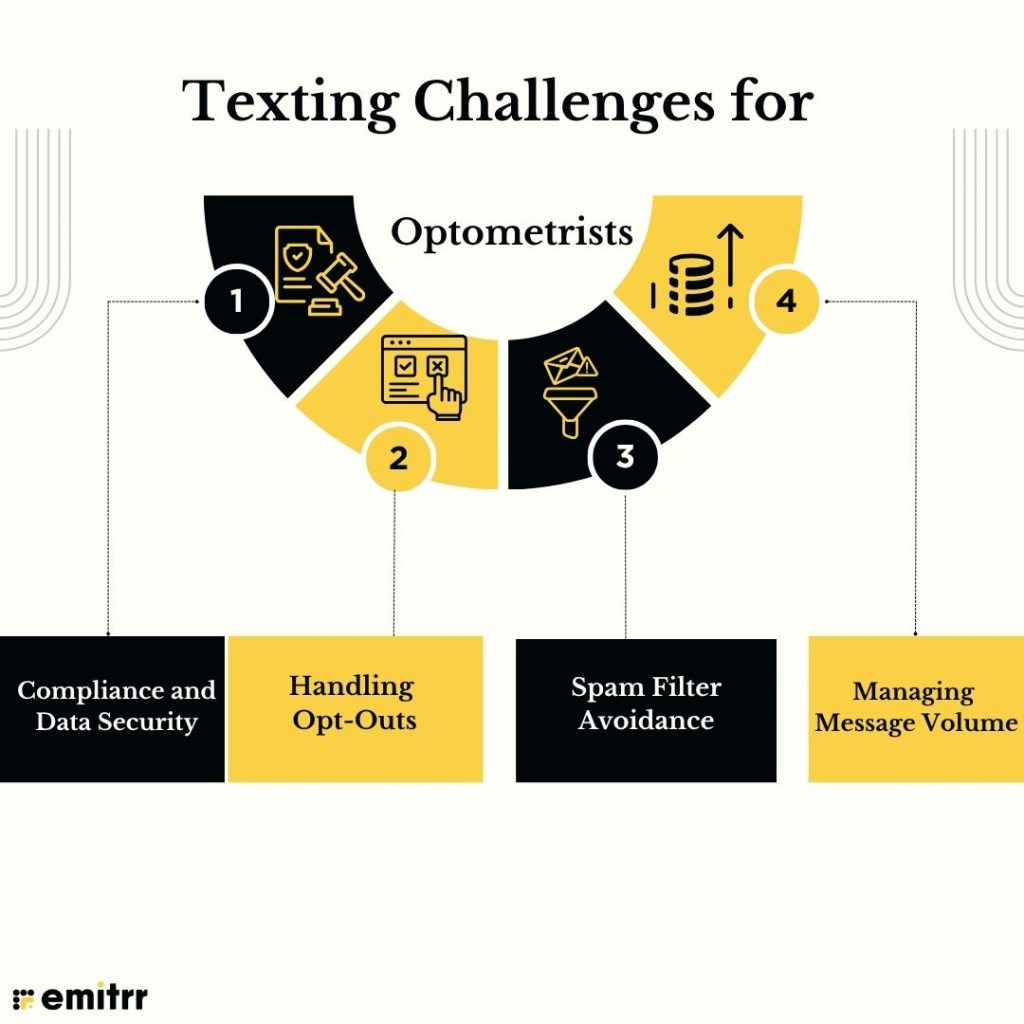
Texting Challenges for Optometrists
While there are advantages to texting, it’s not without its stumbling blocks. Compliance problems, message handling, and patient expectations can catch even good-intentioned practices out. Understanding these pitfalls and having a plan for dealing with them ensures a less bumpy ride for staff and patients alike.
1. Compliance and Data Security
Healthcare organizations need to work under tight privacy regulations like HIPAA. That means all patient messages, particularly those containing personal health information, need to be secure.
Never use personal phones or unsecured apps to send patient text messages. Always use a HIPAA-compliant service such as Emitrr, which guarantees encrypted messaging, audit trails, and access controls. This safeguards your patients and your practice from possible breaches or fines.
2. Handling Opt-Outs
Patients have the right to opt out of receiving messages from your practice at any time. Failing to respond to an opt-out request will result in complaints or legal action.
Use a platform that automatically respects opt-out words such as “STOP” or “UNSUBSCRIBE.” You should also provide opt-out instructions for promotional or bulk messages. Handling these preferences correctly demonstrates respect for your patients and maintains your practice in good standing.
3. Spam Filter Avoidance
If your messages become spammy-looking or include too much punctuation, they can be filtered by cell carriers or dismissed by recipients.
Use clean, businesslike language. Keep your messages free of those that sound overly promotional, and don’t send pointless updates. A well-timed, helpful message is much more likely to be a welcome and responded-to one.
4. Managing Message Volume
Texting is efficient, but it can also lead to a flood of incoming replies, especially if you serve a high-volume clinic. From appointment confirmations to rescheduling requests and general questions, managing that volume can overwhelm your team.
Implement workflows that automatically route incoming messages into categories or to particular team members. You could also use AI-based chat assistants for routine FAQs and route important replies directly to the appropriate staff member immediately.
How to Implement SMS for Optometrists with Emitrr
Texting patients is not only about reminding them; it’s about creating smarter workflows, enhancing engagement, and freeing your staff from tedious tasks. Emitrr is a powerful platform built specifically for healthcare practices, and it excels in optometry clinics where timely, personalized communication makes all the difference.
Why Emitrr Succeeds in Optometry Practices
Emitrr was designed with the distinct requirements of healthcare providers in mind, and that includes optometrists. It’s not an additional messaging app. It’s a comprehensive communication platform that streamlines your workflow, enables your staff to manage messages more effectively, and allows every message to be HIPAA-compliant and secure.
Here’s why Emitrr is well-suited for optometry clinics:
HIPAA Compliance Integrated: Worry about breaches of privacy no more; Emitrr takes care of encryption, safe data handling, and audit tracking from beginning to end.
Smooth EHR Integration: You are using Eyefinity, RevolutionEHR, or another best-of-breed system. Emitrr integrates without a glitch, so you can easily sync up appointments, patient information, and contact information.
Automation Meets Personalization: The system automates tiresome communication, such as appointment reminders and pickup notifications, yet also enables personalized messages that are specific to every patient.
Getting Started with Emitrr
Having Emitrr up and running in your practice is remarkably easy. Here is how you can implement it in just a few simple steps:
1. Sign Up and Integrate
Start by creating your Emitrr account. Once registered, you will be guided through the integration process. Emitrr is compatible with most major practice management and EHR systems. This means no manual data entry, no patient list uploads; just a smooth sync between your systems and your communication dashboard.
2. Set Up Automated Workflows
Emitrr has a collection of pre-made templates for popular messages, like appointment reminders, prescription-ready notifications, check-in reminders, and more. You can use them as is or customize them to fit your clinic’s style.
Configure triggers and schedules so that messages automatically send:
- 48 hours before an appointment
- When a prescription is “ready for pickup”
- Following a visit for check-in or to receive feedback
This automation not only saves time but also minimizes the risk of human error or missed messages.
3. Personalize Your Messaging
Patients don’t want to think that they’re receiving a mass message. Emitrr allows you to personalize messages using dynamic fields such as the patient’s first name, doctor’s name, appointment time, or visit type. You can even modulate tone based on whether it’s a new patient or someone whom you have treated for years.
For instance: “Hi Jordan, your annual eye exam with Dr. Mehta is coming up this Thursday at 2 PM. Reply YES to confirm.”
4. Centralize and Track Patient Replies
Rather than switching between messages on various staff phones or systems, Emitrr brings everything into one centralized inbox. Your front-desk staff can see, assign, and reply to incoming messages in real time.
It also eliminates missed texts and forgotten responses; Emitrr keeps the conversation tidy and searchable by the patient.
You can even sort messages (e.g., prescription requests, appointment modifications, billing issues) to send them to the proper team member in a flash.
5. Remain Secure and Compliant
Emitrr is designed from scratch with healthcare compliance in mind. All your messages are encrypted while in transit and when stored. It has complete audit trails, access control, and data logs so you’ll always be compliant with HIPAA requirements.
That peace of mind allows you to concentrate on caring for patients, rather than headache-causing legal compliance issues.
Get the Free PDF: Ready-to-Use SMS Scripts for Eye Clinics
Bonus Tools Built Into Emitrr
Emitrr provides rich features beyond text messaging to make your clinic wiser:
- Integrated Analytics: Monitor open rates, response times, and no-show decreases. Understand what messages perform best and tweak accordingly.
- Smart Filters & Tags: Push messages to the front that are urgent (such as last-minute cancellations) or mark repeat questions so nothing slips away.
- Bulk Messaging: Have to make a holiday announcement or introduce a promotion, eye care package? Emitrr supports targeted, compliant, and non-intrusive bulk messages.
AI Emitrr Features for Optometry Clinics
Emitrr isn’t automated but intelligent. Its AI capabilities are engineered to assist your clinic in everyday communication, particularly at busy times or when staff are run off their feet. Crucially, these are assistive, not substitutes, maintaining the human touch.
1. AI Assistants for Routine Patient Queries
Patients tend to ask the same group of questions: “Are you open on Sundays?” “What’s the address?” “Can I walk in today?” Emitrr’s AI assistant can provide these in an instant, without the need for human intervention.
That equates to fewer phone interruptions for your staff and quicker responses for patients.
2. Suggested Replies for Staff
When a patient texts in, you can auto-suggest pre-written responses based on the question or inquiry. This enables your staff to respond more quickly, without retyping each time. Responses can be answered as-is, or they can be added to and modified for context.
Example:
Patient: “Can I reschedule for Friday?”
Suggested response: “Sure! We have a 2 PM and a 4:30 PM available Friday. Which works best for you?”
3. Auto-Routing to the Correct Team Member
When somebody texts something about insurance, Emitrr will route it to billing. If it’s urgent or a scheduling concern, it goes directly to reception. This means messages get to the right individual without manual sorting and delay.
4. Sentiment Detection for Escalation
Emitrr’s AI can recognize frustration or urgency in a message. If a patient texts in a complaint or an upset manner, the system alerts so that a senior staff member can take care of it personally.
Taking care of things ahead of time prevents bad reviews and enhances patient satisfaction before a small problem becomes a giant one.
Case Study for the Optometrist Texting
Josey Medical Clinic, which is located in San Antonio, Texas, operates two clinics providing primary care, urgent care, preventive care, and chronic care management. Although their medical services were solid, their communication process was holding everything back.
Employees worked hours a day making reminder calls for appointments, checking up after visits, and seeking feedback. It was tiresome, time-consuming work that took away time from patients. Although their website had constant traffic, hardly any of those visitors scheduled appointments.
To address this, the clinic introduced Emitrr, a HIPAA-compliant communication platform designed for healthcare. The staff utilized it to automate reminders, follow-ups, intake messages, and patient feedback requests. They also included a live chat widget on the website so that it is simpler to connect with prospective patients in an instant.
The results were immediate. They cut over 80 hours of manual calling each month. Staff had more time to focus on patient care. Online reviews tripled because patients now get automatic feedback requests right after visits. Website conversions improved 4x, thanks to real-time chats and direct booking links.
The staff enjoyed the lighter workload. Patients enjoyed the speedy reminders and the ability to schedule online. With enhanced communication, both clinics operate more smoothly now, with increased participation and reduced overhead.
For Josey Medical Clinic, making the switch to Emitrr wasn’t merely a technology update eliminated daily stoppages, enhanced patient flow, and assisted the clinic in expansion without piling on extra stress on employees.
Conclusion
Texting has become an essential tool for optometrists. It is the way people live and communicate now, and this makes it perfect for them. Done correctly, it can save time, stress, and enhance patient care. You can start securely and efficiently texting patients with tools like Emitrr. Reminders, follow-ups, or alerts? Texting simplifies everything.
Your patients are already on their phones; why not greet them there with a friendly, helpful text message?