
 4.9 (400+
reviews)
4.9 (400+
reviews)

Introduction
Why EHRs alone can’t solve prescription refill communication problems comes down to a simple gap, EHRs manage data, but not how that data is captured. Most refill requests still come through calls, voicemails, and portals as unstructured patient messages, leading to manual refill processing, delays, and EHR workflow inefficiencies.
In this guide, you’ll learn where EHR prescription refill problems actually come from, the key EHR limitations in healthcare when it comes to refill communication, and how clinics can fix these gaps to streamline refill workflows and reduce front desk workload.
AI Summary
- EHRs are built for records, not communication—leading to EHR prescription refill problems
- Most refill requests come in as unstructured patient messages via calls, voicemails, and portals
- Staff rely on manual refill processing, causing delays and EHR workflow inefficiencies
- EHR messaging limitations make it difficult to capture complete medication details
- These gaps create electronic health record communication gaps and ongoing refill request workflow issues
- Clinics need solutions beyond EHRs to automate prescription refill communication
- Using AI in patient communication helps reduce refill request calls, workload and streamline refill workflows
What EHRs Are Designed to Do (And Do Well)
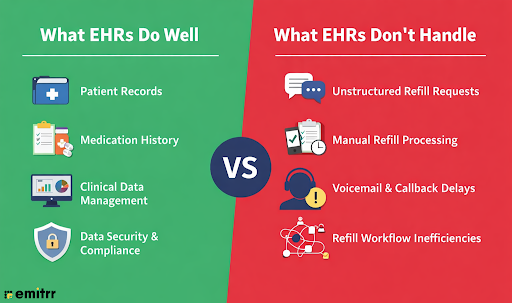
EHRs play a critical role in healthcare by managing patient records, tracking medication history, and supporting clinical decisions. They are highly effective at storing prescription data, maintaining refill history, and enabling providers to review patient information in one place. This makes them essential for EHR refill request management and overall clinical documentation.
However, these strengths also highlight the EHR limitations in healthcare. EHRs are designed as systems of record, not systems built to handle real-time patient communication. They don’t control how prescription refill requests are captured, which creates electronic health record communication gaps and contributes to ongoing EHR prescription refill problems.

Where the Mismatch Happens in Prescription Refill Communication
The biggest issue isn’t what EHRs do, it’s what they don’t do. Patients submi refill requests through calls, voicemails, and portals, creating unstructured patient messages that staff must interpret. Because EHRs don’t standardize how this information is collected, teams rely on manual refill processing, which leads to EHR workflow inefficiencies and inconsistent data.
These gaps highlight the core challenge with EHR patient portal limitations and broader healthcare communication workflows; the system captures data only after it has already been cleaned up manually. This disconnect is why many clinics face ongoing refill request workflow issues despite having an EHR in place.
1. Prescription Refill Requests Start Outside the EHR
Patients keep requesting refills via calls, voicemails, and patient portals, not directly inside structured EHR workflows. Staff must capture this information and bring it into the system, making the first step of the prescription refill workflow manual.
2. EHRs Don’t Control How Refill Requests Are Submitted
EHRs don’t guide patients on what information to provide. As a result, prescription refill requests often miss key details like medication name, dosage, or pharmacy—leading to incomplete requests and delays.
3. EHR Messaging Isn’t Built for Refill-Specific Data
Prescription refill requests require structured inputs, but EHR messaging allows free-text communication. Patients send vague or incomplete messages, and staff must interpret them before processing, slowing down refill request management.
4. Manual Entry Slows Down the Medication Refill Process
Front desk teams must listen to voicemails or read messages and manually enter refill details into the EHR. This increases effort, slows down the medication refill process, and introduces the risk of data entry errors.
5. No Real-Time Validation at the Intake Stage
EHRs don’t validate telehealth prescription refill requests when they are received. Staff must later verify:
- If the medication is active
- If it was prescribed by the provider
- If it’s eligible for refill
This makes the prescription refill workflow dependent on manual review, adding delays.
6. EHRs Don’t Reduce High Refill Request Volume
Prescription refill requests are high in volume and repetitive. EHRs record and manage them but don’t reduce incoming calls, voicemails, or messages, leading to front desk overload and communication bottlenecks. SMS based refill requests can reduce refill call volume, though.
Why Prescription Refill Communication Problems Create Refill Workflow Bottlenecks
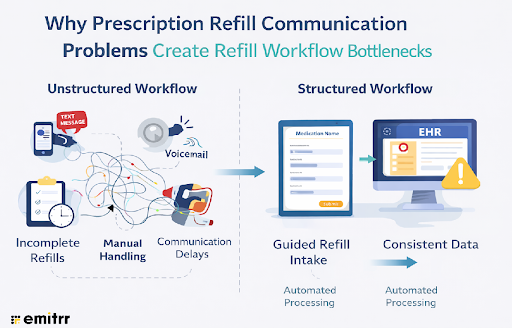
Here are reasons why prescription refill communication problems create refill workflow bottlenecks:
- Unstructured intake slows processing: Prescription refill requests arrive as unstructured patient messages, requiring staff to interpret and standardize them before entering the EHR.
- Heavy manual effort: Teams rely on manual refill processing, which increases workload and reduces efficiency.
- Multiple follow-ups required: Missing medication details lead to callbacks, adding delays to refill request workflow issues.
- Front desk overload: High volume calls & SMS of refill requests create front desk communication overload, pulling staff away from other tasks.
- Nurse rework: Incomplete or unclear requests require nurses to verify and re-enter information, adding unnecessary steps.
- EHR messaging limitations: Lack of structured intake within EHR systems results in inconsistent data entry and slower workflows.
- Delayed turnaround times: Combined inefficiencies contribute to longer processing times in healthcare communication workflows, impacting patient experience.
How AI and Automation Improve Prescription Refill Communication
Why Clinics Need a Communication Layer Beyond EHR for Refill Requests
Prescription refill communication breaks down when requests enter the system in an unstructured way. Here are reasons why clinics need a communication layer beyond EHR for refill requests:
Structured intake for prescription refill requests
Clinics need to collect refill requests, be it a normal or an emergency refill request, using guided inputs instead of unstructured patient messages, so every request follows a consistent format right from the first interaction.
Complete medication details at the source
It is important to capture key information like medication name, dosage, frequency, and pharmacy upfront to reduce manual refill processing and avoid repeated follow-ups.
Standardized refill request data
Every refill request should be recorded in a consistent format to make EHR refill request management easier and to reduce inconsistencies across workflows.
Reduced dependence on EHR messaging
Instead of relying on free-text inputs, clinics should structure data before it enters the system to overcome EHR messaging limitations.
Automation of high-volume refill communication
Healthcare teams can use healthcare workflow automation to manage repetitive refill requests and reduce front desk refill calls and communication overload.
Cleaner handoff into the EHR
When refill requests are complete and structured, they can be passed into the EHR more efficiently, helping improve EHR workflow efficiencies and reducing rework.
How Emitrr Bridges the Gap Without Replacing Your EHR
Emitrr is a HIPAA-compliant AI-driven communication tool that fixes electronic health record communication gaps by turning messy refill requests into structured flows cleanly into your EHR.
Here’s how Emitrr solves prescription refill communication problems:
- Captures prescription refill requests through AI-powered calls and texts instead of relying on unstructured patient messages
- Guides patients step-by-step to collect complete medication details, reducing manual refill processing and missing information
- Structures and standardizes refill data before it reaches the EHR, improving EHR refill request management
- Automatically logs and routes refill requests into systems like Athena, reducing refill request workflow issues
- Helps clinics automate prescription refill communication and reduce front desk communication overload
- Improves overall healthcare communication workflows by acting as a communication layer on top of existing EHR systems
See how Emitrr helped Zynex improve prescription communication workflows by reducing manual triage and enabling faster, more organized message handling.
Have more EHR-related questions? Check these EHR FAQs now!
Frequently Asked Questions
EHRs are designed for storing and managing clinical data, not for handling high-volume prescription refill communication problems. Most refill requests arrive as unstructured patient messages, requiring manual interpretation and entry, which leads to EHR workflow inefficiencies.
Key issues include EHR messaging limitations, lack of structured intake, reliance on manual refill processing, and inability to standardize refill request workflow issues across different communication channels.
Clinics can improve workflows by standardizing intake, reducing reliance on free-text messaging, and using automation or AI in patient communication to streamline refill workflows and reduce manual effort.
No. Due to EHR patient portal limitations, requests often remain incomplete or unstructured, requiring staff to follow up and manually process them, which does not solve EHR refill request management challenges.
Clinics can use a communication layer with healthcare workflow automation and HIPAA compliant communication tools like Emitrr to capture, structure, and route prescription refill requests before they reach the EHR.
Conclusion
EHRs are essential for managing patient and medication data, but they are not designed to handle how prescription refill requests are captured and communicated. As a result, EHR prescription refill problems persist due to unstructured patient messages, manual processing, and ongoing EHR workflow inefficiencies.
To truly fix EHR refill communication issues, clinics need to address the intake layer by adding structure, automation, and a communication layer on top of the EHR, which helps reduce refill request workflow issues and improve healthcare communication workflows.
Book a demo with Emitrr to see how we can solve this problem for your practice.