
Introduction
Inconsistent communication is one of the biggest obstacles to growth in modern business management. Whether it’s missed client messages, delayed internal updates, or inefficient vendor coordination, communication gaps can result in lost opportunities, poor customer experience, and reduced operational efficiency. For many businesses, scaling only makes these problems worse.
Artificial Intelligence (AI) is now transforming how companies communicate, collaborate, and manage their operations. It’s not just about automation — AI communication tools are enabling businesses to respond faster, personalize interactions at scale, and make smarter, data-driven decisions.
In this guide, we’ll explore how AI is revolutionizing business communication and management, why it’s essential for modern enterprises, and how platforms like Emitrr are helping businesses streamline operations, improve productivity, and enhance customer satisfaction.
Top 3 Communication Challenges in Business Management
Delayed Customer Response Times
In today’s rapidly evolving digital landscape, customers anticipate prompt replies. However, many businesses find it challenging to meet these expectations, resulting in customer dissatisfaction and potential loss of business. According to a study by Pumble, 86% of employees and executives cite the lack of effective collaboration and communication as the main causes of workplace failures, which includes delayed customer responses
- Impact: Delayed responses can erode customer trust, reduce satisfaction, and negatively impact a company’s reputation.
- Solution: Implementing AI-powered communication tools, such as chatbots and automated response systems, can ensure 24/7 customer engagement, providing immediate answers to common queries and freeing up human agents for more complex issues.
Inefficient Internal Coordination
Effective internal communication is crucial for seamless operations. However, many organizations face challenges like information silos, inconsistent messaging, and lack of clarity, leading to project delays and decreased productivity. ProofHub highlights that inconsistent communication can create confusion, disrupt workflows, and leave employees feeling disconnected from their objectives.
- Impact: Poor internal coordination can result in missed deadlines, duplicated efforts, and a decline in overall team performance.
- Solution: Adopting centralized communication platforms and establishing clear communication protocols can enhance transparency and ensure that all team members are aligned with organizational goals.
High Cost and Burnout in Support Teams
Customer support teams often face high volumes of inquiries, leading to extended working hours and increased stress levels. This not only affects employee well-being but also incurs higher operational costs due to overtime and potential turnover. LinkedIn discusses how internal communication challenges can lead to increased employee stress and poor employee well-being .
- Impact: Burnout can decrease employee morale, increase absenteeism, and reduce the quality of customer service.
- Solution: Integrating AI-driven tools can automate routine tasks, allowing support teams to focus on more complex issues, thereby reducing workload and preventing burnout.

Why Do These Problems Exist In Business Management?
In today’s digital-first environment, communication remains a key factor in business success. Yet, many organizations struggle with common pitfalls that hinder growth, efficiency, and customer satisfaction. Below are the core reasons why these communication problems persist:
Heavy reliance on manual processes
- Many organizations still manage customer communication, reporting, and coordination through manual methods, such as emails, spreadsheets, or calls.
- These outdated workflows are prone to delays, human errors, and inefficiencies.
- Manual handling limits scalability and reduces the ability to respond to customers or team needs in real time.
- It often diverts employees from high-impact tasks, reducing overall productivity.
Lack of real-time analytics for communication flows
- Without real-time analytics, businesses miss critical insights that could enhance customer engagement or internal efficiency.
- Delayed feedback loops slow down decision-making and hinder performance optimization.
- Teams cannot identify bottlenecks or missed opportunities quickly.
- Real-time communication analytics allow businesses to track KPIs, understand trends, and improve service delivery.
Generic outreach that doesn’t convert
- Many businesses rely on bulk, impersonal messaging that fails to resonate with customers.
- Generic outreach leads to low open and response rates, harming customer acquisition and retention.
- Personalized communication has proven to greatly enhance engagement and improve conversion rates.
- Businesses that lack targeting capabilities struggle to build trust or differentiate from competitors.
The root causes of poor business communication—manual work, missing insights, and impersonalized messaging- create inefficiencies that modern businesses can no longer afford. AI-powered solutions are purpose-built to address these issues.
How AI Solves Business Management Specific Problems?
Artificial Intelligence (AI) is redefining how modern businesses handle communication bottlenecks. By eliminating manual delays, enabling smarter workflows, and driving personalization, AI transforms challenges into competitive advantages.
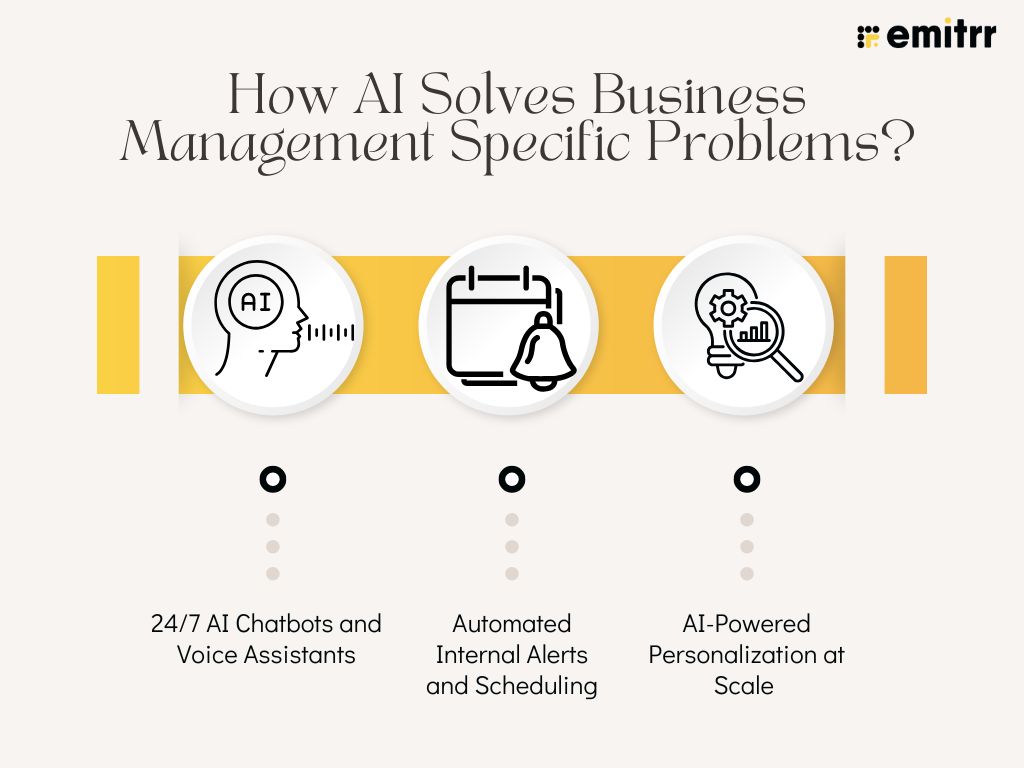
24/7 AI Chatbots and Voice Assistants
AI-powered chatbots and virtual voice assistants provide instant, round-the-clock support to customers and clients, and even internal knowledge bases or chatbots for employee support. They can handle frequently asked questions, resolve complaints, book appointments, and even collect feedback, without human intervention.
This leads to faster response times, improved customer satisfaction, and significant cost savings on support staff. AI also enables multi-language support, making global communication more accessible and efficient.
Automated Internal Alerts and Scheduling
AI streamlines internal communication by automatically sending alerts, reminders, and updates based on real-time data, breaking down information silos and ensuring task follow-ups across departments—reducing miscommunication and lag, a key issue in inefficient internal coordination. Smart assistants can schedule meetings, manage calendars, and ensure task follow-ups across departments. Predictive algorithms can anticipate delays or bottlenecks in workflows, ensuring managers and teams take action proactively
AI-Powered Personalization at Scale
AI leverages its ability to analyze vast amounts of behavioral data, past interactions, and preferences to create hyper-personalized messaging, whether it’s for marketing, support, or follow-ups. This type of personalization boosts engagement, increases conversions, and improves long-term customer loyalty. At scale, AI can segment users in real-time and tailor content for email, SMS, push notifications, and even sales calls—something manual teams can’t achieve efficiently.
AI doesn’t just patch communication problems—it restructures how businesses operate by removing friction, improving timeliness, and ensuring every interaction is data-driven and relevant. Implementing tools like chatbots, automation workflows, and personalization engines can drastically enhance both internal coordination and customer satisfaction.
Human vs. AI in Business Communication
| Feature | AI | Human |
| Efficiency | Can handle thousands of queries or tasks simultaneously, 24/7. | Limited by work hours, fatigue, and multitasking ability. |
| Cost-effectiveness | Lower cost per interaction; scalable without proportional cost increase. | Higher cost per interaction due to salaries, benefits, and training. |
| Accuracy | High accuracy in repetitive and data-driven tasks (up to 90–95%). | Prone to human error, especially with repetitive or manual tasks. |
| Response Time | Instant or near-instant responses (milliseconds to seconds). | Delayed responses depending on availability (minutes to hours). |
How AI Benefits Key Business Functions
Artificial Intelligence (AI) is revolutionizing business functions quickly across departments. Through the automation of repetitive tasks, improving communication, and providing predictive analysis, AI enables organizations to increase efficiency, cut costs, and expand operations more effectively. Here’s how AI benefits key business functions:
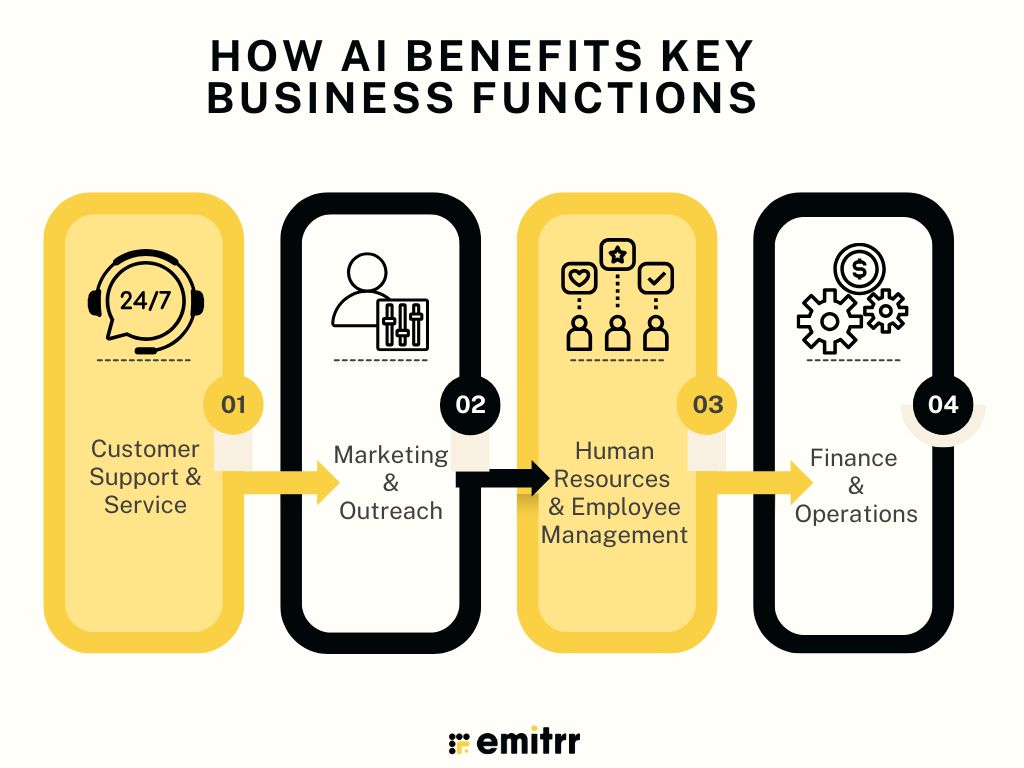
Customer Support & Service
Faster Query Resolution with AI Chatbots
AI chatbots offer real-time, 24/7 customer response. They can answer repetitive questions, provide product advice, and pass on complicated issues to human agents if necessary, saving time and enhancing customer satisfaction.
Voice Assistants for Call Handling
AI voice bots assist with incoming calls, qualify leads, and direct queries to the relevant departments, avoiding missed calls and lowering operational burden on support teams.
Automated Follow-Ups
AI can automate and send targeted follow-ups by SMS or email following interactions, maintaining constant customer engagement and minimizing churn.
Marketing & Outreach
AI-Driven Audience Segmentation
AI segments audiences based on behavioral and demographic information to allow for more personalized marketing campaigns that perform better and convert better.
Predictive Campaign Analytics
AI software examines previous campaign performance to predict future outcomes, allowing marketers to optimize timing, messaging, and targeting.
Automated Messaging Campaigns
AI facilitates automated, rules-based SMS and email marketing campaigns, enhancing efficiency and enabling teams to scale outreach with little effort.
Human Resources & Employee Management
Smarter Hiring with AI Screening
Recruiting platforms powered by AI can screen resumes, match candidates to job postings, and shortlist the top candidates, saving considerable time in the hiring process.
Scheduling & Performance Tracking
AI assists in automating interview scheduling and monitoring employee performance based on real-time data and insights, enabling informed HR decisions.
Improved Internal Communication
AI applications simplify internal communication, respond to frequent HR-related questions, and send timely notifications to employees.
Finance & Operations
Financial Forecasting and Budgeting
AI algorithms use historical data to forecast cash flow, monitor expenses, and offer more accurate budgeting estimates.
Invoice Processing and Fraud Detection
AI simplifies the processing of invoice data, matches purchase orders with it, and marks inconsistencies, lessening errors and fraud detection in the early stages.
Supply Chain and Vendor Communication
AI systems eliminate the need for manual vendor communication, inventory tracking, and immediate alerts of delays or disruptions, maximizing the efficiency of supply chains.
AI is no longer science fiction, it’s today’s business enabler. AI improves productivity and reduces costs, not just across customer support and marketing, but also in HR and finance, enhancing decision-making across teams. Embracing AI-powered tools can provide a strategic advantage in today’s increasingly fast-paced data-driven world.
Overcoming Concerns Around AI in Business
While Artificial Intelligence continues to revolutionize business operations, many organizations still have concerns about its long-term impact. Here’s a breakdown of common questions and how businesses can responsibly address them:
Will AI Replace Human Jobs?
Not entirely —> AI augments, not replaces.
Artificial Intelligence is designed to handle repetitive and time-consuming tasks, allowing employees to focus on more valuable and strategic work. For instance, customer support staff can use AI chatbots to deal with FAQs, while applying human effort on complicated questions requiring empathy and judgment.
AI boosts team productivity, rather than reducing headcount.
Is AI Technology Secure?
Yes, when implemented with best practices.
Leading AI platforms have strong data security processes in place, such as end-to-end encryption, role-based access controls, and adherence to privacy regulations such as GDPR, CCPA, and HIPAA (where they apply). Companies need to guarantee that their suppliers meet accepted security certifications and get regular audits performed.
Prioritize platforms with strong compliance and data protection policies.
Can AI Be Trusted to Make Decisions?
Yes —> with human oversight.
AI models are learned from past data, but they’re not perfect. That’s why responsible use of AI includes human-in-the-loop systems, where humans can examine, override, or accept AI-driven suggestions. Periodic model training and verification also contribute to increasing accuracy over time.
AI works best as a decision-support tool, not a replacement for human judgment.
What About AI Bias and Ethics?
Ethical AI is a shared responsibility.
Bias may be present in data, and thus in AI predictions. Companies can prevent this by:
- Utilizing varied training datasets
- Conducting bias discovery audits
- Deploying explainable AI (XAI) frameworks that provide transparency and explainability for AI decisions
Open communication, ethics policies, and AI governance ensure the technology works within company values and societal expectations.
Transparency and fairness must be fundamental pillars of any AI initiative.
AI is a powerful business enabler — but its adoption should be thoughtful and responsible. By focusing on human collaboration, security, accountability, and ethical safeguards, businesses can confidently integrate AI into their workflows while building trust among employees, customers, and stakeholders.
Why Emitrr is the Ideal AI Communication Platform
Emitrr stands out as the premier AI communication platform, offering a comprehensive suite of features designed to revolutionize how businesses connect with their customers and streamline internal operations. Here’s a closer look at what makes Emitrr the ideal choice:
Advanced Texting + Calling AI That Feels Human:
Emitrr’s core strength lies in its sophisticated AI-powered texting and calling capabilities. Unlike generic automation, Emitrr’s AI is engineered to understand context, sentiment, and intent, enabling interactions that feel natural and human-like. This means:
- Intelligent Conversations: Emitrr’s AI can engage in dynamic two-way conversations via SMS and voice, answering questions, providing information, and guiding customers through processes seamlessly.
- Personalized Tone and Language: The AI can adapt its tone and language based on the context of the conversation and the customer’s history, creating a more engaging and empathetic experience.
- Smart Call Routing and Management: For calling, Emitrr’s AI can intelligently route calls to the most appropriate agent based on availability and expertise, reducing wait times and improving first-call resolution rates. It can also handle call screening, automated callbacks, and provide agents with real-time conversation insights.
Seamless Plug-ins with CRMs, ERPs, and More:
Its seamless plug-ins with leading Customer Relationship Management (CRM) systems, Enterprise Resource Planning (ERP) platforms, and other essential business tools ensure:
- Unified Data Management: Customer data and interaction history are synchronized across platforms, providing a holistic view of each customer and enabling more informed and personalized communication.
- Automated Workflows: Integration allows for the automation of communication workflows triggered by events in your CRM or ERP, such as automated follow-ups after a sale, appointment reminders, or proactive service notifications.
- Enhanced Efficiency: By eliminating manual data entry and the need to switch between multiple applications, Emitrr streamlines operations and boosts team productivity.
Scalable Solutions for Businesses of All Sizes:
Emitrr offers flexible and scalable solutions that can adapt to the evolving needs of businesses ranging from startups to large enterprises. This scalability ensures:
- Growth without Growing Pains: As your business expands and communication volume increases, Emitrr can seamlessly handle the added demand without requiring significant infrastructure changes or manual scaling efforts.
- Customizable Plans: Emitrr offers a variety of plans and features that can be tailored to the specific communication needs and budget of your organization.
- Consistent Performance: Regardless of the volume of interactions, Emitrr maintains consistent performance and reliability, ensuring a positive experience for both your team and your customers.
Data Security and Compliance as a Priority:
Emitrr understands the critical importance of data security and compliance in today’s regulatory landscape. The platform utilizes strong security protocols and follows industry best practices to ensure:
- Secure Data Storage: Customer data is stored securely with advanced encryption protocols to prevent unauthorized access.
- Compliance with Regulations: Emitrr is designed to help businesses comply with relevant data privacy regulations such as GDPR, HIPAA (if applicable), and CCPA, ensuring responsible data handling.
- Regular Security Audits: The platform undergoes regular security audits to identify and address potential vulnerabilities, providing peace of mind that your data is protected.
Example:
Emitrr’s AI-Powered Texting Reduces Average Customer Response Time
Emitrr’s intelligent AI-powered texting capabilities have a proven track record of significantly improving customer engagement and response times. For example:
- Instant Responses to Inquiries: Emitrr’s AI can provide immediate answers to frequently asked questions via SMS, reducing the time customers wait for information.
- Proactive Outreach and Reminders: Automated text message reminders for appointments, payments, or follow-ups ensure timely action and reduce missed opportunities.
- Faster Issue Resolution: By enabling customers to communicate via text, Emitrr facilitates quicker information exchange and faster resolution of simple issues.
Emitrr’s advanced AI, seamless integrations, scalability, and unwavering commitment to data security make it the ideal communication platform for businesses looking to enhance customer engagement, improve operational efficiency, and gain a competitive edge in the market.
Getting Started with AI in Your Business
Implementing AI doesn’t have to be overwhelming. Here’s a structured approach to begin your AI journey and drive real results:
Identify recurring communication bottlenecks
Begin by assessing places where your team experiences regular delays, like slow customer responses, manual lead qualification, or ineffective internal coordination.
Choose a tool like Emitrr in one team (e.g., customer support)
Choose an AI platform that solves one critical use case. For example, apply an AI chatbot within customer service to process FAQs or an AI voice assistant to handle incoming calls.
Train your team to effectively collaborate with the AI
Make sure your staff knows how to effectively utilize the tool. Provide training sessions so staff can use AI as a co-pilot, and not as a replacement.
Track KPIs: response time, cost per lead, etc.
Measure the effect of AI through metrics such as average response time, lead conversion rate, cost per interaction, and customer satisfaction scores.
Scale after seeing early wins
After witnessing measurable gains in one function, roll out AI usage to other departments such as marketing, HR, or operations.
Ensure ethical and compliant AI usage in business operations
Utilize AI responsibly by protecting data privacy, being transparent, and complying with applicable regulations such as GDPR, HIPAA, or CCPA.
The Future of AI in Business Management
As artificial intelligence continues its rapid evolution, its role in business management is undergoing a profound transformation. Below are five key trends shaping the future of AI in the workplace:
Smarter, Human-Like AI Conversations
AI-powered communication tools are advancing quickly, enabling context-aware, natural conversations that closely resemble human interaction. From intelligent customer support to internal operations, AI is evolving into a collaborative team member rather than just a tool.
Predictive and Hyper-Personalized Communication Strategies
AI will enable businesses to shift from reactive messaging to proactive, hyper-personalized communication. By analyzing customer data, behavioral signals, and real-time interactions, AI can anticipate needs, automate personalized responses, and prevent service issues, resulting in stronger customer engagement and loyalty.
Ethics, Accountability, and Regulatory Compliance
As AI adoption scales, ethical implementation becomes critical. Companies will need to focus on algorithm transparency, fairness, and explainability. Compliance with regulations like GDPR, CCPA, and upcoming AI governance frameworks will be essential to earn and maintain user trust.
The Rise of the Human-AI Hybrid Workforce
Rather than replacing humans, AI will augment them. This hybrid model empowers humans to focus on strategic, creative, and relationship-driven tasks while AI handles repetitive or data-heavy functions. Businesses that embrace this synergy will see boosts in productivity and innovation.
Growth of Intelligent AI Copilot Platforms
“AI copilot” platforms – designed to assist across functions like marketing, sales, HR, finance, and support- will see widespread adoption. These AI systems will streamline workflows, reduce errors, and enhance decision-making, making them critical to scaling operations efficiently.
The future of business isn’t just AI-powered—it’s human-guided, ethically grounded, and built for long-term growth.
FAQs
AI streamlines communication by automating repetitive tasks, offering instant replies through chatbots, enabling intelligent call routing, and generating real-time analytics. This results in faster response times, reduced manual effort, and improved customer satisfaction.
Popular AI tools include Slack with AI plugins for team collaboration, Salesforce Einstein for CRM insights, Zoho Zia for business analytics, ChatGPT for content generation and support, and AI voice/chat assistants like Drift, Intercom, and Tidio for customer service automation.
Yes, most modern AI platforms implement robust security protocols, including end-to-end encryption, data anonymization, and compliance with regulations like GDPR, HIPAA, and CCPA. It’s crucial to use trusted platforms with transparent data privacy policies.
AI supports HR functions by automating recruitment, screening applicants, scheduling interviews, tracking employee performance, and enhancing internal communication through AI-driven HR assistants. This enhances accuracy, minimizes bias, and increases efficiency.
Industries such as healthcare, finance, retail, real estate, logistics, and customer service benefit greatly from AI. AI helps automate operations, enhance customer experiences, reduce errors, and enable data-driven decision-making across all sectors.
Conclusion
Don’t get left behind in the communication revolution. Integrating AI is no longer optional—it’s essential for survival and growth in today’s rapidly evolving business landscape. From streamlining communication to enhancing decision-making, AI empowers teams to work smarter and scale faster. Ready to modernize your communication?
Explore how Emitrr’s AI can transform your consulting practice today. The earlier you embrace this shift, the greater your competitive edge.


 4.9 (400+
reviews)
4.9 (400+
reviews)