

Introduction to VoIP for Physicians
The digital waiting room is evolving, but does your phone system still need to be stuck in the past? If unanswered calls make you feel like you’ve missed a patient connection, and your office phone lines are more twisted than your stethoscope, then let’s talk about VoIP.
VoIP (Voice over Internet Protocol) is a virtual phone service that enables you to place and receive calls using the Internet instead of a landline. In contrast to the traditional system, VoIP for healthcare offers flexibility, scalability, and cost-effectiveness for today’s clinics.
In the fast-paced world of healthcare today, the medical office phone system is no longer capable of meeting the increasing demands of modern patients. As consumer demand for remote care, after-hours accessibility, and secure communication, the right VoIP solution can completely reshape patient experiences and streamline internal coordination within organizations.
This how-to guide covers everything a doctor needs to know in order to make a move or upgrade to a medical VoIP solution. With smart use cases to best practices and a deep dive into Emitrr, a powerful healthcare-ready platform, we’ll take a look at how your clinic can gain at every level.
Why is VoIP Important for Physicians?
In healthcare, good communication is not a luxury — it’s necessary for providing quality patient care and an efficient running practice. Every call, every message, is a piece of the practice’s well-being and success.
Legacy phone systems have become obsolete and are likely to fall behind. It’s becoming a challenge to match up to the needs of more remote consultations, coordinating easier appointment management, and contacting the patient earlier before they need to contact you. It’s where VoIP for healthcare is not a “nice to have,” but a need to have.
VoIP has an important role in eradicating operational inefficiencies currently festering within many medical practices. Imagine a scenario where your front desk doesn’t get bogged down with a constant stream of ringing lines, where calls are thoughtfully directed to the right place, and pressing messages never get lost in a jumble of voicemails. It is directly this efficiency that translates into better patient flow, less staff burnout, and additional time to dedicate to direct patient care.
In addition, in an industry based on trust and discretion, a HIPAA-compliant VoIP system is no longer a “nice to have,” but it’s a “must have. The patient health information’s (PHI) security is the top priority, and a strict VoIP system that has been developed under HIPAA’s guidance and recommendations gives you both legal assurances and patients’ confidence.
Whether you’re running a solo practice, overseeing a busy multi-location clinic, or growing into telemedicine, the importance of a modern healthcare phone system cannot be overstated. It works to keep communication smooth, secure, and available at all times, no matter the size or breadth of your practice.
Advantages of VoIP for Physicians
Any modern VoIP software for physicians comes with a big list of benefits that affect your profit, streamline your internal procedures, and, most importantly, guarantee the highest level of your patients’ satisfaction. Thus, by opting for VoIP, your clinic can take advantage of the following opportunities:
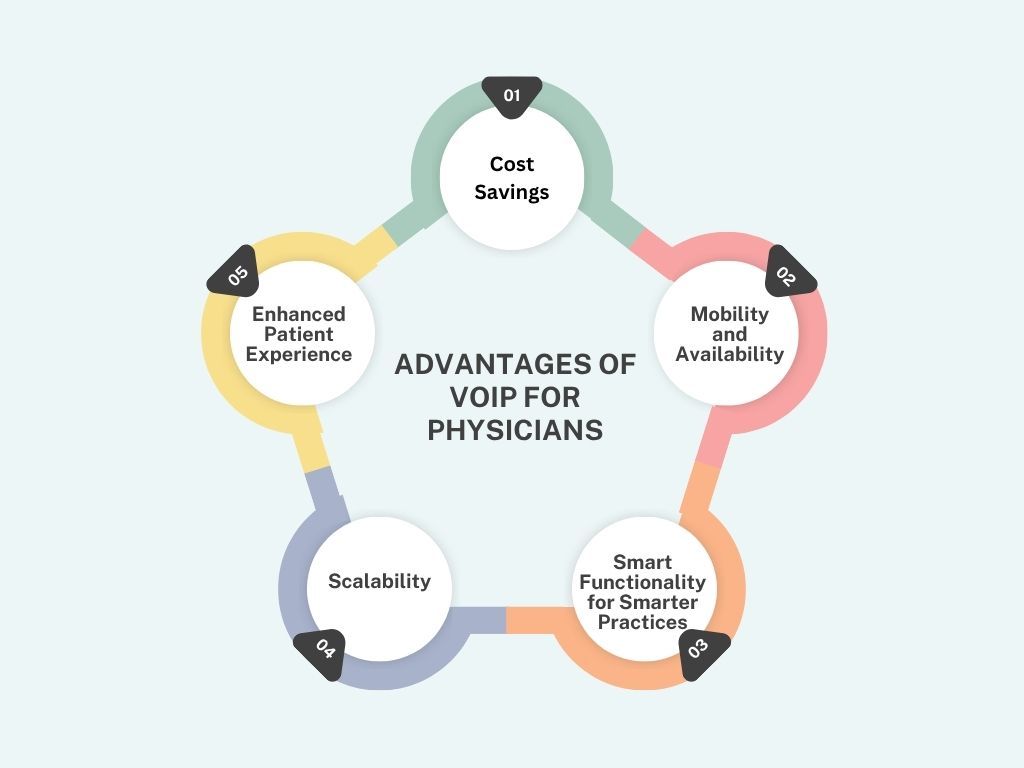
Cost Savings
VoIP significantly drives down communication costs for healthcare.
- Lower Monthly Bills: Heavily discounted traditional landlines with bundled features.
- Reduced Hardware Costs: You can just use existing devices rather than purchasing hardware.
- Free Internal Calls: Extensions in various locations can call each other for free.
- Very Low Long-Distance Charges: Most plans come with unlimited long-distance calling, meaning hourly rates for long-distance travel do not need to be considered.
Mobility and Availability
VoIP is flexible and forward-thinking to accommodate the mobility of today’s healthcare.
- Anytime, Anywhere Presence: You can answer calls and manage your communications from any internet-connected device.
- Remote Worker Capabilities: Supports telemedicine patients / remote support staff using your clinic number from home.
- Business Continuity: Automatic call rerouting during outages protects against service disruptions.
Smart Functionality for Smarter Practices
VoIP takes phone features and makes them operationally efficient by having advanced features.
- Phone Call Forwarding & Routing: Automatically routes call conditions based on time of day, availability, or user input.
- Voicemail to Text/Email: Your voicemails are automatically sent to text messenger to email/SMS, creating a convenient path to retrieve and identify important messages.
- Auto-Attendant (IVR): Route inbound calls “in-basket” style with a virtual receptionist that nearly eliminates front desk telephone responsibilities.
- Call Recording: Record phone calls for training, documentation, and or quality assurance purposes.
- Unified Communications: VoIP combines all communications (call, messaging, video, fax) into a softphone utility.
Scalability
Your VoIP can grow as your practice does.
- Easily Add/Remove Users: You can manage your lines through an online portal with no hardware required.
- Supports Clinics with Multiple Locations: You can seamlessly dial between branches through one system.
Enhanced Patient Experience
Better communication means happy patients.
- Faster Response Times: Smart routing means minimum hold time.
- Fewer Missed Calls: You can utilize features like call queuing and voicemail transcription to assist with as many callbacks as possible.
- 24×7 Reachability: There is always someone patients can reach out to, or they can always leave to have someone call them back if it is an emergency.

VoIP Use Cases for Physicians
Understanding VoIP phone systems for healthcare must be done through the lens of how they Improve the day-to-day scenarios that occur every day in medical practice.
Appointment Scheduling & Reminder Service
- Challenge: The volume of calls for appointments, plus missed appointments, equates to lost revenue.
- VoIP Solution: Administrative staff can have one professional number with an auto-attendant to identify scheduling (e.g., “Press 1…”), and voice/text reminders that can go to patients via automated calls and texts. This reduces missed appointments and saves time for administrative staff.
Telemedicine Consultations
- Challenge: Secure connection with patients for telemedicine while keeping it professional.
- VoIP Solution: Physicians use soft-phones to engage in voice/video calls with a clinic caller ID so it’s simple and secure and they don’t have to engage in complex processes to hold a virtual visit.
After-Hours Communication & On-call Emergencies
- Challenge: Reliable routing of urgent calls to the on-call physicians.
- VoIP Solution: Calls are sent right to the on-call phones. The voicemail as text capability means they will see only the urgent messages and respond quickly.
Multi-location Practicing
- Challenge: Separate systems and inconsistencies across the locate and/or branches.
- VoIP Solution: One system, with one user-friendly centralized system. It allows dialing from one office branch to another and allows for routing patients from just one professional number to the proper destination.
Billing & Administrative Queries
- Challenge: Volume of calls and moving calls to the right location.
- VoIP Solution: Dedicated lines with smart routing – billing, referrals, and medical records. The call recording feature can solve disagreements and be used as a reference for correct answering.
Communication between Staff
- Challenge: How to connect quickly, with minimal disruption to the rest of the office environment.
- VoIP Solution: Internal calls and intercoms deliver messages immediately, while conference calls provide a secure method to conduct staff meetings and specialist consultations.
Download our comprehensive voicemail scripts for physicians to ensure professional and compassionate messaging.
VoIP Best Practices for Physicians
There needs to be a smart approach to implementing hospital or office phone systems. These recommendations will help you maximize the benefits of VoIP and help get everything in place with as few hiccups as possible:
- Choose a HIPAA-compliant Provider: This is non-negotiable. Make sure you select a healthcare phone system that is willing to provide you with a signed BAA, documents, security protocols (like end-to-end encryption methods), and strict access controls for employees. Be sure it is compliant. If it is not, you are at risk for huge fines and patient data breaches.
- Ensure Correct Staff Training: You may have the best VoIP system going but if your staff are not trained it will be useless. Do supplier training on topics such as etiquette on when to use VoIP (just because you can turn it on for a reason, don’t), transfer calls, voicemail-to-text, softphones, etc. Basic troubleshooting training will also help your staff adapt more smoothly.
- Use Call Analytics: Use the built-in reporting tools to track call volume, peak call time, missed and average wait times, and similar data. This data will help you decide on appropriate staffing, which will help improve your call flows, and ultimately lead to better patient service.
- Set Your Call Recording Feature (with permission): If your state allows it and your policy allows it, record calls to help improve the quality of service by using it for quality checks, new staff training, dispute resolution, and more. Always receive permission from the patient to record, and follow HIPAA protocols.
- Set Business Hours and Auto-Attendants Thoughtfully: Make sure you set up your auto-attendants so that the options are clear for callers. Consider using a defined greeting and routing on the auto-attendants that will guide your caller as efficiently as possible, thereby reducing any frustration.
- Backup Internet/Power: VoIP requires internet access. A secondary connection, such as a second ISP or hotspot, and a UPS for key devices can help keep calls going during outages.
- Integrate with Scheduling and EHR Tools: Link VoIP with your EHR and scheduling tools for click-to-dial, automated appointment reminders, and calling a note in the patient chart.
Challenges of VoIP for Physicians
The benefits of VoIP in healthcare are clear, but physicians need to understand the challenges and how to manage them effectively in everyday use.
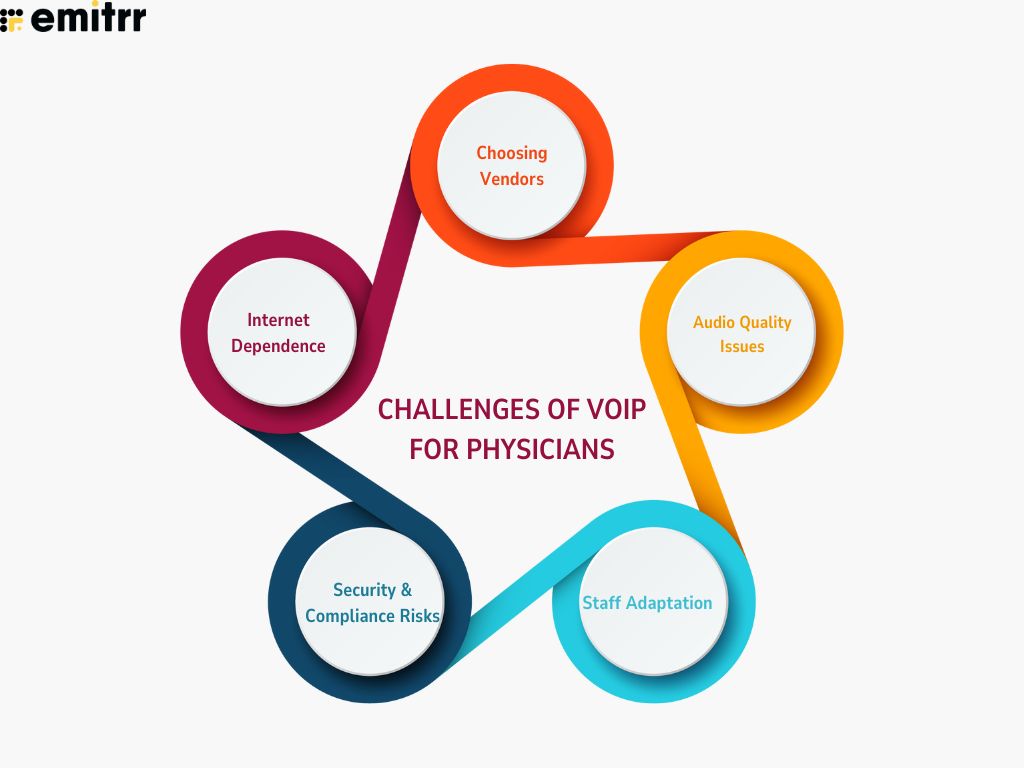
Internet Dependence
- Challenge: Everywhere VoIP relies on the internet, but what if there is an outrage in the system or the internet slows down entirely?
- How to Manage: Consider implementing a secondary connection for backup, utilize providers that offer automatic call rerouting, and ensure there is sufficient bandwidth, Quality of Service (QoS) can set prioritizations for voice.
Security & Compliance Risks
- Challenge: Sending any patient data via the internet comes with security risks.
- How to Manage: Use a VoIP service that is HIPAA compliant and the provider is willing to sign a BAA. They should offer end-to-end encryption, accessible controls, and activity logs.
Staff Adaptation
- Challenge: Staff may complain or resist new technologies & workflow changes.
- How to Manage: Bring the staff in early in the process, provide training & support, and explain how VoIP will simplify tasks.
Audio Quality Issues
- Challenge: Poor internet can cause choppy calls or echoes in communication.
- How to Manage: Make sure you have adequate bandwidth, apply QoS, use good VoIP devices, and locate any network problems.
Choosing Vendors
- Challenge: There are so many VoIP providers, that the key is not to choose a provider with a “one-size-fits-all” setup.
- How to Manage: Select vendors that understand the healthcare environment are HIPAA compliant, provide good support, service reviews, and the capabilities you need.
How to Set Up VoIP For Physicians Using Emitrr
When looking to choose a medical office phone system that understands healthcare operations, Emitrr is the clear choice. It is easy to switch to the future of communications with Emitrr.
Emitrr’s Holistic Approach to Communication:
Emitrr is not just VoIP for healthcare but a single platform for all patient interactions. It connects texting, voicemail, and reviews so that VoIP is only a part of the whole system developed for physicians.
Emitrr’s Streamlined VoIP Features for Physicians:
Our platform is purposely built to provide the best experience within every aspect of clinical communications:
- Voice Calling: Make and receive crystal-clear calling via your unified inbox on your mobile app or your web browser.
- Voicemail Transcriptions: Every voicemail is automatically transcribed into a text message next to your text messages. This is critical to medical professional productivity. You will quickly scan for messages, prioritize follow-up, and never sit and listen to a full voicemail again.
- Missed Call Text Automation: This is a unique and differentiating feature for Emitrr’s VoIP offering. If a patient calls and you don’t answer, Emitrr will automatically text message the patient to ensure no patient inquiry is missed and it keeps the dialogue alive.
- Call Routing & Forwarding: Route calls intelligently to the staff, departments, or external numbers in such a manner as to let the patients get in touch with the direct people on the other end, and forward to personal devices when doctors are on call.
- Customizable Auto-Attendants: Set up professional phone greetings and easy-to-understand multiple menu options to make it simpler for callers to reach the right person quickly.
- Call Recording: With Emitrr, secure Call recordings with the required disclaimers and consent management services for the purpose of quality assurance, training, and compliance.
- Call Analytics: Track inbound/outbound calls, wait times, and agent performance metrics and use your aggregate data to make data-driven decisions.
Reasons Why Emitrr is the Best VoIP Solution for Physicians
Emitrr is not just a VoIP provider, it’s a trusted partner for your practice:
- HIPAA-Compliant: Emitrr is built for healthcare, so it provides encrypted data to maintain confidentiality, a strict access control process, and offers a Business Associate Agreement (BAA) to enable your communications to be secure and compliant.
- Built for a Healthcare Clinic: Emitrr was designed specifically for medical offices to help operate day-to-day practice management features like appointment settings and patient tracking and follow-up.
- One Dashboard for Calls and Texts: Staff can manage any calls, text messages, and voicemails without switching tabs so no message is ever missed.
- AI-Backed Efficiency: Smart routing and sentiment analysis boost the efficiency of staff’s call and text management to achieve better interactions with patients.
- Flexible Resourcing: Whether one location or multi-location, Emitrr can grow with your practice and there is no new hardware or IT team required to enhance your practice.
- Cost-Effective: By streamlining all of the communications tools available to you, Emitrr’s pricing is less expensive than managing separate hype of these communications individually.
Frequently Asked Questions
Frequently Asked Questions Physicians Have Regarding Adopting VoIP for their Practices:
Yes. If you use a HIPAA-compliant VoIP provider like Emitrr which also gives you a BAA, end-to-end encryption, and stringent access controls.
Regular lines transmit conversations over copper wires, whereas VoIP transmits conversations over the Internet. VoIP enables many more features, much greater flexibility, and a lower overall cost.
Reliability is the best feature of VoIP. Most GREAT VoIP providers offer failover. They redirect calls to mobiles, to another office, or, at the very least, a message.
Absolutely. VoIP solutions like Emitrr integrate with EHR systems like Athenahealth, Epic, and eClinicalWorks to offer click-to-call, pop-ups, and call logs.
Cost varies, but VoIP for healthcare, for example, Emitrr, ranges from about $30/month per user. This is much better than traditional line cost structures.
Yes. VoIP solutions, like Emitrr, offer two-way texting and voicemail transcription. Additionally, this increases efficiency.
Very quickly. Typically, most practices with Emitrr have implemented the technology into practice and go live in a couple of days due to easy setup, cloud deployment, and onboarding support.
Conclusion
In the realm of healthcare, communication is not merely a convenience—it is essential for both patients and health providers. VoIP implementation in healthcare is much more than a means to enhance your technical infrastructure; it is indeed a step forward in your practice’s planning and a message to your patients.
Invest in modern VoIP phone systems to optimize operations in your practice, minimize administration, and keep your team safe regardless of location. This system helps in leveraging support providers to deliver an excellent patient experience while lowering the number of missed calls or improving the safety of patient information.
To see how you and your team can transition your communication strategy, schedule a demo for free with Emitrr, and prepare for the future of healthcare communication!

 4.9 (400+
reviews)
4.9 (400+
reviews)