
Introduction
Every patient call contains information that deserves the same level of protection as the rest of your healthcare systems. Appointment scheduling, billing discussions, prescription requests, and voicemails can all involve protected health information, making your phone system an important part of HIPAA compliance. This guide explains what makes a VoIP service HIPAA compliant, the security features to look for, and how to evaluate whether your current setup meets compliance requirements.
AI Summary
- Every patient call involving a name, appointment type, insurance detail, or prescription is PHI, your phone system must meet the full HIPAA Security Rule, not just your texting platform.
- The guide covers which channels fall under HIPAA scope: voice calls, call recordings, voicemail, SMS, video, and fax-over-IP, a wider scope than most practices realise.
- All three HIPAA safeguard categories are mapped directly to VoIP requirements, so you know what your vendor must provide and what your practice must configure internally.
- Technical standards are explained without jargon: AES-256 at rest, TLS and SRTP in transit, MFA, role-based access, and audit logging.
- Emitrr covers every one of those channels under a single BAA with AES-256 encryption, MFA, and role-based access included as standard, not as add-ons.
- You will know exactly what to ask a VoIP vendor before signing and what a non-compliant setup costs when it appears in an OCR audit.
What Is HIPAA & Who Must Comply?
The Health Insurance Portability and Accountability Act (HIPAA) is a U.S. federal law enacted in 1996 that establishes national standards for protecting patients’ Protected Health Information (PHI), including both physical records and electronic PHI (ePHI).
In healthcare communication, this also extends to information shared through phone calls, voicemail, and VoIP systems, making HIPAA compliance essential for any organization handling patient data over digital communication channels.
HIPAA compliance is required for all covered entities, which include three main categories:
- Healthcare providers: Doctors, hospitals, clinics, dentists, and other care delivery organizations.
- Health plans: Health insurance companies, HMOs, and payers responsible for healthcare coverage.
- Healthcare clearinghouses: Organizations that process or convert healthcare data for billing and administrative purposes.
In addition to covered entities, any organization that handles PHI on their behalf is classified as a business associate. This includes IT providers, billing companies, and communication platforms such as HIPAA-compliant VoIP phone system providers.
HIPAA compliance is mandatory and enforced by the U.S. Department of Health and Human Services (HHS) Office for Civil Rights (OCR). Violations can result in significant financial penalties and legal consequences.
For healthcare organizations using HIPAA-compliant VoIP services, selecting a secure communication platform ensures that all patient conversations remain protected during transmission, storage, and acces reducing compliance risk and safeguarding patient trust.
What is a HIPAA-Compliant Phone System?
A HIPAA-compliant VoIP service is a secure VoIP for healthcare and medical communities that meets all HIPAA requirements for protecting PHI (Protected Health Information). In contrast to consumer-level calling applications (e.g., Skype or WhatsApp), the best HIPAA-compliant VoIP service incorporates superior standards of encryption, strictly enforced authentication protocols, and extensive administrative controls to ensure not only secrecy but also audibility of the voice communications.
The best HIPAA-compliant VoIP system does more than just encrypt calls; it protects voicemail, call recordings, and, potentially, SMS. A secure VoIP for healthcare must provide:
- VoIP data-in-transit encryption (the PHI is encrypted while in transfer).
- VoIP data-at-rest encryption (the PHI is secured while in storage of audio or text data).
- VoIP audit trail PHI logging, which tracks access or logging while those logs are logged.
- VoIP user access control and role-based access to VoIP permissions.
- VoIP regulations to ensure that call recording is stored and managed in a HIPAA safe environment.
- A VoIP BAA (Business Associate Agreement) must be signed with the provider.
Why HIPAA compliance matters for VoIP. Every call made in healthcare can have electronic PHI (ePHI) in the call, lab results, prescriptions, billing, diagnosis, etc. Without VoIP HIPAA compliance, the call can be intercepted, monitored, leaked, or worse, not be used for the purpose that the provider intended.
Having a VoIP system that is HIPAA compliant means that:
- Voice and text data are encrypted (both in motion and at rest).
- Only authorized users may have access to communication through VoIP with MFA for users.
- VoIP Audit trail PHI reports provide record-keeping transparency for compliance audits.
- PHI can be altered or deleted without logging it (VoIP with audit logs).
- Service providers share the responsibility with you with a VoIP BAA agreement.
- For the organization, this means fewer data breaches, less liability, and compliance with the HIPAA Privacy, Security, and Breach Notification Rules.
HIPAA-Compliant VoIP vs Standard VoIP
| Feature | HIPAA-Compliant VoIP | Standard VoIP |
| BAA | Yes | No |
| Call Encryption | Yes | Sometimes |
| Audit Logs | Yes | Rarely |
| MFA | Yes | Optional |
| Secure Call Recording | Yes | No |
| PHI Protection | Yes | No |
| HIPAA Ready | Yes | No |

What VoIP Communications Are Covered by HIPAA?
HIPAA compliance includes more than just the spoken voice on a call. The use of a HIPAA-compliant phone system unified digital platform means many channels of communication that use the VoIP system may transmit and/or store ePHI. Therefore, all of these channels sit under the scope of HIPAA security compliance. The important channels that a comprehensive HIPAA-compliant phone system will need to secure include:
- Voice Calls: Any spoken exchange that contains patient identifiers or medical information.
- VoIP Call Recording: Any stored voice logs that are utilized for verification or quality assurance must stay HIPAA safe.
- Voicemail: VoIP will require secure voicemail and voicemail storage encryption.
- Text Messaging (SMS / MMS): The best HIPAA-compliant VoIP service with a secure SMS/messaging protocol falls into the coverage of HIPAA, and would need to be encrypted and authenticated.
- Video Calls: Video calls will need to utilize end-to-end encryption VoIP protocols while used for telehealth.
- Fax-over-IP or VoIP Fax: Fax-over-IP or VoIP fax communication will have the same HIPAA VoIP archiving & backup rules as other PHI channels.
Across all these HIPAA-compliant phone service, HIPAA compliance isn’t limited to encryption and storage alone. It also depends on how messages are delivered when calls go unanswered. Using clearly written, HIPAA-compliant voicemail scripts and a HIPAA compliant VoIP checklist helps ensure patient communication stays professional and privacy-safe without exposing sensitive information.
Access ready-to-use HIPAA-compliant voicemail scripts for healthcare teams.
What Happens If Your VoIP System Isn’t HIPAA Compliant?
Employing a VoIP system that does not comply with HIPAA regulations can be devastating for healthcare providers. Non-HIPAA VoIP risks include:
- Data Breaches: Exposure of PHI due to unprotected calls or messages.
- Fines: A violation penalty of $100 to $50,000, with a cap of $1.5M per year.
- Loss of Reputation: A patient will lose trust after sensitive health information is exposed.
- Legal Action: Class-action lawsuits or regulatory HIPAA compliance audits.
- Operational Downtime: Audits and suspensions of operational capacities or systems.
Non-HIPAA compliant VoIP service risks are not only imposed on large hospitals. Even a solo doctor forwarding patient phone calls to their personal phone number without a VoIP in place to restrict access to PHI is a violation of HIPAA compliance.
Many healthcare teams unknowingly create compliance risks by using personal cell phones for patient communication without proper safeguards. Understanding when cell phones are and are not HIPAA-compliant is critical to preventing accidental PHI exposure.
What Are the HIPAA Requirements for VoIP?
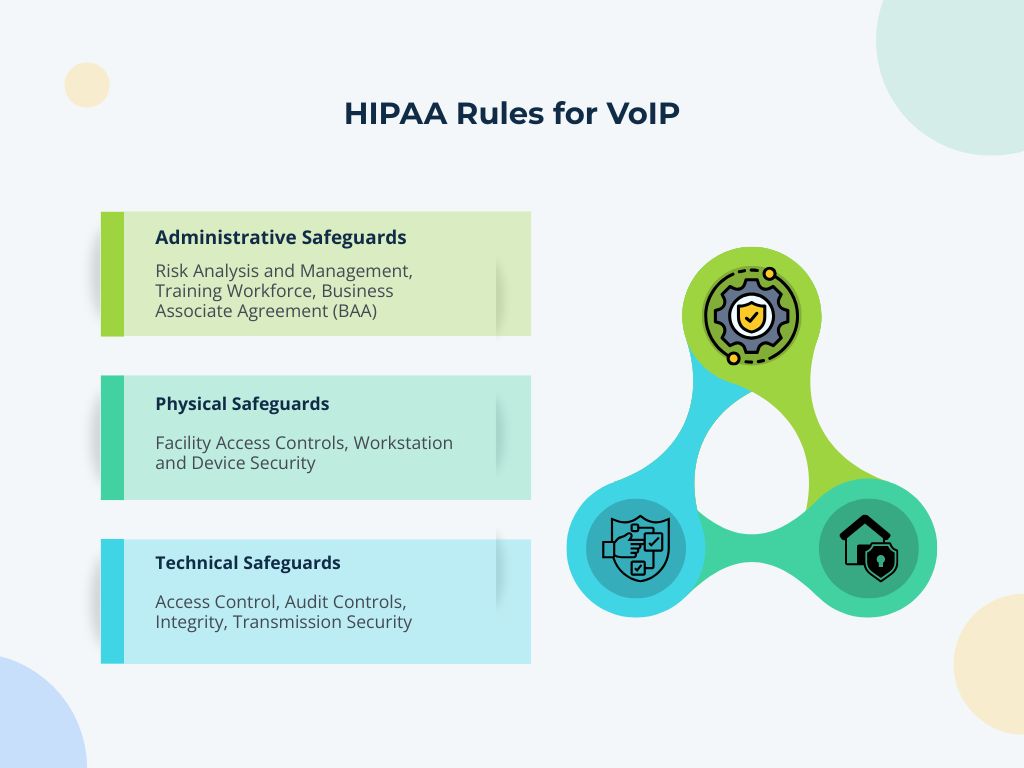
To comply with Medical VoIP HIPAA regulations, we need to adhere to the main rules that specify the security and use of electronic protected health information (ePHI). The HIPAA Security Rule is the prevailing rule that outlines three domains of safeguards that need to be present for the best HIPAA-compliant phone system.
1. Administrative Safeguards
These are the management, policy, and procedure-related obligations to selecting, developing, implementing, and maintaining security measures.
- Risk Analysis and Management: Routine, comprehensive risk assessments of the secure VoIP for healthcare to identify vulnerabilities and threats to ePHI.
- Training Workforce: Ensuring that all employees have a formalized (preferably written) training policy and procedure that indicates their roles and responsibilities in using the best HIPAA-compliant VoIP service, handling PHI, and security requirements.
- Business Associate Agreement (BAA): Obtain a VoIP BAA completed and signed by the VoIP provider, stating that they will maintain HIPAA safeguards for all PHI they create, receive, maintain, or transmit on behalf of the covered entity.
2. Physical Safeguards
These are the measures to protect the physical electronic systems and related equipment, storing/ePHI from unauthorized access, damage, or interference.
- Facility Access Controls: Physical access to the server room/data center that houses any on-premises (in-house) VoIP equipment/data-at-rest is restricted.
- Workstation and Device Security: Implementing policies for the secure management and securing all devices (softphones, desk phones, and mobile devices) that will access the best HIPAA-compliant VoIP phone system.
3. Technical Safeguards
These are the technology-based security processes in place to secure ePHI and to control and monitor access to ePHI. Most of the specific VoIP features to ensure compliance will reside in this safeguard.
- Access Control: Implementation of unique user IDs, procedures for emergency access, and most importantly, VoIP identity authentication and VoIP user access control to ensure that only authorized personnel can access PHI, especially ePHI, in any hardware, software, provider, or environment. VoIP multi-factor authentication (MFA) for users will be a critical part of controls here.
- Audit Controls: Implementation of mechanisms, including VoIP with audit logs, to record and examine activity in any system, for example, who accessed what data and at what time, all of which are critical when forensic analysis is necessary.
- Integrity: Policies and procedures that will protect ePHI from inappropriate alteration or destruction, for example, securing file storage for call recordings.
- Transmission Security: Using end-to-end encryption, VoIP adds encryption measures to mitigate unauthorized access to ePHI when it is in transit, over the data network, and includes VoIP data-in-transit encryption.
How Healthcare Providers Can Maintain VoIP HIPAA Compliance
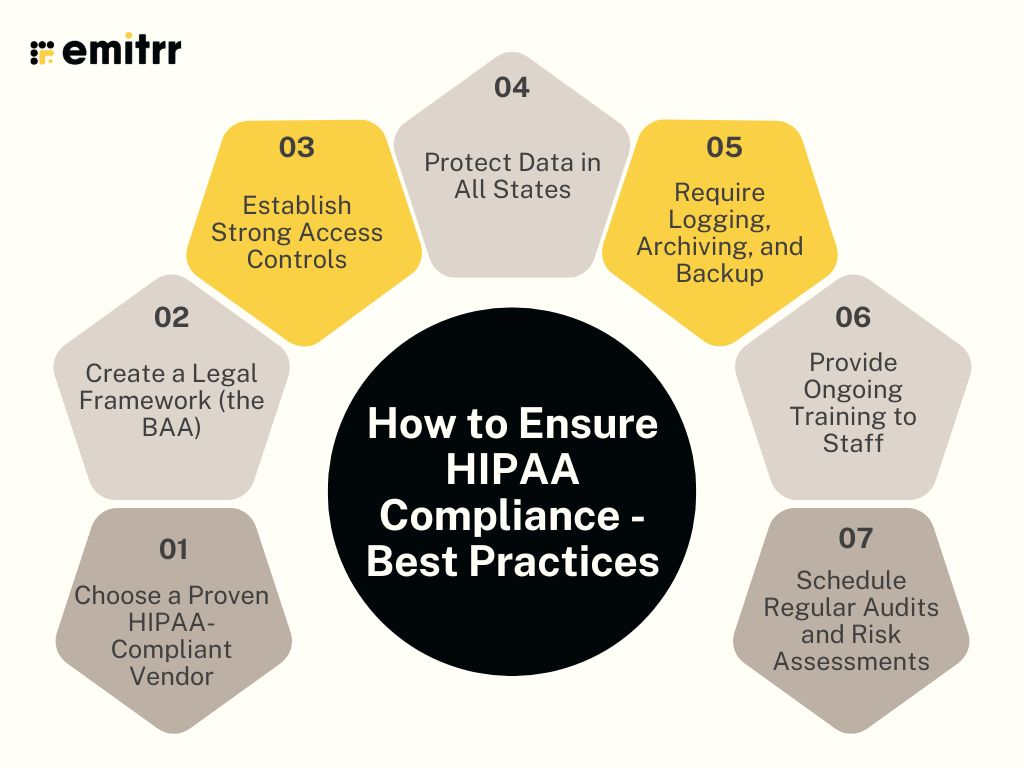
Transitioning from being non-compliant to utilizing a compliant HIPAA VoIP (Voice over Internet Protocol) solution involves a series of systematic processes. Transitioning involves some due diligence, technical setup, and controls, as well as keeping vigilant after the transition.
1. Choose a Proven HIPAA-Compliant Vendor
The first and most important step in your process is to partner with a telecom services provider that has expertise in healthcare VoIP-compliant solutions and is willing to sign a VoIP business associate agreement (BAA). It should be noted that while this paragraph is not assuming they are, you should obtain proof of their internal security controls, if they do exist, and past audits. A qualified vendor should already have the technical safeguards built in.
2. Create a Legal Framework (the BAA)
Execute the BAA with your chosen provider as soon as possible. The BAA establishes the responsibilities of the healthcare organization (the “covered entity”) and the VoIP service provider (the “business associate”) related to the protection of PHI.
In other words, with the BAA, your HIPAA-compliant phone system vendor agrees to properly:
- Provide VoIP data-at-rest encryption and VoIP data-in-transit encryption across all communications.
- Maintain a VoIP audit trail PHI log and secure backup for compliance audits.
- Limit who can access PHI via role-based access VoIP and VoIP user access control.
- Notify you of breaches immediately and cooperate during a VoIP compliance audit HIPAA review.
- Ensure that their subcontractors also comply with HIPAA’s security, privacy, and breach notification requirements.
No BAA equals no legal use of that provider’s service to protect and/or communicate PHI, regardless of how great the system is at encrypting the data or providing other security protocols. The BAA is your organization’s legal shield that establishes liability and accountability between both parties for protecting patient data.
3. Establish Strong Access Controls
Leverage the capabilities of the system to ensure the principle of “minimum necessary access” is followed at all times.
- Role-Based Access: Create Role-based access VoIP policies so that a front-desk receptionist may only have access to VoIP call logs; a clinician may access secure voicemail, and only an administrator may access VoIP access control to configure PHI settings in a VoIP application.
- Authentication: Require strong passwords, regularly change passwords, and use VoIP MFA users at each access point (desk phone, softphone, mobile app) to establish and authenticate VoIP identity.
4. Protect Data in All States
Ensure the provider is encrypting data in transit and at rest appropriately.
- In Transit: Calls and messages must be secured with end-to-end encryption, VoIP protocols like Transport Layer Security (TLS) and Secure Real-time Transport Protocol (SRTP). This is data in transit encryption for a HIPAA-compliant phone system.
- At Rest: Data stored like voicemails, secure chat history, VoIP call recording, HIPAA safe files must be secured by VoIP data at rest (ex., AES-256).
5. Require Logging, Archiving, and Backup
Use appropriate structures to hold people accountable and restore order during a disaster.
- Audit Trails: Enable VoIP with audit logs or a VoIP audit trail, as appropriate. Review regularly to see every access, change, or transmission of PHI. Logging for HIPAA compliance is necessary and also required for breach investigation.
- Retain and Back Up: Have HIPAA VoIP archiving & backup policies that follow state and federal medical record retention laws. Ensure the archive and backup are encrypted and tested regularly.
6. Provide Ongoing Training to Staff
Technology is only as secure as the individual utilizing it. Employees must have training related to secure, HIPAA-compliant VoIP service use, risks of using personal devices, and procedures for handling voicemails and recorded calls containing PHI.
7. Schedule Regular Audits and Risk Assessments
Compliance is an ongoing process, not just an initial effort. Incorporate regular VoIP compliance audit, HIPAA, and risk assessments to address any new VoIP security risks HIPAA that might be introduced through system upgrades, new features added, or changes in workflows.
Features to Look for in a HIPAA-Compliant VoIP System
| Feature | Why It Matters |
|---|---|
| BAA | Required under HIPAA |
| Encryption | Protects PHI |
| MFA | Prevents unauthorized access |
| Audit Logs | Supports compliance audits |
| Secure SMS | Enables compliant texting |
| Call Recording Controls | Protects stored conversations |
| Access Controls | Limits PHI exposure |
Ensure HIPAA Compliance with Emitrr
Emitrr offers the best HIPAA-compliant VoIP phone system that is built specifically for providers and other regulated industries. The system delivers AI automation, end-to-end security, and compliance communication tools, ensuring a seamless, protected environment for voice and text.
Some of Emitrr’s HIPAA VoIP features include:
- End-to-End Encryption VoIP: Emitrr makes certain that every use case for calls, voicemails, and text messaging is fully encrypted from sender to receiver, with encryption that prevents interception or tampering. This VoIP end-to-end encryption capability ensures that PHI is safeguarded during all methods of communication.
- Role-Based Access & VoIP User Access Control: Access to sensitive data is limited using role-based access VoIP permissions, meaning that only authorized staff can see or handle PHI. Admins can simply define access permissions for clinicians, front-desk teams, and administrators.
- VoIP MFA for Users: Emitrr adds a layer of multi-factor authentication (MFA) for users at the time of log-in, to verify user identity beyond the password. This VoIP for user MFA protection ensures that even if a user’s credentials were compromised, unauthorized access would not be possible.
- VoIP Audit Trail PHI & Secure Logging: Every interaction, calls, messages, voicemails, are logged using a detailed VoIP audit trail for PHI. This audit trail provides complete visibility of interactions by logging what data was accessed, by whom, when, and what steps may have taken place. This visibility provides simplicity when conducting compliance audits.
- VoIP Encryption for Data at Rest & Data in Transit: Emitrr uses VoIP data-at-rest and VoIP data-in-transit encryption to ensure that the data is unreadable regardless if at rest on a server or in transit via a network. This two-layered approach provides full PHI privacy and security.
- HIPAA VoIP Archiving & Backup: With HIPAA VoIP archiving and backup, you can automatically archive call logs, messages, and recordings at the same time. All backups maintain encryption and are secured according to the retention policies of HIPAA, which attest that the information is never lost or mishandled.
- VoIP with Secure SMS/Messaging & Secure Voicemail: Emitrr combines communication by utilizing secure SMS/messaging and VoIP with secure voicemail. The platform enables clinics and healthcare professionals to communicate updates, reminders, and follow-ups with patients and stakeholders, using encrypted SMS messaging features and VoIP to keep things HIPAA compliant and secure.
- Signed BAA: Emitrr will sign a VoIP BAA with all healthcare clients which will clearly define the joint responsibilities we will validate ou roles in protecting ePHI (Electronic Protected Health Information) for you and your organization. This agreement will legally bind Emitrr to HIPAA compliance for the safekeeping of ePHI with the clients responsibilities to hiring a HIPAA compliant VoIP provider and further protects Emitrr from liability once signed and agreed upon.
- Technical Safeguards: Emitrr uses end-to-end encryption VoIP for every conversation, and is supported with encryption for all VoIP data-at-rest, including recordings and voicemails to further protect this stored and continuing data as a reminder of the care provided to your patients. These technical safeguards ensure Emitrr is a HIPPA ready VoIP partner you can trust with secure communication for healthcare.
Whether it’s appointment reminders, teleconsults, or patient follow-ups, Emitrr’s secure VoIP for healthcare brings it all together under one compliant, AI-enriched solution, truly the most reliable VoIP HIPAA solution of 2025.
Key Takeaways
- HIPAA covers far more than text messages: every call recording, voicemail, video consultation, and fax-over-IP that references patient health information falls under the Security Rule.
- A BAA alone does not make a VoIP system compliant: the vendor must also implement encryption, MFA, access controls, and audit logging to satisfy the technical safeguard requirements.
- Non-compliant VoIP carries fines from $100 to $50,000 per violation with a $1.5M annual cap per violation category: a single breach event can trigger multiple categories simultaneously.
- AES-256 at rest and TLS/SRTP in transit is the current technical standard: any VoIP provider using older encryption standards (RC4, 3DES) should not be handling PHI.
- Multi-location practices face a higher administrative safeguard burden: workforce training, access policy documentation, and role-based permissions must be managed across every site.
- Why Emitrr: Emitrr delivers HIPAA-compliant VoIP with built-in encryption, secure access controls, audit logging, and healthcare-focused workflows without requiring extensive configuration.
Frequently Asked Questions
Ans: A HIPAA-compliant VoIP uses encryption, access control, logs all activity, and has a signed VoIP BAA to share compliance responsibility.
Ans: Yes, if the system is a VoIP call recording HIPAA safe system, that encrypts the recordings and stores the recordings securely with limited access.
Ans: Only if the vendor agrees to a VoIP BAA, and has VoIP data-in-transit encryption and VoIP MFA for users. If not, it is a VoIP non-HIPAA-compliant system.
Ans: Penalties for violating HIPAA with VoIP include fines of up to $50,000 per violation, and damage to reputation for any exposure of PHI.
Ans: Yes. Emitrr operates VoIP with secure SMS/messaging and VoIP with secure voicemail, both encrypted and HIPAA authorized.
Yes, VoIP can be HIPAA compliant if the provider offers the required security measures to protect patient information and signs a Business Associate Agreement (BAA).
A VoIP system is HIPAA compliant when it includes features such as data encryption, secure access controls, audit logs, secure storage of communications, and a signed BAA to ensure patient information remains protected.
Yes, healthcare providers can use VoIP systems, provided the platform is HIPAA compliant. The VoIP provider must offer appropriate security measures such as encryption, access controls, audit logs, and a Business Associate Agreement (BAA) to protect patient information and meet HIPAA requirements.
Yes, HIPAA applies to phone calls when they involve Protected Health Information (PHI). Any conversation that includes patient identifiers, diagnoses, treatment details, billing information, or other sensitive health data must be protected using appropriate administrative, physical, and technical safeguards.
Yes, patient calls can be recorded if the recordings are stored securely and managed in accordance with HIPAA requirements.
Yes, Zoom Phone can be HIPAA compliant when used under a HIPAA-supported Zoom plan and accompanied by a signed BAA.
Conclusion
As voice and text take center stage as communication modalities with patients, adopting a HIPAA-compliant VoIP system is not only a best practice; it is a requirement. Many VoIP providers implement identity authentication, audit logging, access controls, and encryption for VoIP, allowing for PHI to be safeguarded while trust with patients is maintained and assuring practitioners operate safely while HIPAA compliant.
Emitrr, the best HIPAA-compliant VoIP phone system enables clinics, hospitals, or multi-location networks to communicate securely but seamlessly by merging security with convenience.
Book a demo with Emitrr today and learn how to ease compliance while enhancing patient communication using a HIPAA-ready VoIP solution built for today’s healthcare ecosystem.


 4.9 (400+
reviews)
4.9 (400+
reviews)