
Patient engagement and satisfaction are two of the top priorities in healthcare communication. In the healthcare industry, it’s important to look after patients’ needs in a timely and efficient manner. One missed call can turn into a healthcare emergency, and clinics and hospitals need to prepare accordingly.
This is where hospital call center software swoops in and comes to the rescue. Medical call center software is a great tool and helps improve the entire call center workflow in healthcare organizations. It’s like a complete set of tools for managing call flow. It helps route calls in the right direction and makes sure communication stays smooth for both patients and providers.
This guide aims to break down how the hospital call center software works and the benefits of healthcare communication. So, let’s get into it.
Importance of Hospital Call Center Software
Hospital contact centers deal with a lot of call flow on a daily basis. On average, they handle around 2,000 calls a day, and even then, most manage to cover only 60% of what’s actually needed during the peak hours. Without smart call center software for healthcare, there’s a lot to manage, from missed calls to frustrated patients to overworked staff. That’s exactly where a good hospital call center software makes a difference, helping teams stay organized and patients feel heard without the long hold times.
These tools automate the entire routine, appointment reminders, insurance checks, and prescription updates so agents can focus on the calls that need human interaction. Automating just 34% of those daily calls could save hospitals around $43,702 every single day. That’s money that could be put toward the betterment of patients or even hiring extra resources when needed.
On top of that, these tools keep patient information secure and let hospitals stay on the right side of privacy rules like HIPAA. It also keeps a check on each interaction, so teams can spot patterns for problems early and get a better sense of what patients actually need. In busy, high-pressure spaces, having healthcare contact center software fixes a lot for both patients and providers.
Types of Hospital Call Center Software
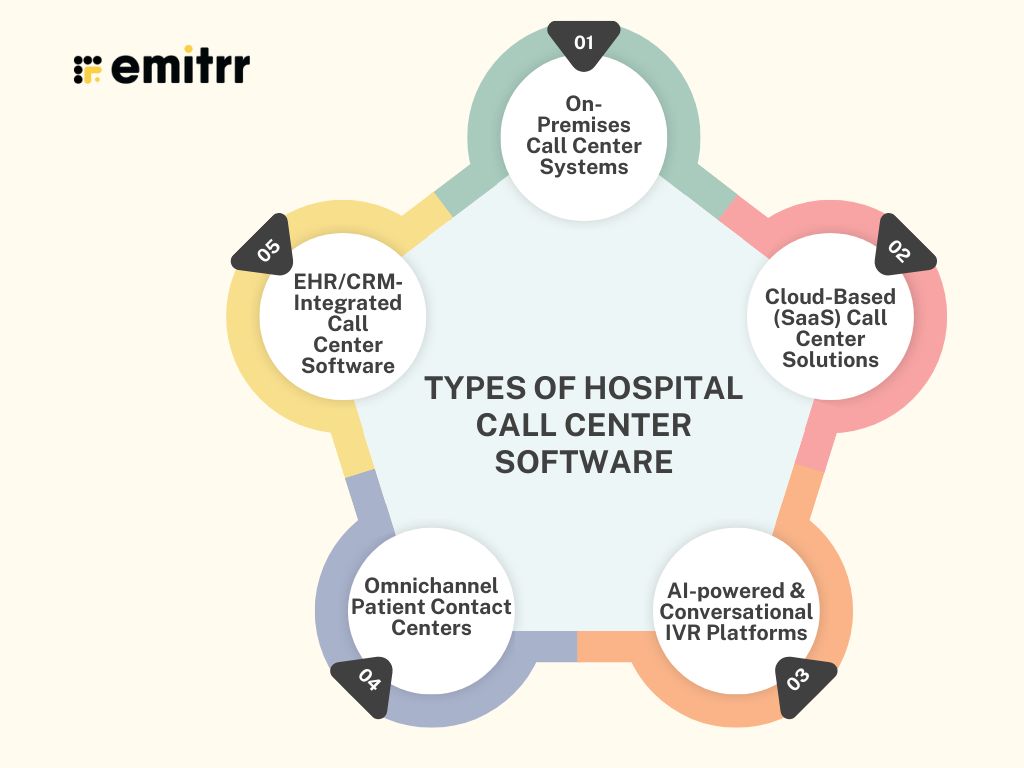
Not every hospital and healthcare provider runs their call center the same way. The right software depends on the hospital’s size, the patient’s needs, and how much freedom or control they have. Here are some of the most common types of healthcare call center software in healthcare.
On-Premises Call Center Systems
This is a kind of old-school setup where everything from servers and phones to software is installed and managed on-site. The hospital’s IT team looks after security, maintenance, and upgrades. While it gives them full control over patient data and system performance, it can also come with high upfront costs, space requirements, and a lot of continuous work to keep it running well.
Cloud-Based (SaaS) Call Center Solutions
These types of systems are a great choice because they are easier to set up, manage, and scale. Since everything is online, hospitals don’t need any heavy setup or large IT teams or manage it. These systems are flexible, support remote work, and usually come with automatic updates and security features to stay HIPAA compliant. Plus, if call volumes suddenly get high, scaling up is as simple as adding more users.
AI-powered & Conversational IVR Platforms
If you are thinking modern call centers are limited to phone menus, you’re wrong. AI-powered IVR systems let patients speak naturally, like saying “book an appointment” instead of pressing buttons. The system understands requests, directs calls smartly, and can even pull up basic patient info from the EHR. It makes the entire process more structured and also frees up agents’ time so that they can focus on calls that genuinely need a human touch.
Omnichannel Patient Contact Centers
Patients today tend to reach out in different ways, be it by phone, email, text, live chat, or even video calls. Omnichannel call center software brings all these conversations into one place. It helps agents keep track of a patient’s full history, no matter how they have contacted the hospital. This makes the process faster and more interconnected, with very few missed conversations.
EHR/CRM‑Integrated Call Center Software
The moment your call center software connects directly to your hospital’s EHR and CRM systems, everything comes into place. Agents can see the patient’s records, insurance information, and appointment details during the call without switching to different screens. Think about how much time it saves, reduces errors, and helps hospitals deliver more personalized care, exactly what a patient wants.

Top Use Cases of Hospital Call Center Software
Hospital call center software is booming in a way that they are utilized in all healthcare centers, from small clinics to big hospital settings. Let’s see some of its top use cases and understand how it’s working.
Appointment Scheduling & Rescheduling
Booking or changing an appointment previously meant spending hours on hold. Sounds annoying, right? But this was only until modern call center software came along. These systems allow patients to schedule themselves online, over the phone, or via text, often outside office hours.
70% of appointments are booked outside traditional work hours, and automated systems reduce no-shows by around 30% according to the data.
Now, instead of long wait times and manual calendar checks, modern systems help agents see doctor availability, patient preferences, and insurance details all at once. Now, this is the kind of flexibility patients expect these days.
Automated Reminders & No‑Show Reduction
Missed appointments not only affect clinic revenues but also put a hold on patient care and mess up daily operations. That’s where automated reminders built into hospital call center software come into play.
Studies show that automated reminders can cut no-show rates by nearly 29% making it a simple yet effective way to improve both patient attendance and clinic workflow.
This system can share personalized texts, emails, or calls, reminding patients about upcoming visits, medication refills, or test results. Now, instead of counting on manual reminder calls from staff, automated notifications make sure every patient gets timely updates. This way, patients can avoid missing appointments. For the front desk, teams can focus on more important patient interactions.
24/7 Patient Support via IVR & Chatbot Self‑Service
If you think healthcare runs on a 9-5 schedule, it does not. Patients can have questions or concerns after hours, and you need to address those with patience. That said, having 24/7 support through IVS (Interactive Voice Response) systems and chatbot self-service is a feature of high value.
Patients can get quick answers to common questions, check appointment details, request prescription refills, or even schedule visits, all without waiting for human expertise. So, naturally, it reduces call volumes at peak times and makes sure patients feel supported no matter what time they reach out.
Patient Follow-ups & Care Coordination
Keeping a check on patients’ health after an appointment is just as important as the visit itself. The aftercare that healthcare providers give means a lot to patients, and it should be timely. However, calling and engaging multiple patients during work hours can be overwhelming.
No worries, though, hospital call center software makes this an easy task by automating follow-up calls, messages, and care coordination reminders. Consistent follow-ups lower hospital readmission rates by nearly 20%. It helps patients stick to their treatment plans, show up for follow-up visits, and get timely care.
It’s a major win from both the point of view of patient safety and operational efficiency. When a centralized system comes into play to manage, care teams stay organized while patients feel genuinely looked after.
Billing Inquiries & Payment Assistance
Healthcare billing is vast and confusing to just about anyone. Hospital call center software makes it easier for patients to get quick and clear answers about their bills, insurance coverage, and payment options. From outstanding dues, insurance coverage, or setting up a payment plan, medical insurance call center software can help teams handle these conversations more efficiently and keep patients from being left wondering or bouncing between departments.
When you have built-in integrations and automated prompts, agents can easily track patient records and billing details during a call. Some systems even offer self-service options via IVR or chatbots for checking the balance and making payments anytime.
Did you know that hospitals report that up to 30% of patient calls are billing-related, making this one of the most crucial use cases for call center software? Once you streamline these interactions, let alone patient satisfaction, it can speed up the complete revenue cycle for healthcare providers.
Best Practices For Hospital Call Center Software
So, you have got the healthcare contact center software you wanted, and everything is great. But how do you make sure the software is in the best advantage for your healthcare services? Let’s explore some of the best practices for hospital call center software.
Prepare a Scalable, Cloud‑Based, and Unified Platform
There’s a reason why hospitals are shifting towards cloud-first call center software. Why? Because it scales easily and keeps everything in the loop, basically connected. So, even if your team is working from home, they wouldn’t need new hardware or phone lines; they can simply use smartphones and browsers while call volumes remain unaffected.
A unified platform means all communication channels, calls, texts, and video consulting are all under the same roof. That makes onboarding or adding new lines as simple as clicking a button. Now, because it’s cloud-based, updates, backups, and maintenance happen behind the scenes, which frees up your IT team to focus on important tasks.
With built-in analytics, you can also keep a check on busy hours, coverage levels, and response time. Great way to monitor everything in real-time.
Integrate Your Call Center Software with CRM and EHR Systems
Integrating your call center software with CRM and EHR systems is very important. With this, you have the right patient information at your fingertips so that you can sort out patients’ records, appointment history, insurance details, and past interactions while they are on the call without even switching tabs.
Provide Real‑Time Call Monitoring, Coaching, and AI Assistance
Even the best call center agents need support in high-pressure healthcare situations. Real-time call monitoring and coaching tools allow supervisors to take a live view of what’s happening on calls. This way, they can step in, guide conversations, and offer immediate feedback when needed.
Many hospital call centers have started using AI-powered systems that can make notes of live calls, track patient interaction, and make sure the conversation is headed in the right direction.
For example, Emitrr can help track call performance, missed call rates, average handle time, and jump in when a call needs intervention. It’s a practical, easy way to support your team in real-time, maintain quality, and manage sensitive patient conversations with care.
Use Call Analytics and KPIs to Optimize Staffing and Routing
Contact center healthcare is a busy place, and without clear insights, scheduling and routing can feel stressful. That’s why call analytics and KPIs are important; they help teams see what’s happening and make smart, data-driven decisions.
With platforms like Emitrr, real-time dashboards track everything from call volume and missed calls to average handle time and agent performance. Once managers review peak hours or long wait times in the data, they can adjust staffing levels or change call routing rules to match demand.
All in all, you get a more efficient operation, fewer dropped calls, more on-time answers, and better use of your team’s time. All of it adds up to happier patients and staff.
Ensure HIPAA‑Compliant, Secure Call Center Infrastructure
We can’t stress it enough, but protecting patient data is in the law, and it must be followed. Any healthcare call center services you use need to be fully HIPAA compliant, with strong security features that keep sensitive patient information more than safe.
Emitrr, for example, is built specifically for healthcare environments and stresses HIPAA compliance. It offers secure, encrypted communication channels for both voice and text interactions, along with access controls to track who’s handling patient data and when.
A secure, compliant system will reduce legal risks, build patient trust, and keep everything in place for healthcare providers.
Challenges With Hospital Call Center Software
While hospital call center software is a great way to keep up with your healthcare communication, there are some challenges to address as well. Let’s break down some of the top concerns below:
High Call Volumes and Limited Resources
High call volumes are one of the constant challenges in medical call center services. In healthcare crises, like COVID-19, natural disasters, or public health crises, hospitals tend to receive high call volumes. And it becomes difficult to manage everything at once.
This isn’t an ideal situation for patients, too, as they are forced to wait for long waiting times, resulting in missed appointments and no response in emergencies. Results? Overburdened staff and dissatisfied patients.
Thankfully, with healthcare call center software, providers can reduce wait times and improve customer satisfaction by directing incoming calls to the right agents. It also includes online appointment scheduling, digital check-in services, and virtual care services, allowing patients to receive the care they need without any waiting times.
Managing Complex Patient Communication Timely
Managing patient communication in hospitals is a tough task. There are multiple things to handle, from insurance queries to appointment scheduling and sharing sensitive medical results. It’s a lot on the table, and getting it right is just as important.
There are patient concerns regarding insurance coverage, billing details other insights; naturally, patients seek clarity before moving forward. Today, almost 88% of healthcare appointments are still scheduled over the phone, and call centers face heavy management while also looking after appointment requests, specialist referrals, and urgent care needs.
Agents also need to coordinate with doctors and nurses to make sure that whatever information they share is accurate and reassuring guidance.
In healthcare, average calls last around 3 minutes and 22 seconds, but complicated queries or poor coordination can delay communication.
The only way to handle this is by integrating healthcare call center solutions with CRMs, EHRs, and knowledge bases. When patient records, appointment schedules, and policy details are all in one place, it can resolve queries faster, reduce any chances of error, and make the patient experience satisfactory.
Technology Gaps and Outdated Systems
Outdated technology and lack of knowledge these two things that can hinder the overall healthcare administrative workflow. In addition, it affects the ability to deliver good patient engagement and care.
Especially, if we talk about the legacy systems, they often lack flexibility and integration capabilities important to meet changing healthcare demands. These technology limitations lead to reduced call quality, poor call routing, and more security risks.
If your team is dealing with outdated systems, it might also be affecting analyses like performance monitoring and optimization. The more you struggle with the system, the more you struggle to identify gaps and judge performance and decision-making.
The solution is to move to an advanced call center technology like hospital phone systems. Cloud-based phone systems, AI-driven solutions, and chat integrations can easily resolve patient issues and increase overall satisfaction.
Teamwork and Staff Retention
With external concerns, let’s not forget to address the internal conflicts leading to delays, missed details, and frustrated patients. Poor coordination between the healthcare call center staff and team is one major challenge for healthcare today.
Features like real-time call monitoring and performance dashboards can help give solutions to these issues by improving visibility and optimizing workflows, making it easy for teams to coordinate.
Another ongoing challenge is keeping trained staff around. According to reports, healthcare call centers face turnover rates as high as 30% – 45%.
This is driven by the demanding nature of the work and the smart agents’ needs, covering insurance rules, medical terminology, and shifting regulations. So, regular training, upskilling with AI technology, and clear communication channels are a must for agents in healthcare.
Handling HIPAA Compliance and Data Security
For any healthcare call center, especially in the US, HIPAA compliance is a must. Every call, message, and data record must be managed in a way that keeps patient privacy at the top of the list. The challenge here is high call volumes, sensitive conversations, and multiple platforms like telehealth and remote monitoring make protecting data more difficult than it ever was.
Thus, it is important for healthcare organizations to have secure phone systems, encrypted messaging, and protected data storage, and to prevent any suspicious activity.
Healthcare call center software makes sure everything is secure. They have end-to-end encryption for calls, texts, and emails, multi-factor authentication for agent logins, HIPAA-compliant cloud platforms with secure data storage, automatic backups, and details access login.
How to Set Up a Hospital Call Center Using Emitrr?
If your healthcare setting is busy with patient calls, appointment requests, and follow-ups, setting up a dedicated healthcare call center software with Emitrr is a smart move. It’s built for busy healthcare spaces and helps streamline communication from the day it’s set up.
Here’s how to set it up easily:
Define Your Call Priorities
Before anything else, decide what call types you want to structure: urgent care inquiries, appointment bookings, prescription refills, or lab results. This helps you organize your call routing and IVR options without any back and forth. So, urgent calls are managed first, and routine queries get automated responses.
Set Up Smart Call Routing
With Emitrr, you can easily make call flows that direct calls to the right department or staff member based on the caller’s needs. You can simply direct billing questions to accounts or route after-hours emergencies to on-call doctors. This means no time wasted transferring calls.
Enable IVR and Self-Service Features
Emitrr’s easy-to-configure IVR menu allows patients to easily pick between scheduling, insurance queries, or speaking to a nurse. You can also add chatbot and text-based options for common requests. A win-win for both you and your patients.
Turn On Automated Reminders and Follow-Ups
Settling up automated reminders with Emitrr is a pretty simple process. You can set up reminder texts, no-show follow-ups, and prescription refill notifications via text, email, or calls. It reduces missed appointments and saves your front desk from overwhelming manual follow-ups.
Monitor Performance with Real-Time Dashboards
Use Emitrr’s reporting dashboard to track call volume, missed calls, wait times, and appointment no-shows. It gives your admin team a clear view of daily operations and helps you adjust staffing or workflows wherever needed.
Integrate with Your Existing Tools
The best part is that Emitrr is easily integrated with EHR, VoIP systems, and billing software. This keeps patient records updated automatically and eliminates the struggle of double-entry data.
Overview of Hospital Call Center Software
Simply explained, hospital call center software is a practical tool that helps healthcare teams, like hospitals, clinics, and other healthcare settings, manage healthcare communication. It includes handling patient calls, appointment bookings, and follow-ups. All this while keeping sensitive information safe and following all necessary complaints. For a broader look at how these workflows operate in hospital environments, explore our guide to hospital call centers.
The best part is that it keeps communication organized, decreases hold times, and keeps a check that no important patient request falls out of place.
What exactly does it do?
If we start with the basics, the healthcare call center solutions manage:
- Appointment scheduling and rescheduling
- Billing and insurance-related questions
- Test results updates
- Prescription refill requests
- After-hours emergency calls dealing
Many advanced systems, like Emitrr, offer features like IVR menus, automated reminders, and call analytics to manage heavy call volumes without overburdening the hospital staff.
Who uses it?
The benefits that this software brings are helpful for more than just call center agents. You’ll find it helps:
- Front desk teams manage appointment calls
- Billing and insurance coordinators
- Triage nurse handling urgent care inquiries
- Admin teams are monitoring call performance
If you see statistics, healthcare call centers manage around 2,000 calls a day on average and unfortunately fall short of required resources during peak hours. So, in this case, phone systems for healthcare are a lifesaver for staying attentive and organized.
Features to Look for in a Hospital Call Center Software
Medical businesses are growing and thus need investment in advanced cloud-based call center technologies that support patient engagement, business growth, and manage heavy call volumes. Thus, looking at hospital call center software features is important to promote the best healthcare practices.

Omnichannel communication
Patients now have different ways to reach out, including text, email, and message. Multiple channels, though, can confuse, and coordinating can be challenging. A good call center software should assist your team in managing all those conversations in one place without getting confused. It should keep things structured and make sure no messages are missed.
EHR & CRM Integration
Whenever a patient calls, your team must be ready to pull out their records quickly. In this case, software that links directly with your EHR and CRM makes it easier to answer questions about appointments, billing, or prescriptions without putting them on hold or transferring calls here and there.
Smart Call Routing & IVR
No one likes being stuck between departments and waiting for confirmation for a long time. If you have a smart IVR system and skill-based routing, it can send a call straight to the right person. So, no waiting around to get a call from the department, whether it’s billing, urgent care, or a specialist. It saves time for both patients and your staff.
Automated Reminders & AI Chatbots
Missed appointments are a huge no-no in the healthcare setting as they cost clinics both time and money. So, always look for software that can send automatic reminders by text or call and has chatbots that can handle common, repetitive questions. This way, your team can focus on the calls that really need attention.
Real-Time Call Analytics
You cannot find a solution for what you can’t find. Built-in dashboards that track analytics, call volume, wait time, and patient satisfaction scores can help you spot problems early and manage staffing better. This is especially helpful in busy healthcare settings.
HIPAA-Compliant Security
When in healthcare, patient data security is not an option; it is a must-have. Your software should have solid encryption, secure call recording, and clear access controls to stay HIPAA compliant and keep sensitive information safe.
Call Recording & Quality Monitoring
The feature that lets you review the call history can be a lifesaver in cases of resolving issues or for training purposes. With quality monitoring tools, supervisors can check how agents are handling calls and give feedback whenever needed.
Must-Have Security & Compliance Features for Hospital Call Center Software
As discussed before, dealing with patient information is very delicate in healthcare. Hospital call center software must emphasize data privacy and HIPAA compliance.
- Every call, text, or email must be end-to-end encrypted to protect information whether it’s seen or sent, with no exceptions whatsoever.
- It’s also important to control who can access what. Role-based access can filter out the information staff need
- Multifactor authentication (MFA) adds an extra layer of security for system logins.
- Always pick a platform that offers a Business Associate Agreement (BAA) and secure, cloud-based infrastructure with real-time monitoring. Your system will be protected against data breaches while making sure you meet audit and HIPAA compliance without any difficulty.
Integrations Required For Hospital Call Center Software
Hospital call center software integrations are a great way to streamline the whole administrative process and make things easier for healthcare agents. Let’s explore some of the top integrations required for healthcare call centers.
EHR and CRM Integration
While working, agents need fast access to patient history, insurance details, and care plans. Even small delays can cost a lot, and it becomes more important to be vigilant in emergencies. Yet only a small percentage of hospitals have fully integrated their contact center software with EHR. Due to this, agents have to work on multiple systems and struggle to provide proper patient care. Strong integration offers a streamlined workflow, reduces errors, and speeds up issue resolution.
Telephony & IVR Integration
Voice system integration is also an important feature that routes calls correctly. There are advanced IVRs, and using voice recognition can automate repetitive tasks like appointment booking or prescription refills. In the healthcare space, this can deflect calls to SMS or self-service and easily reduce unnecessary human workload.
Telehealth/Remote Monitoring Platforms
Telehealth is here to stay for the long and call centers must use that to their advantage by linking directly to virtual care platforms. This connection will allow agents to help patients join video visits, review remote patient data, or adjust care plans.
AI-Powered Chatbots & Virtual Assistants
Automated assistants can do a lot more than human agents. They can handle daily inquiries, billing, and scheduling appointments more professionally than agents. This, of course, frees up time for agents to focus on complex situations and pushes proactive care.
Analytics & Reporting Tools
Having data insights is important for performance and planning. Systems equipped with real-time dashboards can help identify peak call times, first call resolution rates, and staff’s overall efficiency. Tracking these KPIs allows hospitals to fine-tune routine, staffing, and training.
How To Choose the Right Hospital Call Center Software
Now that you know the entire working of a call center software for healthcare, let’s work through how you can pick the right one for your healthcare communication needs.
Define Your Call Center’s Specific Needs
Before jumping straight to software demos and feature lists, it’s important to address what your hospital’s call center actually needs. As every healthcare organization operates differently, a busy multi-specialty hospital won’t have the same needs as a small outpatient clinic.
You can start by reviewing call volume, types of inquiries that are coming (appointments, insurance questions, prescriptions, or urgent care calls), and other channels that patients prefer. As 88% of healthcare appointments are still scheduled over the phone, understanding your patients’ habits is more important than ever.
Also, think about whether your team manages after-hours support, telehealth scheduling, or specialist referrals, as these use cases might demand advances in routing, integration with EHR systems, and secure messaging options.
Lastly, plan for growth ahead. If your hospital is expanding services or adding new locations, the software should be scalable. It should add users, phone lines, or new features with an overhaul of your entire setup.
Evaluate and Compare Software Vendors
Once you have figured out your call center needs, the next move is to shortlist vendors that can meet those demands. Don’t just look at big brand names; keep the focus on healthcare-specific solutions that are HIPAA compliant and built to handle patient data securely.
Start by checking each vendor’s track record in healthcare. Have they worked with hospitals, clinics, or specialty practices? For example, platforms like Emitrr have a proven healthcare client base and offer HIPAA-compliant cloud infrastructure.
Then you can compare features and integrations. Does the software offer easy EHR and CRM integration? Can it support appointment scheduling, patient reminders, real-time analytics, and secure messaging?
Also, request demos and trials from your top picks. Involve your frontline call center agents in testing the software, too. They can help spot usability issues or missing features that you might miss.
Conduct a Cost-Benefit Analysis
Before making a final decision about software, it’s wise to understand the costs against the value it will deliver. Think beyond just subscription fees, factor in setup changes, training expenses, integration costs, and ongoing support fees. Then, think about what you are getting out of it. Will the software reduce no-shows with automated reminders?
Understand how long it will take to recover your investment through these operational improvements and choose accordingly.
Plan for Implementation and Staff Training
Once you have picked your software, it’s important to plan a smooth rollout. You can coordinate with the vendor to set clear implementation timelines, covering everything from system setup and data migration to integration with your hospital’s EHR and CRM.
Then comes equally important staff training. There should be hands-on sessions to get familiar with the new tools, especially features like call routing, patient data access, and security protocols. This will make sure there are fewer errors and faster patient support from day one.
Last, keep a support plan in place for the first few weeks after going live. Encourage feedback from your call center team and avoid any issues early.
Why Emitrr Is The Best Hospital Call Center Software
Emitrr stands out because it’s built specifically for healthcare practices and not just generic call centers. How? Let’s see below:
- Healthcare-first design: Emitrr is built in keeping in mind clinics, hospitals, and healthcare groups with HIPAA-compliant communication tools
- 500+ EHR & PMS Integrations: It connects easily with major EHR and practice management systems for smooth appointment management, patient lookups, and follow-ups.
- Smart Call Routing & IVR: The platforms can direct calls to the right department or person, reduce hold times, and unnecessary call transfers
- Automated reminders: Sends SMS, email, or voice reminders that help lessen no-shows by up to 90%, keeping schedules on track
- 24/7 IVR & Chatbot Support: It lets patients access self-service options for usual tasks and inquiries after hours with needed human intervention
- Real-time analytics: You have access to live dashboards to track call volumes, wait time, and agent performance to help with better staffing and workflow decisions
- Built-in review management: Collects and manages patient feedback and online reviews directly via platforms to maintain your hospital’s reputation.
Conclusion
If you are looking for the best healthcare call center software, knowing its working, benefits, and challenges is important to make the best use of it. With advanced medical call centers, healthcare agents can now streamline and structure the complete healthcare
communication.
This helps increase patient engagement and satisfaction, which is exactly what the healthcare industry strives for.
Emitrr can be a great tool to simplify your medical call center services. From managing high call volumes to appointment scheduling and reducing no-shows, the platform is built to assist healthcare. So, choose wisely.
Frequently Asked Questions
Hospital call center software is basically a tool to manage patient calls, appointment bookings, test results follow-ups, and billing inquiries, all in one place. What makes it different is how easily it connects with existing hospital systems, making the integration and complete process in proper sync. It actually reduces wait times, improves patient experience, and keeps things in place even during peak hours.
Hospital call center software is specifically built for healthcare, and it’s crucial for them to be HIPAA compliant. The compliance keeps patient information safe through encryption, access controls, and secure data storage. It protects sensitive patient data and helps hospitals stay on the right side of healthcare regulations.
If we look at the basic features of a hospital call center software, there’s a lot that goes beyond just answering calls. A great medical cell center platform offers smart call routing, automatic appointment reminders, call recording, and live analytics. The main thing here is that it should connect easily with your EHR and billing systems. This would make things much easier for better synchronization within existing and advanced systems.
Yes, of course. A good software integrated directly with EHRs or EMRs so agents can quickly access patient records, update appointments, and log call details without going back and forth. It reduces errors, saves time, and makes patient interactions feel easy and personal.


 4.9 (400+
reviews)
4.9 (400+
reviews)