
Introduction
Remote work has morphed from a pandemic-era requirement into a permanent feature of today’s workplace. However, the issues with productivity, collaboration, and communication accompany the distribution of teams. AI technology for remote offices can be the solution to this problem, providing smart automation, real-time assistance, and coordination of work in different time zones for continuous connection and productivity.
Smart chatbots, intelligent scheduling, and workflow tools empower businesses to harness remote AI to automate tasks, boost the team’s morale, and grow their businesses. In this article, we dive into the way AI propels remote work forward, tools that make it possible, major benefits, obstacles, and the role of Emitrr, a platform that takes the lead in this transition.
Key AI Technologies Empowering Remote Offices
Throughout this shift, AI technologies have become indispensable in orchestrating distributed teams to collaborate efficiently, remain productive, and maintain security. These are some of the prominent AI-powered instruments that rebuild remote offices today:
Intelligent Virtual Assistants & AI Chatbots
AI virtual assistants aim at facilitating communication by automating frequent jobs, e.g., they answer employees’ questions, plan meetings, and keep track of reminders. The availability of these assistants all the time (24/7) allows them to help remote teams to be over time zone boundaries and help them do less manual work.
Smart Scheduling & Calendar Automation
AI tools-driven scheduling improves calendar management by taking into account availability, priorities, and deadlines. These systems automatically match and send reminders without the need for the remote employees, and at the same time, improve the overall time management.
Automated Workflow Management Systems
AI digitally replicates task assignment, status monitoring, and approval processes, thus assuring that projects are progressing as planned across various distributed teams. Besides saving time, this also eliminates mistakes and enhances visibility, which makes it easy for remote teams to collaborate smoothly without the need for continuous monitoring.
AI-Enhanced Communication Platforms
The integrated AI-powered real-time language translation system, as well as the voice transcription and meeting summarisation functions, provide a high level of clarity and inclusiveness. This feature also intelligently prioritises and routes messages, ensuring that collaboration is effective among teams scattered across different parts of the world.
AI-Powered Cybersecurity Solutions
Considering the fact that working from home has become a trend and it is also at the same time exposing companies to cyber attacks, the security tools that are driven by AI actively watch over the network and devices in real-time, thus they are able to instantly identify the source of danger and consequently eliminate it. These solutions not only prevent the leakage of sensitive data but also build up trust between parties involved in remote office settings through their safekeeping. By incorporating advanced tools like NordLayer’s deep packet inspection solutions, organizations can gain even deeper visibility into encrypted traffic and detect anomalies that traditional systems might miss.

Use Cases of AI in Remote Work Environments
Remote work is getting a facelift thanks to AI, which is doing the automatisation of tedious tasks, bettering collaboration, and safeguarding business continuity across time zones. Here are some instances where AI technology is helping teams working remotely to become more productive:
Meeting transcription & auto-summarisation
Such tools allow conferences to identify and then record an audio transcript, after which a summary can be generated of the main ideas presented, along with a list of course of action, thus tasks can be distributed correctly even in case somebody wasn’t able to join the conference live. This not only reduces the need for manual note-taking but also greatly increases the level of clarity amongst team members.
Remote onboarding & hiring automation
AI enables quicker, unbiased recruitment by reviewing resumes, conducting video interviews in a non-simultaneous mode, and evaluating candidates based on job fit. Also, it helps with onboarding by providing automated workflows and training modules designed for each new hire through an AI LMS.
AI-powered project tracking
Project management applications leverage AI to continuously monitor progress and due dates, set priorities and notify you about potential issues. They can also provide possible solutions and send reminders. Apart from all this, AI reduces the work burden on project managers and keeps remote teams aligned in real-time. For deeper visibility into how remote employees spend their time, an employee monitoring tool like Time Champ helps managers track productivity, monitor app and website usage, and generate detailed work-hour reports all without micromanaging.
24/7 customer support with AI agents
AI voice and text agents are available anytime to handle customer queries from anywhere in the world and across various time zones. They can respond to customers immediately, schedule appointments, or answer FAQs. Emitrr, for example, is a platform that allows small remote teams to provide enterprise-level responsiveness without having to increase the number of employees.
Sentiment analysis for team wellness
These AI systems go over internal communications and pick up emotional tone, stress level, or lack of interest. Thus, a leader of a remote team is not only able to pinpoint the signs of burnout or dissatisfaction but is also at the forefront of taking action before these problems worsen.
Benefits of Using AI in Remote Offices
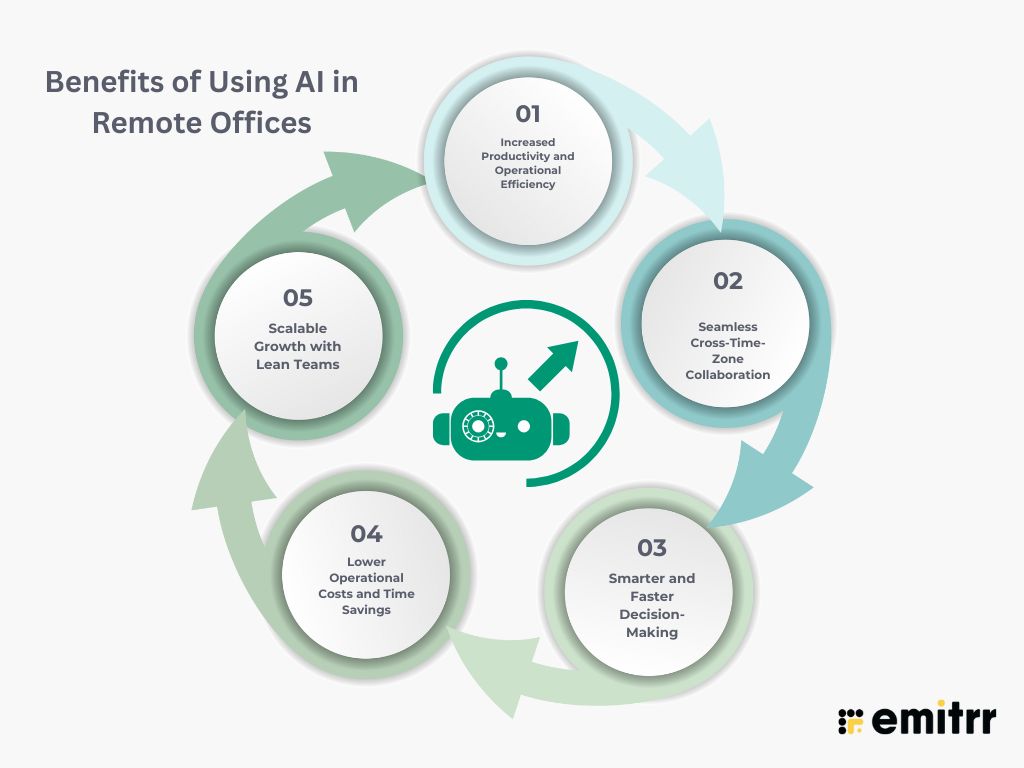
Increased Productivity and Operational Efficiency
Artificial intelligence takes over repetitive tasks like copying information, scheduling appointments, and making summaries of meetings. As a result, the team can concentrate on higher-value work, especially when switching to a standing desk helps reduce fatigue and maintain focus throughout the day.
Seamless Cross-Time-Zone Collaboration
AI automates routine tasks like data entry, appointment scheduling, and meeting summarisation. This allows remote teams to focus on high-impact work, reducing time spent on manual operations.
Smarter and Faster Decision-Making
AI tools collect data from performance, project workflows, and communication habits, analyse them, and then provide the information they get instantly. Managers can make better choices if they have the resources for planning, deadlines, and the optimisation of the team.
Lower Operational Costs and Time Savings
AI reduces the number of employees needed to provide support because it automates tasks such as answering questions, managing leads, and setting appointments. This means that there will be enormous savings both in time and money spent.
Scalable Growth with Lean Teams
The example of businesses using AI to grow without hiring more people is a case in point. AI systems enable a team to do more with less administrative work by automating repetitive tasks.
Challenges and Limitations of AI in Remote Work
- Privacy and Data Security Risks
AI technology is designed to collect and use data that is mainly confidential about individuals and organisations to function at its best. However, in remote setups, where equipment and networks differ greatly, this situation can become more dangerous and lead to data leaks or even wrong surveillance. However, in remote setups, where equipment and networks differ greatly, these risks can intensify, increasing the chances of data leaks or ineffective oversight. In such environments, thoughtfully implemented employee monitoring software can provide visibility into productivity and potential security issues while helping organizations maintain responsible and transparent monitoring practices. Unless strict rules are followed and end-to-end encryption is used, remote teams will continue to be at risk from cybercriminals.
- Over-Reliance on Automation
While AI does its best to take off humans’ routine work, too much reliance on it can lead to less human intervention. If there is a failure in the system or the data is wrongly interpreted, the consequences will be dealt with as if they never happened until they become very serious, particularly in distributed teams where immediate human intervention is usually not accessible.
- Potential AI Bias in Decision-Making
When AI tools are trained on data that is from the past or that is skewed, they may mirror or even increase existing prejudices. This is especially dangerous for remote hiring, performance reviews, or sentiment analysis, where the biased AI outputs might result in unfair evaluation, or situations where the deserving candidates are overlooked because of bias.
- Misinterpretation of Human Tone/Emotion
The work done by AI tools, especially those handling communication or feedback analysis, is often hard to understand the part of human feelings, sarcasm, or cultural context due to the subtlety of such phenomena. In remote teams, where only limited face-to-face interactions are possible, tone plays a major role; thus, such an issue can lead to misunderstandings or even uncalled-for responses.
- Tech Fatigue or Resistance from Teams
The situation is one where a worker is at risk of being overwhelmed due to being frequently introduced to new AI tools. There can be a case that employees may not be trained well or may feel that AI systems are spying on them, and this feeling of being watched may become resistance, frustration, or burnout, which is the opposite of intended productivity gains.
AI-Based Communication vs Traditional Communication in Remote Work
| Area | Traditional Approach | AI-Powered Solution |
| Scheduling | Manual coordination, back-and-forth emails, and timezone confusion | AI calendar tools auto-schedule based on availability, preferences, and time zones |
| Task Management | Task tracking via spreadsheets or manual project boards | AI automates task assignment, sends reminders, and predicts delays or dependencies |
| Communication | Email chains, delayed replies, and inconsistent message tracking | AI-enhanced platforms streamline chats, auto-respond to FAQs, and summarise threads |
| Support | Human reps are available only during business hours | 24/7 AI agents handle queries, triage issues, and escalate to humans only when needed |
Where AI Excels Over Humans in Remote Work
Speed and Scalability in Data Analysis
AI systems process and analyse data virtually at lightning speed, which is massive in size and of multi-dimensional nature that humans can hardly comprehend or get a grasp of. This allows remote teams to quickly make data-driven decisions, enhancing agility and operational efficiency because of AI.
Automation of Repetitive and Routine Tasks
AI is perfectly suited for tasks that need consistency and repetition, like automatically scheduling meetings, sorting emails, and managing workflows. In addition, eliminating human errors that often occur in such tasks leads to more focus on strategic work for team members.
Precision and Consistency in Execution
In addition to these, machines also do not get tired, suffer from mood changes, or get distracted; thus, they do not make mistakes in their work, both quantitatively and qualitatively. AI is well-suited for tasks requiring accuracy and standardisation, such as compliance checks, data entry, and performance monitoring.
Predictive Capabilities for Resource Planning
AI reveals patterns in past data, correlates them, and forecasts workloads, highlights project risks, and recommends resource allocation. Through handling such predictive functionality, remote teams can thereby be more targeted in their capacity management, operational planning and timeline arrangements across distributed teams.
Where Humans Outperform AI in Remote Work
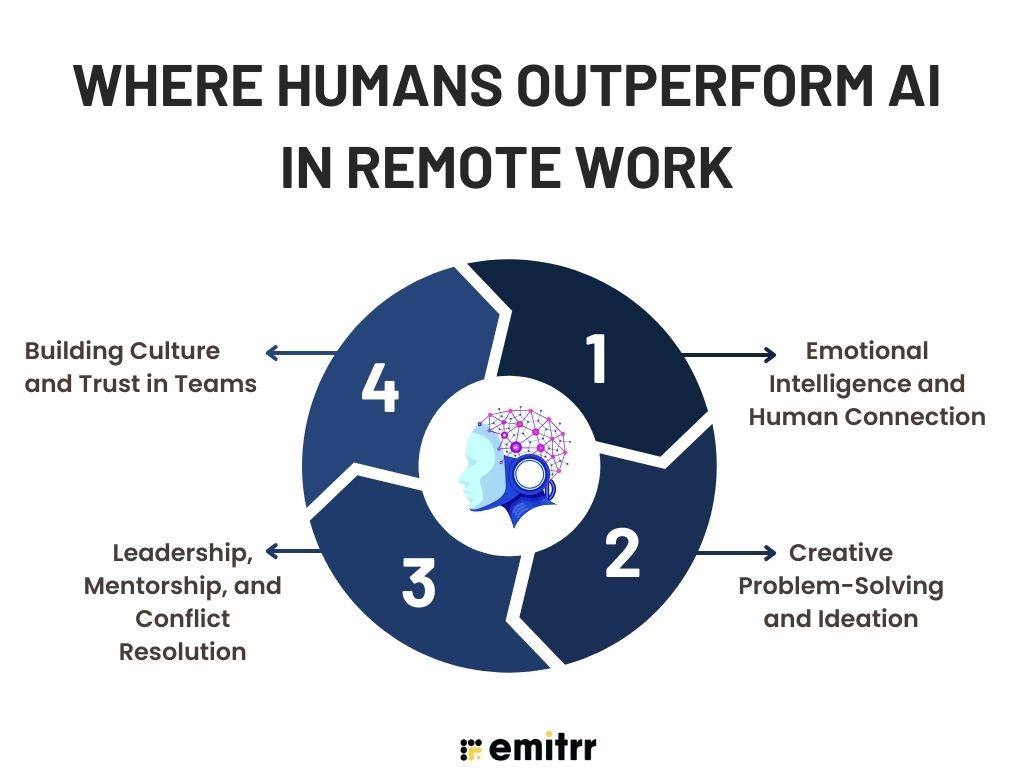
Emotional Intelligence and Human Connection
Remote work can leave one feeling lonely sometimes. Most humans are endowed with empathy, active listening skills, and emotional sensitivity; these are the qualities that team morale, employee engagement, and mental well-being cannot do without.
Simple actions like acknowledging contributions, celebrating achievements, and showing appreciation can go a long way in making employees feel connected and valued.
Organizations can strengthen these efforts by adopting a more structured approach to recognition. Building consistent employee recognition can reinforce positive behaviors and foster a stronger sense of belonging across distributed teams.
Creative Problem-Solving and Ideation
Although artificial intelligence (AI) can provide suggestions based on data, it still cannot perform intuitive reasoning and imagination, which are the major inputs in human creativity. New and creative ideas, especially in unclear or complicated situations, are still dependent on human resourcefulness.
Leadership, Mentorship, and Conflict Resolution
Successful leadership is characterised by qualities such as flexibility, motivation, and dealing with conflicts. Human leaders have the opportunity to lead teams through unfamiliar conditions, give mentorship, and work out the relations amongst the team members. These are areas in which AI cannot play a significant role.
Building Culture and Trust in Teams
The energy of an organisational culture comes from shared values, informal conversations, and emotional cues. Trust is built through authenticity and human presence, something that cannot be automated or artificially created. Providing remote employees with must-have remote office items fosters their presence and makes virtual interactions natural and engaging.
As work-from-anywhere becomes the new norm and no longer an exception, future-proof teams will be characterised by the marriage of AI and human capabilities. While AI offers unprecedented speed, precision, and scalability, it is human intuition, empathy, and creativity that add depth, significance, and cohesiveness to remote work.
Why Businesses Need Remote AI Now
The remote and hybrid work models that have been trending since COVID-19 have become popular, and businesses need to adopt new strategies for coping with changes and can’t rely on traditional tools and manual processes alone anymore. AI turns out to be the critical layer that energises modern remote offices, not only for ease, but also for long-term sustainability and growth. Therefore, the following are the reasons why embedding AI into remote workflows has become a must-have rather than an option:
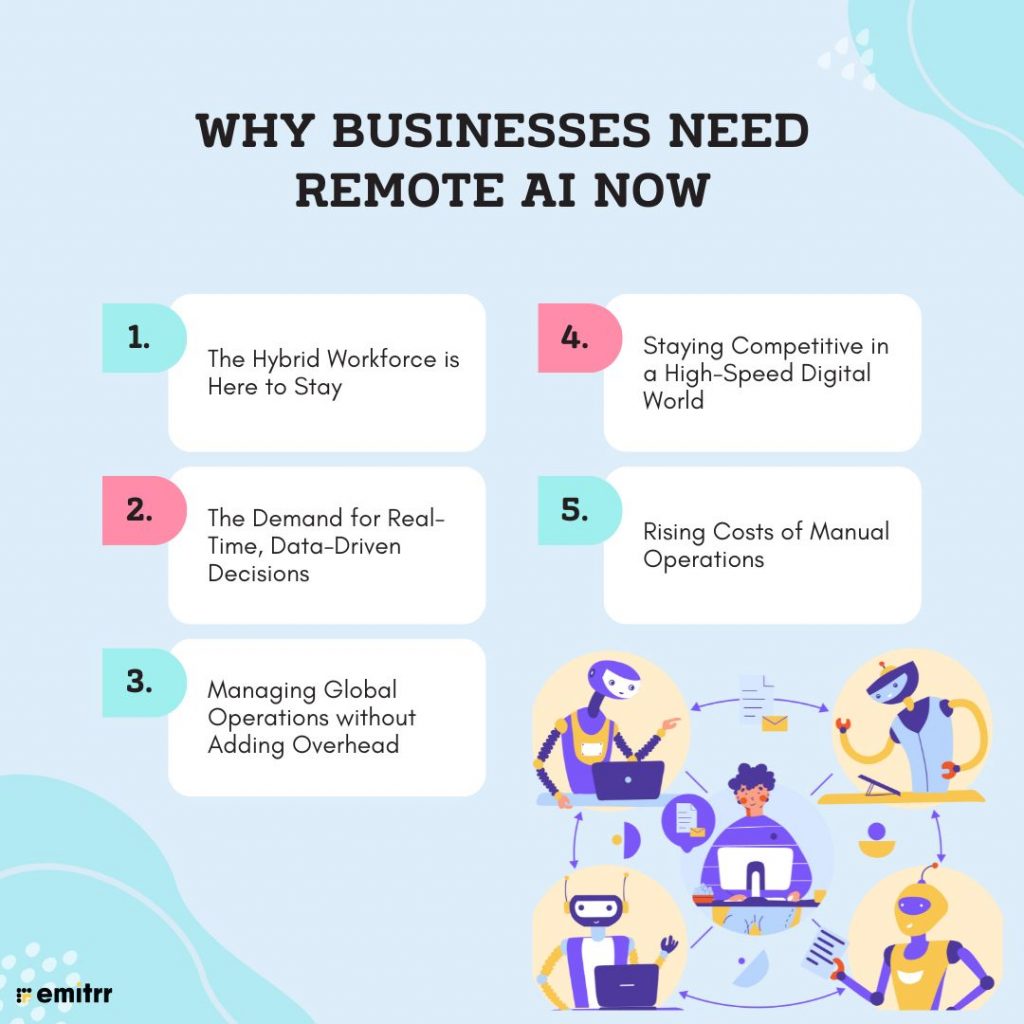
The Hybrid Workforce is Here to Stay
Due to the very nature of teams that are distributed all over the world, the coordination of working in multiple time zones, besides different languages, may be quite challenging, but AI comes to assist with this, ensuring that those inconveniences will be solved. For example, AI offers such features as real-time language translation, smart scheduling, and resource allocation to make teams work smoothly together, regardless of their location.
The Demand for Real-Time, Data-Driven Decisions
The very dynamic markets have this characteristic that they need decisions to be made quickly, so they don’t lose the advantage over their competitors; delayed decisions can turn out to be very expensive. AI deployment analytics help leaders extract actionable insights from vast data streams, allowing teams to act quickly and accurately, even without being in the same room.
Managing Global Operations without Adding Overhead
Automation practice in AI enables managers to organise tasks, activate repetitive work, and customer support even non-stop without human intervention, leading to performance at efficient levels as well, and all these can be done without increasing employee numbers. This, in turn, allows businesses to grow without having to raise operational costs proportionally.
Staying Competitive in a High-Speed Digital World
Automation through AI is not only about becoming more efficient, it also means being able to meet the changing customer requirements, improving the quality of the products and reducing the turnaround time. Companies that are leveraging AI are gaining a measurable edge in real time.
Rising Costs of Manual Operations
Artificial Intelligence (AI) has changed the employment landscape. It automates HR, IT, and operations tasks such as hiring, onboarding, and monitoring performance. Higher wages and rising administrative costs are taken care of by AI, which decreases the need for human resources to perform repetitive tasks.
Why Emitrr is the Ideal AI Platform for Remote Teams
In the time when modern businesses have remote and hybrid teams as their backbone, using the right tools can become a game-changer. Emitrr is no one-to-many communication platform; instead, it is a remotely designed AI superpower for going through operations swiftly, getting more responsiveness, and solving repetitive problems with distributed teams. The following are the reasons:
Unified Communication & Support Across Channels
Emitrr is a tool that merges all communication into one unified space, regardless of where your customers or team members are. The platform covers your team from AI voice agents to SMS responders and smart auto-replies; therefore, even if your team is in different time zones, they can still be in sync without missing anything.
- Responds 24/7, without needing a live agent every time
- Eliminate gaps in communication with automated routing and replies
Intelligent Call Handling and Routing
Besides routing an urgent service call, managing higher volumes during peak times is a challenge that Emitrr’s AI-powered smartphone steers correctly and no real-time call of any customer or lead is left behind.
- Automatically route calls to the appropriate person or customer at the right time.
- Manages call queues efficiently and also sends missed call texts instantly
- Reduce manual call triaging with intelligent automation
AI-Powered Automation to Reduce Manual Work
Remote teams are successful only if they aren’t consumed by monotonous work. Emitrr is in the position to perform tasks like appointment scheduling, lead capture, follow-ups, and SMS campaigns; it does so automatically.
- Send personalized sms journeys with auto-scheduling
- Respond quickly and instantaneously with AI-supported answers
- Team is motivated to work on high-value tasks instead of monotonous work
Self-Evolving AI that Improves Over Time
Emitrr’s AI gets better the more you use it. Unlike basic automation tools, it self-learns and improves without requiring constant updates or manual retraining.
- Adapts to changing scripts, scenarios, and customer behaviour
- Improves accuracy over time, leading to smarter responses
- Zero maintenance burden on the remote IT teams
Seamless Integration with Remote Work Tools
No need to change your systems completely. Emitrr is designed to work with your existing team’s favourite applications without any friction. It can be CRM platforms, HRMS, calendars, or project management software.
- More efficient workflows without switching between different tools
- Data is automatically synchronised across departments
- Compatible with the apps your remote teams depend on
Scalable, Affordable, and Remote-Ready
Emitrr’s open and extensible framework allows it to grow as your business expands. From a start-up to an organisation managing endless offices remotely, the platform offers modular pricing, allowing a high ROI irrespective of your team size.
- Plans tailored to fit small and large enterprises
- Only pay for the uptime you consume with no additional fees
- Remote-ready from the get-go
Real-World Impact and Case Examples
Emitrr is not at the concept stage; it is an on-the-ground operation. Healthcare, retail, home services, and education are the industries where Emitrr is utilised and teams have disclosed.
- More than 100 hours saved monthly via automation
- Better response times and more loyal customers
- Higher team productivity in both virtual and hybrid situations
When you set up or manage a remote team, the tools you use need to flex with your needs, adjust, and be available 24/7. With Emitrr, you have a smart communication and automation platform designed for remote work as your assistant.
Want to see how Emitrr’s AI Voice Agent is transforming businesses? Watch this YouTube video now!
Future of AI in Remote Offices
AI-Powered Project Orchestration
AI is transforming to become more than just an assisting tool. Soon, AI machines will not only walk the talk but also actively distribute, change priorities, and adjust work among remote teams. They will do this based on actual work, delivery time, and team performance registered in real-time. Besides that, these AI-powered orchestration engines will keep work on track, as they will be actively monitoring even in different time zones.
Personalised AI Workflows for Every Employee
AI is gradually replacing traditional human tasks with one that fits an individual’s work style perfectly. AI will facilitate remote workers by recommending not only the best meeting hours but also adjusting their dashboards based on their KPIs to enable them to perform better with less effort. Such a high degree of personal relevance may have a strong impact not only on the reduction of cognitive overload but also on the increase of satisfaction with the final product.
Spatial AI Collaboration
The moment AR/VR technology fuses with AI, spatial collaboration will revolutionise the way work is done remotely. Imagine a virtual whiteboard where the avatars are interactively brainstorming in 3D spaces, AI is converting the discussion into notes, highlighting the points, and also syncing them with the project management software. Besides, intelligent, vibrant surroundings will replicate the vibe of a face-to-face meeting, although without the travel part.
AI for Mental Wellness and Burnout Detection
Burnout menace in remote teams is a silent killer. Novel artificial intelligence programs will continuously survey working hours, language used, and excitement levels of the participants to indicate the seed of tiredness or stress. In addition to wellness ideas, reminders for breaks, or notifications for HR, these AI tools can secure team well-being and lower staff turnover.
Decentralised & Privacy-First AI Collaboration
Currently, privacy issues have become an extremely important priority for many at a global scale; as such, the future of AI in remote offices is seen in scenarios where decentralised and edge-based models are used. In these systems, the data stays local, thus both privacy and intelligent insights are preserved. Remote teams will be able to enjoy AI offers without having to worry about their sensitive information being leaked.
Voice-First AI Interfaces for Hands-Free Work
Voice-first AI is definitely going to be one of the biggest elements in remote settings in just a few years. When it comes to such things as scheduling or sending emails, analysing reports, without touching a keyboard, voice-enabled AI will allow multitasking, furnish accessibility, and raise efficiency in a home or mobile workplace.
Proactive AI Mentorship and Training Systems
AI is going to act as a mentor by looking into the career path, skills that are not there, and the performance record and then giving a list of needed education for oneself. The new ones will get automated onboarding, while the experts will be given the option to continue education if they want to, by AI-powered guidance engines.
FAQs
There is no “best” tool as such; they all have their unique and important features. For example, AI-powered unified communication and automation that is good for support and operations. On the other hand, platforms like Notion AI, Grammarly Business, and Motion help with writing, productivity, and scheduling. The most suitable AI tool is related to the number of your team, their objectives, and the work organisation.
No, and that is how it should be. AI is great at handling repetitive tasks, data analysis, and decision-making, but human skills such as creativity, leadership, emotional intelligence, and cultural building are definitely needed. The best outcomes result from human-AI cooperation, not replacement.
How AI platforms implement privacy and data use differs greatly. Dependable providers are characterised by adherence to strict rules concerning data encryption, GDPR, and privacy-first AI. It is always advisable for businesses to familiarise themselves with a platform’s security policies and select the tools that permit customising, being transparent, and having control over the use of the data.
The following are some of the relevant use cases:
Smart meeting transcription and summarisation
Automated customer support through AI agents
AI-powered project and task tracking
Sentiment analysis for team well-being
Remote hiring and onboarding automation
Most certainly. AI makes it possible for small businesses to compete with their larger counterparts without the necessity to maintain vast support teams, improves response time, and optimises workflows. Taking advantage of modular pricing and platforms that can be scaled, like Emitrr, allows small teams to implement AI without incurring high overhead costs.
Conclusion
Technology is dramatically changing the labour force, but it also alters the locations and times of work. As virtual and mixed models grow and change, using AI is not a simple change; it is an essential strategy. The suitable AI solutions enable teams to work in a more intelligent, faster, and more enjoyable manner by automating the boring tasks, improving collaboration and support, and being able to go anywhere without losing the effect of the place they are in.
Begin your AI path with Emitrr and get a remote team that can perform at a high level, fully functional, and ready for the future, anytime, anywhere.

 4.9 (400+
reviews)
4.9 (400+
reviews)