
Introduction
For a podiatry clinic, voicemail isn’t just an afterthought, it’s often the first voice your patients hear when you’re not available. A great greeting can set the tone, reassure callers, and even save you time in the long run. In fact, most people won’t bother leaving a message if the voicemail greeting isn’t helpful or inviting. That’s huge! It means the quality of your message could make the difference between a patient hanging up or getting the info they need. So, what does the best voicemail greeting for podiatrists sound like? In this guide, we’ll break it all down.
We’ll explore why voicemail still matters for your foot clinic, you’ll learn best practices, we’ve even packed in plenty of medical office voicemail message examples and voicemail greeting for podiatrists template scripts you can snag for your own practice! By the end, you’ll know exactly how to craft voicemails that make callers feel cared for and keep your clinic running smoothly. So let’s dive in!
Why Voicemail Matters in Podiatry Clinics
Here’s why a solid voicemail greeting matters, from every angle:
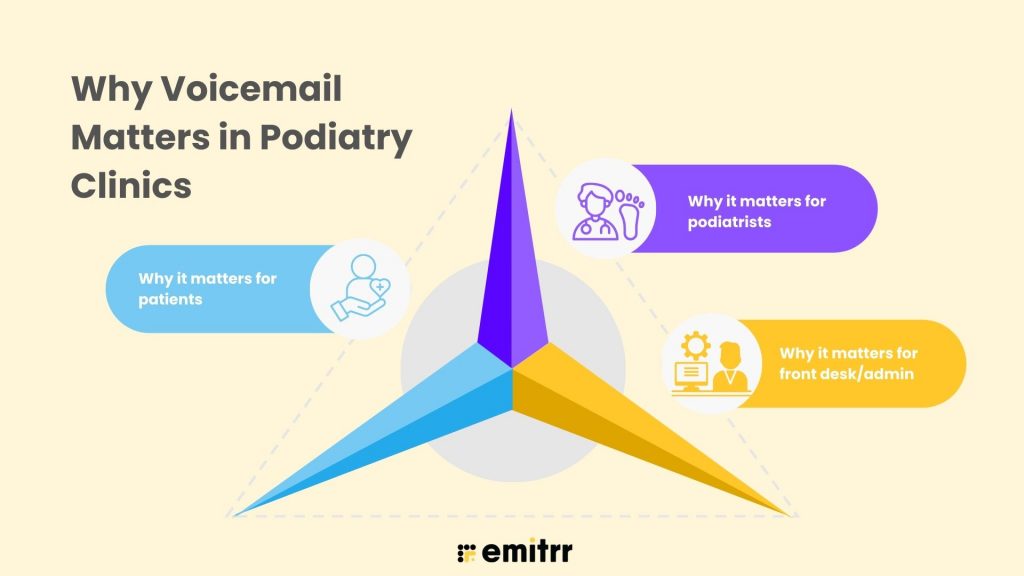
Why it matters for patients
For your patients, voicemail can be a lifeline when they can’t reach you directly. Think about an elderly patient with heel pain calling after hours, or a worried parent calling about their teenager’s ankle sprain. A warm, clear voicemail greeting instantly assures them that they’re heard and that help is on the way.
On the flip side, if all they get is a robotic “Leave a message” or confusing phone maze, they may hang up feeling frustrated or anxious. Your voicemail is essentially a virtual front desk staffer: it should tell them what to do next, set expectations, and show empathy. When done right, it builds trust and makes patients feel looked after, even when you’re not there to pick up.
Why it matters for podiatrists
From the podiatrist’s perspective, a good voicemail system protects both your patients’ health and your practice’s bottom line. First impressions are a big deal, your voicemail is often the first impression new callers get of your clinic. A clear, professional greeting signals that your practice is organized and caring, whereas a muddled message might send them running (or dialing another doctor).
If a patient with a painful bunion calls and can’t get through or isn’t sure you’ll call back, they might seek help elsewhere. In a world where customer experience is king, voicemail mismanagement can erode trust and hurt patient retention. On the other hand, a great system ensures urgent issues don’t fall through the cracks and that patients know you’ll get back to them.
Why it matters for the admin/front desk
Your front desk and admin staff are the unsung heroes juggling ringing phones, patient check-ins, and insurance paperwork – sometimes all at once. A well-crafted voicemail greeting for podiatrists will act like their personal assistant, helping handle calls when they can’t. By directing callers to leave key info or informing them of office hours, the voicemail can reduce the call load on your staff.
This is crucial for a small podiatry team, if one person has to listen to 50 messages after lunch, important requests might get delayed. In short, a smart voicemail setup makes your admin workflow saner: less phone tag, more prompt responses, and no patient “left in the dark.”
Best Practices for Voicemail in Podiatry Clinics
Now that we know why voicemail is a big deal, how do we make yours effective? Whether you’re setting up a new greeting or sprucing up an old one, these best practices will ensure your voicemail checks all the right boxes:
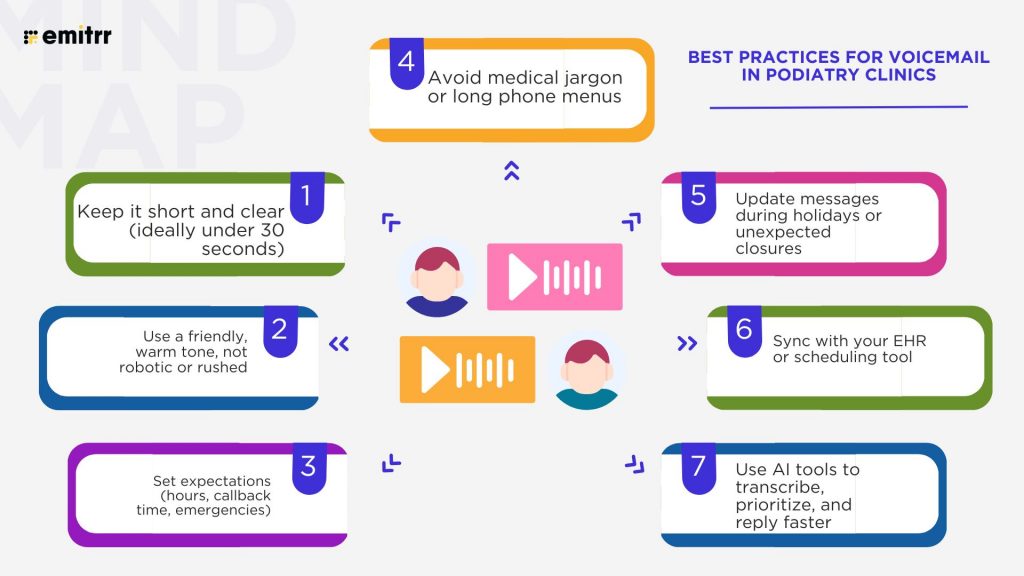
Keep it short and clear (ideally under 30 seconds)
Patients don’t want to sit through a long-winded message, they want the key info quickly. Aim for about 20 to 30 seconds max. In that time, you can cover who you are, why you can’t take the call, what the caller should do, and a polite thank-you. That’s it. Keeping it brief not only respects your caller’s time, but it also increases the odds they’ll actually listen to the whole message (and leave you a voicemail).
Use a friendly, warm tone, not robotic or rushed
Ever heard a voicemail that sounded like a bored robot reading a script? Don’t let that be your clinic! Tone is everything. Even though it’s a recording, you want the caller to sense a human on the other side who cares. Use a friendly, warm tone, as if you were speaking to the patient in person. Smile as you record (strange as that feels), it actually makes your voice sound kinder. And don’t rush: speak at a calm, conversational pace.
Set expectations (hours, callback time, emergencies)
One of the smartest things you can do in a voicemail greeting is to tell callers what to expect next. If your office is closed or you’re tied up with other patients, say so, and give your office hours or when you’ll be back. Example: “Our clinic is open Mon-Fri, 9-5, and we’ll return your call the next business day.” This prevents the caller from repeatedly calling or wondering if you got their message. Also, always include what to do in case of emergencies. Setting these expectations helps in two ways: it reassures patients, and it buys your team the appropriate time to respond without people panicking.
Avoid medical jargon or long phone menus
Keep your voicemail message easy to follow. Use simple language, if a term isn’t something you’d use in casual conversation with a patient, skip it. The same goes for having an overly complex phone tree. You’ve probably experienced those frustrating menus yourself: “Press 1 for this, 2 for that, 3 for the other, 4 to hear these options again…” By the time the poor caller presses a number, they’ve forgotten which option does what. The goal is to avoid overwhelming the caller.
Update messages during holidays or unexpected closures
Life happens, clinics close for holidays, staff training days, or the occasional snowstorm. Your voicemail should keep up. Remember to update your greeting whenever there’s a change in routine, like a holiday closure or any unexpected event that affects your hours. There’s nothing worse for a patient than calling on Christmas Eve, hearing the normal greeting, driving to the clinic the next day, and finding it closed. Keeping your voicemail up-to-date shows professionalism and saves everyone from such slip-ups.
Sync with your EHR or scheduling tool
Integrate your voicemail system with your EHR (Electronic Health Record) or scheduling software if possible. The idea is to make sure voicemails aren’t living in a silo. By syncing or logging them with your main tools, you ensure follow-ups happen and you have a paper trail. Plus, if multiple people handle calls, everyone can see what’s been addressed. In a busy podiatry practice, this coordination prevents double-booking or forgotten calls. It keeps your communication organized and efficient.
Use AI tools to transcribe, prioritize, and reply faster
AI tools, from simple voicemail-to-text services to full virtual receptionists, can be a game-changer. One basic step is voicemail transcription: using a tool that transcribes the voice message into text. This saves time and helps you prioritize. Beyond transcription, some clinics use AI assistants that can interact with callers. These systems might answer common questions, book appointments, or at least categorize voicemails by topic. In fact, AI answering services can automate a lot of simple calls, freeing up your team’s time. Embracing these tech tools will help you respond faster, making your small team super efficient without losing that personal touch!
Watch this video before using voicemail transcription to get best results:
Use Cases of Voicemail Greetings in Podiatry Clinics
Not all voicemails are one-size-fits-all. You need different greetings for different situations. Let’s walk through some main ones:
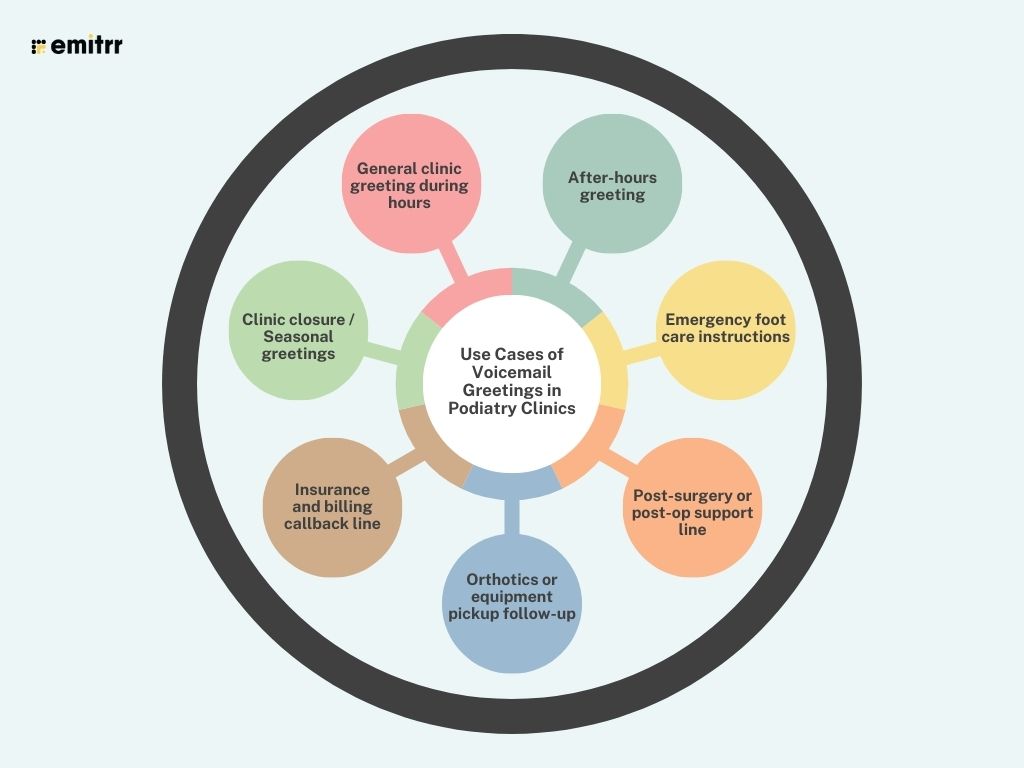
General clinic greeting during hours
This is your bread-and-butter voicemail, the one callers hear when they ring during normal office hours but no one can pick up (maybe you’re with a patient, or the front desk is swamped). The purpose here is to assure the caller that the clinic is open and active, and you’ll get back to them soon. You should ideally mention that you’re busy helping other patients at the moment. This lets them know their call isn’t being ignored, you’re just tied up. It’s also like an invitation for them to leave their name, number and a brief reason for calling so you can return the call promptly. The tone should be upbeat and welcoming.
After-hours greeting
When your clinic is closed, whether it’s after 5 PM or over the weekend, a medical assistant voicemail script should take over. The after-hours greeting needs to make it clear that the office is closed and repeat your regular hours so callers know when to expect a response. This way, no one is waiting for a late-night callback. Most importantly, the script must include emergency instructions, such as calling 911 or reaching an on-call doctor if one is available.
Emergency foot care instructions
There are times a patient might need immediate help – say, a possible ankle fracture, signs of infection spreading up the leg, or severe post-surgical complications. Your emergency greeting should cut straight to the chase: if it’s a medical emergency, they need to seek immediate care (911 or ER). That way, no one wastes time leaving a voicemail when they should be getting care. If you have an on-call number or nurse line, you can share that too.
Post-surgery or post-op support line
A post-op support line voicemail is for patients who’ve recently had surgery and may have questions or concerns. If you use a separate number for these calls, the greeting should mention it’s for post-surgery support. Since patients may feel anxious, keep the tone calm and reassuring. Having a dedicated voicemail for recovery helps with voicemail triage, showing you take aftercare seriously and that support is always within reach.
Orthotics or equipment pickup follow-up
If someone’s calling about orthotics or equipment, your voicemail should make things easy for them. A simple line like, “Hi, you’ve reached the orthotics department at [Clinic Name],” works well. Then, ask them to leave their name, order details, and what they need, maybe checking if their inserts are ready or setting up a pickup. This way, your team can check everything before calling back, and the patient isn’t left waiting for answers.
Insurance and billing callback line
Billing calls usually don’t need a doctor. They need the right office person. That’s why having a separate billing voicemail helps. The greeting should let callers know they’ve reached the billing desk and guide them on what to leave, like their name, account info, and question. It’s also good to give them a timeline: “We’ll return your call within 1-2 business days.” Keep the tone calm and understanding, because money questions can already feel stressful.
Clinic closure / Seasonal greetings
Closures happen, whether it’s a holiday, a staff day, or something unexpected like bad weather. Your voicemail should say so right away: why you’re closed, when you’ll reopen, and that you’ll reschedule any missed appointments. Around the holidays, it’s also a nice touch to add a quick greeting like, “We wish you a happy and healthy season.” It keeps things personal and lets patients know you’re still thinking of them even while the office is shut.

Ready-to-Use Voicemail Scripts for Podiatrists
Here are a bunch of ready-to-use voicemail greeting examples tailored for podiatry clinics. You can feel free to tweak the wording so it fits your practice’s personality:
General Clinic Greeting (During Office Hours)
Template 1: “Hi, you’ve reached [Clinic Name]. We’re sorry we missed your call. Our team is helping other patients at the moment. Please leave your name, phone number, and a brief message, and we’ll call you back as soon as possible. If this is a medical emergency, please hang up and dial 911. Thank you!”
Template 2: “Hello, and thank you for calling [Clinic Name]. We apologise that we can’t pick up right now. It’s likely we’re with a patient or on another call. Kindly leave your name, contact number, and the reason for your call. We promise to return your call promptly. Remember, if you’re experiencing a medical emergency, hang up and call 911 immediately.”
Template 3: “You’ve reached [Clinic Name]. We’re currently attending to other patients. Your call is important to us, so please leave your name, the best number to reach you, and a short description of how we can help. We’ll get back to you as soon as we can. For any urgent medical needs, please call 911. Thanks, and have a great day!”
Template 4: “Hi there, this is [Clinic Name]. We’re sorry that we can’t come to the phone right now. Please leave your name and number, and let us know how we can assist you. We’ll return your call as soon as possible. If this is an emergency or you need immediate care, please hang up and dial 911. Talk to you soon!”
After-Hours Greeting
Template 5:
“Thank you for calling [Clinic Name]. Our office is currently closed. We are open Monday through Friday from 9 AM to 5 PM. If you need urgent medical attention before we reopen (for example, if you’re in severe pain or have an emergency), please hang up and call 911 or go to the nearest emergency center. Otherwise, feel free to leave your name, number, and reason for calling. We’ll return your call on the next business day. Take care!”
Template 6:
“Hi, you’ve reached [Clinic Name] after hours. We’re sorry we missed you! Our normal hours are 8 AM to 6 PM, Monday to Friday. If this is not urgent, please leave us a message with your name and phone number, and we’ll get back to you first thing when we’re back in. If you require immediate assistance (for example, you suspect a broken bone or have another foot emergency), please go to your nearest urgent care or dial 911. Thank you for understanding.”
Template 7:
“Hello, this is [Clinic Name]. Our clinic is currently closed. We will reopen on the next business day at our regular hours. In the meantime, if you’re calling about a routine matter (scheduling, general questions, or follow-ups), please leave your name and number, and we’ll call you back when we open. However, if your concern is urgent or you can’t wait, please contact the on-call provider at [on-call number] or dial 911 for emergencies. We hope you have a good day, and we’ll speak with you soon.”
Template 8:
“You’ve reached [Clinic Name] after hours. We’re not in the office right now. You can still leave us a message! Please let us know your name, why you’re calling, and a callback number. We check these messages and will respond on the next working day. But if you’re dealing with a serious or urgent health issue, please seek immediate care. Call 911 or head to the emergency room. Thank you for calling, and we’ll be in touch soon.”
Emergency Foot Care Instruction Line
Template 9:
“Hello, you’ve reached the Emergency Foot Care Line for [Clinic Name]. If you are experiencing severe bleeding or signs of a serious infection (fever with a very painful, red, swollen foot), please hang up and dial 911 immediately. If your situation is urgent but not life-threatening (such as a concerning post-surgery issue or injury that can’t wait until morning), you can call our on-call podiatrist at [phone number]. Please leave your name, number, and a brief message, and we’ll get back to you as soon as possible. Your foot health is important to us. Don’t hesitate to get emergency help if you need it.”
Template 10:
“You’ve reached [Clinic Name] emergency instructions. If you’re in extreme pain, please call 911 right now. For urgent foot problems that aren’t 911-level (like a broken toe you just want advice on, or a post-op concern after hours), you may call our urgent line at [urgent contact] and the doctor on call will assist you. We want you to be safe and get the right care. If your issue can wait until we’re open, please leave a message with your details and we’ll contact you when the clinic opens. Thank you!”
Template 11:
“Hi, this is the emergency information line for [Clinic Name]. If you’re reaching out because of a serious foot or ankle emergency, here’s what to do: For any limb-threatening or life-threatening emergencies, call 911 immediately. If it’s urgent but not an ER situation (for example, you suspect a fracture or have unbearable post-surgical pain), you can page our on-call podiatrist at [number] and they will respond promptly. Otherwise, please leave us a message and we will follow up during regular hours. We always prioritize our patients’ well-being, so please get the immediate help you need if it can’t wait.”
Post-Surgery / Post-Op Support Line
Template 12:
“Hello, you’ve reached the Post-Operative Support Line at [Clinic Name]. If you’re a recent surgery patient of ours and you have questions or concerns, you’re in the right place. Please leave your name, contact number, and a brief description of your concern. Important: If you’re experiencing very severe pain, excessive bleeding, signs of infection (like spreading redness or high fever), or any emergency, please hang up and seek immediate medical care or call 911. Our clinical team will return your call as soon as possible to assist with your post-op needs.”
Template 13:
“Thank you for calling [Clinic Name] Post-Surgery Care line. We understand recovering from a procedure can be stressful, and we’re here to support you. Please let us know how we can help: leave your full name, the date of your surgery, and what issue or question you have. One of our nurses or the doctor will call you back promptly with guidance. If your concern is urgent (for example, unmanageable pain or complication), and it’s after hours, you may also reach the on-call provider at [number]. Wishing you a speedy recovery!”
Template 14:
“Hi, you’ve reached [Clinic Name] post-operative helpline. If you’re calling about a recent foot surgery or procedure, please know we take your concerns seriously. At the tone, leave your name and the best callback number. We monitor these messages closely during business hours and will respond ASAP. If it’s nighttime or a weekend and you have an urgent post-op issue that can’t wait, you should seek immediate care or use our emergency contact options [emergency numbers if any]. Thank you and heal well!”
Orthotics & Equipment Pickup Follow-Up
Template 15:
“Hi, you’ve reached the Orthotics and Equipment Line at [Clinic Name]. If you’re calling to check on your custom orthotics, braces, or any equipment order, you’re in the right place! Please leave your name, a contact number, and the date you were measured or your order number for the item. Let us know whether you’re looking to schedule a pickup, check the status, or have a question about using your equipment. Our team will review and get back to you with an update as soon as possible!”
Template 16:
“Thank you for calling [Clinic Name] orthotics and supplies department. We apologize that we missed your call. To help us assist you faster, please leave us some details: your full name, the type of item you’re waiting for, and a callback number. Our staff checks these messages regularly and will return your call with the information or to arrange a pickup time. We appreciate your patience and look forward to getting you what you need!”
Template 17:
“Hello, you’ve reached the orthotics pickup line at [Clinic Name]. If you’re calling about your shoe inserts, diabetic footwear, or other equipment, we can help. Please leave your name and the item you’re expecting. We’ll check on the status of your order and call you back to confirm if it’s ready or to schedule a convenient pickup. Thank you!”
Insurance & Billing Callback Line
Template 18:
“Hi, you’ve reached the insurance and billing department at [Clinic Name]. We’re sorry we can’t take your call at the moment. Please leave your name, a call-back number, and if you’re an existing patient, any identifying info like your patient ID or date of birth, this helps us pull up your records. Let us know briefly what your question or issue is. Our billing specialist will review your message and return your call as soon as possible. If your call isn’t about a billing matter, please call our main clinic line so we can assist you in the right department. Thank you!”
Template 19:
“You’ve reached [Clinic Name] billing office. We understand that medical bills and insurance can be confusing, and we’re here to help. All of our representatives are currently unavailable, but if you leave a message, we’ll get back to you. Please include your full name, the date of service or invoice number you’re calling about, and a callback number. We strive to return all billing inquiries within 24-48 hours on weekdays. Thank you for your patience and for choosing us for your care!”
Template 20:
“Hello, this is the billing and insurance line at [Clinic Name]. We can’t come to the phone right now, but we’d like to assist you soon. For a quicker response, please leave us some details: your name, the best phone number for us to reach you, and a brief note on what you need help with. If you received a bill, you can mention the bill date or amount so we know exactly which one. We’ll research your account and call you back with answers. Thanks, and have a great day!”
Clinic Closure / Seasonal Greetings
Template 21:
“Happy Holidays from [Clinic Name]! Our office is currently closed for the holidays. We will be closed from [Date] until [Date], and will reopen on [Date] at [Opening Time]. We apologize for any inconvenience. Please feel free to leave a message with your name and number, and we’ll return your call once we’re back in the office. If you need medical assistance during this period, please contact your primary care provider or visit an urgent care, or call 911 in case of an emergency. We wish you a safe and joyful holiday season!”
Template 22:
“Thank you for calling [Clinic Name]. Our clinic is currently closed due to [reason – e.g., a winter storm / a special event]. All appointments scheduled for today are being postponed. We’re sorry for the inconvenience! We plan to reopen on [Next Open Date] if conditions allow. If you had an appointment, our staff will reach out to reschedule once we’re back in. You can leave us a message here with your name and number. If you are facing urgent health issues, please seek emergency care. Thank you for understanding, your safety is important to us!”
Template 23:
“Hello, this is [Clinic Name], our office is taking a short break for [Holiday Name] and is currently closed. We will resume our regular schedule on [Date] at [Time]. In the meantime, you may leave a voicemail, and we will return calls when we’re back. If you’re calling about something non-urgent, we appreciate your patience. Remember, for any pressing medical issues that can’t wait, it’s best to seek immediate care or dial 911. We hope you have a wonderful holiday. Thank you for trusting us with your foot care. We’ll step back into the office soon!”
Feel free to mix and match elements from these templates to suit your practice’s voice and specific needs. The key is to remain clear, compassionate, and appropriate to the scenario, no matter which greeting you use.
When to Use Voicemail vs. SMS in Podiatric Clinics
Both voicemail and text messaging have a place in your clinic’s communication toolkit. Each one has its strengths, and knowing when to use which can make a big difference. In fact, the smartest approach is often a mix of the two. Here’s a simple breakdown:
When to use voicemail
- Personal touch: Go with voicemail when patients need empathy, like sharing test results or easing worries.
- Detailed info: It’s better for instructions that are too long or complex to be a voicemail, such as pre-surgery prep.
- Tone matters: A warm voice can comfort patients in ways a short message never could.
- Not everyone texts: Some patients, especially older ones, may prefer hearing your voice.
- Beyond quick facts: Use it when the situation calls for more of a conversation than a one-liner.
When to use SMS
- Quick reminders: Perfect for things like “Your appointment is tomorrow at 3 PM.”
- Fast updates: Handy for alerts like “Your orthotics are ready” or “Doctor is running 15 minutes late.”
- Easy check-ins: Great for short follow-ups like “How’s your pain today? Reply 1-10.”
- Simple updates: Best when no warmth or detail is needed, just straightforward info.
- Best of both worlds: Use SMS for speed, but back it up with voicemail for those who call in. For example, send a closure text and also update your voicemail greeting.
How Emitrr Helps Podiatrists Manage Voicemails Better
Managing voicemails and all those patient calls can be a handful! Emitrr simplifies communication so podiatrists can focus on patient care instead of phone tag. Here’s how it helps:
- HIPAA-compliant security: All calls, voicemails, and texts are encrypted and stored safely to protect patient privacy.
- Unified dashboard: Manage calls, texts, and voicemails in one place so nothing slips through the cracks.
- Custom greetings & schedules: Set different voicemail greetings for business hours, after-hours, or holidays, automated on a schedule.
- Voicemail-to-text: Read transcriptions of messages instead of listening through them all, saving time and reducing errors.
- Automated SMS follow-ups: Patients instantly get a confirmation text after leaving a voicemail, reducing duplicate calls.
- Multi-location ready: Works across single clinics or multi-branch practices with central visibility.
- Analytics & reporting: Track call volumes, missed calls, and response times to improve efficiency.
- EHR/EMR integration: Sync calls, voicemails, and texts directly into patient records for smooth workflows.
- Two-way texting: Reply to patients securely from your clinic number, not a personal cell phone.
- High uptime: Cloud-based phone system with 99.99% uptime ensures calls stay clear and reliable.
- Scalable setup: Add or remove lines and users easily as your clinic grows, with no heavy setup costs.
- Cost-effective model: Simple, predictable monthly pricing without hidden fees or long contracts.
- Smart routing (IVR): Direct callers to the right person or department, and flag emergencies immediately.
- 24/7 support: Round-the-clock help and training so your team is never stuck with tech issues.
- Regular updates: System improvements and new features roll out automatically at no extra cost.
In a nutshell, Emitrr acts like a smart receptionist and office assistant combined. It helps answer calls you’d otherwise miss, engages patients instantly, and streamlines all your communication channels. The result? Your team saves time, and your patients get faster, better service!
Watch this tutorial to understand how to use voicemail in Emitrr:
The Future of Voicemail: Zero Voicemails With AI
Is a “zero voicemail” future really possible? Yes! And it’s not as far off as you might think. A friendly voicemail will always matter, but AI is changing the game. Instead of messages piling up, AI can step in and give patients answers right away, no matter the time of day. Let’s look at the challenges and how AI bridges the gap:
Common Voicemail Challenges Podiatric Clinics Face
The reason voicemails pile up is simple – most calls aren’t emergencies, but they still take staff time.
- Too many routine calls: Staff spend hours fielding simple questions like “What are your hours?” or “Do I need a referral?”, all of which lead to unnecessary voicemails.
- After-hours booking gaps: Patients who can’t schedule appointments at night often leave frustrated, or worse, go to another clinic.
- Voicemail overload: Monday mornings often start with a mountain of messages to sort, delaying responses and risking missed urgent issues.
- Slow response times: Small teams struggle to keep up with calls, texts, and voicemails piling up, hurting patient satisfaction and trust.
These challenges highlight why voicemail alone isn’t enough anymore. This is exactly where AI steps in.
How AI Solves These Problems
AI doesn’t replace the personal touch of a voicemail. It prevents most messages from needing one in the first place.
- Real-time answers: AI can handle FAQs instantly, from insurance queries to clinic directions, without a callback.
- 24/7 booking: Patients can schedule or reschedule anytime, even at midnight, keeping your calendar full while you sleep.
- Instant call routing: Urgent or complex concerns get sent straight to the right staff, while routine calls are handled automatically.
- Smart voicemail triage: AI categorizes or summarizes the rare voicemails that do come in, saving staff hours of manual sorting.
With AI taking the load off, voicemail becomes less of a bottleneck and more of a backup.
The Impact of “Zero Voicemail”
The results are already showing up in clinics using Emitrr AI for patient calls:
- 20% staff time saved: Clinics using Emitrr AI free up significant hours that were once lost to call-backs and note-taking.
- Fewer missed opportunities: Patients get immediate engagement, so fewer drop off to look for another provider.
- Smoother workflows: Teams spend more time on care, not on chasing phone messages.
- Happier patients: No waiting games, callers feel heard and helped right away.
It’s proof that “zero voicemail” isn’t just a concept, it’s actually happening!
What the Future Looks Like
Looking ahead, voicemail won’t vanish overnight, but its role will shift:
- Voicemail as backup: It won’t disappear entirely, but it will become a safety net instead of the default.
- AI-first engagement: Most calls will be answered by AI instantly, eliminating the “leave a message” dead end.
- Balance of tech and touch: AI manages the routine, while humans focus on empathy-driven interactions.
By adopting these AI communication tools, podiatry clinics can move toward a future of zero missed calls and zero voicemail backlogs, all while maintaining the warm, human touch that patients trust. The best of both worlds!
FAQs
Keep it short, clear, and warm. Start with a greeting, name the clinic, explain why you can’t take the call, and guide patients on what to leave (name, number, reason). Always include emergency instructions like “Call 911 if urgent” and set a callback expectation.
Yes! Emitrr converts voicemails into text so staff can scan them quickly. This makes it easier to prioritize urgent messages and saves time compared to listening to every recording.
Absolutely! You can set different greetings for business hours, after-hours, or holidays and schedule them to switch automatically. It ensures patients always hear the right message.
Update whenever hours, location, or schedules change. At a minimum, review a few times a year so details don’t go stale. Seasonal or friendly updates also keep your practice approachable.
Yes! AI assistants can answer FAQs, schedule appointments, or send instant text confirmations. They reduce routine voicemails and make the few that remain easier to manage.
Conclusion
Voicemail isn’t going away, but how clinics use it is evolving fast. With smarter scripts and tools like AI, podiatry practices can reduce missed calls, speed up responses, and keep patients reassured at every step.
The future is about balance: AI handles the routine, while a thoughtful voicemail greeting keeps the personal touch alive. Ready to make your voicemail smarter? Book a free demo with Emitrr AI today and see how effortless patient communication can be!

 4.9 (400+
reviews)
4.9 (400+
reviews)