
Introduction
“It’s not just about treating feet anymore, it’s about predicting, communicating, automating, and engaging.” These words could not be any truer in the new age of AI in podiatry and clinics being utilized as digital-first care centers. With aging populations, increased diabetic foot complications, and growing demand for specialist foot & ankle care, podiatry clinics face unprecedented pressure. An administrative burden, high no-show rates, difficulty in securing appropriate reimbursements, and patient demand for real-time contact have rendered conventional workflows unsustainable.
That’s where AI agents, virtual assistants, conversational bots, predictive intelligence solutions , and automated scheduling systems come into play. They are not simply better, they’re game-changing. They facilitate the diagnosis, optimize treatment planning, simplify clinic workflows, and patient engagement – all along in a highly efficient manner.
This ultimate guide explains how AI is changing podiatry, particularly through the use of AI agents that support podiatrists to perform better in communication, diagnostics, operations, and business. You’ll also learn why Emitrr, a unified communications and automation platform, is fast emerging as the preferred solution for podiatry clinics looking to implement contemporary AI workflows without sacrificing HIPAA compliance or patient confidence.
Why Podiatry Practices Need AI Agents
The need to introduce AI in Podiatry practice is driven by a combination of clinical, administrative, and financial pressures that are no longer efficiently mitigated by traditional tools.
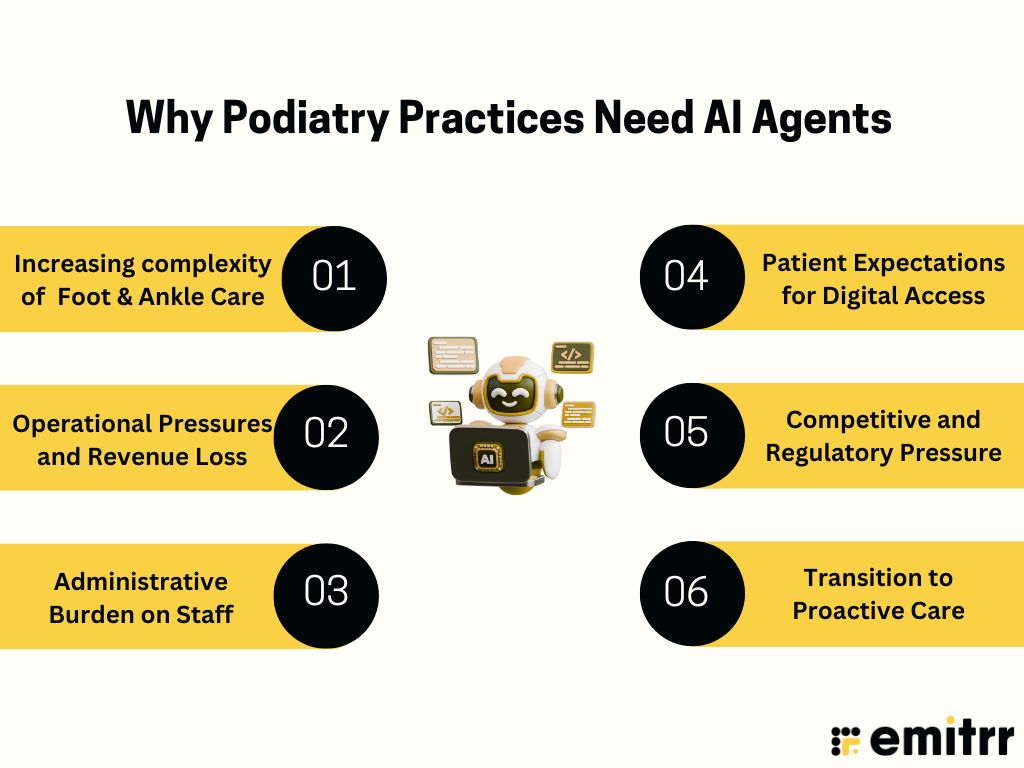
Increasing complexity of Foot & Ankle Care
Foot and ankle care has become much more complicated. A higher proportion of chronic diseases, such as diabetes, vascular disease, and chronic pain, results in more complex patient visits, greater documentation, and follow-up over time. This is where AI for diabetic foot care podiatry comes in, helping practices to handle the volume and risk associated with serious conditions.
Operational Pressures and Revenue Loss
High no-shows and late cancellation rates are common challenges in the podiatry clinic. These no-shows amount to scheduled time wasted and lost revenues. An AI agent is essential in reducing this burden, making it more than a simple reminder to proactively communicate with the patients for confirmation or self-scheduling.
Administrative Burden on Staff
Clinical staff and podiatrists spent an overwhelming amount of time on nonclinical work, such as charting, coding, complicated documentation, patient follow-up, and intake forms. The main adoption factor is now shifting to AI agents in podiatry clinic workflow, which makes a dent in the administrative burden. The aim is to relieve human staff of the burden of that operation so people can be used on patient-facing care.”
Patient Expectations for Digital Access
Today’s patients expect convenience. They want mobile access, two-way text interaction, online self-scheduling, and digital interactions that mirror what takes place beyond healthcare. Practices not offering this digital-first access could find themselves losing patients to the competition.
Competitive and Regulatory Pressure
Pressure being exerted by larger multispecialty groups or hospital-based podiatry facilities that are already trading in state-of-the-art technology makes smaller practices have to step up. At the same time, the regulatory/compliance requirements like HIPAA Compliance require secure and auditable communication and outcome data.
Transition to Proactive Care
Care historically was reactive: Patients called when they had a medical problem. AI agents will aid practices move from this reactive model of care to a proactive approach, leverage data to uncover at-risk patients, reach out automatically, engage them for preventative screenings, and avoid complications. This is a change for AI towards diabetic foot care podiatry.
Download our professionally crafted voicemail greeting scripts for podiatrists to ensure clear, reassuring communication with patients.
How AI Agents Fit into the Podiatry Practice Workflow
AI agents are involved throughout the patient journey, supporting all of these administrative and clinical use cases. Some of the ways AI agents are being utilized in foot & ankle care include:
A. Patient Communication & Engagement
AI for podiatry practice begins with the patient experience, facilitating instant and secure communication:
- Two-Way Texting through AI Agent: Patient-focused AI agents for podiatry respond to and manage basic patient inquiries in an instant. Questions such as “Do I need special shoes after my bunionectomy?” or “What insurance do you take?” receive immediate, accurate answers by text and save front-desk staffers hours on the phone.
- Auto Reminders and Follow-Ups: Let the AI agents automate SMS appointment reminders with self-reschedule links. Most importantly, they alert the front desk only if there is a non-response and action by a human is indeed required, thereby mitigating the operational strain of high no-show.
- Receptionist/Assistant: An AI chatbot via the website or ported in through a secure text line manages basic intake/screening and appointment triaging. Case in point: “I have a foot ulcer, urgent or routine? Is triaged by the AI agent and is forwarded to a human operator or provided with time-sensitive counsel. Practices looking for a dedicated solution can also explore a virtual assistant for podiatrists to handle calls, appointment booking, patient questions, and routine front-desk tasks.
- Survey and Review Automation: The AI Agent automatically sends out patient satisfaction surveys after a visit, gathers feedback, and, if the patient is unhappy, immediately receives a staff follow-up call that engages the contact in an attempt to save the relationship before receiving a negative public review.
- Patient Education: AI agents can deliver personalized proactive messaging about post-op care, home exercises (a crucial component for foot & ankle rehab), or reminders to monitor a diabetic’s foot health, driving value for the patient even beyond your clinical walls.
B. Diagnostics & Clinical Support
This is where the investment in advancing AI podiatry clinic tools will pay for itself, by transforming data into clinical insight.
- Predictive Analytics for High-Risk Patients: Using AI for Diabetic Foot Care Podiatry, the AI agent uses predictive analysis to constantly track patient data (labs, EHR records, and how often patients visit you). It would flag patients who are statistically at high risk for complications (such as diabetic foot ulcers, or DFUs), alerting the podiatrist that the patient might be due for a preventative examination.
- Imaging Analysis AI: Tailored smart tools use computer vision for AI agents for gait analysis or x-ray interpretation. They can see minor defects, alignment problems, or an early stress fracture in images of your feet and ankles. The AI agent warns the clinician with early red flags and potential risk factors, complementing the knowledge of the clinician (who is still the ultimate decision-maker). This also applies to AI in Podiatry for orthotic design, where AI can model weight distribution more accurately.
- Virtual Follow-Up Tracking (Tele-Podiatry): For wound-care patients, the AI agents introduces tele-podiatry where it can automatically send follow-up check-in text messages to the patient that based on their needs and behaviors, request them to upload photos of their ulcerated foot for the computer-visioning machine-learning agents that will track whether or not it’s healing at an optimal pace and only in cases where there is risk of failure or trajectory delay, elevate those exceptions up to the podiatrist.
- Clinical Decision-Support: The AI agent serves as a knowledge navigator with elements prompting the clinician whenever decision support reminders are appropriate, pertaining to vascular screening due to historic findings or evidence-based foot-ankle care guidelines.
C. Operations and Workflow Automation (OWA) Patterns
Utilizing AI agents in the podiatry workflow is a leverage point for a bottom-line improvement, by maximizing every second that your practice operates.
- Scheduling Optimization: The AI agent evaluates appointment history data and patterns, no-show details, and more to propose an optimal slot allocation, continually adapting the schedule to optimize provider time and minimize gaps. It will also send out proactive reschedule reminders when they are required, a key feature in AI podiatry clinic automation tools.
- Intake and Documentation Automation: AI agents convert audio or text intake (symptoms, history) into structured elements that can be filled in a secure way in the EMR/screen/PMS. It is a significant way to take away the burden on the front desk.
- Call/Text Routing: The AI agent serves as an intelligent call center response to abstract phone calls or texts, answers basic questions (clinic hours, directions), and routes high-priority complex inquiries to the appropriate staff member or doctor, reducing overall time on hold.
- Billing and Coding Help: Staff is prompted for the correct ICD-10 or CPT code by a specially trained AI agent pre-programmed with podiatry codes in response to clinical notes and alerted of necessary documentation not present or anomalies that might lead to delayed reimbursement, making these AI agents podiatry practice cost savers.
- Analytics Dashboards: Real-time reports on KPIs such as no-show rates, cancellation trends, and patient engagement metrics allow leadership to make decisions that are driven by data as well as strategy.
D. Compliance, Security, and Growth of Business
AI agents are an indispensable driver for a secure expansion in healthcare.
- Compliance Tools: AI agents are programmed to send encrypted messages, communicate end-to-end encrypted, as well as automatic tracking of opt-in/consent for texting, all vital for HIPAA-Compliance in podiatry.
- Audit-Trail Generation: The AI agent records all automated and patient-staff interactions and stores them. This detailed audit trail can also serve to protect your practice in the event of disputes or regulatory investigations.
- Scalability and Practice Size: With automated routine tasks, the AI agent enables a small AI footprint to be placed inside Spotlight AI podiatry to handle significantly higher patient volume without requiring a proportional increase in expensive human staff. This is important when you need to expand to multiple locations.
- Competitive Differentiator: By providing this on-demand digital-first care and proactive monitoring that can also provide personalized foot care with AI agents, podiatry clinics have the opportunity to stand out in the increasingly shifting marketplace, offering a competitive advantage over traditional competitors.
Key Benefits of Using AI Agents in Podiatry Practices
What are the pros of AI agents for podiatrists? The results are quantifiable throughout patient care, operations, and finances.
Decrease in Lost Appointments
Automated reminders and self-scheduling links result in the AI agent leading to an increased show rate and instant revenue.
Higher Patient Satisfaction and Retention
Faster response time, more availability (24/7), bidirectional texting delivers increased engagement while making patients feel supported and appreciated, which in turn results in higher loyalty.
Improved Care Quality & Outcomes
Applying AI for Diabetic Foot Care Podiatry. Facilitating early warnings (predictive analytics), regular tele-follow-up visits (AI in podiatry for wound monitoring), and optimized, well-planned treatments (AI in podiatry to design orthotics).
Less Administrative Work for Staff
Automating tasks that are repetitive, such as answering FAQs and populating intake forms, gives staff the time they need to work with patients instead of spending it on easy beverage filling and clinical problem-solving.
Improved Clinic Efficiency
Simplified scheduling, intake, and call handling result in a more efficient and organized workflow, easing staff frustration and enhancing your clinic environment overall.
Compliance / Risk Reduction
The application of secure messaging, automated audit trails, and AI-assisted documentation reduces the likelihood of regulatory offences and malpractice liability.
Growth Enablement
The clinic can scale operations and grow patient volume while avoiding increasing staff cost linearly also, so the investment is an obvious growth engine.
Challenges and Considerations When Adopting AI Agents
The future for podiatry clinics is AI, but it needs to be approached thoughtfully.
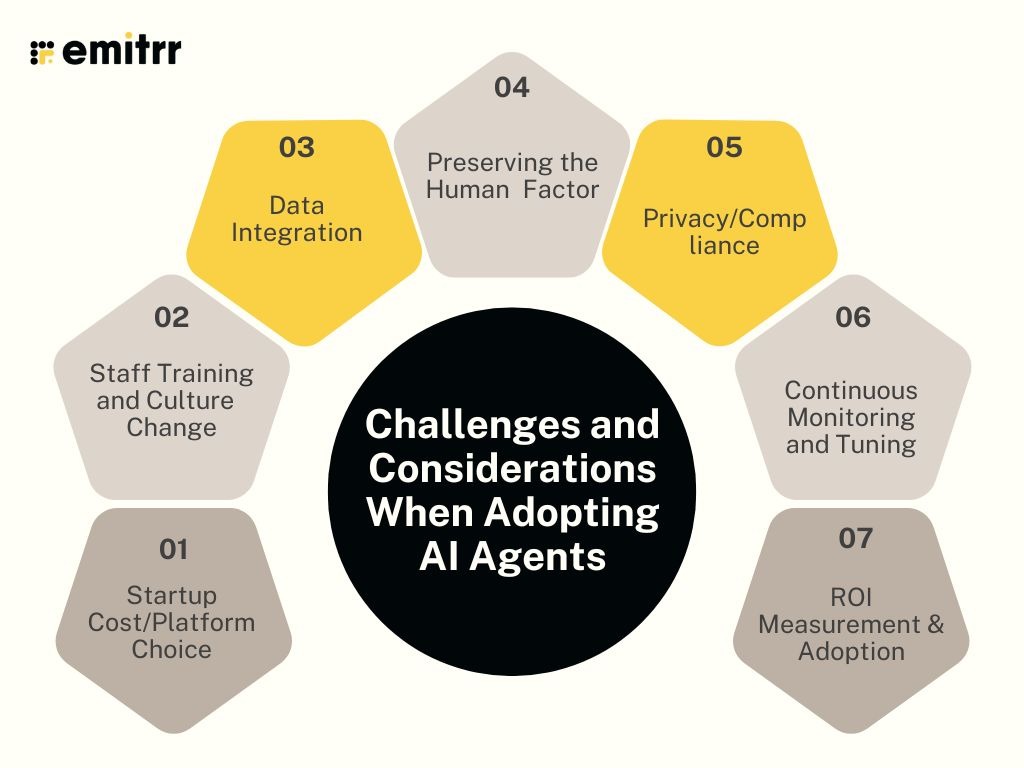
Startup Cost/Platform Choice
Practices must decide on a platform that is strong and high-quality but also meets HIPAA criteria and caters to the unique workflows in podiatry. The initial cost and learning curve must be factored in.
Staff Training and Culture Change
Current staff might not support new work patterns. Trust in the AI agent and thorough training on how to integrate the technology into everyday operations are non-negotiable.
Data Integration
Most of the smaller podiatry practices are on legacy or old EHR/PM systems. Seamless integration is a crucial need for the AI agent to effectively access and fill up patient data.
Preserving the Human Factor
The essence of podiatric care is the doctor-patient relationship. And while AI agents are in charge of automation, practices have to make sure they’re not sounding robotic by using custom templates and clear escalation paths to human staff.
Privacy/Compliance
Select an AI agent platform that includes HIPAA compliance, end-to-end encryption, signed BAAs (Business Associate Agreements), and a comprehensive audit trail.
Continuous Monitoring and Tuning
After you deploy your AI model to production, it must be continuously monitored for its performance against the desired outcomes trained on, quality of input data, potential sources of bias, etc. In order to prevent suboptimal outcomes for patients, workflows need to be adapted according to real-life results.
ROI Measurement & Adoption
Practices must measure key metrics (no‐show rate, patient satisfaction, staff time saved) to analyze and justify the initial investment and to benchmark the efficiency of the AI agent.
Attributes to Look for When Selecting an AI Agent Platform for Your Podiatry Practice
First, selecting the appropriate technology is the initial decision in implementing AI agents within a podiatry clinic. Here are the crosscutting features you should look for when seeking out a platform:
- HIPAA-Compliant and Secure Messaging: Non-negotiable. Needs to be end-to-end encrypted, and the vendor has agreed to BAA.
- Automated Scheduling + Reminders + Two-Way Texting Features: The core engine for reducing no-shows and increasing patient access.
- Virtual Assistant/Chatbot Functionality: It has to be capable of patient intake, frequently asked questions (FAQs), and smart routing to the appropriate staff member.
- EHR/PM integration: Your AI agent must be able to integrate with your EHR/PM software (for example, podiatry-specific software), calendar system, and patient database.
- Analytics Dashboard: Access engagement data like no-show trends, patient communications content, and reports on revenue impact.
- Workflow Automation: Ensure you have call/text routing, patient follow-up triggers, and automated review requests to streamline your practice.
- Mobile and Web Friendly: The platform needs to be user-friendly for staff and patients on the run.
- Scalability: The solution should be one that is suitable for a solo practice today, yet able to support the needs of a larger group/multi-location practice tomorrow.
- Vendor Support and Onboarding: You want a vendor that provides plenty of training materials, a responsive customer support team, and makes it easy to get up and running with good documentation.
- Customization: Customizing the messages, branding, and templates that are specific to podiatry (e.g., post-op instructions for various foot procedures) is crucial to personalized foot care with AI agents in podiatry.
Watch to understand the difference between AI healthcare receptionists and AI agents and find out which one your Podiatry practice needs
How Emitrr Empowers Podiatry Practices with AI Agents
Emitrr is a trusted partner for specialty practices, including podiatry, that wish to harness the power of AI agents without sacrificing security or simplicity. Emitrr is an all-in-one unified communication platform for modern healthcare communication: from text to voice, fax, and AI Automation to secure messaging.
Auto-Texting & Scheduling
Emitrr’s AI bot is designed to oversee podiatry patients’ entire appointment lifecycle by automating reminders, follow-ups, and secure links for patient self-scheduling, which results in a substantial decrease in no-shows, an essential capability to have in a bustling podiatry practice.
Two-Way Texting / Chatbot
Patients can text the office directly with questions about their conditions, post-treatment instructions, insurance, and much more. The AI agent acts as a virtual assistant that answers Salesforce and inbound call volume with 24/7 access to information, helping you provide patient-centric care.
AI Agent for Triage
Emitrr AI agent that manages follow–up on missed calls and auto-texts, this triages patient inquiries based on acuity and topic. It guarantees that no patient waits, reads human-level comments to filter high-priority clinical questions with the potential care providers, and works through expected tasks independently.
Secured, HIPAA Compliant Messaging
Specifically developed for healthcare, Emitrr offers full encrypted messaging and a complete tamperproof audit convenient for all patient communications to help you meet your compliance with HIPAA in podiatry.
Assimilation with EHR, PM Systems
Emitrr interfaces with the most widely used practice management and EHR systems in podiatry, or can link up via Zapier to communicate with an AI agent that will sync up appointment data and update patient records.
Analytics Dashboards
With detailed analytics in patient engagement, no-show reduction, and staff time savings within the platform, practices can easily measure the ROI of their AI agent investment.
Frequently Asked Questions
No. An AI agent’s goal isn’t to replace but to augment. The AI agent takes care of repetitive, transactional work (like answering FAQs, confirming appointments, and handling basic scheduling), allowing front-desk staff to concentrate on high-level patient care issues, managing the physical flow of the clinic, and offering the human touch – which only people can deliver.
Yes, if you use an AI agent platform built for healthcare (like Emitrr) that is HIPAA compliant, uses end-to-end encryption, and will sign a Business Associate Agreement (BAA). Do not ever apply consumer-level AI tools to patients’ data.
The best new, cloud-based platforms (like Emitrr) can be up and fully integrated in weeks! Timeframe depends mostly on your current EHR/PM system complexity and the time allowed for staff training & finalization of custom messaging unique to your podiatry practice.
The ROI is typically high. The AI agent’s podiatry practice solutions do have a monthly cost, but you should see that returned to you in three distinct ways: lowering no-shows (which equals revenue recovery); saving your staff time (there’s no need to hire another person); and increasing patient retention and positive reviews (receiving, reconciling, or making new business). Research indicates AI scheduling can help decrease no-shows by 35% or more.
The AI agent cuts no-shows by distributing across multiple channels (SMS, email), proactively providing reminders at the most effective times, and, perhaps most importantly, offering two-way texting and self-rescheduling. Rather than cancel, for example, a patient can text “need to reschedule” and the A.I. agent responds immediately with a link to book a new slot, capturing revenue that would otherwise have been lost.
Conclusion
AI agents are no longer optional; they are essential for modern podiatry practices. From diagnoses to tracking wounds, from communications to compliance, AI automates mundane tasks and improves patient outcomes. Although obstacles such as training and integration have to be faced, the advantages outweigh the difficulties.
Emitrr stands out as a trusted partner, combining automation, AI-driven patient communication, and HIPAA-compliant workflows tailored for podiatry. If you’re looking for opportunities to scale your podiatry practice, enhance patient outcomes and productivity, it could be time to transform with AI. Find out how Emitrr can revolutionise your podiatry practice. Book a demo today.


 4.9 (400+
reviews)
4.9 (400+
reviews)