
Introduction
Healthcare practices and their front desk staff are facing intense pressure these days, as
with the advancement of communication technology, patients expect quick responses, instant information, instant updates, and frictionless communication. But healthcare practcies are are facing staff shortages, rising operational costs, and increasing burnout among front desk teams.
When it comes to Athenahealth practices, high call volume is no longer just a sign of being “busy.” It has become a daily operational risk that negatively affects patient satisfaction, burdens staff with administrative workload, and affects revenue as well. But here’s the good news: you do not need to hire more staff to fix this problem.
Curious to know how? This is what we are going to discuss in this blog. From how to handle call volume in Athenahealth without adding staff, why call volumes spike, where Athenahealth alone falls short, and how smart automation and communication workflows can dramatically reduce calls in Athenahealth and more!!
So let’s get started!!
Understanding the Real Reasons Behind High Call Volumes in Athenahealth Practices
Common Reasons Why Patients Call
- If we look closely, then we find out that most calls are not clinical emergencies; they are repetitive and largely administrative in nature, including Athenhealth appointment scheduling calls, rescheduling, confirmations, and reminders, which are one of the biggest call drivers.
- Prescription refill requests are another major contributor. Many patients prefer calling because they want immediate confirmation that their request was received, especially if they are running low on medication.
- Athenahealth billing calls and insurance questions frequently lead to calls because medical bills are often confusing. When statements lack clarity or payment options aren’t obvious, patients default to calling for explanations.
- Lab results and referral updates also drive calls when patients don’t receive proactive communication. Silence creates uncertainty, and uncertainty leads to phone calls.
Why These Calls Keep Repeating
One of the major reasons why there are Athenahealth phone call overload and they are repetitive is because the information shared is not proactive and sometimes is incorrect. Communication is mostly fragmented across various systems, which makes it difficult for patients to get answers without calling.
Not only this, but many Athenahealth communication workflows still rely heavily on staff intervention. Follow-ups are manual, reminders are limited in interactivity, and communication often depends on staff availability. Without Athenahealth automation, even simple updates require phone calls, and those calls compound quickly.

The Hidden Cost of High Call Volumes
Impact on Healthcare Front Desk Call Management
Constant calls and high phone traffic directly impact front desk teams. Repetitive calls are time-consuming and create mental fatigue, which makes it harder to manage other tasks. Frequent interruptions also increase the possibility of human error, especially when they are switching between calls and screens, and patients at the desk. And if this continues for a long time, then it also leads to burnout.
Impact on Patients
If we take a look from the patient’s perspective, high call volume translates into long hold times, missed calls, and delayed responses, which makes patients feel frustrated even when the front desk staff is trying their best to help. Sometimes, poor communication can even overshadow excellent clinical care.
Impact on Practice Revenue
Administrative failure, which is caused by high call volume, has a direct impact on revenue. Missed calls also mean missed appointments or lost new patient inquiries. Unsatisfied and frustrated patients are also more likely to leave negative reviews, which also impacts online reputation as well as patient acquisition. Every unanswered or mishandled call represents potential lost revenue.
Why Hiring More Staff Isn’t the Right Long-Term Fix
Yes, hiring more staff at first glance seems like the fastest and best solution for solving the issue of handling high call volume, but it does not address the real cause of the problem. It definitely solves the problem immediately, but the labour cost continues to rise, training takes time, and turnover remains high. Most importantly, inefficient Athenahealth communication workflows remain inefficient.
No matter how many extra staff you hire for healthcare front desk call management, without fixing communication systems, adding staff simply means more people managing the same broken process. This increases costs without delivering sustainable improvements.
The Smart Way to Reduce Call Volumes Without Adding Staff
The goal of handling a high volume of calls without hiring more staff is not to replace the human workforce, but rather to eliminate the unnecessary calls. Here is when automation comes in, which allows staff to focus on complex, high-value conversations while routine communication happens automatically in the background.
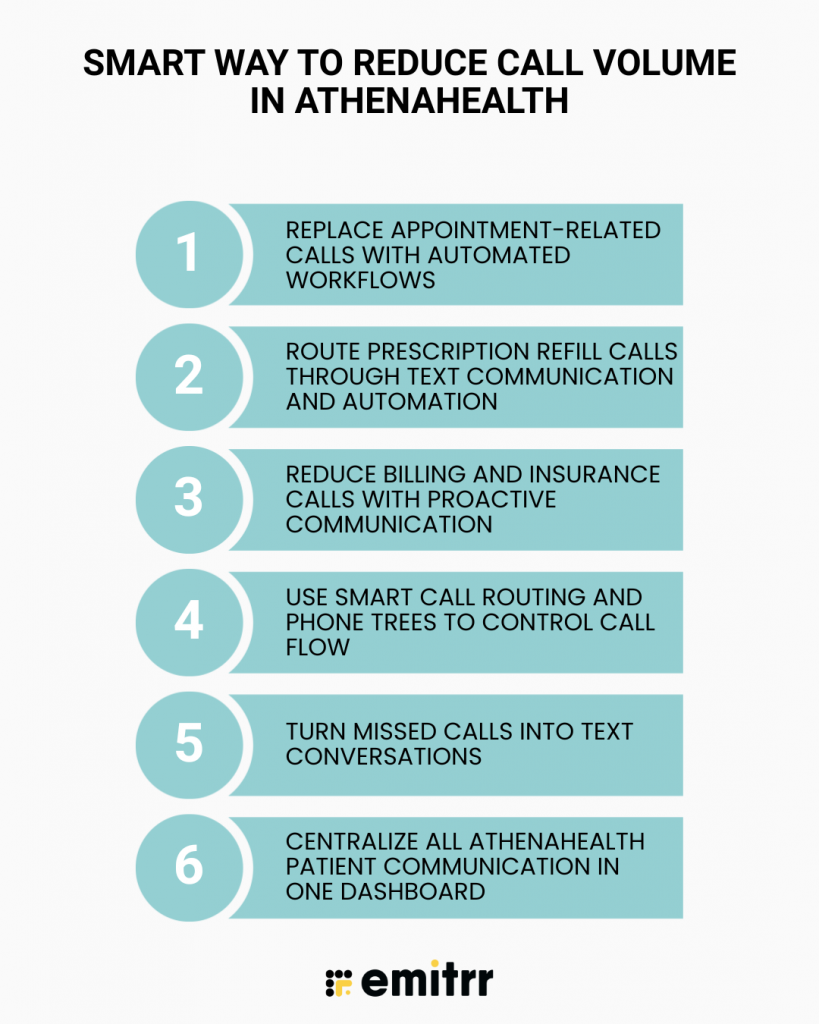
Replace Appointment-Related Calls With Automated Workflows
- Automated Appointment Reminders and Confirmations: Using automation to send patient appointment reminders that allow patients to confirm or cancel directly, which reduces uncertainty and prevents confirmation-related calls.
- Self-Service Rescheduling via Text: Give patients the capability to schedule, reschedule, or cancel appointments without calling you can also opt for text-based scheduling for better management.
- Directly sync updates in Athenahealth: Updates sync directly with Athenahealth, keeping schedules accurate while removing a major burden from front desk teams.
- Two-Way Texting for Quick Clarifications: Two-way texting allows front desk staff to answer quick questions, share instructions, and resolve issues quickly.
Route Prescription Refill Calls Through Text Communication and Automation
- Proactive Refill Notification: Proactively sending refill reminders helps in improving medication adherence and also lowers the frequency of urgent calls.
- Refill Requests via Text Rather than Calls: Front desk staff can also use text-based prescription refill workflows to reduce staff interruptions, remove voicemail backlogs, and establish clear request tracking.
Reduce Billing and Insurance Calls With Proactive Communication
- Automated Billing Texts: Front desk staff can also send billing messages with clear payment links, which helps in reducing confusion and speeding up collections.
- FAQs and Auto-Replies for Common Billing Questions: Automated responses address common questions about office hours, insurance, payments, and statements, reducing the number of repetitive calls daily.
Use Smart Call Routing and Phone Trees to Control Call Flow
- Medical Office Phone Trees Designed for Call Routing: A well-designed phone tree for call routing guides callers to the respective departments and offers self-service options where appropriate, which reduces unnecessary transfers and delays.
- After-Hours Call Handling: Using after-hours automation also ensures that patients receive timely responses even when the office is closed.
Turn Missed Calls Into Text Conversations
- Why Missed Calls Turn Into Lost Revenue: Most patients don’t call back after a missed call. Each missed call is a missed opportunity for care, revenue, and trust.
- Automatic Missed Call Text Back: Automatic text responses acknowledge missed calls instantly and invite patients to continue the conversation via text, recovering opportunities without manual effort.
Centralize All Athenahealth Patient Communication in One Dashboard
- Centralizing calls, texts, voicemails, and reminders gives staff full context, reduces errors, speeds up responses, and simplifies training.
Recommended for reading: What is AthenaOne Voice Solutions
How Emitrr Helps In Athenahealth Call Volume Management
While Athenahealth manages clinical data and core workflows, Emitrr helps to complement those workflows with automated, real-time patient communication in Athenahealth, which eliminates the need for constant phone interactions.
This Athenahealth VoIP integration addresses the root cause of high call volumes: manual, reactive communication that depends on staff availability.
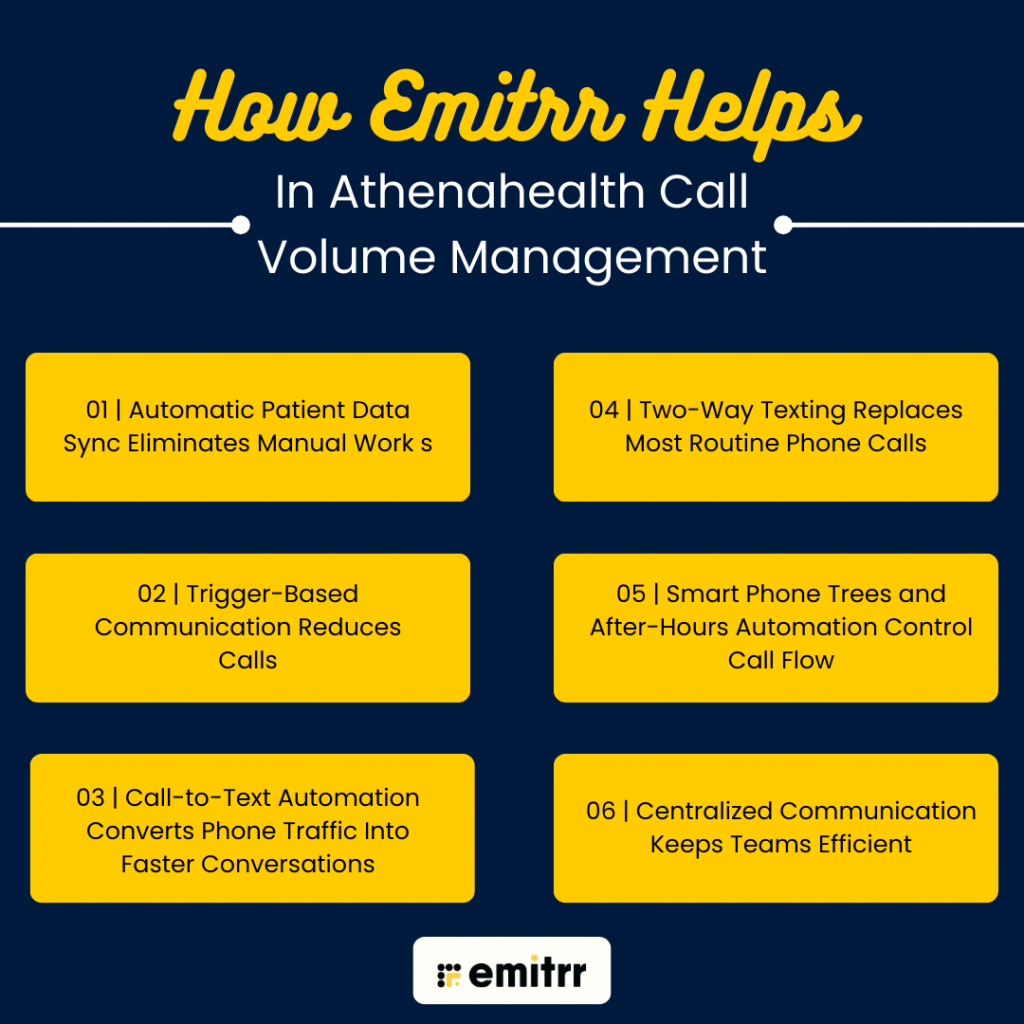
Automatic Patient Data Sync Eliminates Manual Work and Communication Gaps
Integrating Emitrr with Athenahealth offers the capability to sync patients’ data automatically, in real-time. Details like appointments, patient demographics, provider details, and updates are automatically logged without any manual effort.
This automatic syncing ensures that:
- All Athenahealth patient communication in Athenahealth is tied to the correct Athenahealth record
- Staff no longer need to copy or re-enter patient information
- Messages are sent using accurate, up-to-date data
- Errors caused by outdated schedules or missing details are eliminated
Trigger-Based Communication Reduces Calls Before Patients Even Pick Up the Phone
One of the major advantages of the Athenahealth and Emitrr integration is trigger-based automation. Instead of just waiting on hold, Emitrr helps in sending timely reminders based on real Athenahealth events. As patients receive timely and proactive updates, they no longer need to call the practice for any clarification. This workflow indeed eliminates a large number of inbound calls.
Automated messages are triggered by:
- Appointment confirmations, cancellations, or reschedules
- Upcoming visits and no-show risks
- Prescription refill timing and status updates
- Billing statements, balances, and payment reminders
- Missed calls to the practice phone number
Call-to-Text Automation Converts Phone Traffic Into Faster Conversations
When healthcare practices integrate Athenahealth with Emitrr, there is no need for the front desk staff to answer the call in real time just to be effective. What Emitrr does is it automatically converts missed calls into text communication by quickly sending a text back via SMS. Instead of calling and leaving voicemails, patients also have the option to reply to texts for scheduling appointments, ask questions, or get help.
Two-Way Texting Replaces Most Routine Phone Calls
Emitrr, with its robust Athenahealth integration, ensures secure, HIPAA-compliant two-way texting that is capable of handling various interactions that earlier needed phone calls. Texting is indeed a faster and more efficient alternative to calling and is less disruptive to staff, and preferred by many patients. Front desk staff can use texting to confirm or reschedule appointments via text, answer quick patient questions without long calls, send instructions, links, or forms instantly, follow up on referrals or lab-related updates, and more!!
Smart Phone Trees and After-Hours Automation Control Call Flow
Emitrr also enhances Athenahealth phone workflows with intelligent phone trees and after-hours automation. This ensures that front desk teams aren’t overwhelmed during peak hours or after hours, without sacrificing patient access.
Instead of routing all calls to staff:
- Patients are guided to self-service options
- Urgent calls are routed appropriately
- After work calls, receive automated responses
- Voicemails are converted into text conversations
Centralized Communication Keeps Teams Efficient and Focused
All calls, texts, voicemails, reminders, and automated messages are centralized in a single Emitrr dashboard that is fully synced with athenahealth. Efficiency improves not by working harder, but by working smarter with integrated systems.
This centralized view allows teams to:
- Respond faster with full patient context
- Avoid duplicate or missed messages
- Reduce training time for new staff
- Maintain consistent communication standards
Frequently Asked Questions (FAQs)
High call volumes in Athenahealth practices usually stem from repetitive, non-clinical patient requests. Patients often call for appointment confirmations, rescheduling, prescription refills, billing questions, or follow-ups because they are not receiving proactive communication. When these interactions rely on manual Athenahealth communication workflows and phone calls, even a small patient base can overwhelm the front desk.
The Athenahealth and Emitrr integration enables automated, trigger-based patient communication tied directly to Athenahealth data. Patients receive appointment reminders, refill notifications, billing updates, and missed-call responses automatically via text. This proactive communication significantly reduces the number of patients who feel the need to call the office for clarification or follow-up.
Athenahealth automation can reduce calls in Athenahealth for various scenarios:
Appointment confirmations and reminders
Scheduling and rescheduling requests
Prescription refill status checks
Billing balances and payment questions
Referral and follow-up inquiries
Missed calls and voicemail callbacks
Yes, patients prefer texting over calling as it is faster, more convenient, and less time-consuming, where they get an instant response instead of waiting on hold.
Yes, when you use tools like a HIPAA-compliant platform like Emitrr. Integration of Athenahealth with Emirrr ensures that patient data is securely handled, messages are logged, and access controls are maintained.
Athenahealth automation assists people at the front desk and helps in getting rid of trivial and time-wasting tasks, and as a result, employees can spend more time on important patient contact and complex situations that are best solved with a human touch.
Missed Call Text Back makes sure that every missed call is responded to immediately. Rather than calling again or leaving a voice message, patients can communicate further through text messages.
Yes, Emitrr offers robust features like call routing, auto attendant, and more that help with after-call Athenahealth automations that make sure that patients receive timely responses even when the office is closed.
Conclusion
If we sum up everything we have discussed till now, we can say that high call volumes are not at all a staffing problem; the real problem is the communication workflow.
Most Athenahealth practices struggle with high call volume; it is not because the patients are demanding, but rather because many routine communication still depends on manual calls and tasks. Tasks like appointment scheduling, rescheduling requests, prescription refills, billing questions, and follow-ups should not require live phone conversations every time.
Here is where Emitrr comes in!!
By integrating athenahealth with Emitrr, practices can shift from reactive, phone-heavy workflows to proactive, automated communication. Emitrr extends athenahealth with two-way patient texting, missed-call text back, smartphone trees, and trigger-based messaging, all tied directly to athenahealth data. This ensures patients receive timely updates without needing to call, while front desk teams regain control of their day. High-performing athenahealth practices don’t scale by adding more people; they scale by building smarter systems that work together.
Ready to Reduce Calls in Athenahealth Without Adding Staff?
Book a demo with Emitrr to see how call-to-text, Athenahealth automation, two-way patient texting, and smart workflows can dramatically reduce calls in Athenahealth while improving both staff efficiency and patient experience.


 4.9 (400+
reviews)
4.9 (400+
reviews)