
Introduction
Ever paused at a pharmacy counter and wondered whether you need a prescription refill or a prescription renew? Patients ask this every day. Clinics deal with it all day. The confusion leads to delays, repeat calls, and missed doses. As more patients seek for an online prescription refill or medicine refills online, the gap between intent and action grows wider. This guide breaks down the process in plain language and highlights where it currently falls short within clinics today.
What Is Prescription Refill?
A prescription refill means getting a new supply of the same medication from the pharmacy without needing another doctor’s visit. When a prescription is first written, the doctor approves a set number of refills, and these are recorded in the EHR.
Refills are meant for ongoing treatment, so patients can continue their medication without interruption. Blood pressure treatment, cholesterol management, or thyroid therapy often fall into this category. Patients expect a medication refill to be quick, especially when they try to get a prescription refill online or use medication refill online services.
The refill itself is not a clinical decision. It is an administrative action meant to support continuity of care.

How Prescription Refilling Works
When a patient requests a prescription refill, the clinic must confirm that refills remain and that the request matches what is already on file. In an ideal situation, this verification happens quickly, and the request moves forward without clinical interruption.
In practice, refill requests arrive through phone calls, voicemails, and portal messages. Details vary. Some messages miss a date of birth. Others mention a medication name that sounds unfamiliar. When this happens, staff must pause, interpret, and often call back. A simple medication refill turns into a chain of follow-ups, even for online medication refill requests.
Emergency prescription refill situations add urgency, especially outside office hours. Speed matters, but accuracy still comes first, regardless of whether the request comes by phone, portal, or through tools used to request prescription refills using Athenahealth.
If your practice uses Athenahealth, integrating AI into everyday workflows can significantly reduce manual front-desk effort. Below, we break down how Athenahealth practices use AI to save over 70 staff hours each month without adding headcount or changing their EHR.
What Is Prescription Renew?
A prescription renewal is needed when no refills are left on a medication. In this case, the pharmacy cannot provide a new supply until the provider reviews and approves the prescription again. This review helps make sure the medication is still safe and appropriate.
Renewals are different from refills, but many patients do not realize this at first. It often causes confusion when someone tries to request a refill online and learns that a renewal is required instead.
During a renewal, the provider may look at recent visits, lab results, or how the medication is working. Because this step involves clinical judgment, it usually takes more time than a standard refill.
How Prescription Renewal Works
When a renewal request reaches the clinic, it requires careful evaluation. Providers must confirm that the medication remains active, appropriate, and originally prescribed by them. Discontinued medications or drugs prescribed elsewhere raise questions that must be resolved before approval.
Without real-time validation at intake, these checks happen later in the workflow. Nurses often step in to re-enter details, assess eligibility, and route the request correctly. Telehealth prescription refill requests frequently arrive as general cases rather than clear renewal tasks, which slows the process further.
Each extra handoff increases wait time and patient frustration.
Key Differences Between Refills and Renewals
Prescription refills and prescription renewals may sound similar, but they follow different paths inside a clinic. A refill continues an approved treatment, while a renewal triggers clinical review. Understanding this difference at a glance helps patients set the right expectations and helps clinics route requests correctly.
| Criteria | Prescription Refill | Prescription Renewal |
| Purpose | Continues an existing treatment | Reassesses the medication |
| Refill Status | Refills still available | No refills remaining |
| Provider Review | Not required | Required |
| Typical Speed | Fast turnaround | Takes more time |
| Risk Level | Low | Higher due to clinical review |
| Online Handling | Works well for medication refill online | Needs careful evaluation |
| Common Patient Action | Get prescription refill online | Request review or follow-up |
When You Need a Refill vs When You Need a Renewal
Knowing whether you need a prescription refill or a prescription renew can save time and prevent missed doses. The difference usually comes down to what is left on your prescription label and whether provider approval already exists.
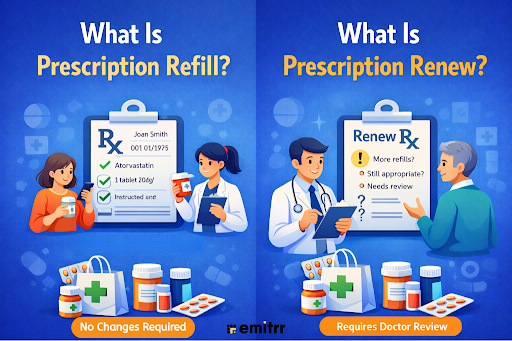
You need a prescription refill when:
- Your prescription label shows refills remaining
- The medication, dose, and provider have not changed
- You are continuing a long-term treatment
Example: You take a daily blood pressure tablet. Your bottle shows two refills left. You can request a medication refill or get a prescription refill online without a provider review. Online prescription refill tools work well in these cases.
You need a prescription renew when:
- The label shows zero refills
- The medication needs provider review before approval
- Time has passed since your last visit
Example: You have no refills left on a cholesterol medication. Even if you request a medication refill online, the clinic must review and approve it. This is a prescription renew, not a refill.
This distinction becomes easier to manage when patients are alerted before refills run out. Prescription refill reminders notify patients while refills are still available and signal when a prescription renew may be needed.
Watch how a single refill call changes when an AI agent steps in –
Common Prescription Refill and Renewal Confusions
Small errors at the start of a request often create the biggest delays later, especially in clinics handling high call volumes. These are the most common issues patients and staff face with prescription refill and prescription renew requests, where even minor gaps in information can trigger repeat calls and manual rework.
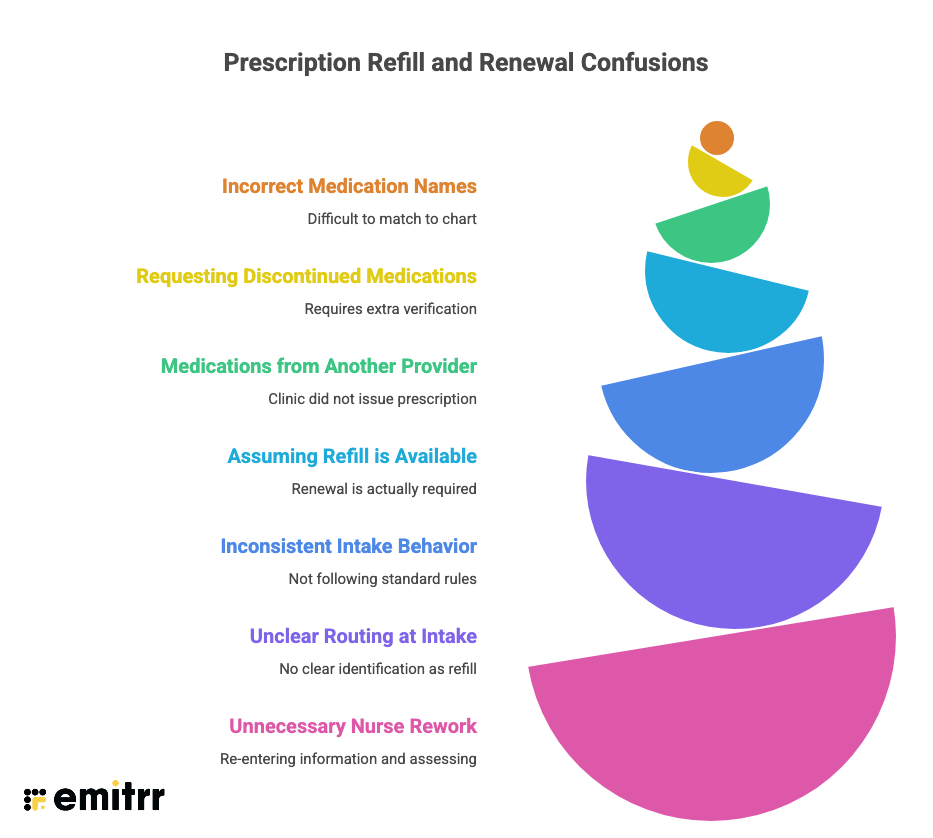
Patient-side mistakes
- Incorrect medication names: Patients often mispronounce or shorten medication names, which makes matching them to the chart difficult.
- Requesting discontinued medications: Some requests come in for drugs that were stopped earlier, requiring extra verification.
- Medications prescribed by another provider: Clinics receive medication refill requests for prescriptions they did not originally issue.
- Assuming every request is a refill: Many patients ask for a refill even when refills are exhausted, and a prescription renewal is required.
Clinic-side inconsistencies
- Different intake behavior at the front desk: Some staff create proper refill requests, while others log general cases based on experience rather than standard rules.
- Unclear routing at intake: Requests enter the system without clear identification as a refill or renewal.
- Nurse rework that should not exist: Nurses must re-enter information, assess eligibility, and decide next steps.
Why does this cause delays?
- Medicine refills online lose speed due to manual review
- Online prescription refill requests turn into callback loops
- Clinical staff spend time on corrections instead of care
Clear patient intake and consistent handling reduce errors, speed up medication refill online workflows, and lower staff burden without compromising safety.
How Automation Is Changing Prescription Refill and Renewal Management
As prescription refill and prescription renew volumes grow, manual intake no longer scales. Clinics now rely on AI for healthcare to bring structure to requests before clinical review begins.
Automation helps standardize how medication refill and online prescription refill requests enter the system. Instead of free-text messages or unclear voicemails, automated intake ensures key details are captured consistently. Patient name, date of birth, medication, dose, and pharmacy arrive in a usable format every time.
For medicine refills online, automation reduces dependency on individual staff judgment. Refill and renewal requests follow the same rules, regardless of who answers the phone or reads the message. This consistency prevents refill requests from being logged as generic cases and removes unnecessary nurse rework.
Automation also improves speed for medication refill online workflows. Requests that qualify as refills move faster, while requests that need review surface earlier. SMS-based prescription refill requests reduce call volume in healthcare by shifting routine intake away from phones and into structured digital workflows.
By reducing manual interpretation at the front door, automation allows clinical teams to focus on decisions that actually require expertise.
How Emitrr AI Agent Simplifies Prescription Refills and Renewals
A large share of prescription refill requests follow predictable patterns and do not require staff-led intake. Clinics that automate this front layer reduce front-desk refill call volume by up to 40% while keeping clinical review unchanged.
Many practices already recognize this shift. Emitrr customers no longer rely on voicemails, scattered phone calls, or manual message reading to manage medication refill requests. Instead, they use AI to bring structure to intake before staff ever get involved and automate prescription refill requests without replacing your EHR.
Automation with AI works because refill intake is predictable. Patients share the same core details every time. Name. Date of birth. Medication. Dose. Pharmacy. Emitrr’s AI agent handles this repetitive layer consistently, allowing clinics to shift nearly 80% of prescription refill intake away from staff time.
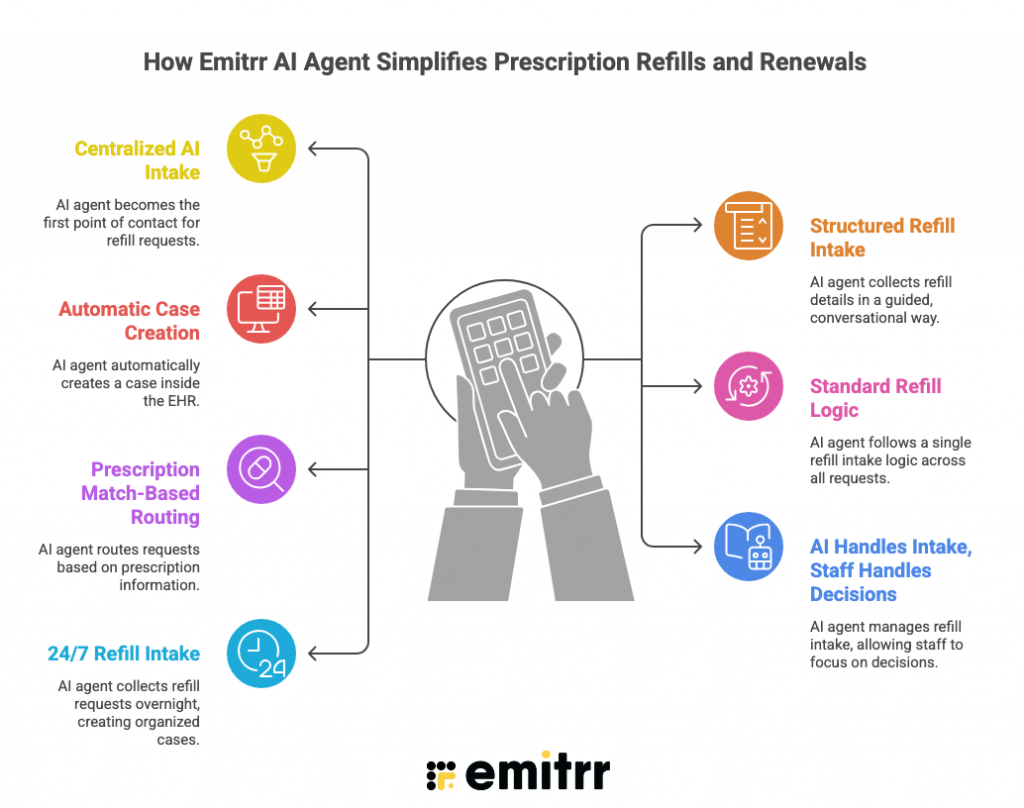
Centralized AI Intake for Refill Requests
Refill requests often arrive through scattered channels like phone calls, voicemails, and patient portal messages. Emitrr’s HIPAA-compliant AI agent becomes the first point of contact for prescription refill requests through voice or SMS, if enabled.
Instead of staff chasing information across channels, every medication refill request enters through one standardized intake flow. Refill intent stays clear from the start, which prevents missed details and duplicated work.
Structured Refill Intake With No Missing Information
Emitrr’s AI agent collects refill details in a guided, conversational way. It asks for patient identifiers such as name and date of birth, captures medication name, dosage, and frequency, and confirms the preferred pharmacy.
If a response sounds unclear or incomplete, the AI asks again in real time. Each interaction produces a structured summary, a full transcript, and a call recording for verification. Refill requests arrive complete the first time, which removes the need for callbacks.
Watch how Emitrr’s AI Voice Agent manages calls end-to-end and reduces manual work without acting like a basic answering system –
Automatic Case Creation Inside the EHR
Once the AI captures all refill information, a case is automatically created inside the EHR. Patient-provided details, the AI summary, transcript, and recording are attached to the case.
This mirrors existing workflows without manual intake. Staff no longer need to listen to voicemails, decode messages, or retype data. They review instead of rebuilding context.
One Standard Refill Intake Logic Every Time
Emitrr’s AI agent follows a single refill intake logic across all requests. The same questions. The same structure. The same decision points.
This removes inconsistencies caused by staff experience or training gaps. Whether the request comes in during business hours or after hours, the intake stays consistent.
Prescription Match-Based Routing
Patients may mispronounce medication names, request discontinued drugs, or ask for medications prescribed elsewhere. Emitrr’s AI agent does not approve refills on its own.
If the information aligns with existing records, the refill can move forward based on clinic rules. If something does not match, the request is flagged and routed for further review. This ensures safety without slowing down valid medication refill requests.
AI Handles Intake at Scale, Staff Handles Decisions
Emitrr’s AI agent manages refill intake around the clock. It captures required details upfront and prepares requests for review before staff involvement begins.
Nurses and front-desk teams no longer spend time listening to voicemails or re-entering information. They focus on decisions that require clinical judgment.
24/7 Refill Intake Without Backlogs
Refill requests do not stop after office hours. Emitrr’s AI agent collects prescription refill requests overnight and creates organized cases automatically.
By morning, staff see structured refill cases instead of voicemail and text backlogs. Nothing gets lost or delayed.
How the End-to-End AI Refill Flow Works
Patients submit online prescription refill requests through the same channels they already use. Phone calls, voicemails, or portal messages route to the AI instead of staff.
The AI collects all required refill details and prepares a review-ready request. Existing clinic rules still apply. Providers approve or deny refills. Patients receive updates once the request is processed.
The difference is not in decision-making, but in how cleanly requests arrive.
Why This Matters for Online Prescription Refill Workflows
AI agents do not change approval rules. They remove fragmentation, incomplete intake, repeated clarification calls, and unnecessary nurse rework.
As medicine refills online continue to grow, structured AI-led intake keeps workflows manageable without adding staff or risk.
Quick Summary: Emitrr AI Medication Refill Workflow
| Stage | Automated by Emitrr AI? |
| Request intake | ✅ Yes |
| Information collection | ✅ Yes |
| Eligibility checks | ✅ Yes |
| Routing & escalation | ✅ Yes |
| Patient updates | ✅ Yes |
| Final clinical approval | ❌ Human |
Frequently Asked Questions
A prescription refill allows you to receive the same medication again when refills remain. A prescription renewal is required when refills run out, and the provider must review and approve the medication again.
Renewing a prescription means your provider reviews your medication before approving more doses. This step confirms the treatment is still appropriate and safe.
A refill means the provider already approved additional fills of the same medication. The pharmacy can dispense the next supply without a new prescription.
Prescription refills are allowed only if refills remain and the medication details stay unchanged. Controlled substances and expired prescriptions may require renewal instead.
The number of refills depends on the provider’s instructions and the type of medication. Some prescriptions allow multiple refills, while others allow none and require renewal.
Key Takeaways
- Prescription refills and prescription renew serve different purposes and follow different approval paths. Confusing the two leads to delays and unnecessary follow-ups.
- A prescription refill continues an approved treatment when refills remain, while a prescription renew requires provider review before medication can be dispensed.
- Medication refill and online prescription refill requests move faster when refills are available, and details are complete at intake.
- Emergency prescription refill situations require speed but still depend on accurate patient and medication information.
- Online medication refill and medication refill online workflows work best when requests are structured and consistent across channels.
- Telemedicine prescription refill and telehealth prescription refill options reduce wait times only when the system clearly distinguishes refills from renewals.
- Automation helps clinics manage growing medicine refills online volume by reducing manual data entry, rework, and staff burden.


 4.9 (400+
reviews)
4.9 (400+
reviews)