
Introduction
A health call center handles a steady flow of prescription refill requests every day. These requests come through phone calls, voicemails, and patient portals, often with incomplete information. Staff spend time sorting, confirming, and re-entering details before a refill can even move forward.
This happens repeatedly throughout the day and disrupts normal workflows, pulling attention away from other patient needs. In this blog, we look at how healthcare call centers can streamline prescription refill requests and reduce the effort required to manage them.
Why Prescription Refill Requests Are a Growing Problem in Healthcare?
Refill requests arrive through multiple channels. Live calls. Voicemails. Athenahealth Patient Portal. Each path demands manual effort. Someone listens to a voicemail. Someone reads a portal message. Someone re-enters details into the system.
Health call centers manage thousands of calls each month, and refill requests make up a large share of that volume. Even small inefficiencies create daily friction.
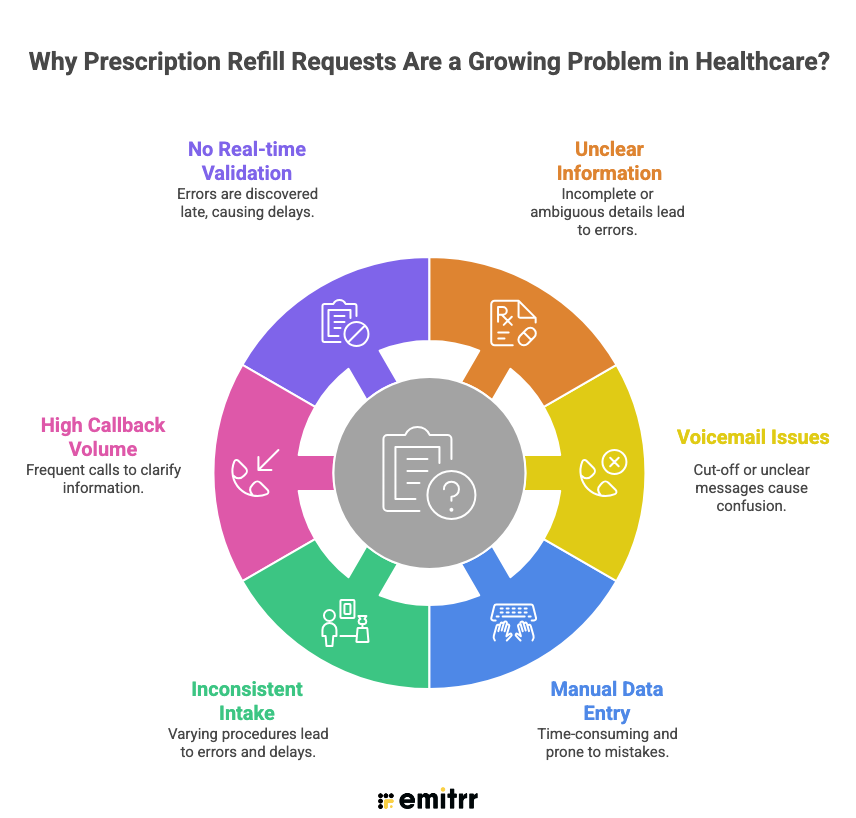
- Unclear or incomplete refill information: Patients often leave voicemails without a full name, date of birth, or medication details.
- Cut-off or hard-to-understand voicemails: Messages end abruptly or include medication names that are difficult to interpret.
- Manual data entry across systems: Staff re-enter the same information into call logs, EHRs, and internal queues.
- Inconsistent intake by front-desk staff: Some requests are logged as refills, others as general cases, based on training and experience.
- High callback volume: Missing or unclear refill details force staff to call patients back, creating high call volume and putting additional pressure on already busy healthcare call center queues.
- No real-time validation: Call center teams cannot always confirm active medications, prescribing providers, or refill eligibility during intake.
Patients feel the delay. Staff feel the strain. What should be routine turns urgent simply because refill requests enter the system without a streamlined structure.

How Health Call Centers Manage Prescription Refill Requests
Health call centers act as the first stop for most prescription refill requests. The process looks straightforward, but each step depends on manual effort and clear information from the patient.
Step 1: Patient contacts the call center
A patient calls the clinic, leaves a voicemail, or sends a portal message on Athenahealth asking for a refill. For example, a patient may call and say they need more blood pressure medication but forget to mention the dosage or pharmacy.
Watch the video below to see why healthcare voicemails fail and how AI captures refill requests accurately without HIPAA risk:
Step 2: Staff collect and document refill details
A front-desk agent listens to the voicemail or answers the call and writes down patient details, medication name, and refill reason. If the information is incomplete, the request pauses until someone can follow up.
Step 3: Refill request or case is created
Depending on training, the agent either creates a refill request or logs a general case in the system. Two agents may handle the same type of request differently, which creates inconsistency.
Step 4: Request moves to clinical review team
Clinical teams review the entry, re-enter missing details, and decide whether the request qualifies as a refill or needs provider review. If the medication name sounds incorrect, they may need to check the patient record in Athenahealth or call the patient back to confirm details.
Step 5: Provider review and approval
Once cleaned up, the request reaches the provider for approval or denial. By this point, a simple refill may already be delayed due to intake issues.
Step 6: Patient follows up
If the patient does not hear back, they call again to check the status. This is why patients keep calling about prescription refills, creating repeat calls for the healthcare call center even when the request is already in progress.
This manual, multi-step process explains why refill requests consume so much call center time and why delays often happen before clinical review even begins.
Common Problems Healthcare Call Centers Face With Refill Requests
Prescription refill requests create daily friction inside healthcare call centers. Most issues start at intake, where information arrives unstructured and inconsistent. These problems slow down refill processing, increase patient follow-up calls, and push simple requests into urgent situations.
| Problem | What Happens in the Call Center | Impact |
| Too many intake channels | Refill requests come through calls, voicemails, and portals, each handled differently | Delays and missed requests |
| Incomplete patient information | Patients forget names, DOB, dosage, or pharmacy details | Follow-up calls and stalled refills |
| Unreliable voicemails | Messages get cut off, or medication names sound unclear | Staff must call patients back |
| Manual data entry | Staff re-enter the same details into multiple systems | Errors and wasted time |
| Inconsistent request handling | Some agents create refill requests, others log cases | Extra work for clinical teams |
| Medication name errors | Patients request wrong or discontinued medications | Rework and safety risk |
| No real-time validation | Staff cannot confirm active meds or prescriber during intake | Slower review and cautious processing |
| Repeat status-check calls | Patients call back for updates | Higher call volume and staff burnout |
How Can Health Call Centers Streamline Prescription Refill Requests?
Health call centers can streamline prescription refill requests by fixing intake first. With AI in call centers, refill requests enter the system clearly and consistently, fewer follow-ups are needed, and reviews move faster. The goal is to reduce manual work before a request reaches the clinical team.
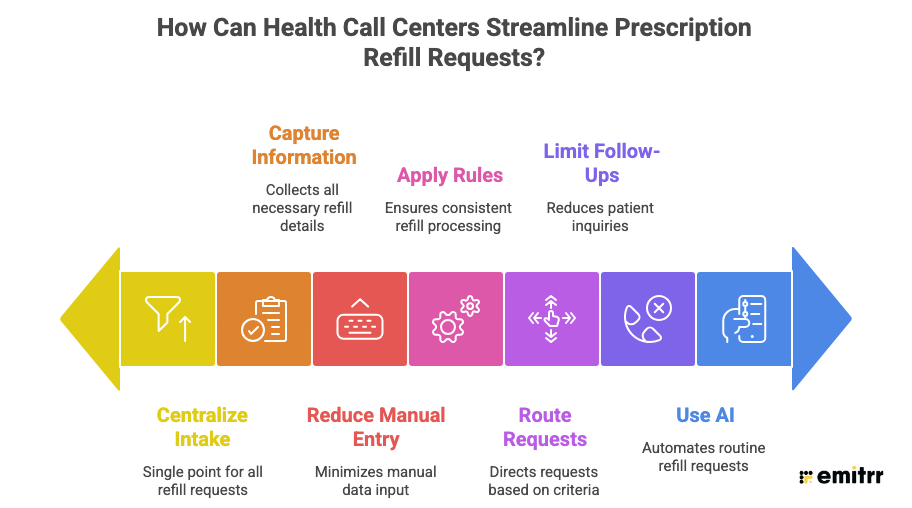
Centralize Refill Intake Into One Entry Point
Refill requests should start in one place instead of coming through multiple channels. A single intake flow prevents missed requests and keeps refill intent clear from the beginning.
Capture Complete Refill Information Upfront
Every refill request should include patient identifiers, medication name, dosage, frequency, and preferred pharmacy. Collecting this information early avoids callbacks and delays.
Reduce Manual Data Entry
When staff re-enter information across systems, errors increase. Streamlined workflows limit transcription and preserve refill details, which becomes especially important as patients ask, can a virtual doctor refill a prescription?, and expect faster, more accurate handling across digital care channels.
Apply Consistent Refill Rules
All refill requests should follow the same logic, regardless of who handles them or when they arrive. This removes variation and reduces rework.
Route Requests Based on Clear Criteria
Refill requests that meet defined rules should move forward quickly. Requests that need review should be flagged clearly instead of stalling in queues.
Limit Repeat Patient Follow-Ups
Clear intake and timely updates reduce the need for patients to call back for status checks, lowering call volume for the center.
Use AI Automation to Handle Routine Refill Requests
Advanced healthcare automation helps manage high-volume, routine refill requests. Automated intake, validation, and case creation reduce delays and maintain consistent workflows.
Curious how refill calls get handled without staff jumping in? Watch this:
How Do Healthcare Call Centers Benefit From Streamlined Refill Requests?
When prescription refill requests follow a structured flow, healthcare call centers see immediate operational relief. With the right hospital call center software, fewer interruptions, fewer follow-ups, and clearer requests allow teams to focus on moving refills forward instead of fixing intake prob
- Lower refill-related call volume: When refill intake is clear from the start, patients do not need to call back for clarification or status checks. For example, a patient who submits a complete refill request does not need to follow up the next day, which reduces repeat calls.
- Faster turnaround on refill requests: Requests reach the clinical team in a review-ready state. Instead of waiting in queues for missing details, a blood pressure refill moves directly to review and approval.
- Reduced front-desk and call center workload: Staff no longer spend time listening to voicemails, re-entering data, or chasing patients. This highlights the difference between answering services vs. call center services, where call centers can handle structured refill workflows while front-desk teams focus on other patient needs instead of making refill-related callbacks.
- Less rework for clinical teams: Clear intake reduces the need to fix cases or convert them into refill requests. A clinical team member reviews the request instead of rebuilding it from scratch.
- More consistent refill handling: Every refill request follows the same process. Two patients requesting the same medication receive the same treatment, regardless of who handled the intake.
- Fewer urgent and escalated refill requests: When routine refills move on time, they do not turn urgent. Patients get their medications before running out, which reduces stress for both patients and staff.
- Better patient experience: Patients receive timely responses and clear status updates instead of silence. As AI will replace call center agents for routine refill interactions, patients know their refill request has been received, reviewed, and is moving forward, which helps them feel informed and reassured rather than guessing or calling back out of concern.
What Makes Emitrr a Complete Prescription Refill Automation Solution For Healthcare Call Centers?
Emitrr uses an AI healthcare agent to handle prescription refill intake from the first patient interaction. The AI agent answers calls and messages, guides patients through a structured refill request, and captures complete information every time. Instead of scattered, incomplete requests reaching staff, every refill arrives as a clear, structured case ready for review. This reduces manual intake work, lowers refill-related call volume, and allows healthcare call centers to manage refills at scale as SMS-based prescription refill requests reduce call volume in healthcare.
This is how Emitrr turns prescription refill requests into a predictable, streamlined workflow for healthcare call centers.
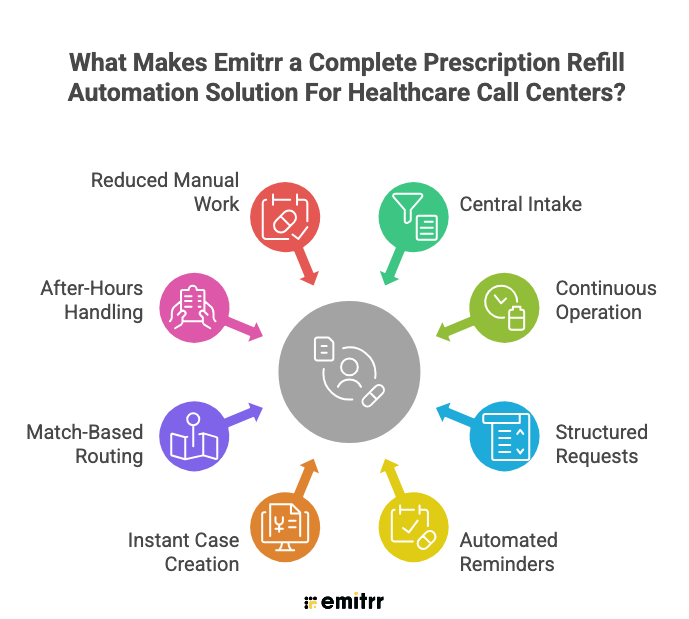
One Central Intake for Every Refill Request
Emitrr replaces phone calls, voicemails, and portal messages with a single intake flow through voice or SMS. Every refill request starts the same way, so nothing gets missed or misrouted. Patients follow guided prompts that capture required details upfront, which prevents routine refills from turning into urgent follow-ups.
Intake That Runs All Day Without Interruptions
Emitrr handles refill intake around the clock. Calls do not roll to voicemail after hours, and staff do not return to backlog the next morning. Refill requests continue to enter the system in an organized way, even during peak hours or overnight.
Complete and Structured Refill Requests From the Start
Emitrr collects patient identifiers, medication name, dosage, frequency, and preferred pharmacy in one guided interaction. If details are unclear, the system confirms them immediately. Each request arrives with a structured summary, transcript, and call recording, ready for review.
Automated Prescription Refill Reminders and Follow-Ups
Emitrr’s HIPAA-compliant AI agent sends automated prescription refill reminders to patients before they run out of medication. If a refill request is pending or incomplete, the AI follows up automatically to collect missing details. This reduces last-minute refill calls, prevents gaps in medication, and cuts down repeat status-check calls to the call center.
Instant Case Creation Inside the EHR
Once intake is complete, Emitrr creates a refill case directly inside the EHR with all information attached. Staff do not re-enter data or piece together context from multiple messages. This makes it possible to automate prescription refill requests without replacing your EHR, shifting staff work from transcription to review.
Match-Based Routing That Prevents Delays
Emitrr checks refill details against clinic-defined rules before routing. Requests that align move forward quickly. Requests that do not align are flagged clearly for review. This prevents valid refill requests from stalling while maintaining safety.
Consistent Refill Handling Across Staff and Hours
Every refill request follows the same logic, regardless of who is on duty or when it arrives. This consistency reduces errors, removes guesswork, and keeps workflows stable during busy periods.
Less Intake Work, More Focus on Decisions
Emitrr does not change how providers review refills. It removes the intake burden that slows everything down before review begins. Call center teams spend less time collecting information and more time moving refill requests forward.
Watch how Emitrr’s AI voice agent answers patient calls, understands refill requests, and captures complete details before your team ever steps in:
Key Takeaways
- Prescription refill requests overwhelm health call centers because intake comes through too many channels.
- Voicemails and manual entry lead to errors, rework, and repeated follow-ups.
- Call center teams spend time fixing intake issues instead of reviewing refill requests.
- AI agents simplify refill intake by capturing complete, structured information upfront.
- Emitrr AI automates prescription refill requests end-to-end, reducing manual effort and call volume related to refills.
Frequently Asked Questions
Patients should provide their full name, date of birth, medication name, dosage, how often they take it, and their preferred pharmacy. Sharing this information upfront helps healthcare teams process the refill faster and avoid follow-up calls.
Yes. Licensed healthcare providers can prescribe medications through telehealth after reviewing the patient’s condition and medical history. When appropriate, a telehealth prescription refill is approved and sent electronically to the patient’s pharmacy.
If a prescription still has refills remaining, the pharmacy can process it directly. If no refills are left, the request is sent to the provider for review and approval before the medication is renewed.
Yes. Telehealth providers can prescribe many routine and maintenance medications. Some medications, such as certain controlled substances, may require an in-person visit depending on regulations.
Book a telehealth appointment, speak with the provider about your symptoms or refill needs, and complete the evaluation. If approved, the prescription is sent electronically to your chosen pharmacy.
If your doctor is not responding, you can follow up with the clinic or your pharmacy to confirm the request was received. You may also schedule a telehealth visit or contact the healthcare call center to check the refill status and avoid gaps in medication.
Final Thoughts
Prescription refill requests overwhelm healthcare call centers when intake is manual and inconsistent. This leads to delays, rework, and repeated follow-ups. Emitrr helps healthcare call centers streamline refill requests by using an AI healthcare agent to capture complete information, reduce manual effort, and lower refill-related call volume. The result is a more predictable workflow that supports staff efficiency and patient satisfaction.


 4.9 (400+
reviews)
4.9 (400+
reviews)