
Introduction
Many healthcare practices consider Google Voice as a simple and affordable way to handle calls and messages with patients. It’s easy to set up, works across devices, and integrates with other Google tools many clinics already use.
However, when patient communication involves protected health information (PHI), healthcare providers must follow strict HIPAA compliance requirements. This raises an important question for clinics, therapists, and private practices:
Is Google Voice HIPAA compliant?
The answer isn’t always straightforward. While Google provides security features and offers a Business Associate Agreement (BAA) through certain plans, there are important limitations healthcare providers need to understand before using Google Voice for patient communication.
In this guide, we’ll explain whether Google Voice meets HIPAA requirements, what risks exist, and what healthcare practices should consider before relying on it for patient communication.
AI Summary
Here’s a quick overview of what this guide covers:
- Whether Google Voice is HIPAA compliant and when it may meet HIPAA requirements
- How Google Voice encryption and security features work
- Whether Google provides a Business Associate Agreement (BAA) for compliance
- The limitations of Google Voice for healthcare communication
- What to look for in a HIPAA-compliant texting and phone system
- Situations where Google Voice may or may not be safe for private practices
- Better HIPAA-compliant alternatives to Google Voice
What HIPAA Compliance Means for Healthcare Communication
Healthcare organizations must follow the Health Insurance Portability and Accountability Act (HIPAA) when handling patient data. This includes any communication that involves protected health information (PHI), such as appointment details, treatment discussions, prescriptions, or medical records.
If patient information is shared through phone calls, text messages, or messaging platforms, those systems must follow strict security and privacy standards.
For this reason, healthcare practices must ensure their communication tools support HIPAA-compliant workflows and safeguards.
HIPAA Requirements for Messaging and Phone Systems
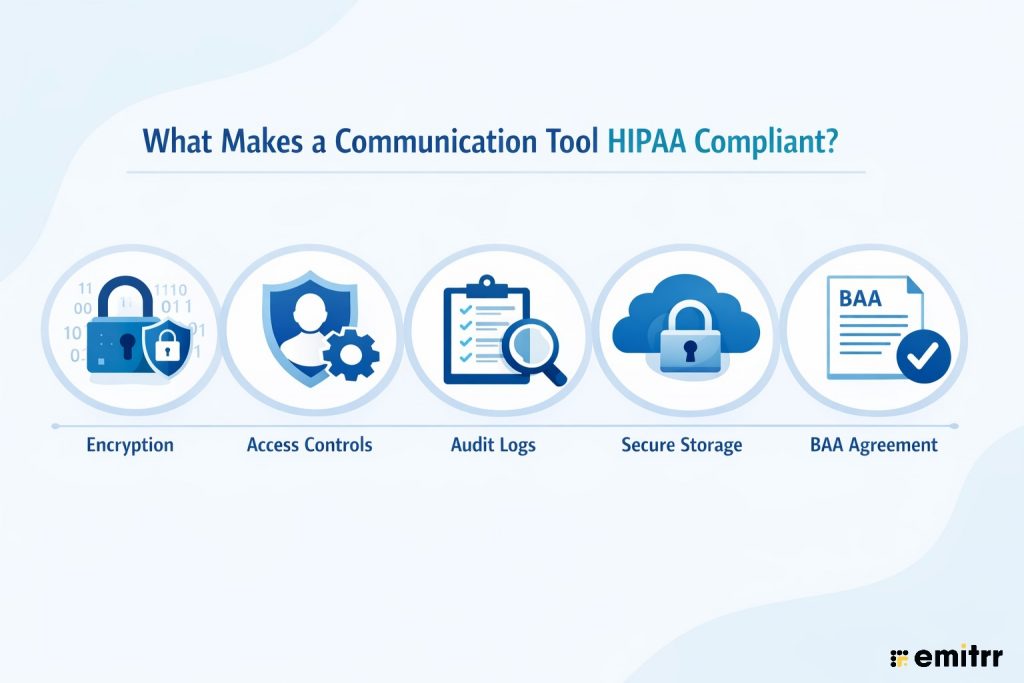
For a phone or texting system to be considered HIPAA compliant, it must support several important protections.
- Data encryption: Patient information should be protected using encryption when it is transmitted or stored.
- Access controls: Only authorized staff members should be able to access patient communication records.
- Audit logs: The system should maintain records showing who accessed patient information and when.
- Secure data storage: Patient data must be stored securely to prevent unauthorized access.
- Business Associate Agreement (BAA): Any vendor handling protected health information must sign a Business Associate Agreement, confirming they will safeguard the data.
Without these safeguards in place, healthcare providers risk HIPAA violations and potential penalties.
Learn more about HIPAA-compliant texting in this interesting video:
Why Standard Communication Tools Often Fail HIPAA Compliance
Many everyday communication tools were not designed for healthcare environments. General-purpose calling and messaging services may lack:
- HIPAA-compliant texting
- audit logging
- healthcare workflow automation
- secure handling of PHI
- compliance monitoring features
Because of this, healthcare providers must carefully evaluate whether a communication tool is safe for patient interactions before adopting it.
Is Google Voice HIPAA Compliant?
Google Voice is not automatically HIPAA compliant. Healthcare providers can only use Google Voice in a HIPAA-compliant way if it is part of Google Workspace, covered by a signed Business Associate Agreement (BAA), and configured with proper security controls. However, standard SMS messaging through Google Voice may still pose compliance risks when sharing protected health information (PHI).
When Google Voice Is NOT HIPAA Compliant
Google Voice is not HIPAA compliant in several common situations, including:
- Using a personal Google Voice account not tied to Google Workspace
- No signed Business Associate Agreement (BAA) with Google
- Sending protected health information (PHI) via standard SMS, which is not end-to-end encrypted
- Lack of proper security configuration, such as weak account access controls
- Using shared devices or personal phones without proper security policies
Because these situations are common in small practices, using Google Voice without proper safeguards can create HIPAA compliance risks when communicating with patients.
When Google Voice MAY Be HIPAA Compliant
Google Voice may be used in a HIPAA-compliant environment if the following conditions are met:
- The practice uses Google Workspace instead of a personal Google account
- A Business Associate Agreement (BAA) is signed with Google
- Administrative and security controls are properly configured
- Staff follow HIPAA communication policies when handling patient information
Even when these requirements are met, healthcare providers should still be cautious when using Google Voice for SMS messaging, since traditional text messages are not always designed for transmitting sensitive patient information.
Recommended for watching: Learn more about what HIPAA compliance in phone systems mean:
Google Voice HIPAA Compliance Explained
Google Voice offers convenient calling, voicemail, and SMS capabilities. However, when used in healthcare settings, providers must understand how its security and compliance features work.
Does Google Offer a Google Voice BAA?
Yes, Google provides a Business Associate Agreement (BAA) for certain services within Google Workspace. A BAA is a legal agreement stating that the vendor will appropriately safeguard protected health information.
However, there are important details to understand:
- The BAA applies only to eligible Google Workspace services
- Personal Google accounts are not covered
- Healthcare providers must actively sign the BAA
Without a signed BAA, using Google services to store or transmit PHI may violate HIPAA regulations.
Google Voice Encryption: Is Google Voice Encrypted?
Google Voice includes encryption in transit, meaning communication between devices and Google servers is protected while being transmitted.
However, encryption has some limitations. Standard SMS messages are not end-to-end encrypted. This means:
- Messages may pass through mobile carriers
- Intermediary systems may temporarily store messages
- Full encryption cannot be guaranteed
For healthcare communication involving sensitive information, this limitation can introduce security risks.
Is Google Voice Secure Enough for PHI?
Google Voice offers basic security protections, but its design focuses on general business communication rather than healthcare-specific compliance.

Potential concerns include:
- SMS limitations for transmitting PHI
- lack of healthcare workflow tools
- limited compliance reporting features
- minimal automation for patient communication
Because of these limitations, healthcare providers should carefully evaluate whether Google Voice can safely support patient communication needs.
Learn about: How much does Google Voice cost
How to Make Google Voice HIPAA Compliant (If Possible)
While Google Voice is not automatically HIPAA compliant, healthcare providers can take certain steps to improve compliance if they plan to use it.
Step 1: Use Google Workspace Instead of Personal Google Voice
Personal Google Voice accounts are not eligible for HIPAA compliance. Healthcare providers must use Google Workspace accounts, which provide access to enterprise security controls and HIPAA agreements.
Step 2: Sign a Google Business Associate Agreement (BAA)
Before transmitting or storing PHI through Google services, the organization must sign Google’s Business Associate Agreement. This agreement outlines Google’s responsibilities for protecting patient data.
Step 3: Configure Security Settings
Proper account configuration is essential for protecting patient data.
Recommended security measures include:
- enabling multi-factor authentication
- restricting user access
- setting strong password policies
- monitoring login activity
These controls help reduce the risk of unauthorized access.
Step 4: Train Staff on HIPAA Communication Policies
Even secure systems can become risky if employees are not trained properly. Healthcare organizations should ensure staff members understand:
- what information counts as PHI
- when it is safe to communicate with patients
- which communication channels are permitted
Proper training significantly reduces the risk of compliance violations.
Step 5: Avoid Sending PHI via Standard SMS
Since traditional SMS messaging is not fully encrypted, healthcare providers should avoid transmitting sensitive patient information through text messages whenever possible. Instead, communication should focus on non-sensitive notifications, such as appointment reminders.

Limitations of Google Voice for Healthcare Practices
While Google Voice works well for basic calling, healthcare organizations often require more advanced communication capabilities. Below are some limitations healthcare providers should consider.
No HIPAA-Safe SMS Communication
Standard SMS messaging lacks full encryption and may not meet strict HIPAA communication standards when PHI is involved.
Limited Patient Communication Automation
Healthcare practices frequently rely on automated messaging for tasks like:
- appointment reminders
- follow-ups
- patient intake instructions
Google Voice does not include built-in healthcare automation tools.
No Healthcare-Specific Workflow Features
Healthcare communication often involves specialized workflows such as:
- patient intake
- prescription refill coordination
- appointment confirmations
- post-visit follow-ups
These workflows are not native to Google Voice.
Limited Integrations with EMRs
Many healthcare communication platforms integrate directly with electronic medical record (EMR) systems. Google Voice offers limited integration capabilities, which may require manual processes for staff.
Lack of Detailed Compliance Monitoring
Healthcare organizations must track communication activity for compliance audits. Some specialized healthcare platforms provide:
- audit trails
- communication logs
- compliance reporting
These capabilities are not the primary focus of Google Voice.
Real HIPAA Risks of Using Google Voice for Patient Communication
Using general communication tools in healthcare environments can create compliance risks, particularly when patient information is involved.
Risk of Sending PHI Through Standard SMS
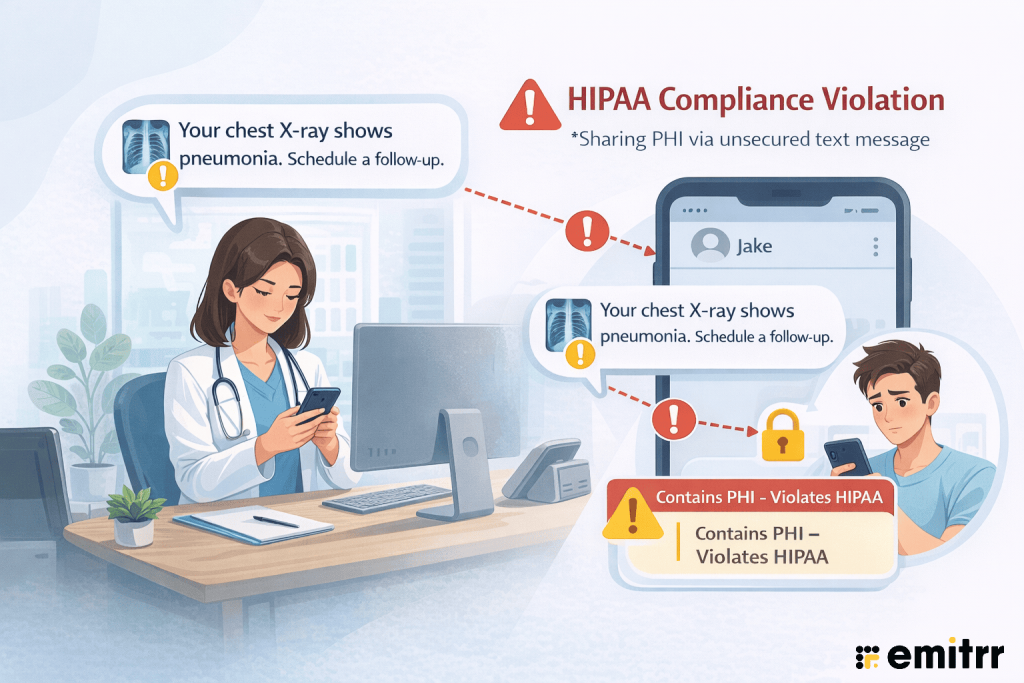
SMS messages travel through multiple carrier networks and are not designed for secure medical communication. If protected health information is sent through SMS, it may be vulnerable to unauthorized access.
No Guaranteed Audit Logs for Compliance Investigations
HIPAA requires healthcare organizations to maintain records of how patient information is accessed and shared. Basic communication systems may not provide the detailed audit logs needed for compliance reviews.
Risk of Staff Using Personal Devices
Many teams access Google Voice on personal smartphones. Without proper device security policies, patient information may be stored on unsecured devices, increasing the risk of data exposure.
Risk of Accidental HIPAA Violations
Common situations that can lead to compliance issues include:
- patients sharing medical details through text
- staff responding with sensitive information
- messages being stored on unprotected devices
These scenarios highlight why healthcare organizations must carefully evaluate communication tools.
Is Google Voice Good for Private Practice Clinics?
Small healthcare practices often explore Google Voice because it is easy to set up and relatively inexpensive. However, the suitability if google voice for private practice depends on how the clinic communicates with patients.
When Google Voice for Private Practice Might Work
Google Voice may be suitable in limited situations, such as:
- internal staff communication
- non-clinical administrative calls
- basic call routing
In these scenarios, sensitive patient data is typically not shared.
Situations Where Google Voice for Private Practice Becomes Risky
Google Voice may be less suitable when practices rely heavily on:
- patient texting
- automated reminders
- follow-up communication
- appointment management workflows
These use cases require tools designed specifically for healthcare communication compliance.
Google Voice vs HIPAA-Compliant Texting Platforms
Healthcare communication platforms often provide additional features designed to support secure patient interactions and clinical workflows.
| Feature | Google Voice | HIPAA-Compliant Platforms |
| HIPAA-safe SMS | ❌ | ✅ |
| Two-way patient texting | Limited | ✅ |
| Appointment reminders | ❌ | ✅ |
| Automated follow-ups | ❌ | ✅ |
| Missed call auto-text | ❌ | ✅ |
| EMR integrations | Limited | ✅ |
| Compliance logs | Limited | ✅ |
Is Google Business HIPAA Compliant?
Many healthcare organizations use Google products like Google Workspace, which leads to a common question: Is Google Business HIPAA compliant? The answer depends on how the services are configured.
Is Google Workspace HIPAA Compliant?
Google Workspace can support HIPAA compliance when the organization signs a Business Associate Agreement and configures proper security settings. Google provides administrative tools that help organizations control access and monitor activity.
Which Google Services Are Covered Under Google’s BAA
Several Google Workspace services may be covered under the BAA, including:
- Gmail
- Google Drive
- Google Calendar
- Google Meet
Healthcare providers should review Google’s documentation to confirm which services are eligible.
Services That Are NOT Covered
Not every Google service is covered under the HIPAA BAA. Healthcare organizations should verify coverage before using any service for PHI-related communication or storage.
Is Google Chat HIPAA Compliant?
Google Chat can support HIPAA compliance when used through Google Workspace with a signed Business Associate Agreement (BAA). In this setup, Google Chat encryption and security controls help protect communication within an organization.
However, healthcare providers must ensure proper access controls, security settings, and HIPAA policies are in place before sharing protected health information (PHI). Like other Google services, compliance depends on how the tool is configured and used within a HIPAA-compliant environment.
Google Voice vs HIPAA-Compliant Communication Platforms
Many healthcare practices start with simple communication tools like Google Voice, but as patient communication grows, they often move to platforms designed specifically for healthcare workflows.
Tools such as Emitrr, RingCentral, Spruce, etc., provide more advanced capabilities for secure patient communication, automation, and integrations.
The key difference is that these platforms are built to support HIPAA-compliant patient engagement, not just calling and texting.
Feature Comparison: Google Voice vs Healthcare Communication Tools
| Feature | Google Voice | Emitrr | RingCentral | Spruce | |
| HIPAA compliance support | Limited | Yes | Yes | Yes | |
| HIPAA-safe patient texting | ❌ | ✅ | Limited | ✅ | |
| Appointment reminders | ❌ | ✅ | Limited | ✅ | |
| Two-way patient texting | Limited | ✅ | ✅ | ✅ | |
| Missed-call-to-text automation | ❌ | ✅ | Limited | ❌ | |
| AI call handling | ❌ | ✅ | ❌ | ❌ | |
| EMR/EHR integrations | Limited | Strong | Limited | Limited | |
| Healthcare workflow automation | ❌ | Advanced | Limited | Moderate |
What to Look for in a HIPAA-Compliant Phone & Texting Platform
When evaluating a communication system for healthcare, it’s important to ensure the platform supports secure messaging, compliance safeguards, and healthcare workflows. Since tools like Google Voice are not automatically HIPAA compliant, practices should look for solutions specifically designed for HIPAA-compliant patient communication.
Secure Messaging
A HIPAA-compliant platform should provide secure messaging with encryption and access controls to protect protected health information (PHI). Unlike standard SMS, where Google Voice encryption may be limited, secure messaging systems are designed specifically for HIPAA-compliant communication.
Patient Communication Automation
Healthcare platforms should automate routine patient interactions such as appointment reminders, confirmations, and follow-ups. Automation helps practices manage communication at scale without relying on manual texting tools like Google Voice for private practice.
EMR Integration
Strong EMR or EHR integrations allow patient messages, calls, and updates to sync directly with medical records. This ensures healthcare teams can track patient communication in one place while maintaining HIPAA compliance.
AI-Powered Call Handling
Modern platforms may include AI-powered call routing, virtual receptionists, and automated responses to help manage incoming patient calls. These capabilities go beyond basic tools like Google Voice, which primarily focuses on simple calling and SMS.
Compliance Monitoring
A reliable platform should include audit logs, access controls, and compliance monitoring tools to help healthcare organizations track communication activity. These features make it easier to maintain HIPAA compliance and reduce risks when handling patient data.
Why You Should Switch to Emitrr
If you’re using basic calling tools like Google Voice, you may quickly run into limitations around HIPAA compliance, automation, and patient engagement. Healthcare practices need communication systems built specifically to handle secure patient messaging and clinical workflows.
This is where platforms like Emitrr stand out.
Built for HIPAA-Compliant Patient Communication
Emitrr is designed specifically for healthcare communication. It offers encrypted messaging, role-based access controls, audit logs, and a signed Business Associate Agreement (BAA) to help practices safely handle protected health information (PHI).
Automates Patient Communication
Emitrr helps clinics reduce manual work by automating tasks such as:
- appointment reminders and confirmations
- follow-up messages
- patient feedback collection
- missed-call text-backs
These automated workflows improve patient responsiveness while reducing front-desk workload.
AI-Powered Call Handling
Emitrr includes AI capabilities that can answer calls, route patients to the right department, and help manage high call volumes, reducing missed opportunities and wait times.
See what more Emitrr’s voice agent can do:
Seamless Healthcare Integrations
The platform integrates with EHR/EMR systems and healthcare tools, allowing communication data to sync automatically with patient records and reducing manual entry errors.
All-in-One Patient Communication Platform
Instead of using multiple tools, Emitrr centralizes SMS, voice, web chat, automation, and patient workflows in one dashboard, helping healthcare practices manage patient communication more efficiently.
Bottom line:
If your practice needs secure patient texting, automation, and compliance-ready communication, switching to Emitrr provides a more complete solution than basic phone systems.
Checklist: How to Evaluate a HIPAA-Compliant Phone System
Use this checklist to evaluate any phone or messaging platform for HIPAA compliance and ensure your practice is protected.
FAQs About Google Voice HIPAA Compliance
Google Voice is not automatically HIPAA compliant. Doctors can only use Google Voice in a HIPAA-compliant way if it is part of Google Workspace, covered under a Google Voice BAA (Business Associate Agreement), and configured with proper security safeguards. Personal Google Voice accounts are not suitable for handling protected health information (PHI).
Yes, Google Voice encryption protects data in transit between devices and Google servers. However, standard SMS messages are not end-to-end encrypted, which means Google Voice SMS may not be fully secure for sharing PHI in healthcare settings.
Google can provide a Business Associate Agreement (BAA) through Google Workspace, which may cover certain services used in healthcare environments. However, healthcare organizations must sign the BAA and configure their systems correctly before using Google services for PHI.
A Google phone system, such as Google Voice is not automatically HIPAA compliant. It can only support Google Voice HIPAA compliance when used under Google Workspace with a signed BAA and proper security controls.
Therapists may use Google Voice for private practice for basic calls or administrative communication. However, if therapists plan to exchange protected health information, they must ensure the system meets HIPAA compliance requirements, which may require additional safeguards.
Google Workspace (formerly G Suite) can support HIPAA compliance when a Google Business Associate Agreement (BAA) is signed and security settings are properly configured. However, healthcare providers should verify which services are covered under Google’s HIPAA compliance program before using them for patient data.
Final Verdict: Should Healthcare Practices Use Google Voice?
Google Voice is not automatically HIPAA compliant. It can only support HIPAA compliance when used with Google Workspace, a signed Business Associate Agreement (BAA), and proper security configurations. However, limitations around standard SMS messaging and healthcare workflows can make it less suitable for regular patient communication.
Healthcare practices that need secure patient texting, automation, and integrations often move to platforms built specifically for healthcare. Solutions like Emitrr provide HIPAA-compliant messaging, automated patient communication, and AI-powered call handling, helping practices manage patient interactions more securely and efficiently. Book a free demo to learn more!

 4.9 (400+
reviews)
4.9 (400+
reviews)