

Introduction
Prescription refill requests are one of the most frequent yet frustrating tasks in healthcare, and they’re quickly becoming a major source of overload for front desk staff. What seems like a simple request often turns into a time-consuming process involving voicemails, patient portal messages, and live calls, all requiring manual handling. The result? Delays, errors, and unnecessary back-and-forth.
In this blog, we’ll break down why prescription refill requests overwhelm front desk teams, where the process breaks down, and how clinics can fix it with smarter, more structured workflows.
AI Summary (Quick Takeaways)
- Prescription refill requests overwhelm front desk staff due to unstructured intake across multiple channels (calls, voicemails, portals)
- Voicemails are unreliable, often missing key patient or medication details
- Inconsistent workflows among front desk staff lead to errors and extra work for nurses
- Staff spend significant time on manual data entry and rework, slowing down the refill process
- Incorrect or incomplete medication information creates risk and delays
- Lack of real-time validation forces staff to manually verify every request
- High refill volumes add constant pressure, increasing staff burnout and inefficiency
- AI-driven HIPAA-compliant AI agent help by standardizing intake, capturing complete information, and reducing manual workload
- A phased approach to automation ensures accuracy, safety, and scalability in refill workflows
What Is the Prescription Refill Process in Healthcare?
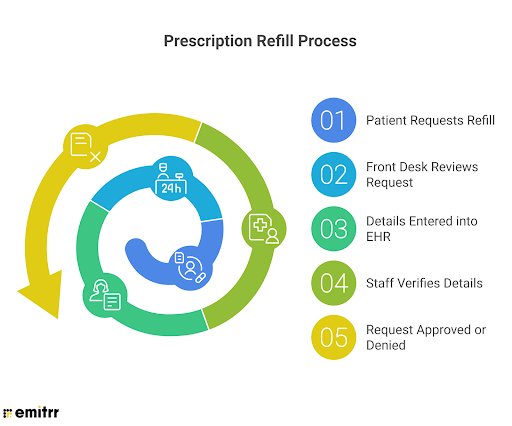
The prescription refill process is how patients request continued access to their medications after a prescription runs out. While it sounds simple, it involves multiple steps, and that’s where complexity builds.
Typically, the process looks like this:
- Patients request a refill via calls, voicemails, or patient portals
- Front desk staff review and interpret the request
- Details are entered into the EHR system
- Nurses or clinical staff verify medication, eligibility, and provider
- The request is approved, denied, or sent for clarification
The problem? Most refill requests are unstructured and inconsistent. This forces front desk teams to spend time decoding messages, filling gaps, and manually entering data, turning a simple request into a time-consuming workflow. You can very easily automate prescription refill requests without replacing your ehr.
Why Are Prescription Refill Requests So Overwhelming for Front Desk Staff?
Prescription refill requests overwhelm front desk staff because the process is messy, manual, and high in volume. Here are some common reasons why prescriptions refill requests are overwhelming front desk staff:
1. Refill Requests Come From Too Many Channels (Calls, Voicemails, Portals)
Prescription refill requests don’t come from one place, they come through calls, voicemails, and patient portals. Each channel requires a different way of handling, and none of them are standardized. Front desk staff have to constantly switch between listening, reading, and entering data, which slows down the entire refill request management process and increases administrative workload.
Learn how to reduce prescription refill calls
2. Voicemails Are Unstructured and Often Unusable
Voicemails are one of the biggest problems in the prescription refill process because they rarely contain complete information. Patients often forget to mention key details like their date of birth, spell medication names incorrectly, or get cut off mid-message. This leaves staff with incomplete data, forcing them to call patients back and creating delays in refill processing.
3. Front Desk Staff Follow Inconsistent Workflows
There is usually no standard way to handle refill requests across the team. Some staff create proper refill requests in the EHR, while others log generic cases depending on their training or experience. This inconsistency creates confusion and pushes extra work onto nurses, who then have to reprocess and correct these requests.
4. Manual Data Entry Creates Bottlenecks and Errors
Most prescription refill workflows rely heavily on manual data entry. Staff have to extract information from calls or messages and enter it into the system, which takes time and increases the chances of mistakes. This repetitive work slows down the process and adds unnecessary friction to refill request management.
5. Medication Information Is Frequently Incorrect or Incomplete
Patients often provide incorrect or incomplete medication details. They may mispronounce drug names, request medications that were discontinued, or ask for prescriptions from another provider. Without accurate information, staff have to spend extra time verifying details, which delays the refill process and increases the risk of errors.
6. No Real-Time Validation Leads to Risk and Delays
Most systems don’t support real-time validation of refill requests against the patient’s medication list. This means staff must manually check whether the medication is active, who prescribed it, and whether it’s eligible for refill. This adds another layer of work and slows down the entire medication refill workflow.
7. High Refill Volume Adds Constant Pressure on Staff
The volume of prescription refill requests is high in most clinics, often reaching hundreds or thousands each month. When every request requires manual effort, even small inefficiencies quickly add up. This constant inflow of requests puts continuous pressure on front desk staff and makes it difficult to keep up.
8. Constant Callbacks Frustrate Both Staff and Patients
Because many refill requests are incomplete or unclear, staff frequently have to call patients back for clarification. This creates high call volume, more interruptions, and more work for the front desk. Over time, this back-and-forth leads to frustration for both staff and patients and makes the overall process feel inefficient and exhausting.
9. Refill Requests Create “Gridlock” in Front Desk Workflows
Prescription refill requests create operational gridlock. Front desk teams often come back after weekends or busy days to a backlog of voicemails, messages, and requests with no clear way to prioritize them. Many of these requests are low-value or repetitive, but they still clog the system. As a result, staff spend time going through everything one by one, slowing down the entire prescription refill workflow and delaying more important tasks.
Learn more by watching this video on why Healthcare Front Desks Are Always Overwhelmed (And How Emitrr Fixes It)
How Prescription Refill Overload Impacts Clinics
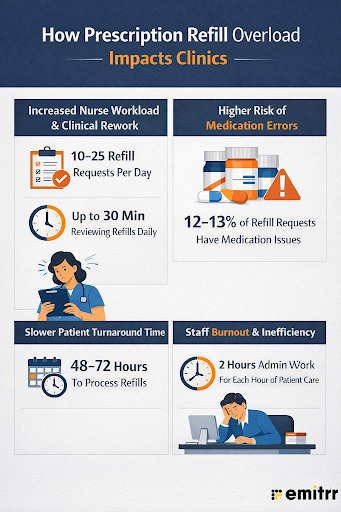
When prescription refill requests aren’t managed well, the impact goes beyond the front desk. It slows down clinical workflows, increases risk, and adds pressure across the entire team.
Increased Nurse Workload and Clinical Rework
Refill requests often move to nurses when they’re incomplete or unclear. On average, providers handle 10–25 refill requests per day, taking up to 30 minutes daily just to review them. When data is missing or incorrect, nurses have to re-enter and verify information, adding avoidable rework.
Higher Risk of Errors in Medication Handling
Unstructured refill requests increase the risk of mistakes. Around 12–13% of refill requests involve medication issues like incorrect or mismatched drugs. This forces staff to double-check everything, slowing down the medication refill process.
Slower Turnaround Times for Patients
Manual refill workflows lead to delays. In many cases, refill requests can take 48-72 hours to process, especially when callbacks and verification are needed. This directly impacts patient experience.
Staff Burnout and Operational Inefficiency
Administrative work, including refill requests, adds significant load. Providers spend up to 2 hours on admin work for every 1 hour of patient care. At scale, this leads to constant interruptions, inefficiency, and staff burnout.
Learn how to reduce staff burnout with automated refill requests.
Why Traditional Solutions Don’t Fix the Problem
Most clinics try to manage prescription refill requests using existing systems like patient portals, voicemails, and staff training. But these don’t solve the core issue—they still rely on manual effort and unstructured input, which keeps the refill workflow inefficient.
Patient Portals Still Require Manual Review
Patient portals are meant to simplify refill requests, but in reality, they still need staff to read, interpret, and process each request. Messages often lack complete medication details or context, so front desk teams still spend time reviewing and entering information into the system.
Voicemail Systems Lack Structure
Voicemails remain a common way patients request refills, but they are inherently unstructured. Staff have to listen to each message, identify key details, and figure out next steps. Missing or unclear information leads to callbacks, making voicemail-heavy workflows slow and inefficient.
Training Staff Doesn’t Solve Process Gaps
Training can improve how staff handle refill requests, but it doesn’t fix the underlying workflow issues. When requests come in incomplete or inconsistent, even well-trained staff have to spend time correcting them. Without structured intake, the process continues to depend on manual effort and individual judgment.
How AI Can Simplify Prescription Refill Workflows
AI agents can simplify prescription refill workflows by fixing the biggest problem, unstructured intake. Instead of relying on voicemails, calls, and free-text messages, AI creates a guided, consistent way to collect refill requests, making the entire process easier to manage. Since there are HIPAA-compliant AI tools like Emitrr available, you do not have to worry about compliance as well.
Captures Complete and Structured Refill Requests
AI replaces unstructured inputs with guided conversations that ask patients for the right details, like name, DOB, medication, dosage, and pharmacy. This ensures every prescription refill request comes in complete, reducing back-and-forth and speeding up processing.
Reduces Manual Work for Front Desk Staff
With structured intake, front desk teams no longer have to listen to voicemails or interpret messages. The information is already organized, so staff can focus on processing requests instead of figuring them out. This significantly reduces manual data entry in healthcare workflows.
Learn more about how AI Agent Prescription Refills Reduce Call Volumes by 40%
Minimizes Errors in Medication Information
Since AI collects information step-by-step, it reduces the chances of missing or incorrect details. While it may not fully validate medications yet, it ensures that refill requests are clear, complete, and easier to verify, lowering the risk of errors.
Speeds Up Refill Processing and Turnaround Time
When requests come in structured and complete, there’s less need for callbacks and clarification. This helps clinics process refill requests faster and improves turnaround time for patients.
Creates a Foundation for Smarter Automation
AI doesn’t need to automate everything at once. By first standardizing intake, it sets the foundation for future improvements like smarter routing, validation, and partial automation of refill decisions, making the workflow more efficient over time.

How Emitrr Helps Automate & Streamline Prescription Refill Requests
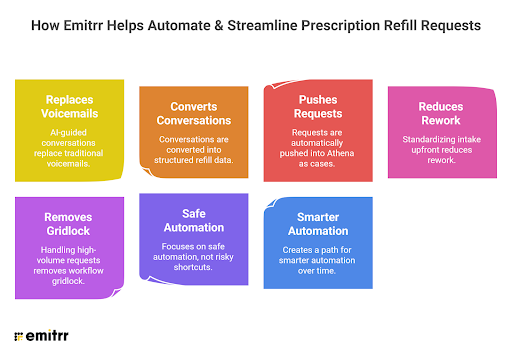
Emitrr improves prescription refill workflows by intercepting unstructured prescription requests (calls, voicemails) and turning them into structured, ready-to-use data inside your EHR. Instead of staff figuring out requests manually, the system handles intake upfront and passes clean information down, helping streamline your prescription workflow.
1. Replaces Voicemails with AI-Guided Conversations
Instead of patients leaving voicemails, Emitrr’s AI answers the call and guides them through a short, structured flow. It asks for key details like name, DOB, medication, dosage, and pharmacy, just like a trained staff member would.
Because the conversation is guided, every prescription refill request comes in complete, reducing missing information and callback loops.
2. Converts Conversations Into Structured Refill Data
Once the call is complete, Emitrr doesn’t just store a recording; it extracts and organizes the information into a structured format. This means front desk staff don’t have to listen to voicemails or interpret messages. The refill request is already clear, readable, and ready for the next step in the workflow.
3. Automatically Pushes Requests Into Athena as Cases
After structuring the data, Emitrr automatically creates a case inside Athena. Each case includes:
- A clear summary of the refill request
- Full transcript of the conversation
- Call recording for reference
This ensures clinical staff get complete context without any manual prescription data entry, making refill request management faster and more reliable.
4. Reduces Rework by Standardizing Intake Upfront
Because every request follows the same structured flow, there’s no inconsistency in how refill requests are captured. Front desk teams don’t have to decide how to log requests, and nurses don’t have to fix or re-enter data later. This removes a major source of rework in the medication refill process.
5. Removes Workflow “Gridlock” by Handling High-Volume Requests
A large portion of incoming calls are repetitive requests like prescription refills. Emitrr handles these automatically, reducing the number of interruptions and backlogs staff deal with daily. By offloading this volume, it frees up front desk teams to focus on more important patient interactions.
6. Focuses on Safe Automation (Not Risky Shortcuts)
Emitrr does not try to make clinical decisions or validate medications in real time today. Instead, it focuses on collecting accurate information and passing it to staff. This ensures clinics can improve efficiency in refill workflows without introducing risk.
7. Creates a Path for Smarter Automation Over Time
With structured refill request data in place, clinics can gradually move toward smarter workflows, like routing valid requests differently from those that need review. This phased approach allows automation to scale safely as confidence grows.
Best Practices to Reduce Front Desk Burden for Refill Requests
Reducing the burden of prescription refill requests isn’t just about handling volume—it’s about fixing how refill request management works at a process level. Clinics that improve their medication refill workflow focus on structure, consistency, and reducing manual effort.
Standardize the Prescription Refill Workflow
Start by defining a clear, consistent process for handling prescription refill requests. Every request, whether from calls, voicemails, or patient portals, should follow the same workflow. Standardization reduces confusion, minimizes errors, and improves overall clinical workflow efficiency.
Reduce Dependence on Voicemails and Manual Intake
Voicemails and free-text messages are a major source of inefficiency in the patient communication workflow. Moving toward structured intake, through guided forms or AI tools, ensures that refill requests come in complete, reducing callbacks and improving refill processing speed.
Minimize Manual Data Entry in EHR Systems
Manual data entry slows down the medication refill process and increases the risk of errors. Clinics should aim to reduce repetitive data entry by capturing structured information upfront and integrating it directly into the EHR refill request workflow.
Improve Accuracy of Medication Information
Incorrect or incomplete medication details are a common issue in refill request management. Encouraging structured input and clear data capture helps reduce errors related to medication names, dosage, and prescribing providers, improving patient safety and workflow reliability.
Use Automation to Handle High-Volume Refill Requests
A large percentage of patient refill requests are repetitive and predictable. Using automation for intake and initial processing can significantly reduce the workload on front desk staff and improve overall healthcare workflow automation efficiency.
Track and Optimize Refill Request Metrics
Clinics should monitor key metrics like:
- Volume of prescription refill requests
- Turnaround time for refill processing
- Number of callbacks required
Tracking these helps identify gaps in the prescription refill workflow and continuously improve efficiency.
Key Takeaways
- Unstructured prescription refill requests create delays, errors, and extra workload
- Multiple channels (calls, voicemails, portals) make refill request management inefficient
- Manual work and poor intake slow down the medication refill process
- Fixing intake is the fastest way to improve the prescription refill workflow
- Automation helps reduce front desk burden and improves healthcare workflow efficiency
Frequently Asked Questions
Prescription refill requests are often unstructured and incomplete, requiring staff to review, verify, and manually enter data, which slows down the workflow.
The biggest challenge is handling unstructured requests from multiple channels, which leads to manual effort, errors, and delays in the prescription refill workflow.
Clinics can improve the process by standardizing intake, reducing reliance on voicemails, and using automation with HIPAA-compliant tools like Emitrr to capture structured refill requests.
AI can automate intake and reduce manual work, but clinical validation and approval still require human oversight to ensure safety and accuracy.
Conclusion
Prescription refill requests become overwhelming when the prescription refill workflow is unstructured and manual. The real fix isn’t more effort, it’s better refill request management through structured intake and reduced manual data entry. When clinics streamline how requests come in, the entire medication refill process becomes faster, cleaner, and easier to manage.
Book a demo with Emitrr and simplify your prescription workflow!


 4.9 (400+
reviews)
4.9 (400+
reviews)